

Tech
Texas judge throws out second lawsuit over CrowdStrike outage | Computer Weekly


CrowdStrike has been granted a motion to dismiss a consumer class action lawsuit brought by shareholders who were affected by the now-infamous 19 July 2024 outage – prompted by a faulty sensor update – which crashed Windows PCs around the world causing widespread disruption and billions of pounds worth of losses.
The suit, filed on behalf of CrowdStrike investors in August 2024, accused the defendants, who included the company’s founder and CEO George Kurtz of making false and misleading statements over the efficacy of the Falcon platform at the centre of the outage.
It also alleged failings over software testing and quality assurance and claimed that CrowdStrike was seeking to maximise its profit by rushing untested updates.
Handing down his decision at the federal district court for the Western District of Texas in the city of Austin, US district judge Robert Pitman said the plaintiff’s claims were dismissed in their entirety in part because the shareholders had failed to establish any plausible motive of intent to commit securities fraud on CrowdStrike’s part.
It his judgment, Pitman said the court agreed with CrowdStrike that the statements it made were neither false or misleading when considered in the context from which the plaintiffs removed them. He wrote that the court concluded that if anybody was being misleading, it was the plaintiffs.
Rejecting other arguments, Pitman also said that corporate mismanagement did not, standing alone, give rise to a multibillion-dollar claim
“We appreciate the Court’s thoughtful consideration and decision to dismiss this case,” said CrowdStrike chief legal officer Cathleen Anderson in a brief statement.
The Reuters news agency earlier reported that the office of New York State comptroller Thomas DiNapoli, who led the lawsuit, is reviewing options following the decision.
Multiple actions
Last June, Pitman also dismissed another lawsuit brought by airline passengers who experienced delays and cancellations after the sudden blackout.
Pitman’s decision in this case was made on the basis that the US Airline Deregulation Act preempted the claims the plaintiffs were making against CrowdStrike. His ruling has effectively shielded CrowdStrike from consumer suits related to disruptions experienced by its customers.
However, a third lawsuit brought by US airline Delta is still working its way through the US legal system.
Delta was particularly badly affected by failures arising from the outage and was highly critical of CrowdStrike in the wake of the incident after it was forced to cancel thousands of flights and spend millions compensating stranded passengers and putting them up in airport hotels.
CrowdStrike and Microsoft have both claimed that Delta in fact rejected their offers of help during and after the disruption.
Single point of failure
The 2024 CrowdStrike outage stands as a stark reminder of the potential for a global catastrophe arising from unscheduled technical outages given the interconnected nature of cloud platforms, which enable single points of failure to cascade rapidly.
The scale of the problem was aptly demonstrated in November 2025, when web traffic management firm Cloudflare was hit by its worst outage in six years.
In an incident that bears some similarities to the CrowdStrike outage, Cloudflare had made a minor and seemingly innocuous change to a feature configuration file used by its Bot Management security system, which caused the file to grow larger than expected and propagate across the Cloudflare network, causing crashes and disrupting daily life on the world wide web for millions.
A month earlier, AWS customers experienced a 15-hour outage after the cloud giant experienced a series of cascading technical issues at a northern Virginia datacentre powering its US-East-1 region, and in June, Google Cloud went on the blink for many after an incorrect change to an application programming interface (API) management system triggered a crash loop.
Speaking to Computer Weekly’s sister title Search Cloud Computing today, Forrester principal analyst Lee Sustar said that such incidents are a “preview of what’s to come” and predicted more similar stories to come in 2026.
Sustar said that a combination of hyperscalers pivoting from legacy environments to GPU-centric datacentres to manage AI workloads, and ageing infrastructure, would likely lead to “major multiday outages” in the near future.

As ceasefire announcements between the US and Iran—and separately between Israel and Lebanon—dominated headlines over the past two weeks, they also prompted a look back at how war spread online: through memes.
There were jokes about conscription. Captions about getting drafted, but at least with a Bluetooth device. The song “Bazooka” went viral, with users lip-syncing to: “Rest in peace my granny, she got hit by a bazooka.” Military filters followed. So did posts about Americans wanting to be sent to Dubai “to save all the IG models.”
Across the Gulf, the tone was different but the instinct was the same. Memes joked that Iran was replying to Israel faster than the person you’re thinking about. Delivery drivers were shown “dodging missiles.” “Eid fits” became hazmat suits and tactical vests.
Dark humor is one of the oldest responses to fear, a way of reclaiming control, however briefly, over events that offer none. Variations of that idea appear across psychology and philosophy, including Freud’s relief theory, which frames humor as a release of tension.
But social media changes the scale and speed of that instinct.
A joke once shared within a small community can become a global template in minutes. Algorithms do not reward depth or accuracy; they reward engagement. The memes that travel fastest are usually stripped of context, easy to recognize and simple to remix.
Middle East scholar and media analyst Adel Iskandar traces political satire back centuries, from banned satirical papyri in ancient Egypt to cartoons during revolutions and gallows humor in modern wars. “Where there is hardship, there is satire,” he says. “Where there is loss of hope, there is hope in comedy.”
That tradition still exists online. But today it is fused with recommendation systems designed to keep attention moving.
Memes Spread Faster Than Facts
The word “meme” was coined by Richard Dawkins in his 1976 book The Selfish Gene, where he described how ideas replicate like genes. On today’s internet, replication follows platform logic.
Fitness means generality. A meme does not need to be accurate. It needs to feel familiar. It needs the right format, paired with trending audio and the right emotional shorthand.
“A meme is like a virus,” Iskandar says. “If it doesn’t travel, it’ll die.”
The most visible response online is not always the truest one. It is often just the easiest to spread. And once context disappears, one crisis can start to resemble any other.
Geography shapes humor too, and adds another level of tension. “If you live far away from the threat, you’re capable of producing content that ridicules it with an element of safety,” says Iskandar. “Whereas if you happen to be within close proximity, it is more of a fatalism.”
That divide matters. For some users, war exists mainly as mediated spectacle: clips, edits, graphics, headlines, and reaction posts. For others, it is sirens, uncertainty, disrupted flights, rising prices, and messages checking who is safe.
The same meme can function as entertainment in one country and emotional survival in another. Take the American experience of violence, which Sut Jhally, professor of communication at the University of Massachusetts Amherst, says “is very mediated.”
What much of the Western world has consumed instead is what cultural critic George Gerbner called “happy violence”: spectacular, consequence-free, and detached from the aftermath.
Jhally argues that the September 11 attacks remain the defining modern American experience of war-adjacent political violence. Much else has been cinematic: distant invasions, blockbuster destruction, video-game logic, apocalypse franchises.
The teenager from the Midwest joking about being drafted is drawing from zombie films and superhero apocalypses. “There is almost no discussion about what an actual Third World War would look like,” he says. “People do not have a perception of what that really looks like.”
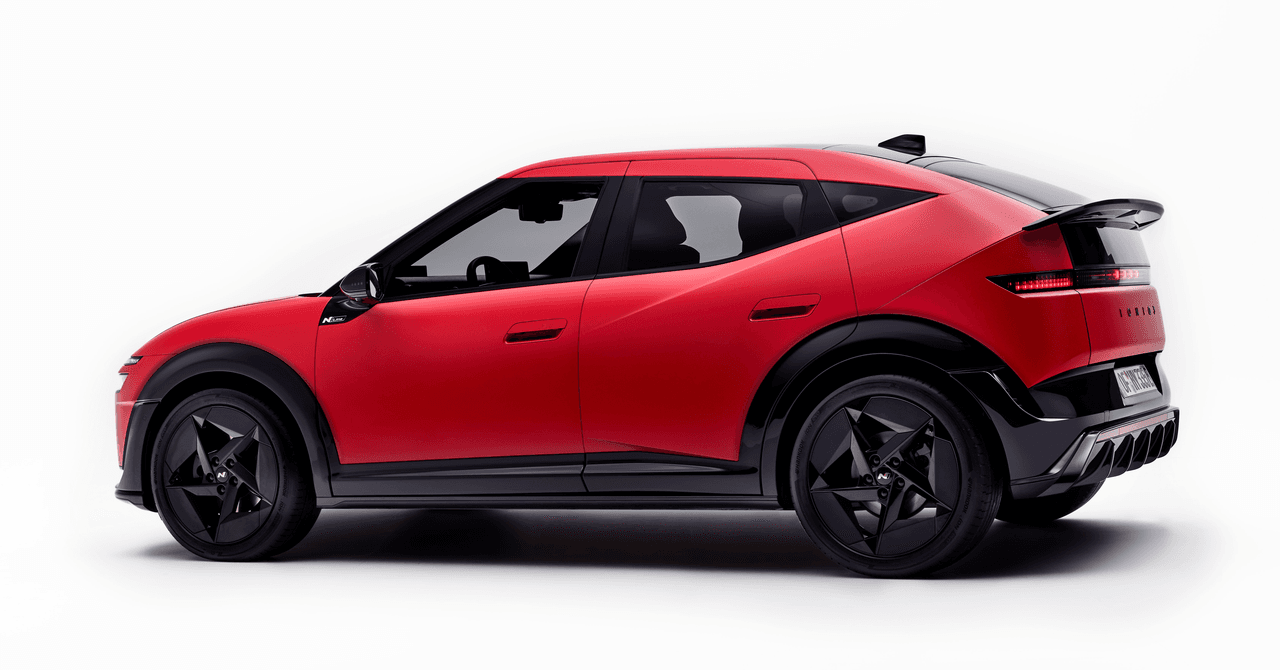
Hyundai has unveiled its Ioniq 3, a fully electric compact hatchback for urban driving designed to be as aerodynamically efficient as possible yet still offer up a surprisingly spacious interior—a trick the carmaker is loftily calling Aero Hatch. The 3 is intended to fill the gap between Hyundai’s Inster supermini and Ioniq 5 crossover.
In profile, the Ioniq 3 has a sleek front end that transitions into a roofline that stays straight over both front and rear occupants before dropping to merge with the rear spoiler. It’s this roofline that maximizes interior headroom for the rear passengers, but it also offers a supposed class-leading drag coefficient of 0.263.
The car has the same underpinnings as its sibling brand, Kia’s EV2. Two battery options will deliver a projected WLTP distance of 344 km (around 214 miles) for the Standard Range Ioniq 3; the Long Range version is supposedly good for a competitive 308-mile range. Built on the group’s Electric-Global Modular Platform (E-GMP), the car has a 400-volt architecture to lower costs rather than the 800-volt system of the Ioniq 5 N, 6, or 9 SUV. Still, this means that if you can find sufficiently fast DC charging, you can, in theory, top up from 10 to 80 percent in approximately 29 minutes (AC charging capability is up to 22 kW).
This is fine, but it is not a match for BYD’s new Blade 2.0 battery tech that WIRED tried, astonishingly allowing the Denza Z9 GT to charge its battery in just over nine minutes from 10 percent. True, that battery tech was in a $100,000 “premium” EV, but it’s coming to BYD’s wider models. And if BYD makes good on its plans to deliver a charging network to rival Tesla’s Supercharger, then very soon buyers will be expecting comparable charge times, and 30 minutes will quickly feel awfully long.
I asked José Muñoz, Hyundai Motor Company president and CEO, whether this new battery technology from BYD concerns him, whether Hyundai—leading the EV pack with 800-volt architectures for so long—needs to match the Blade 2.0’s performance. “We welcome the challenge,” Muñoz tells me. “Every challenge is an opportunity to do better. And I can tell you that, lately, we have a lot of opportunities to do better.”
“We are also working on fast charging,” Muñoz says, adding that Hyundai’s success will be built on not merely one leading technology but many. “There are not more elements that may be offered by the Chinese that we can offer. It’s only a matter of how you mix them. A lot of times, you get stuck into one indicator. I’m an engineer. And we always have the example of the airplanes: What is more important in an airplane, altitude or speed? There is only one answer. You need to achieve both.”

Prego, the pasta sauce company, is getting into hardware with a device that sits on your table and records dinner conversations. No, this isn’t April Fools’.
The Connection Keeper is a round puck that houses two microphones for recording around the table. The recorder was developed in partnership with StoryCorps, the 20-year-old nonprofit that has recorded conversations with more than 720,000 people about their lives.
The Connection Keeper is more of a publicity stunt than a readily available product. Fewer than 100 will be made. The pucks look more like a tuna can than what you’d associate with the pasta sauce brand—small and meant to be tucked aside so as not to attract attention. The whole goal here, Prego and StoryCorps say, is to advocate for keeping people off their phones during dinner.
“Everything now is AI, and everyone has their phones on the table,” says Elyce Henkin, a managing director of StoryCorps studios and brand partnerships. “It interrupts the conversation and the flow. We wanted to get rid of that and go back to the basics and have everyone talking to each other.”
The pucks come packaged with cards inspired by StoryCorps, designed to prompt conversations between family members. Some are aimed at kids; some are aimed at parents or other family members.
The device doesn’t record automatically. Press a button, and the device begins recording CD-quality audio. Push the button again to stop. It records all the audio on a 16-GB microSD card that can hold up to eight hours of audio at a time. Those recordings can then be saved on a StoryCorps microsite or the family’s own storage. There is no cloud connection, no Wi-Fi, and no artificial intelligence features whatsoever.
The more communal element of the project is that StoryCorps will allow users to share their recordings on its website (or keep them private). Anything that has been voluntarily shared will also be physically preserved as a recording along with the larger StoryCorps collection within the US Library of Congress.
Prego is a US company, named after the Italian word for “you’re welcome.” I’ll tell you this from experience growing up in an Italian-American extended family: The Connection Keeper is going to have a hell of a time keeping track of a conversation at a table full of loud uncles and your wine-drunk grandma, who all talk at the same time.
“I think it’s how a lot of families are,” Henkin says. “What StoryCorps does is that it reminds us of our similarities and the humanity that’s in us all, even though we are all different. I imagine that if someone were to go through and listen to the collection, there would be rowdy moments, and there would be kids laughing and moms saying, ‘Don’t eat with your mouth full.’ That’s all part of the truth of it.”


2026 NBA Draft Declarations Tracker: Florida’s Rueben Chinyelu Makes Decision

Lee Anderson, Zarah Sultana kicked out of UK Parliament for calling PM ‘liar’

Education department forgives student loans for 21,200 borrowers: New changes explained

-

 Fashion4 days ago
France’s LVMH Q1 revenue falls 6%, shows resilience amid Iran war
-

 Sports1 week ago
The case for Man United’s Fernandes as Premier League’s best
-

 Entertainment1 week ago
Palace left in shock as Prince William cancels grand ceremony
-
 Business1 week ago
UK could adopt EU single market rules under new legislation
-

 Entertainment5 days ago
Is Claude down? Here’s why users are seeing errors
-

 Fashion1 week ago
Energy emerges as biggest cost driver in textile margins
-

 Tech1 week ago
A Lot of Shops Won’t Fix Electric Bikes. Here’s Why
-
 Business1 week ago
Delta Air Lines unveils first new Delta One suite in premium cabin arms race