

Sports
‘The canaries in the coal mine’: Why teams like Man United invest in player care

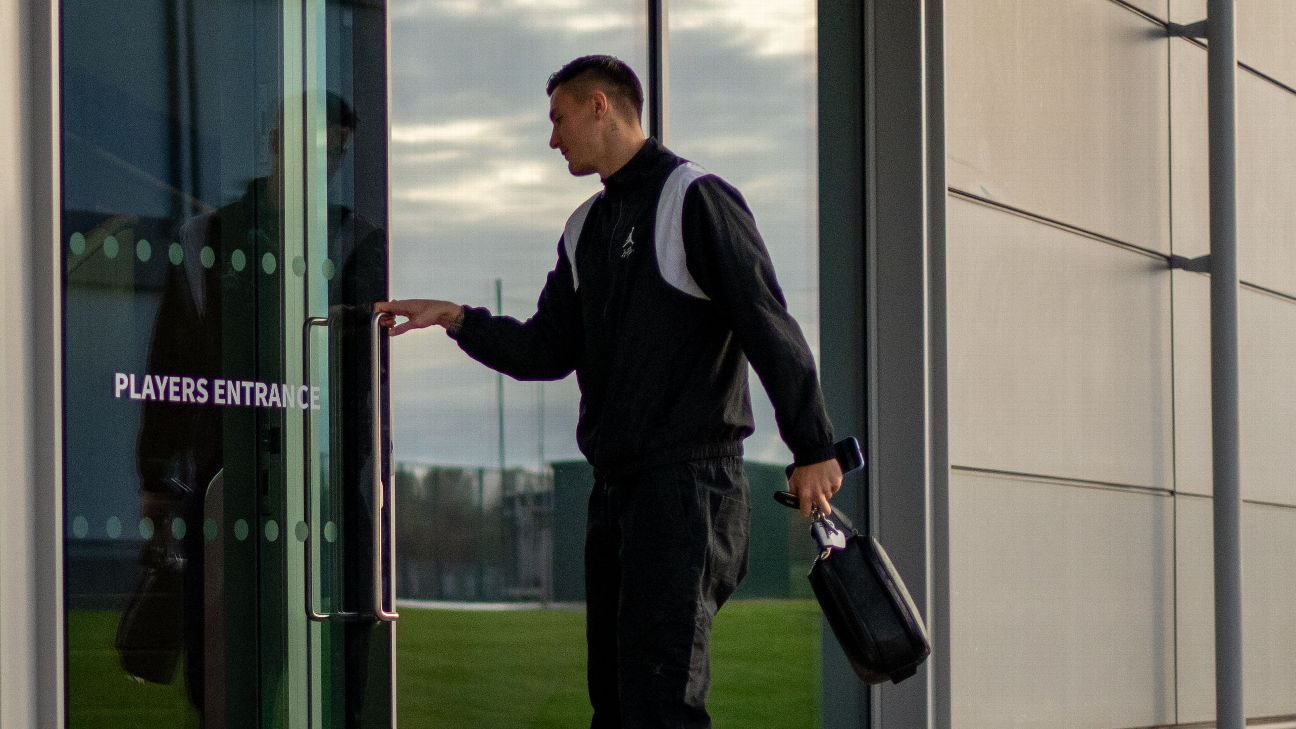
Each day, Manchester United‘s players drive down Birch Road, occasionally stopping for the horses from the Carrington Riding Centre or a cyclist, and turn into the club’s training ground. When the autograph seekers are satisfied and the entry barriers are lifted, they turn in front of the red neon “Manchester United” sign and head toward the first team parking lot behind the main building.
With their sports cars and luxury SUVs locked and their travel bags under their arms, they walk inside.
Once in the area known as the “players’ corridor,” an office behind glass panels is immediately on the left side, with a large desk in the middle and chairs on either side. On the back wall is a large flat-screen TV, and there are telephones and laptops in the room. The door is always open.
But it’s not an office for manager Ruben Amorim, CEO Omar Berrada or director of football Jason Wilcox. Instead, this room is reserved for the player care team. It’s the department that works to ensure each squad member has everything they need off the pitch so they can perform on it.
Player care departments aren’t unique to United. Across the Premier League, clubs are investing more to make sure their players have everything they need to perform at their optimum level. At United’s training ground, these services are front and centre for a reason.
The goal? Players leaving their problems at the door, feeling better and heading into training with a clear mind, ready to focus on football.
What is player care?
If the manager’s job is to oversee what happens at the training ground, it’s the responsibility of the player care department to look after the rest. Anything and everything a player might encounter can land on their desk, most of it not football-related.
“It’s based around the person rather than the player,” player care expert Hugo Scheckter told ESPN. “A very vague way of putting it is that it’s everything that affects a player that’s not football or medical. For three or four hours a day, players are at the training ground. Everything outside of that can be covered by player care.
“It could be personal-developmental stuff, giving them the life skills to improve themselves, welfare stuff like signposting to mental health provisions, or operational things like relocations and problem-solving. We’re trying to be that resource where they can remove the stress away from life to focus on football.”
– Ian Darke’s PL stars so far: Haaland, Caicedo, more
– If the World Cup started today, who will win it?
– Connelly: Lessons learned after 10 games in top leagues
Scheckter has worked for Premier League clubs, including West Ham and Brentford, and in 2020, he set up the Player Care Group. He has years of experience helping players find houses, pick schools for their children, tax cars and sort match tickets.
Other times, it means dealing with emergencies such as a car accident or home break-in. Occasionally, the problem is more unusual.
“I had one player who asked me to hunt a bird that was scaring his girlfriend. He wanted it shot, and I had to say, ‘We don’t do that in England,'” Scheckter said.
“My solution was to get an ultrasonic bird that basically scared it away, but his first thought was can we [kill it]? Ultimately, they wanted a problem solved, and I can understand that. The bird was tapping on the window all the time, and his girlfriend was scared of birds. So we got a little £10 thing on Amazon to scare it away.
“It can seem a small thing, but then on the other hand, if he’s awake all night or always getting complaints from his girlfriend, it can affect performance. It sounds silly, but it can be quite important as well.”
‘The canaries in the coal mine’
In the search for marginal gains and a competitive edge, clubs are increasingly taking player care more seriously. Foster and Partners, the London-based architectural firm responsible for the £50m revamp of Manchester United’s Carrington training ground, purposely put the player care office toward the front of the players’ entrance to the building.
It’s a similar story at clubs all over the world.
“The player care team are like the canaries in the coal mine,” one high-level source at a Premier League club told ESPN. “Often, they’re the ones who can spot the first sign of trouble.
“Coaches and medical staff will know everything about a player’s performance, but the player care or player support team know far more about their non-football lives than a manager or coach. And the two things are intertwined. One impacts the other.”
Scheckter adds: “I think it used to be a very reactive service where a player would bring a problem in, and they would try and solve it. Now, I think you’re seeing more and more clubs who are trying to get ahead of those problems, so they don’t even appear at all. Or if they do, that they’re well-managed, and there’s a process in place.”
Investment in player care varies from club to club. Player care teams can range from one or two employees to five or more. Most Premier League clubs have separate departments for their men’s, women’s and academy sides.
Most of the time, however, the department’s effectiveness depends on how seriously it’s taken by the first-team manager and his staff. Some coaches can be quite dismissive of anything that goes on outside the training ground, but others are keen to take a more holistic approach.
“A lot of time, it’s club culture-dependent,” Scheckter said. “I’ve had managers who are not negative towards it, but kind of apathetic. It depends from manager to manager. With some, you just stay out of the way, and with others, you’re really involved at the top table in management meetings every day. That’s really exciting as well.”
There are clear benefits to including the player care team in performance meetings that include other key heads of department.
“You’ve got the nutritionist there, you’ve got the fitness coaches there, you’ve got the coaching staff there, the manager there. And the conversation can be about a player who has lost three kilos in the last month,” Scheckter said.
“I can be like, ‘Oh well, that’s because his girlfriend is away and he doesn’t cook.’ So next time his girlfriend goes away, we need to make sure he’s getting food delivered or we get a chef in, or whatever it is. The nutritionist in isolation might be thinking he’s unwell or he’s skipping meals. It’s good to have that joined-up approach.
“I’ve gone to managers before and said privately, ‘Look, his mother died a year ago on this day, just so you are aware,’ and they’ll go, ‘OK, thank you. That’s why he was off today in training.'”
With football becoming an increasingly global game, there’s pressure on player care teams to help players new to the country settle quickly. It’s not unusual for departments to be in touch with counterparts at rival clubs, especially if they have players of the same nationality.
“If we’ve got a player from Brazil, we might get in touch with another club local to us if they also have a Brazilian player,” one Premier League source said. “It’s in our interest to do that, share intelligence, and help build a wider network for a player’s family to help them feel settled.”
1:12
Are Manchester United getting smarter with their transfer deals?
Mark Ogden explains why there’s optimism around Manchester United’s transfer strategy after turning down the chance to sign Chelsea’s Roméo Lavia.
In many circumstances, the role of the player care team extends beyond the players.
“The partners, especially at the Premier League level, none of them tend to work or very few of them tend to work, and so you have a situation where they’ve just sat around and so trying to provide a purpose for them and a direction for them is really important,” Scheckter said.
“We see it more and more where the player is really happy, but the partner or the family aren’t, and so we’re seeing clubs invest more and more into family programs.
“It can be hard moving to a new country. We’re definitely seeing that as a bigger issue, where players are happy, partners are not, and then that’s leading to a player either wanting to leave or talking about potentially having to leave, which is a disaster for clubs.”
Whether it’s to take on the role of wellness professional or concierge, the job of the player care team is to keep players happy. But that doesn’t mean clubs want to pamper their stars.
“There’s a balance,” one source told ESPN. “We don’t want players who are detached from everyday life. But we also don’t want players worrying about renewing a passport or a dispute with a landlord because that takes up mental space.
“There’s a growing understanding throughout sport that mental well-being is important to performance. We want to take away the burden of the stresses associated with everyday life as much as we can so players can focus on training and matches.”
‘Make sure the athletes are the best they can be’
More often than not, the player care team members work in the background. On other occasions, they’re thrust into the spotlight.
After West Ham failed to win for more than two months, new manager Nuno Espirito Santo revealed that the club’s player care department sourced baby pictures of the players to decorate the dressing room to serve as motivation ahead of Newcastle’s visit to the London Stadium. It worked, and West Ham won 3-1.
“It was a surprise for everybody,” Nuno said afterward. “The player care [team] really do things really nice. They did it in a really nice way, the player care. The players didn’t know.
“It’s nice to see when we are young and had dreams. For us, it is important to go back to that feeling of being young and happy and try to enjoy things.”
Scheckter tells a story about a player he encountered at the start of his career in player care who appeared to be fine on the surface but left at the end of the season because his partner hadn’t settled.
There also have been small wins that can make all the difference.
“There was a player who was consistently late for team meetings and he was an African player, and he got dropped from a game,” Scheckter said. “The manager was basically like, ‘He’s just not professional, he’s not focused.’ So, I went and spoke to him, and he was very upset about it.
“I said to him, ‘Why are you late? He said, ‘Well, where I’m from … we don’t have reliable transport, we don’t have reliable timekeeping devices, and meeting time in my culture and my life has always been a suggestion.’ And I’m like, ‘Well, OK, I appreciate that, but in the UK or in England, if you’re not five minutes early, you’re late.
“And so I said, ‘OK, let’s work with you.’ I would go and knock on his door or go get him before everything he had to be at for a couple of weeks, and after those couple of weeks, then he kind of got it and was on time. It’s about working proactively to solve problems and make sure the athletes are the best they can be.”
In the end, the goal is always the same, whether the issue is timekeeping, staying on top of the pressures of the game, or dealing with a bird that won’t stop tapping on a window.

New Jersey Gov. Mikie Sherrill on Wednesday joined U.S. Senator Chuck Schumer in calling on FIFA to contribute toward World Cup transit security costs.
MetLife Stadium will host eight World Cup games, including the tournament final. The Athletic reported earlier this week that NJ Transit is considering charging $100 for train tickets to shuttle fans between New York Penn Station and the stadium. Standard fare is $12.90.
Parking will be restricted at the Meadowlands stadium complex compared to NFL games — making public transport one of the only options to attend World Cup matches, which get underway June 11.
“We inherited an agreement where FIFA is providing $0 for transportation to the World Cup,” Sherrill said on X. “And while NJ TRANSIT is stuck with a $48 million bill to safely get fans to and from games, FIFA is making $11 billion. I’m not going to stick New Jersey commuters with that tab for years to come.
“FIFA should pay for the rides. But if they don’t — I’m not going to let New Jersey get taken for one.”
Speaking on WNYC on Wednesday, Sherrill said she would approve the fare increase if FIFA doesn’t step in.
“I will, if that’s what it takes, because I’m not putting this on the back of New Jerseyans,” she said.
On Wednesday, NJ Transit’s board of directors unanimously approved a resolution to set transport prices to “cover any and all costs” to transport fans and comply with Sherrill’s directive.
NJ Transit CEO Kris Kolluri on Wednesday said he supported Sherrill’s plea to FIFA and confirmed that commuters would not pay extra costs, according to NJ.com.
“The governor said whatever the fare will be, it will not be cross subsidized by our regular commuters. I’d think every NJ Transit customer would stand behind that,” Kolluri told NJ.com. “It will cost us $48 million. We will charge FIFA fans for those tickets, and it will not be subsidized by our commuters.”
Schumer on Monday said FIFA should be helping pay for World Cup transit security costs.
“FIFA is set to reap nearly $11 billion from this summer’s World Cup, yet New York area commuters and residents are being handed the bill,” Schumer wrote on X. “The least FIFA can do is ensure New York residents can go to the stadium without being gouged at the turnstile. I am demanding FIFA step up.”
We inherited an agreement where FIFA is providing $0 for transportation to the World Cup.
And while NJ TRANSIT is stuck with a $48 million bill to safely get fans to and from games, FIFA is making $11 billion.
I’m not going to stick New Jersey commuters with that tab for years… pic.twitter.com/pugU8davkW
— Governor Mikie Sherrill (@GovSherrillNJ) April 15, 2026
Earlier this month, New Jersey’s host travel committee released a detailed plan for transport and parking during the matches, outlining a park-and-ride plan with specific parking lots and shuttle buses that will run to and from the stadium.
“While rideshare and limited premium parking options will be available, the FIFA World Cup at NYNJ Stadium will be a public transportation first event, largely relying on NJ Transit rail and Host Committee bus shuttles,” Natalie Hamilton, a host committee spokesperson, told NJ.com.
“We are strongly encouraging all ticket holders to utilize expanded NJ Transit rail service and the Host Committee’s Stadium Shuttle.”
A FIFA spokesperson insisted the host city had previously agreed to provide free or at-cost transportation to fans at all matches.
“We are quite surprised by the NJ governor’s approach on fan transportation,” FIFA said in a statement Wednesday.
“The original FIFA World Cup 2026 host city agreements signed in 2018 required free transportation for fans to all matches. Recognizing the financial strain this placed on the host cities, back in 2023 FIFA adjusted the host agreement requirements across all host cities as follows: All match ticket holders and accredited individuals shall be able to access transport [public or additionally planned transport] at cost to allow travel to stadiums on match days.
“Moreover, FIFA has worked for years with host cities on their transportation and mobility plans, including advocating for millions of dollars in federal funding to support host cities for transportation.
“The FIFA World Cup will bring millions of fans to North America along with the related economic impact. Many of these fans will travel to NYNJ to enjoy the eight matches scheduled, including the FIFA World Cup final.
“FIFA is not aware of any other major event previously held at NYNJ Stadium, including other major sports, global concert tours, etc, where organizers were required to pay for fan transportation.”
During the last World Cup in Qatar in 2022, ticket holders enjoyed free transport on the city’s Metro system, funded by the country’s government.
UEFA bore the cost of ticket holders using German public transport in host cities on match days during Euro 2024.
Kansas City, where England’s training camp will be based, will offer free bus travel for fans from the airport close to the Fan Festival in the city center, and daily, weekly and tournament passes for unlimited regional travel costing $5.25 and $50, respectively.
Ticket holders will also be able to use a Stadium Direct service, which connects four park and ride locations as well as the Fan Festival to the Arrowhead Stadium for $15 per person, the host city committee said.
Meanwhile, a spokesperson for the Southeastern Pennsylvania Transportation Authority (SEPTA) said that there will be no fare increases connected to the staging of World Cup matches in Philadelphia.
The spokesperson said most if not all of the added operating costs of running the services during the World Cup would be covered by a recently awarded federal grant.
Information from Press Association and The Associated Press was used in this report.

NEWYou can now listen to Fox News articles!
The Baltimore Orioles fell victim to an accidental challenge.
In the second inning of the Orioles’ 8-5 loss to the Arizona Diamondbacks on Wednesday, third baseman Coby Mayo was forced to challenge a pitch he didn’t want to.
Mayo took a 3-0 pitch from Diamondbacks starter Eduardo Rodríguez on the outside and began walking toward first base, thinking he had a walk. Instead home plate umpire John Tumpane called it a strike.
CLICK HERE FOR MORE SPORTS COVERAGE ON FOXNEWS.COM
Baltimore Orioles’ Coby Mayo talks with umpire John Tumpane during the second inning against the Arizona Diamondbacks in Baltimore, Maryland. April 15, 2026. (Stephanie Scarbrough/AP Photo)
Mayo expressed his displeasure with the call and raised his right hand toward his helmet, but did not tap his head, as he did not want to challenge the pitch. Tumpane thought he did indeed challenge the pitch and initiated a review.
The call was confirmed to be a strike as Mayo argued he did not challenge the call. The Orioles ended up losing the challenge, one of their two on the day. A replay confirmed that Mayo never actually touched his head.
ASTROS’ $54M PITCHER BLAMES ARM FATIGUE ON STRUGGLE TO ADJUST TO AMERICAN LIFESTYLE

Baltimore Orioles’ Coby Mayo celebrates hitting a double during the second inning against the Arizona Diamondbacks in Baltimore, Maryland. April 15, 2026. (Stephanie Scarbrough/AP Photo)
Mayo, however, still had a successful at-bat. On the ensuing 3-1 pitch, Mayo ripped a 91-mph fastball down the left-field line for a double and ended up scoring the game’s first run.
Mayo’s unintentional challenge is one of a few that have occurred so far this season. Last week, Pittsburgh Pirates infielder Nick Gonzales challenged a pitch but immediately tried to reverse his decision, as the team only had one challenge left.
CLICK HERE TO DOWNLOAD THE FOX NEWS APP

Baltimore Orioles’ Coby Mayo celebrates with Blaze Alexander after scoring on an RBI hit by Sam Huff during the second inning against the Arizona Diamondbacks in Baltimore, Maryland. April 15, 2026. (Stephanie Scarbrough/AP Photo)
Gonzales ended up winning the challenge, and the Pirates retained their last challenge.
Mayo and the Orioles (9-9) will hope they don’t have any more ABS snafus when they play the Cleveland Guardians (10-9) on Thursday at 6:10 p.m. ET.
Follow Fox News Digital’s sports coverage on X, and subscribe to the Fox News Sports Huddle newsletter.

KARACHI: In the evolving landscape of Pakistan women’s football, diaspora talent is playing an increasingly important role, and few embody that shift more clearly than Layla Banaras.
Born in Birmingham in 2006 to a Pakistani father and English mother, Banaras has already carved out a professional pathway in English football while simultaneously becoming an important part of Pakistan’s national team setup.
A midfielder for FA Women’s National League South club Lewes, she represents a growing generation of British South Asian women breaking into elite football environments.
Her journey is not just about football development; it is also about identity, belonging, and opportunity across two cultures.
“It’s like two different worlds coming together, so it has really taught me a lot about myself and about the world, really, and I think I’m so grateful that I was brought up in that sort of household.”
That dual identity has helped shape her outlook, both as a player and as a person navigating the demands of professional sport.
Like many footballers, Banaras’ earliest steps came far away from stadium lights.
“I got introduced to football through, obviously, my brother, my cousins, my family. We always used to play in the garden, so that’s what sort of, you know, pushed me to play football, sort of.”
That informal beginning eventually turned into a historic rise through English football. In January 2023, she made history as the first South Asian heritage woman to appear for Birmingham City in the professional era, debuting in an FA Cup match against Huddersfield Town. Later, she joined Wolverhampton Wanderers on dual registration before moving to Lewes in 2025.
Now firmly established in the English system, Banaras continues to grow as a player in a highly competitive environment while balancing her international commitments with Pakistan.
Her decision to represent Pakistan came at a defining stage in her career“I think for me it was the right time in my career and my life to sort of take that next step to play international football and to represent Pakistan means so much, so I thought when they came, and they offered, I thought, why not, like just do it, and it’s been a dream so far.”
That choice has added a new layer to her football journey, one that connects her to her roots while testing her at the international level.
Like many players of her generation, Banaras grew up watching some of football’s biggest names“I used to watch clips of Messi, Ronaldo, Neymar, Ronaldinho, just all these legends really, and I think they really helped me develop my game and really inspire me.”
Since joining the national setup, Banaras has quickly adapted to international football. In Pakistan’s AFC Women’s Asian Cup qualification campaign in Jakarta, she made an immediate impact from defence, registering assists in key matches against Indonesia and Kyrgyzstan.
Her performances reflect both technical ability and game intelligence, rare qualities for a young footballer adjusting to international demands.
Banaras also highlighted the importance of international exposure in shaping team unity and development“I think the experience in West Africa has been amazing,” she said about the Pakistan team’s tour to the Ivory Coast.
“The hosts have been so welcoming, the people are really lovely, and it’s a really nice place, and I think we’ve really been able to bond here.”
Facing different styles of opposition has also given her a clearer understanding of where the team needs to improve.
“Obviously, the physical side is really big, and it’s shown us that we need to probably work more in the gym, but I think, to be honest, the playing style is quite similar, but I think it’s just the physical aspect of the game, and I think everything else we do really matches in West Africa.”
Despite challenges, Banaras remains confident in Pakistan’s ability to compete on the international stage.
“I think we’re really excited. We’re the underdogs. And I think we’re really excited to go and show a world-class team what we can do and compete against them,” she said.
Beyond her playing career, Banaras has also contributed to athlete welfare and nutrition awareness.
As a teenager, she worked with Birmingham City’s nutrition staff to create Ramadan-specific performance guidance for fasting athletes.
For now, her focus remains split between club football in England and international duty with Pakistan.
“At club level, I’m not sure. When I go back, I’ve still got a week left of the season. So we’ll see what happens in pre-season. And with the national team, I just want to continue to help it grow football to grow in Pakistan and for us to keep showing the world what we can do.”
Layla Banaras represents more than a footballer moving through two systems. She stands at the intersection of English development structures and Pakistan’s emerging football ambitions, a bridge between established professionalism and growing potential.
For Pakistan women’s football, she is not just a member of the squad. She is part of a longer project: building belief, experience, and identity on the international stage.

Netflix co-founder Reed Hastings to step down as chairman

N.J. governor: FIFA should pay extra train costs to MetLife for World Cup

Bryan Cranston takes a jab at Shia LaBeouf: ‘Get Some Help’

-

 Entertainment1 week ago
Queen Elizabeth II emotional message for Archie, Lilibet sparks speculation
-

 Tech1 week ago
Azure customers up in arms over ‘full’ UK South region | Computer Weekly
-

 Tech1 week ago
As the Strait of Hormuz Reopens, Global Shipping Will Take Months to Recover
-

 Fashion1 week ago
CII submits 20-pt agenda to Indian govt to back firms hit by Iran war
-

 Tech1 week ago
This AI Button Wearable From Ex-Apple Engineers Looks Like an iPod Shuffle
-

 Politics7 days ago
Indian airlines hit hardest after Dubai limits foreign flights until May 31
-

 Entertainment4 days ago
Palace left in shock as Prince William cancels grand ceremony
-

 Politics6 days ago
Chinese, Taiwanese will unite, Xi tells Taiwan opposition leader