

Tech
The hidden military pressures behind the new push for small nuclear reactors


Donald Trump’s recent visit to the UK saw a so-called “landmark partnership” on nuclear energy. London and Washington announced plans to build 20 small modular reactors and also develop microreactor technology—despite the fact no such plants have yet been built commercially anywhere in the world.
The UK prime minister, Keir Starmer, promised these plans will deliver a “golden age” of nuclear energy that will also “drive down bills.” Yet the history of nuclear power has been decades of overhype, soaring costs and constant delays. Around the world, the trends point the wrong way.
So why the renewed excitement about going nuclear? The real reasons have less to do with energy security, or climate change—and far more to do with military power.
At first sight, the case may seem obvious. Nuclear supporters frame small modular reactors, or SMRs, as vital for cutting emissions, meeting rising demand for electricity from cars and data centers. With large nuclear plants now prohibitively expensive, smaller reactors are billed as an exciting new alternative.
But these days even the most optimistic industry analyses concede that nuclear—even SMRs—is unlikely to compete with renewables. One analysis in New Civil Engineer published earlier this year concluded that SMRs are “the most expensive source per kilowatt of electricity generated when compared with natural gas, traditional nuclear and renewables.”
Independent assessments—for instance by the formerly pro-nuclear Royal Society—find that 100% renewable systems outperform any energy system, including nuclear on cost, flexibility and security. This helps explain why worldwide statistical analysis shows nuclear power is not generally linked to carbon emissions reductions, while renewables are.
Partly, the enthusiasm for SMRs can be explained by the loudest institutional voices tending to have formal pro-nuclear remits or interests: they include the industry itself and its suppliers, nuclear agencies, and governments with entrenched military nuclear programs. For these interests, the only question is which kinds of nuclear reactors to develop, and how fast. They don’t wonder if we should build reactors in the first place: the need is seen as self-evident.
At least big nuclear reactors have benefited from economies of scale and decades of technological optimization. Many SMR designs are just “powerpoint reactors,” existing only in slides and feasibility studies. Claims these unbuilt designs “will cost less” are speculative at best.
Investment markets know this. While financiers see SMR hype as a way to profit from billions in government subsidies, their own analyses are less enthusiastic about the technology itself.
So why then, all this attention to nuclear in general and smaller reactors in particular? There is clearly more to this than meets the eye.
The hidden link
The neglected factor is the military dependence on civil nuclear industries. Maintaining a nuclear-armed navy or weapons program requires constant access to generic reactor technologies, skilled workers and special materials. Without a civilian nuclear industry, military nuclear capabilities are significantly more challenging and costly to sustain.
Nuclear submarines are especially important here as they would very likely require national reactor industries and their supply chains even if there was no civil nuclear power. Barely affordable even vessel by vessel, nuclear submarines become even more expensive when the costs of this “submarine industrial base” is factored in.
Rolls-Royce is an important link here, as it already builds the UK’s submarine reactors and is set to build the newly announced civil SMRs. The company said openly in 2017 that a civil SMR program would “relieve the Ministry of Defense of the burden of developing and retaining skills and capability.”
Here, as emphasized by Nuclear Intelligence Weekly in 2020, the Rolls-Royce SMR program has an important “symbiosis with UK military needs.” It is this dependency that allows military costs (in the words of a former executive with submarine builders BAE Systems), to be “masked” behind civilian programs.
By funding civil nuclear projects, taxpayers and consumers cover military uses of nuclear power in subsidies and higher bills—without the added spending appearing in defense budgets.
When the UK government funded us to investigate the value of this transfer, we put it at around £5 billion per year in the UK alone. These costs are masked from public view, covered by revenues from higher electricity prices and the budgets of supposedly civilian government agencies.
This is not a conspiracy but a kind of political gravitational field. Once governments see nuclear weapons as a marker of global status, the funding and political support becomes self-perpetuating.
The result is a strange sort of circularity: nuclear power is justified by energy security and cost arguments that don’t stand up, but is in reality sustained for strategic reasons that remain unacknowledged.
A global pattern
The UK is not unique, though other nuclear powers are much more candid. US energy secretary Chris Wright described the US-UK nuclear deal as important for “securing nuclear supply chains across the Atlantic.” Around US$25 billion a year (£18.7 billion) flows from civil to military nuclear activity in the US.
Russia and China are both quite open about their own inseparable civil-military links. French president Emmanuel Macron put it clearly: “Without civilian nuclear, no military nuclear, without military nuclear, no civilian nuclear.”
Across these states, military nuclear capabilities are seen as a way to stay at the world’s “top table”. An end to their civilian program would threaten not just jobs and energy, but their great power status.
The next frontier
Beyond submarines, the development of “microreactors” is opening up new military uses for nuclear power. Microreactors are even smaller and more experimental than SMRs. Though they can make profits by milking military procurement budgets, they make no sense from a commercial energy standpoint.
However, microreactors are seen as essential in US plans for battlefield power, space infrastructure and new “high energy” anti-drone and missile weaponry. Prepare to see them become ever more prominent in “civil” debates—precisely because they serve military goals.
Whatever view is taken of these military developments, it makes no sense to pretend they are unrelated to the civil nuclear sector. The real drivers of the recent US–UK nuclear agreement lie in military projection of force, not civilian power production. Yet this remains absent from most discussions of energy policy.
It is a crucial matter of democracy that there be honesty about what is really going on.
This article is republished from The Conversation under a Creative Commons license. Read the original article.
Citation:
The hidden military pressures behind the new push for small nuclear reactors (2025, October 27)
retrieved 27 October 2025
from https://techxplore.com/news/2025-10-hidden-military-pressures-small-nuclear.html
This document is subject to copyright. Apart from any fair dealing for the purpose of private study or research, no
part may be reproduced without the written permission. The content is provided for information purposes only.












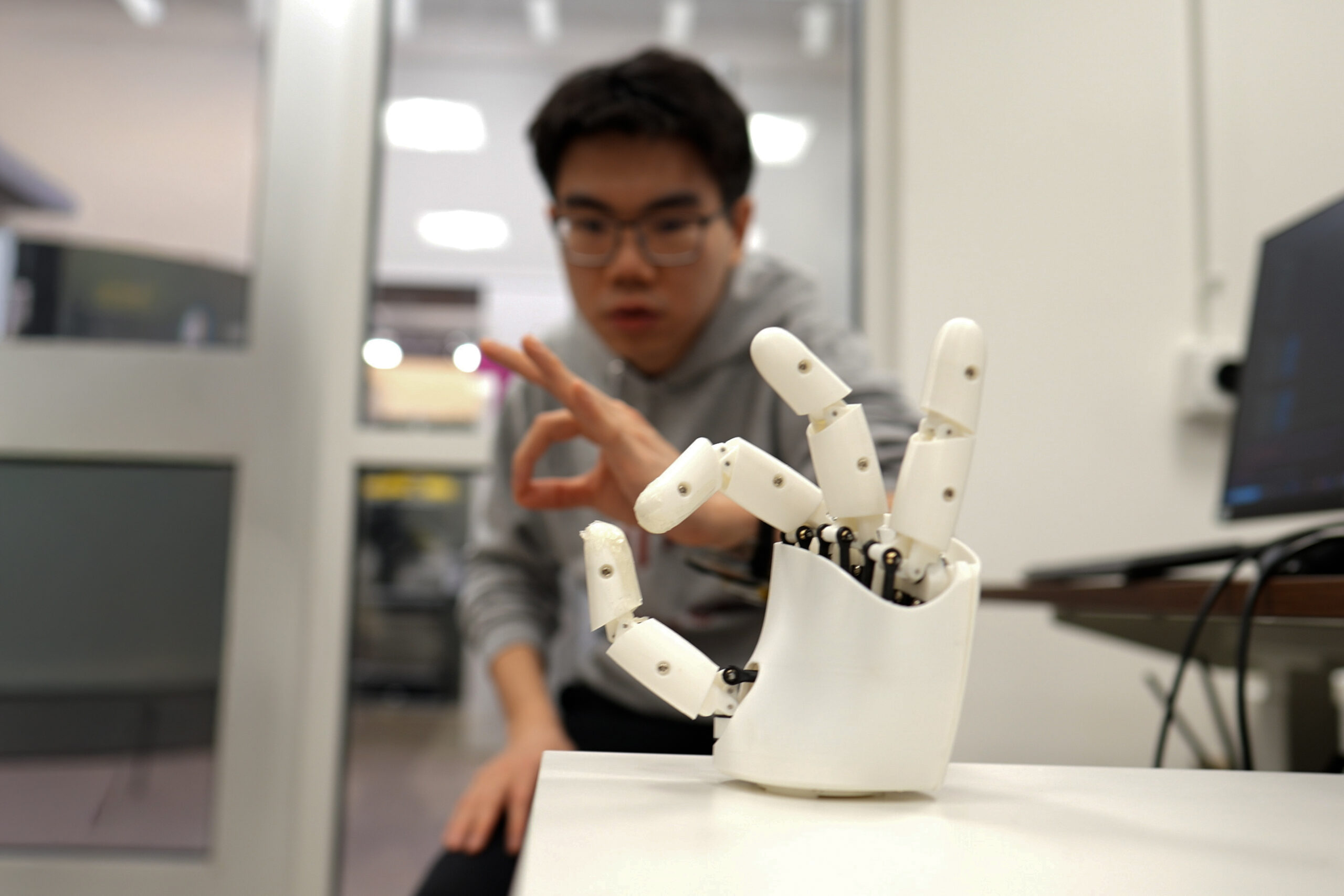
The next time you’re scrolling your phone, take a moment to appreciate the feat: The seemingly mundane act is possible thanks to the coordination of 34 muscles, 27 joints, and over 100 tendons and ligaments in your hand. Indeed, our hands are the most nimble parts of our bodies. Mimicking their many nuanced gestures has been a longstanding challenge in robotics and virtual reality.
Now, MIT engineers have designed an ultrasound wristband that precisely tracks a wearer’s hand movements in real-time. The wristband produces ultrasound images of the wrist’s muscles, tendons, and ligaments as the hand moves, and is paired with an artificial intelligence algorithm that continuously translates the images into the corresponding positions of the five fingers and palm.
The researchers can train the wristband to learn a wearer’s hand motions, which the device can communicate in real-time to a robot or a virtual environment.
In demonstrations, the team has shown that a person wearing the wristband can wirelessly control a robotic hand. As the person gestures or points, the robot does the same. In a sort of wireless marionette interaction, the wearer can manipulate the robot to play a simple tune on the piano and shoot a small basketball into a desktop hoop. With the same wristband, a wearer can also manipulate objects on a computer screen, for instance pinching their fingers together to enlarge and minimize a virtual object.
The team is using the wristband to gather hand motion data from many more users with different hand sizes, finger shapes, and gestures. They envision building a large dataset of hand motions that can be plumbed, for instance, to train humanoid robots in dexterity tasks, such as performing certain surgical procedures. The ultrasound band could also be used to grasp, manipulate, and interact with objects in video games, design applications, or other virtual settings.
“We think this work has immediate impact in potentially replacing hand tracking techniques with wearable ultrasound bands in virtual and augmented reality,” says Xuanhe Zhao, the Uncas and Helen Whitaker Professor of Mechanical Engineering at MIT. “It could also provide huge amounts of training data for dexterous humanoid robots.”
Zhao, Gengxi Lu, and their colleagues present the wristband’s new design in a paper appearing today in Nature Electronics. Their MIT co-authors are former postdocs Xiaoyu Chen, Shucong Li, and Bolei Deng; graduate students SeongHyeon Kim and Dian Li; postdocs Shu Wang and Runze Li; and Anantha Chandrakasan, MIT provost and the Vannevar Bush Professor of Electrical Engineering and Computer Science. Other co-authors are graduate students Yushun Zheng and Junhang Zhang, Baoqiang Liu, Chen Gong, and Professor Qifa Zhou from the University of Southern California.
Seeing strings
There are currently a number of approaches to capturing and mimicking human hand dexterity in robots. Some approaches use cameras to record a person’s hand movements as they manipulate objects or perform tasks. Others involve having a person wear a glove with sensors, which records the person’s hand movements and transmits the data to a receiving robot. But erecting a complex camera system for different applications is impractical and prone to visual obstacles. And sensor-laden gloves could limit a person’s natural hand motions and sensations.
A third approach uses the electrical signals from muscles in the wrist or forearm that scientists then correlate with specific hand movements. Researchers have made significant advances in this approach, however these signals are easily affected by noise in the environment. They are also not sensitive enough to distinguish subtle changes in movements. For instance, they may discern whether a thumb and index finger are pinched together or pulled apart, but not much of the in-between path.
Zhao’s team wondered whether ultrasound imaging might capture more dexterous and continuous hand movements. His group has been developing various forms of ultrasound stickers — miniaturized versions of the transducers used in doctor’s offices that are paired with hydrogel material that can safely stick to skin.
In their new study, the team incorporated the ultrasound sticker design into a wearable wristband to continuously image the muscles and tendons in the wrist.
“The tendons and muscles in your wrist are like strings pulling on puppets, which are your fingers,” Lu says. “So the idea is: Each time you take a picture of the state of the strings, you’ll know the state of the hand.”
Mapping manipulation
The team designed a wristband with an ultrasound sticker that is the size of a smartwatch, and added onboard electronics that are about as small as a cellphone. They attached the wristband to a volunteer’s wrist and confirmed that the device produced clear and continuous images of the wrist as the volunteer moved their fingers in various gestures.
The challenge then was to relate the black and white ultrasound images of the wrist to specific positions of the hand. As it turns out, the fingers and thumb are capable of 22 degrees of freedom, or different ways of extending or angling. The researchers found that they could identify specific regions in their ultrasound images of the wrist that correlate to each of these 22 degrees of freedom. For instance, changes in one region relate to thumb extension, while changes in another region correlate with movements of the index finger.
To establish these connections, a volunteer wearing the wristband would move their hand in various positions while the researchers recorded the gestures with multiple cameras surrounding the volunteer. By matching changes in certain regions of the ultrasound images with hand positions recorded by the cameras, the team could label wrist image regions with the corresponding degree of freedom in the hand. But to do this translation continuously, and in real-time, would be an impossible task for humans.
So, the team turned to artificial intelligence. They used an AI algorithm that can be trained to recognize image patterns and correlate them with specific labels and, in this case, the hand’s various degrees of freedom. The researchers trained the algorithm with ultrasound images that they meticulously labeled, annotating the image regions associated with a specific degree of freedom. They tested the algorithm on a new set of ultrasound images and found it correctly predicted the corresponding hand gestures.
Once the researchers successfully paired the AI algorithm with the wristband, they tested the device on more volunteers. For the new study, eight volunteers with different hand and wrist sizes wore the wristband while they formed various hand gestures and grasps, including making the signs for all 26 letters in American Sign Language. They also held objects such as a tennis ball, a plastic bottle, a pair of scissors, and a pencil. In each case, the wristband precisely tracked and predicted the position of the hand.
To demonstrate potential applications, the team developed a simple computer program that they wirelessly paired with the wristband. As a wearer went through the motions of pinching and grasping, the gestures corresponded to zooming in and out on an object on the computer screen, and virtually moving and manipulating it in a smooth and continuous fashion.
The researchers also tested the wristband as a wireless controller of a simple commercial robotic hand. While wearing the wristband, a volunteer went through the motions of playing a keyboard. The robot in turn mimicked the motions in real-time to play a simple tune on a piano. The same robot was also able to mimic a person’s finger taps to play a desktop basketball game.
Zhao is planning to further miniaturize the wristband’s hardware, as well as train the AI software on many more gestures and movements from volunteers with wider ranging hand sizes and shapes. Ultimately, the team is building toward a wearable hand tracker that can be worn by anyone, to wirelessly manipulate humanoid robots or virtual objects with high dexterity.
“We believe this is the most advanced way to track dexterous hand motion, through wearable imaging of the wrist,” Zhao says. “We think these wearable ultrasound bands can provide intuitive and versatile controls for virtual reality and robotic hands.”
This research was supported, in part, by MIT, the U.S. National Institutes of Health, the U.S. National Science Foundation, the U.S. Department of Defense, and Singapore National Research Foundation through the Singapore-MIT Alliance for Research and Technology.

Since Donald Trump’s war on Iran started more than three weeks ago, United States military forces have allegedly attacked more than 9,000 sites, creating a climate of fear and constant uncertainty for Iranians in Tehran and across the country. Without an advanced warning system from the government, and amid the longest internet shutdown in Iran’s history, Iranians are left in an information void.
Even before Israel and the United States began dropping bombs, Iran’s lack of a public emergency alert tool and severe state-controlled digital oppression has impacted tens of millions of citizens. Since the 12-day Israel-Iran war last year, though, a group of Iranian digital rights activists and volunteers has been working to fill the gap with a dynamic, regularly updated mapping platform called Mahsa Alert. The project can’t replace real-time early alerts that could come from a coordinated government service, but the tool sends push notifications when Israeli forces warn about attacks, details some confirmed strike locations, and offers offline mapping capabilities.
“There is no emergency alert in Iran,” says Ahmad Ahmadian, the president and CEO of US-based digital rights group Holistic Resilience, which is behind Mahsa Alert and has been developing the platform since last summer. “This was where we saw the traction, we saw the need, and we continued working on it with the volunteers, with some [open source intelligence] experts, and used this to map the repression machinery ecosystem of Iran and surveillance.”
Mahsa Alert is a website but also has Android and iOS apps, which were intentionally designed to be lightweight and easy to use on any device. Given the heavy government connectivity control inside Iran and erratic access to the internet, volunteers also prioritized engineering the platform for offline use. And it can be easily updated if a user does get connectivity for a brief period by downloading APK files that contain new data. The team works to keep these updates extremely small; a recent release was 60 kilobytes, and Ahmadian says they are typically no more than 100 kilobytes.
One overlay on Mahsa Alerts plots the locations of “confirmed attacks” that Ahmadian says his team or other OSINT investigators have verified, using video footage or images that are submitted to a Telegram bot or shared on social media. There are also warnings about areas where Israeli forces have issued evacuation alerts, along with the crucial component of people submitting reports on what is happening around them.
“We have to go through a due diligence and verification process and tag them before putting them on the map,” Ahmadian says of the reported attacks and incidents, adding that the team has a backlog of more than 3,000 reports that it is working through or is unable to verify. Along with attempting to map strikes, the team behind Mahsa Alert have also plotted “danger zones” that could be at risk of attack—such as sites linked to Iran’s nuclear program or military—so ordinary citizens can stay away from them. Ahmadian claims 90 percent of attacks it has confirmed were at sites that were already present on the map. “Some of them that we can confirm, we do it because [a user] has shared a photo or they have shared some details that makes them verifiable,” he says.
The map also includes locations of thousands of CCTV cameras, suspected government checkpoints, and other domestic infrastructure. Medical facilities, such as hospitals and pharmacies, are included on the map along with other resources like the locations of religious sites and past protests.
Mahsa Alert has become more visible on global social media feeds as Iranians around the world share details from the map, encouraging people to look into the service and flagging it for friends and family who could use it as a resource. “The app went from near zero to over 100,000 daily active users in a matter of days,” Ahmadian says, adding that in total there have been around 335,000 users this year, with people first turning to the app during the Iranian regime’s brutal crackdown on anti-government protesters in January. Through the limited user information the app collects, Ahmadian claims there are signs that 28 percent of users are accessing the platform from inside Iran.

After a relatively quiet few months, Amazon is bringing back another of its famously invented shopping holidays. The Amazon Spring Sale is on its third year, and it’s on now through March 31. Like during last year’s event, Amazon is promising customers thousands of deals across various daily, themed categories.
Of course, as we’ve seen in the past with Prime Day, Black Friday, and Cyber Monday, the true discounts on good products will likely be buried among junk deals on shoddy wares. The WIRED Reviews team tests gear all year long, and we fact-checked discounts on the products we actively recommend to our friends, family, and readers. We’ve highlighted the best deals below.
Updated March 25: We’ve added new deals and checked for accuracy throughout.
WIRED Featured Deals:
Our audiophile reviewers test more headphones than anyone would deem sane or necessary. The Sony WH-1000XM6 are the pair they’ve declared the best wireless headphones of all, with “the best noise reduction on Earth.” You’ll also get 30 hours of battery life, multipoint Bluetooth pairing, folding ear cups and a travel case, sparkling and clear sound, and fabulous controls. They’re nearly perfect. When they’re not on sale for this price, they’re selling for the full MSRP. If you’re in the market, now is the time—or, if you’re not ready right now, wait until the next time they’re on sale for this price.


US’ Torrid sees FY25 sales fall 9.4%, reports $7 mn loss

Wristband enables wearers to control a robotic hand with their own movements

UK inflation rate steady in February ahead of Iran war

-

 Fashion7 days ago
Sales at US apparel, clothing accessories stores up 4% YoY in Jan 2026
-
 Business1 week ago
Peloton is launching bikes and treadmills for gyms, accelerating commercial strategy
-

 Tech1 week ago
Justice Department Says Anthropic Can’t Be Trusted With Warfighting Systems
-

 Fashion1 week ago
Trump signs order to combat fraudulent ‘Made in America’ labels
-
 Business1 week ago
Stocks and pound rise as US rate call approaches
-

 Fashion1 week ago
Lenzing launches TENCEL Lyocell-HV100 at Intertextile Shanghai
-

 Entertainment7 days ago
Val Kilmer revived 1 year after death through AI
-

 Sports1 week ago
PCB files complaint over allowing Bangladesh to take review on penultimate ball – SUCH TV