

Sports
The legacy and legality of the Bush Push 20 years later

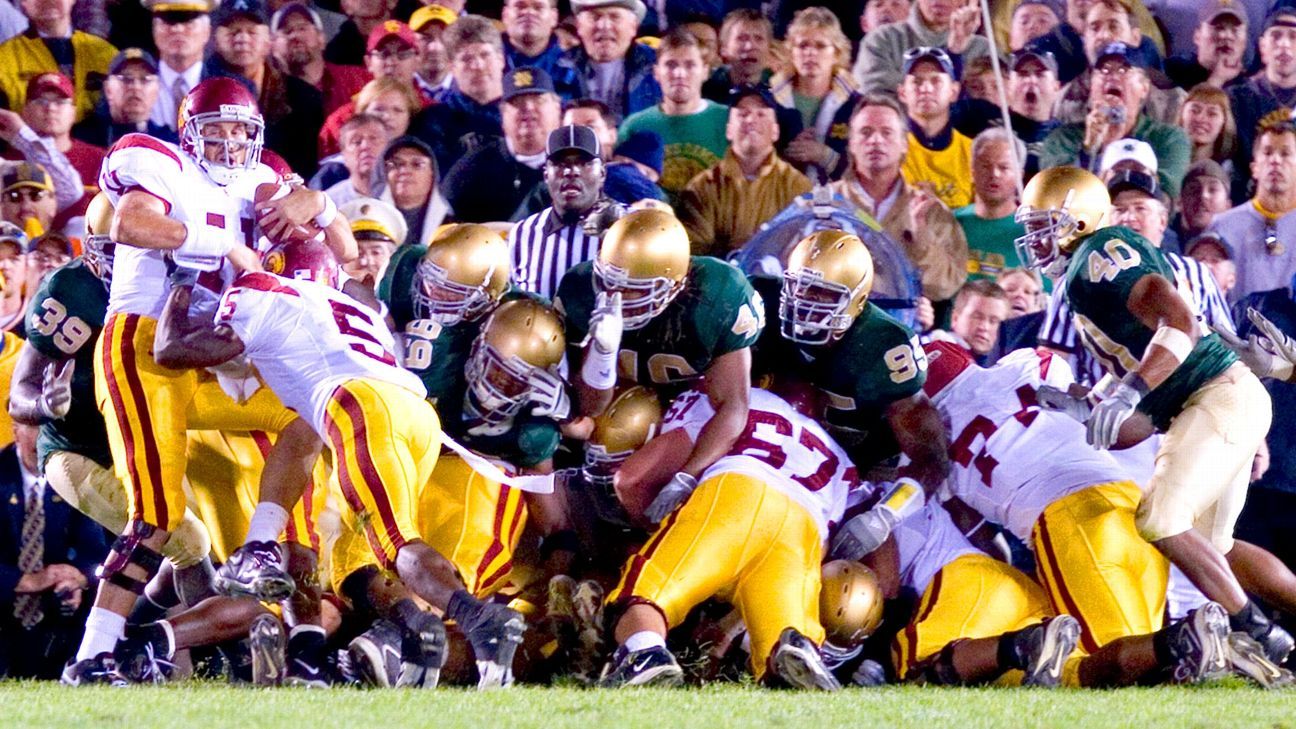
ON THE SIDELINE at Notre Dame Stadium, USC coach Pete Carroll frantically waved for quarterback Matt Leinart to spike the ball. The Trojans trailed 31-28, inches from the goal line with seven seconds left.
“[Leinart] was to look back at [offensive coordinator Steve Sarkisian] on the sidelines, and if we wanted to sneak it, we could sneak it,” Carroll said this week. “And he had to point at him. So, we tell him to sneak it. So, he points at the line, and he looks at the line of scrimmage, and he goes, ‘There’s no way, they’re all jammed up.’ And he looks back at us, and Reggie [Bush] yelled something at him, ‘Go for it. Go for it.'”
Moments earlier, Leinart had fumbled out of bounds inside the 1. The clock mistakenly ran out, and NBC’s Tom Hammond declared, “Notre Dame has won,” as Notre Dame coach Charlie Weis raised his arms and fans stormed the field.
When play resumed, the Trojans would have one last chance to extend their winning streak to 28 games.
Leinart sneaked left from under center, but he was bounced backward into a half spin and into the path of Bush, who famously shoved him across for the winning score.
“It was about as sweet a finish as you could have in a great situation to keep the streak alive and all that, too,” Carroll said.
Twenty years ago, the “Bush Push” would become one of the most unforgettable moments in college football history — and one of its most controversial. In the box score, it was the touchdown that preserved USC’s dynasty and allowed for the Rose Bowl matchup with Texas that became an all-time classic. In the rulebook, though, it was illegal.
Except, it was almost never called. In fact, the rule had become a running joke among officials.
“You were teased if you made the call,” said former NCAA official and current ESPN analyst Matt Austin. “It was such a rare occurrence.”
In the years that followed, an obscure rule became a flashpoint. It was debated, tweaked and, eventually, led to strategic evolution.
THE “HELPING THE Ball Carrier” rule had been part of the NCAA rulebook for decades. Its language was virtually identical in every edition dating back to at least 1950.
“No [teammate] shall grasp, pull, push, lift or charge into him to assist him in forward progress.”
The idea is believed to have originated as a way to differentiate football from rugby. Teammates could block defenders, but once the ball carrier was engaged, the play was meant to be his alone. Anything more — a shove, a tug, a lift — was considered an unfair advantage.
It was almost impossible to enforce in short-yardage piles, where pushes and blocks blur together, especially near the goal line.
Steve Shaw remembers that problem well. Now the NCAA’s national coordinator of officials, Shaw spent more than two decades on the field, and he has seen just about everything. But in the 2000 season, his crew made a rare, yet memorable call.
It happened during a Middle Tennessee–UConn game. Late in the contest, a Middle Tennessee lineman reached out and grabbed his running back, helping drag him toward the end zone. Shaw’s line judge, Mike Taylor, threw the flag.
“At the end of the year, there’s a report listing every penalty called nationally,” Shaw said. “Under aiding the runner, there was one — and it was ours. We gave him a hard time for calling it, but it was the right call.”
The rule technically existed, but almost nobody enforced it. And when it was flagged, it was usually because a player was being pulled, not pushed.
So when Bush shoved Leinart across the goal line in 2005, the officials did what most would have done: They kept the flag in their pockets. In fact, after Leinart’s touchdown, the Pac-10 officiating crew huddled up to discuss the play only to emerge with an unsportsmanlike contact penalty against the Trojans for their celebration after. There was no mention of the legality of the push on the broadcast, either.
It wasn’t until the next day when the conversation shifted from the game’s remarkable ending into a nationwide rules debate that is still built into the game’s lore.
Pac-10 commissioner Tom Hansen admitted to the Los Angeles Times that his conference’s officiating crew could have called a penalty, but made essentially the same point Shaw did two decades later.
“I just don’t think they ever call it,” Hansen said, adding it would have been different if it was a pull, not a push.
This is where the consensus seemed to land. The play looked like part of the normal chaos that happens at the goal line. By the letter of the law, Bush committed a foul. But by the spirit of the game, he just did what any teammate would do.
RULE CHANGES IN college football often move slowly. Proposals wind through the NCAA Rules Committee, a rotating group of coaches, officials and administrators who meet each offseason.
Most suggestions come after issues are identified over the course of a season. If the committee deems something urgent, it can move quickly. If not, it can linger in discussion until a consensus forms.
Sometimes, a single play can trigger an immediate rewrite. When Pitt quarterback Kenny Pickett faked a slide in the 2021 ACC championship game — beginning to give himself up before resuming his run for a long touchdown — the reaction was instant. Within days, the NCAA issued a memo closing the loophole. The same thing happened last year when Oregon‘s Dan Lanning found a way to shave off game time by using a 12th man on defense.
The Bush Push didn’t work that way.
Despite the fierce public debate — and the way it was officiated — the rule remained unchanged in the years that followed.
It wasn’t until 2013, when the rules committee formally decided to adjust the official wording.
“The rules committee had a good debate about this and they watched much video, including the Bush Push play,” Shaw said. “Overall, they came to the conclusion that it was very difficult to determine when a push was truly a foul.
“There were few guidelines that could be given to make this a consistent call. Examples were pushing a rugby scrum pile vs. pushing the runner specifically, and they felt it was nearly impossible to distinguish between pushing a runner, leaning on a runner, pushing the pile or leaning on the pile. They felt removing the ‘push’ component would be the best course of action.”
When the NCAA released its updated rulebook for the 2013 season, the word “push” was simply deleted, bringing it in line with a similar rule change the NFL made in 2005.
Without realizing it, the committee paved the way for innovation in the sport.
Right away, coaches tried to use the subtle change to their advantage, including former Kansas State coach Bill Snyder, whose Wildcats started running what is now commonly referred to as the tush push later that year.
“It was just a natural thing to do,” Snyder told ESPN’s Kalyn Kahler earlier this year. “We needed to create a way in which we could take the shortest distance to get the short distance we needed to go and not get held up, because everybody put all the people over there, so we wanted to compete against no matter how many people you put there.
“We wanted to be strong enough not to get held up at the line of scrimmage. And we would bring one or two, or on occasion, three backs up right off of the hip of the center, and on the snap of the ball, we would push the center or push the back of the quarterback.”
That small tactical adjustment eventually made its way to the pros. Nearly a decade later, the Philadelphia Eagles adopted a version of the play built around quarterback Jalen Hurts, perfecting it into an almost unstoppable short-yardage weapon. Which, once again, led to a nationwide debate about whether pushing — once outlawed, then ignored and finally embraced — belonged in football at all.
In May, a proposal from the Green Bay Packers to ban the tush push came up two votes shy of the 24 it needed to pass.
At the NCAA level, the play drew some discussion over the offseason, too, but those conversations were more centered on potential injury concerns.
“The NCAA rules committee has looked at it and really up to now have not seen it become an injury, a player safety issue,” Shaw said. “So it really becomes a strategic part. Is that something strategically we want in the game? And so far there’s not been a big driver to try to put together a reason to eliminate it from our game.”
Over the past four seasons, the current rule has been enforced only six times, according to Shaw. Three times in 2022, and just once in 2021, 2023 and 2024.
AS USC RETURNS to Notre Dame this weekend for a top-20 matchup, the Bush Push helps define one of the sport’s most storied rivalries.
Carroll, now the Las Vegas Raiders coach, has very specific memories of that game in South Bend: the high grass, the green Notre Dame jerseys, the legends in the crowd.
“The stories I heard are that they sold out the night before the game at their rally that they had,” Carroll said. “And they brought Joe Montana back, and Rudy [Ruettiger] came back to speak to the crowd and a guy dressed up as Jesus showed up trying to bring home the power. … It was just an incredible setting for college football.”
The push that once went uncalled now defines the rule. Twenty years later, it’s still moving the game forward.
ESPN NFL reporter Ryan McFadden contributed to this story.
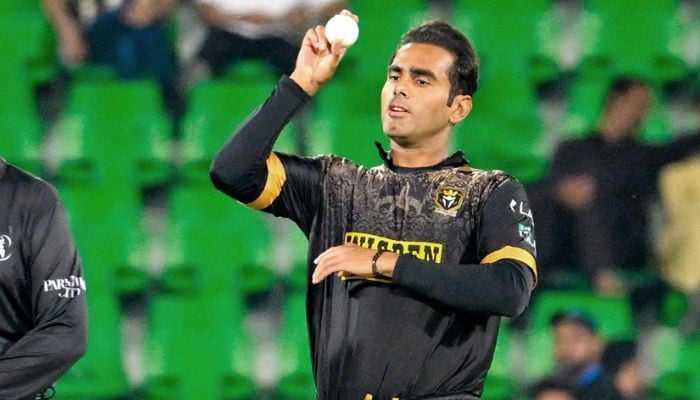
Hyderabad Kingsmen fast bowler Mohammad Ali has been fined 10% of his match fee after pleading guilty to a Level 1 breach of the HBL Pakistan Super League (PSL) Code of Conduct during Friday night’s Eliminator 2 against Islamabad United at Gaddafi Stadium in Lahore.
Ali was found to have violated Article 2.21 of the HBL PSL Code of Conduct for Players and Player Support Personnel, which relates to “conduct that brings the game into disrepute”.
According to officials, the incident took place in the 16th over of Islamabad United’s innings when Faheem Ashraf walked in to bat after the dismissal of Haider Ali.
The charge was levelled by on-field umpires Ahsan Raza and Shahid Saikat, while match referee Roshan Mahanama imposed the sanction.
The Kingsmen went on to beat Islamabad United by two runs to book their place in the PSL 11 final against table-toppers Peshawar Zalmi at the same venue on Sunday, ending United’s campaign in the tournament.
Chasing 187, Islamabad lost Sameer Minhas for six and Mohsin Riaz for five inside the first three overs with 15 runs on the board. Devon Conway and Shadab Khan then added 42 before Saim Ayub dismissed Conway for 30 off 25 balls in the eighth over.
Shadab made 22 off 24 deliveries before falling to Hassan Khan at the start of the 11th over, while Mark Chapman kept Islamabad in the hunt with 43 off 26 balls. Chapman added 64 runs with Haider Ali, who scored 31 off 16 before falling to Mohammad Ali in the 16th over.
Faheem Ashraf and Chris Green then smashed 22 runs off Ali in the penultimate over to leave Islamabad needing six from the last over, but Hunain Shah conceded only three to seal a two-run win. Ali and Hunain took two wickets each, while Akif Javed, Hassan Khan and Saim Ayub picked up one apiece.
Earlier, Hyderabad Kingsmen posted 186/5 after being put in to bat, driven by a 101-run fifth-wicket stand between Usman Khan and Kusal Perera.
Usman remained unbeaten on 61 off 30 balls, while Perera made 37 from 21 deliveries. Saim Ayub scored 38 and captain Marnus Labuschagne added 40, while Imad Wasim was Islamabad’s standout bowler with 2 for 16 in two overs.
NEWYou can now listen to Fox News articles!
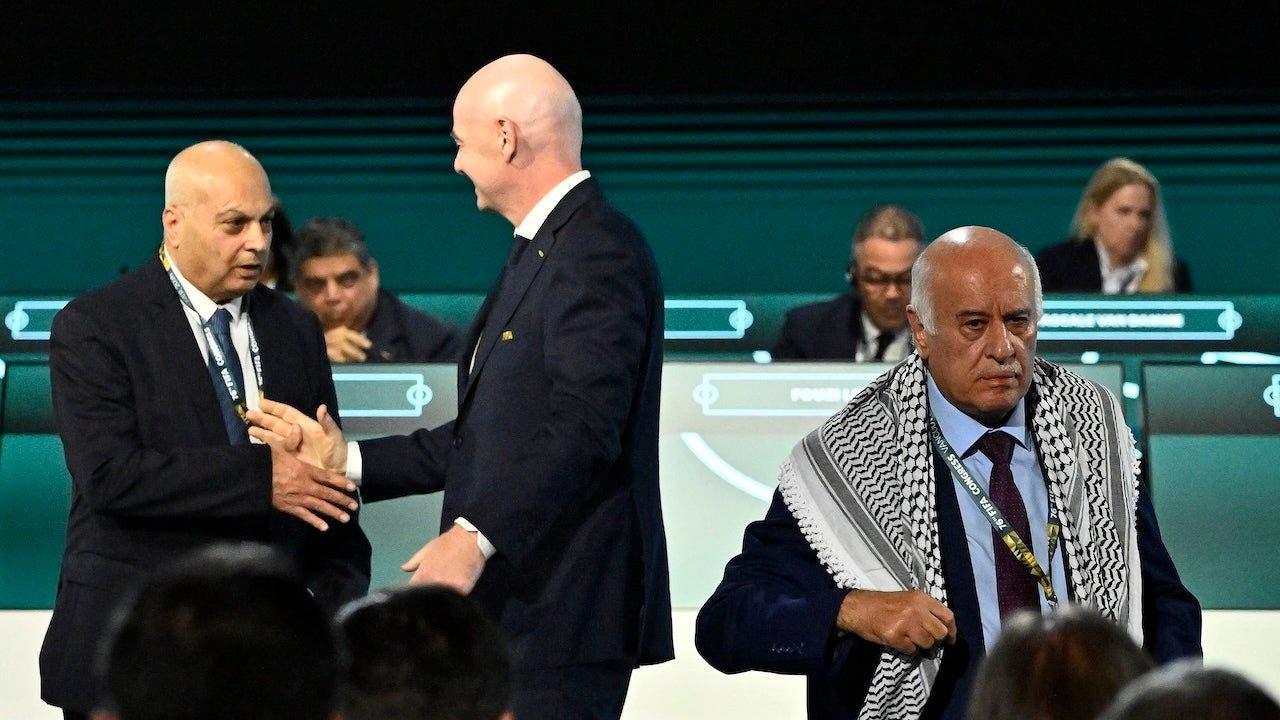
Palestinian Football Association President Jibril Rajoub refused to shake hands or even stand beside Israel Football Association Vice President Basim Sheikh Suliman during a tense exchange at the FIFA Congress Thursday.
Both officials were invited to the stage by FIFA President Gianni Infantino, but the Palestinian representative resisted efforts to bring him closer to his Israeli counterpart.
FIFA President Gianni Infantino shakes hands with Basim Sheikh Suliman (left), vice president of the Israeli Football Association, as Jibril Rajoub (right), president of the Palestine Football Association, leaves the stage at the 76th FIFA Congress in Vancouver, Canada, April 30, 2026. (Reuters/Jennifer Gauthier)
Infantino briefly placed a hand on Rajoub’s arm and gestured for him to step forward, but Rajoub did not comply.
CLICK HERE FOR MORE SPORTS COVERAGE ON FOXNEWS.COM
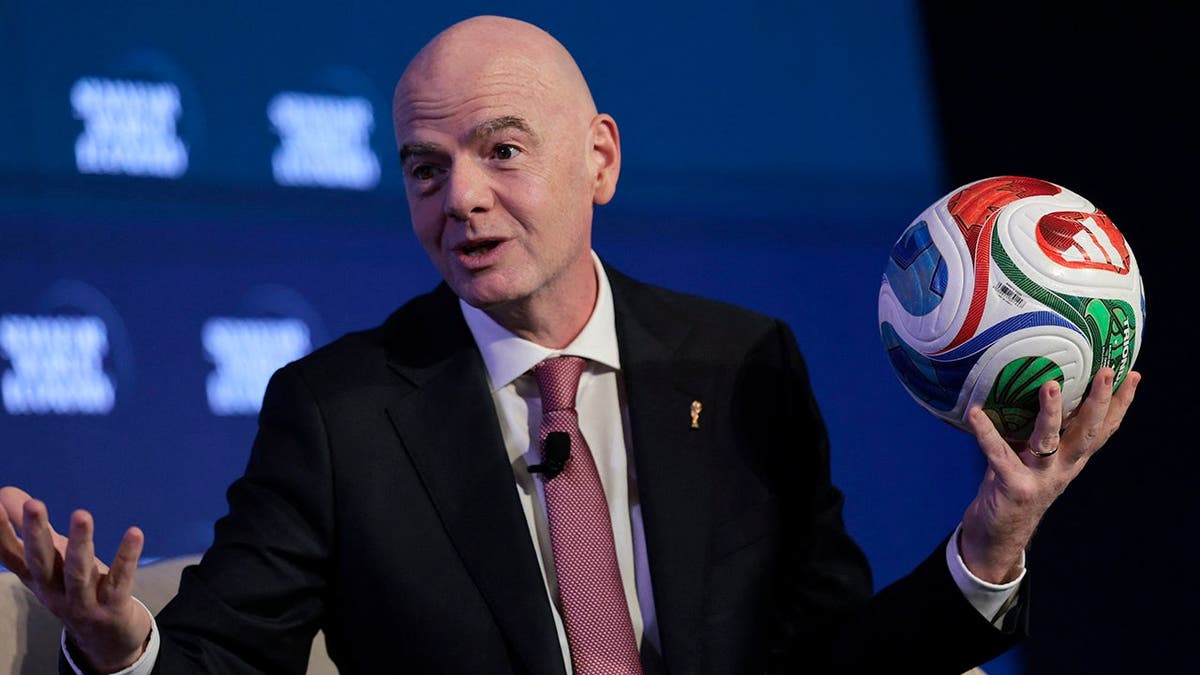
FIFA President Gianni Infantino speaks during the 2026 Semafor World Economy conference in Washington, D.C., on April 15, 2026. (Kent Nishimura/AFP)
The Palestinian FA, led by Rajoub, has long pushed for Israel to be suspended from international soccer competition.
Rajoub defended his decision, saying he remains committed to formal processes but believes stronger action is needed.
“I still respect and follow the legal procedure, but I think it’s time to understand that Israel should be sanctioned. The double-standard policy should stop,” Rajoub said, according to The Times of Israel.
“I refused to shake hands. Sport is sport. … For me, that should be respected, but if the other side is representing a criminal like Bibi [Prime Minister Benjamin Netanyahu] and speaking on behalf of Bibi as if Bibi is Mother Teresa, how can I shake hands or have a photo with such a man?
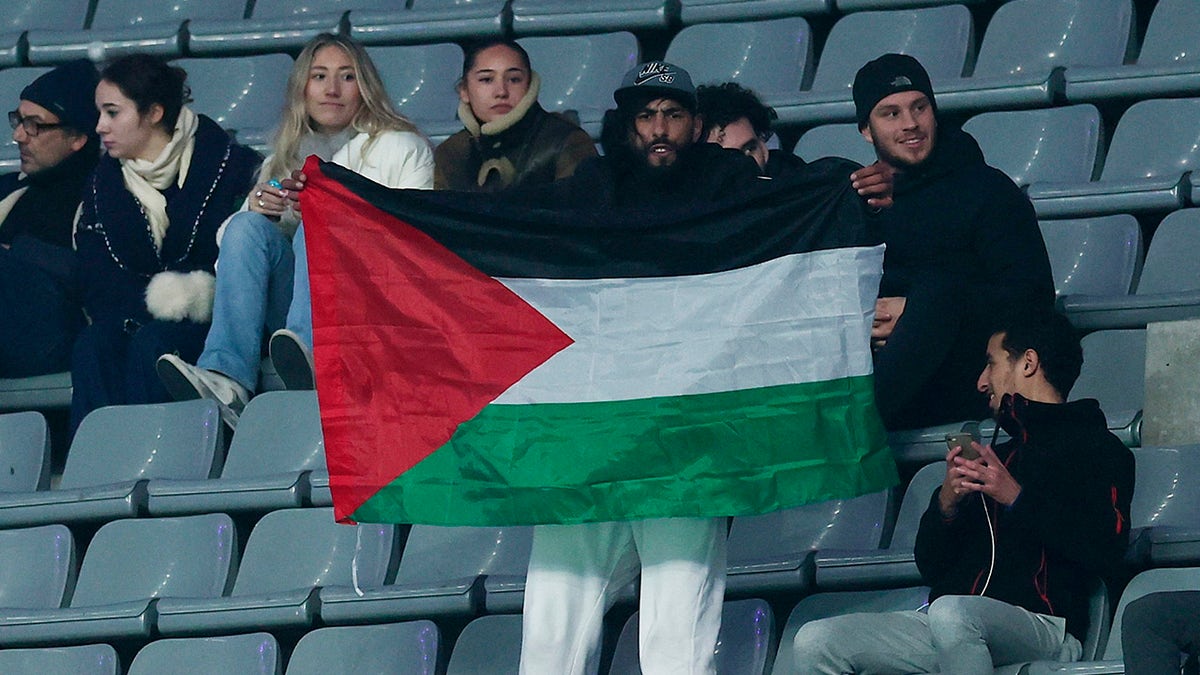
A fan displays a Palestinian flag during a Nations League group stage match between France and Israel Nov. 14, 2024. (Gonzalo Fuentes/Reuters)
“I think Gianni has the right to try to bridge gaps and bring people together, but I think maybe he does not understand or does not know the deep suffering of the Palestinian people.”
After the exchange, Infantino addressed the room, urging cooperation.
“We will work together, President Rajoub, Vice President Suliman. Let’s work together to give hope to the children. These are complex matters,” Infantino said.
Speaking just before the incident, Suliman emphasized the unifying role of the sport.
“In football, there is no place for politics,” Suliman said. “Everyone has the right to play and compete. We are teaching children values like respect, equality and love for others, and we hope that by the next time we meet, the situation will be better. We extend a hand to the Palestinian FA in the spirit of those shared values.”
CLICK HERE TO DOWNLOAD THE FOX NEWS APP
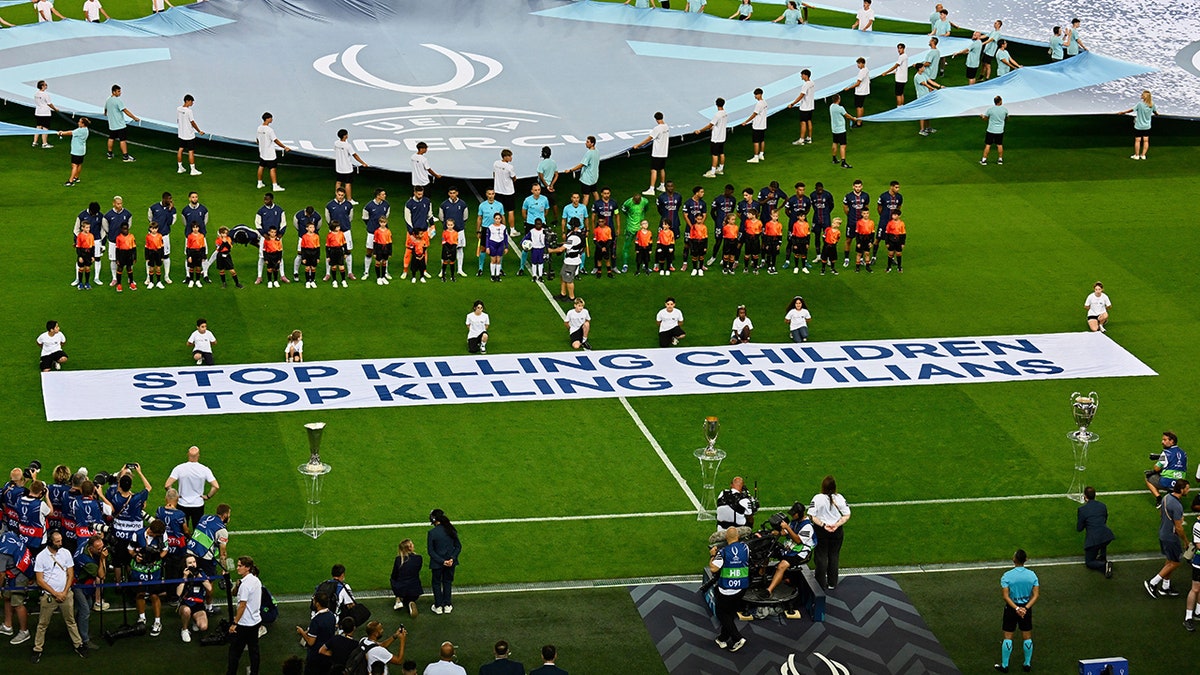
Players from Paris Saint-Germain and Tottenham Hotspur line up before the UEFA Super Cup soccer match in Udine, Italy, on Aug. 13, 2025. (Denes Erdos/AP)
UEFA was reportedly moving toward a vote to suspend Israel over the war in Gaza in September, but the motion was put on pause.
Infantino announced no action would be taken against the team on Oct. 3 after a historic peace proposal by President Donald Trump and Netanyahu.
However, even after the peace proposal, Israeli sports teams have faced opposition and exclusion.
Follow Fox News Digital’s sports coverage on X, and subscribe to the Fox News Sports Huddle newsletter.
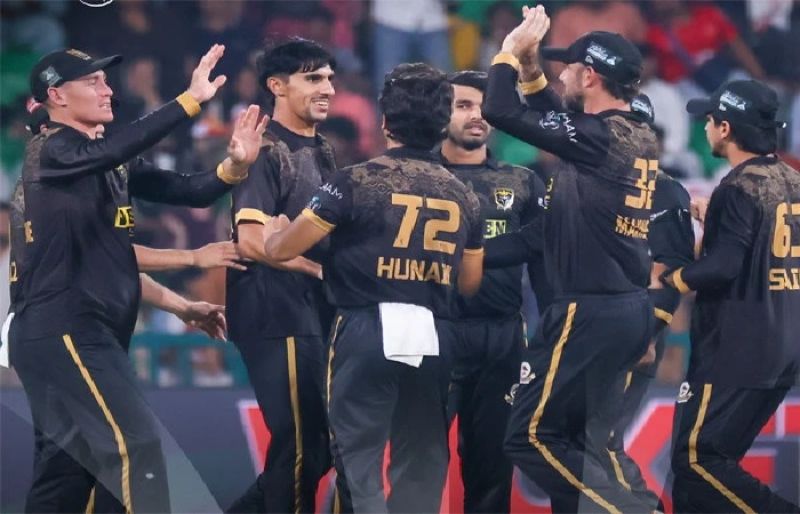
Hyderabad Kingsmen advanced to the Pakistan Super League (PSL) 11 final after defeating Islamabad United by two runs in the thrilling second eliminator at Lahore’s Gaddafi Stadium on Friday.
The victory propelled the debutants into the final, where they will lock horns with table-toppers Peshawar Zalmi at the same venue on Sunday, while it drew curtains on the United’s campaign at the eight-team tournament.
The United got off to an unwanted start to the pursuit as they lost Sameer Minhas (six) and Mohsin Riaz (five) inside three overs with just 15 runs on the board.
Skipper Shadab Khan then joined Devon Conway in the middle, and the duo batted cautiously to put together 42 runs for the second wicket until Saim Ayub dismissed the left-handed opener in the eighth over, who made a 25-ball 30 with the help of three fours and a six.
Shadab was then involved in a brief 11-run partnership for the fourth wicket until eventually falling victim to Hassan Khan on the first delivery of the 11th over and walked back after a cautious 22 off 24 deliveries.
Following his dismissal, Chapman took the reins of United’s pursuit and raised a crucial 64-run partnership for the fourth wicket with Haider Ali, who contributed with a 16-ball 31 until falling victim to Mohammad Ali in the 16th over.
Chapman, on the other hand, followed suit 10 deliveries later, falling victim to Hunain Shah in the 18th over. He remained the top-scorer for the United with a quickfire 43 off 26 deliveries, studded with five fours and two sixes.
But his dismissal did not bother the three-time champions as the all-rounder duo of Faheem Ashraf and Chris Green put them into the commanding position by smashing Ali for 22 runs in the penultimate over, and brought the required equation down to six runs off the last over.
Bowling the final over, with just six runs to defend, Hunain delivered impeccable death bowling as he gave just three runs to secure a thrilling two-run victory for the Kingsmen.
For the Kingsmen, Ali and Hunain bagged two wickets each, while Akif Javed, Hassan Khan and Saim Ayub chipped in with one scalp apiece.
Hunain claimed the Player of the Match award for a brilliant six-run defence in the tense final over.
Put into bat first, the Kingsmen piled up 186/5 in their 20 overs, courtesy of a sensational fifth-wicket partnership between Usman and Kusal Perera.
The Kingsmen got off to a dismal start to their innings as Richard Gleeson dismissed left-handed opener Maaz Sadaqat for a four-ball duck in the first over, with just one run on the board.
Following the early stutter, Saim Ayub joined captain Marnus Labuschagne in the middle, and the duo batted cautiously to put together 70 runs for the second wicket.
Chris Green eventually broke the budding partnership in the 10th over by getting rid of Saim, who walked back after scoring 38 off 27 deliveries with the help of seven fours.
Labuschagne was then involved in a brief 13-run partnership for the third wicket with Glenn Maxwell (three) until both Australians fell victim to Imad Wasim in the pulsating 12th over, resulting in Kingsmen slipping to 85/4.
The Kingsmen captain remained a notable run-getter for the tournament debutants, scoring 40 off 32 deliveries, featuring four fours and a six.
Following the back-to-back blows, in-form wicketkeeper batter Usman and Perera forced an astounding turnaround as they bolstered the Kingsmen’s total past the 180-run mark with a 101-run partnership for the fifth wicket.
Usman, who dominated the crucial stand, remained their top-scorer with an unbeaten 61 off 30 deliveries, studded with 10 boundaries, while Perera chipped in with a 21-ball 37, comprising four fours and two sixes.
Imad was the standout bowler for the United, taking two wickets for just 16 runs in his two overs, while Faheem Ashraf, Gleeson and Green made one scalp apiece.


Harry Styles, Zoe Kravitz in major wedding planning mode after big step

what happens to stranded passengers now?

US awards $488m F-16 radar support contract for Pakistan, other countries


-

 Tech5 days ago
A Brain Implant for Depression Is About to Be Tested in Humans
-

 Tech1 week ago
They Wanted to Join Raya. They’ve Been on the Waiting List for Years
-

 Tech5 days ago
Almost 90% of women leave tech industry within 10 years | Computer Weekly
-
 Tech1 week ago
Why Do I Like Dyson’s PencilVac So Much?
-

 Fashion1 week ago
North India cotton yarn steady despite continued push by spinners
-
 Entertainment1 week ago
Anne Hathaway makes shocking confession about Taylor Swift’s music
-
 Sports1 week ago
US says Iran can play in Fifa World Cup but IRGC-linked individuals won’t be allowed
-
 Entertainment5 days ago
Norway joins Type 26 Frigate Programme to boost NATO naval power