

Tech
The South Carolina Measles Outbreak Is Slowing Down


A large measles outbreak in South Carolina is finally showing signs of slowing down as the total number of cases in the state nears 1,000.
For several weeks now, the state has experienced a downward trend in new infections, with approximately 10 cases being reported per week. At its peak in mid-January, the state was reporting around 200 new cases a week.
The South Carolina outbreak is the largest measles outbreak in the US in more than 30 years, according to data from the Centers for Disease Control and Prevention. The CDC has confirmed 1,281 measles cases across the country this year, as of March 5. That is already more than half of the documented cases in 2025, which totaled 2,283.
Measles was declared eliminated in the US in 2000, a status attained when there has been no ongoing transmission within the country for longer than a year. Even with cases in South Carolina abating, the US is now at risk of losing its measles elimination status. According to the CDC, there have been 12 outbreaks in the US this year, including ones in Arizona, Texas, and Utah.
Linda Bell, South Carolina’s state epidemiologist, is encouraged by the decrease in new cases in her state, though she notes that with schools going on spring break in March and April, there is a potential for more exposures as families travel and visit tourist attractions.
“We remain concerned and must be mindful of the fact that we can see cases increase again from the low number that we’re seeing now,” she said in a March 4 press briefing. “We are very hopeful that the downward trend continues, but we have to be vigilant about the risk that we can see another surge.”
The outbreak began with just a handful of cases in October and has centered in Spartanburg County. Low vaccination rates in schools helped spread the virus, with social events around the winter holidays fueling a surge of cases in January. Churches have also been a major source of exposure, according to Bell.
Measles symptoms, which include high fever, cough, runny nose, and watery eyes, typically don’t appear until one to two weeks after exposure. The characteristic measles rash takes another several days to develop, which contributes to a lag in diagnosing the infection. Measles can cause severe complications, such as pneumonia and brain swelling, both of which have been documented in South Carolina. More than 93 percent of the cases in South Carolina have occurred in people who were unvaccinated. The vast majority of infections have been in children under 18.
Bell said that modeling from earlier in the outbreak showed that South Carolina’s outbreak could go on for six months or longer. Now, it may end sooner than predicted.
The outbreak has prompted an uptick in vaccination with the measles, mumps, and rubella (MMR) vaccine in Spartanburg County and across the state. Compared to February 2025, there was a 133 percent increase in measles vaccination in Spartanburg County, representing roughly 900 additional doses given, according to the South Carolina Department of Public Health. An additional 7,000 doses of measles vaccinations were administered statewide in February, a 70 percent increase from the same time last year.












By law, autonomous vehicles aren’t legally allowed to carry unaccompanied minors in California. Waymo, Alphabet’s self-driving car company, doesn’t allow kids under 18 to ride alone anywhere outside of metro Phoenix, Arizona. But that hasn’t stopped some time-strapped parents from using their own accounts to transport their kids to school, extracurricular activities, and even social outings. Some have reported that the lack of drivers makes them feel safer.
Waymo is working to crack down on the practice, the company confirmed Friday, after reports of new mid-ride age-verification checks began to float around on social media. The company has “policies in place” to help it identify violations of its terms of service, Waymo spokesperson Chris Bonelli wrote in a statement to WIRED. “We are continuing to refine our system and processes for accuracy over time.” Violating its terms of service can lead to temporary or permanent suspension of an account, Waymo says.
The company uses cameras inside its cars to check that riders aren’t violating its rules. Its privacy policy notes that the company records video inside the vehicle during trips. Waymo says its support workers “may review video under certain circumstances,” and, “in more urgent circumstances,” access live video during a trip. The company says it does not use facial recognition or “other biometric identification technologies” to identify individuals.
The news comes a month after several California labor groups, including the California Gig Workers Union, filed a formal complaint with a state regulatory agency, accusing Waymo of violating the terms of its permit to operate in the state by knowingly transporting unaccompanied minors. The matter was assigned to a judge this week. The state is evaluating new rules that could allow solo riders under 18 in driverless cars, perhaps patterned after a program that permits ride-hail companies with human drivers to transport minors in California.
So far, several fresh-faced adults have been caught in the crossfire. On Tuesday, San Francisco machine learning engineer Nicholas Fleischhauer was about five minutes into his Waymo ride when the car connected him to support. A voice came over the line asking Fleischhauer to verify his age. He told the worker the truth: He’s 35. “I had messy and wet hair, and a backpack on me,” he says, by way of explaining why he might have been flagged by Waymo’s system. Plus, “people have told me that I look young for my age.” Fleischhauer says he takes Waymo weekly, but this marked the first time he had been asked about his age.
Since last summer, Waymo has allowed parents in the Phoenix area to set up teen accounts for riders ages 14 to 17. The accounts allow the teen riders’ adults to track their real-time locations during their trips. Waymo says a specially trained team of support agents deals with any issues its teen riders might have. Waymo says that “hundreds” of Phoenix families use the service each week.
In Waymo’s other markets across the US, adults are allowed to ride with guests under 18, though children under 8 must be in a secured car or booster seat.
Ethan S. Klein is 23, but his 26th LA Waymo ride on Thursday—plus the music he was listening to—was interrupted by an in-car call from a support agent who asked him, for the first time, to verify his birth date. Klein is an adult, but his first impulse was almost teen-like. “I was a little startled,” he says. “I thought I was in trouble!”
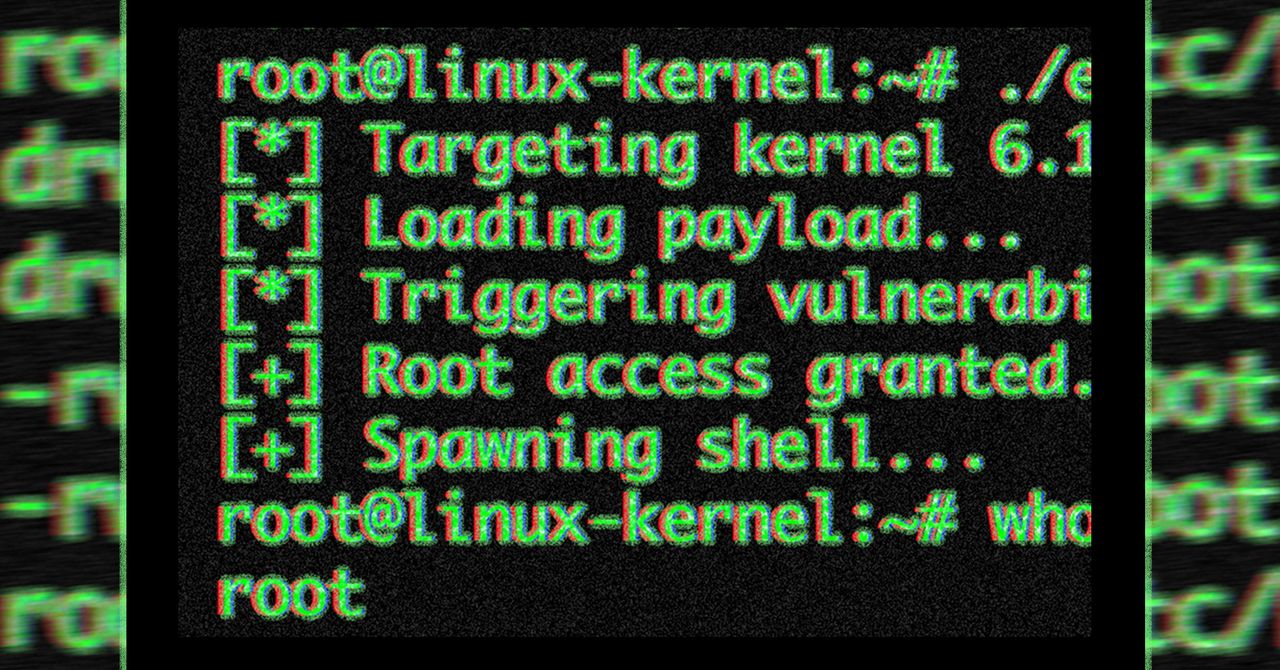
Publicly released exploit code for an effectively unpatched vulnerability that gives root access to virtually all releases of Linux is setting off alarm bells as defenders scramble to ward off severe compromises inside data centers and on personal devices.
The vulnerability and exploit code that exploits it were released Wednesday evening by researchers from security firm Theori, five weeks after privately disclosing it to the Linux kernel security team. The team patched the vulnerability in versions 7.0, 6.19.12, 6.18.12, 6.12.85, 6.6.137, 6.1.170, 5.15.204, and 5.10.254) but few of the Linux distributions had incorporated those fixes at the time the exploit was released.
A Single Script to Hack Them All
The critical flaw, tracked as CVE-2026-31431 and the name CopyFail, is a local privilege escalation, a vulnerability class that allows unprivileged users to elevate themselves to administrators. CopyFail is particularly severe because it can be exploited with a single piece of exploit code—released in Wednesday’s disclosure—that works across all vulnerable distributions with no modification. With that, an attacker can, among other things, hack multi-tenant systems, break out of containers based on Kubernetes or other frameworks, and create malicious pull requests that pipe the exploit code through CI/CD work flows.
“‘Local privilege escalation’ sounds dry, so let me unpack it,” researcher Jorijn Schrijvershof wrote Thursday. “It means: An attacker who already has some way to run code on the machine, even as the most boring unprivileged user, can promote themselves to root. From there they can read every file, install backdoors, watch every process, and pivot to other systems.”
Schrijvershof added that the same Python script Theori released works reliably for Ubuntu 22.04, Amazon Linux 2023, SUSE 15.6, and Debian 12. The researcher continued:
Why does that matter on shared infrastructure? Because “local” covers a lot of ground in 2026: every container on a shared Kubernetes node, every tenant on a shared hosting box, every CI/CD job that runs untrusted pull-request code, every WSL2 instance on a Windows laptop, every containerised AI agent given shell access. They all share one Linux kernel with their neighbors. A kernel LPE collapses that boundary.
The realistic threat chain looks like this. An attacker exploits a known WordPress plugin vulnerability and gets shell access as www-data. They run the copy.fail PoC. They are now root on the host. Every other tenant is suddenly reachable, in the way I walked through in this hack post-mortem. The vulnerability does not get the attacker onto the box; it changes what happens in the next ten seconds after they land there.
The vulnerability stems from a “straight-line” logic flaw in the kernel’s crypto API. Many exploits exploiting race conditions and memory corruption flaws don’t consistently succeed across kernel versions or distributions, and sometimes even on the same machine. Because the code released for CopyFail exploits a logic flaw, “reliability isn’t probabilistic, and the same script works across distributions, researchers from Bugcrowd wrote. “No race window, no kernel offset.”
CopyFail gets its name because the authencesn AEAD template process (used for IPsec extended sequence numbers) doesn’t actually copy data when it should. Instead, it “uses the caller’s destination buffer as a scratch pad, scribbles 4 bytes past the legitimate output region, and never restores them,” Theori said. “The ‘copy’ of the AAD ESN bytes ‘fails’ to stay inside the destination buffer.”
The Worst Linux Vulnerability in Years
Other security experts echoed the perspective that CopyFail poses a serious threat, with one saying it’s the “worst make-me-root vulnerabilities in the kernel in recent times.”
The most recent such Linux vulnerability was Dirty Pipe from 2022 and Dirty Cow in 2016. Both of those vulnerabilities were actively exploited in the wild.

Two new projects, including one from a Pulitzer-winning reporter, claim they’ve solved the mystery of Bitcoin’s creator. So why does the hunt continue?
Source link


Sydney Sweeney hard launches her romance with beau Scooter Braun

AAFA pushes for swift US House passage of key anti-counterfeiting law

Greta Gerwig finally reveals her wild new ‘Narnia’ movie title

-
 Business1 week ago
France Ends Airport Transit Visa Requirement for Indian Travellers | Business – The Times of India
-

 Fashion1 week ago
Canada forms new advisory committee to strengthen US trade relations
-

 Tech1 week ago
They Wanted to Join Raya. They’ve Been on the Waiting List for Years
-

 Tech5 days ago
A Brain Implant for Depression Is About to Be Tested in Humans
-

 Tech1 week ago
Why Do I Like Dyson’s PencilVac So Much?
-

 Entertainment1 week ago
Anne Hathaway makes shocking confession about Taylor Swift’s music
-

 Tech5 days ago
Almost 90% of women leave tech industry within 10 years | Computer Weekly
-

 Fashion1 week ago
North India cotton yarn steady despite continued push by spinners