

Business
Tips And Tricks: 8 Budgeting Hacks For Beginners


Starting a budget can feel overwhelming, especially if you’re new to managing your finances. The good news is, with a few simple hacks, anyone can take control of their money and build healthy financial habits. Budgeting doesn’t have to be restrictive—it’s about making smarter choices, reducing stress, and planning for the future.
Track Every Expense: Start by recording every penny you spend for at least a month. This helps you understand where your money goes and highlights areas for improvement. Use apps or spreadsheets to keep it simple and accurate. Awareness is the first step toward control. (Image: AI-generated)

Set Clear Financial Goals: Define what you’re budgeting for—emergency fund, debt repayment, or vacation. Clear goals give purpose to your budgeting and make it easier to stay motivated. Break large goals into smaller milestones to celebrate progress along the way. (Image: AI-generated)

Follow 50-30-20 Rule: Divide income into 50% needs, 30% wants, and 20% savings or debt repayment. This simple guideline helps beginners balance spending and saving. Adjust percentages slightly based on personal circumstances to maintain a realistic and flexible budget. (Image: AI-generated)

Automate Savings: Set up automatic transfers to a savings account each month. Automation ensures you save consistently without thinking about it. Even small amounts add up over time, making it easier to build an emergency fund or reach financial goals. (Image: AI-generated)

Cut Unnecessary Subscription: Review recurring subscriptions like streaming, apps, or memberships. Cancel services you rarely use. These small monthly savings can accumulate quickly, freeing up money for essentials or savings without feeling a significant lifestyle change. (Image: AI-generated)

Track Bills: Set reminders for bills and subscriptions to avoid late fees. Timely payments keep your budget accurate and reduce unnecessary penalties. Using calendar alerts or automatic payments ensures you stay on top of financial obligations consistently. (Image: AI-generated)

Shop With A List: Whether grocery shopping or buying essentials, create a list and stick to it. Impulse purchases often disrupt budgets. Prioritizing needs over wants helps you save money while still getting what’s necessary each month. (Image: AI-generated)

Review Monthly: Budgeting isn’t static; review your spending every month. Track what worked and what didn’t, adjusting categories as needed. Regular evaluation ensures your budget remains realistic, helping you stay on track toward financial stability and growth. (Image: AI-generated)





Experts say Mythos potentially has an unprecedented ability to identify and exploit cybersecurity weaknesses.
Source link
Business
Anthropic’s new AI model exposes fresh risks, flaws for cybersecurity, IT services – The Times of India
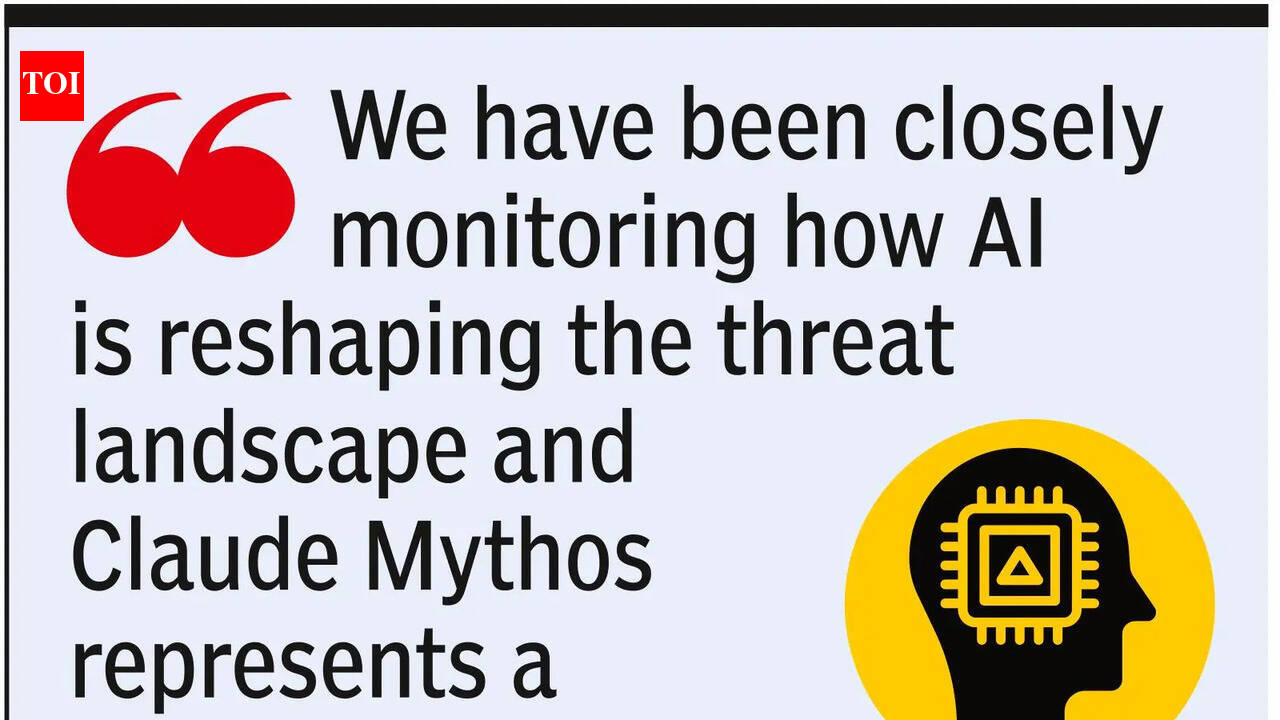
New Delhi: A powerful new AI model is forcing govts, banks, and technology firms to rethink the rules of cybersecurity – and in India, the stakes may be even higher.Claude Mythos, developed by Anthropic, has demonstrated the ability to autonomously detect and exploit software vulnerabilities, including flaws that have persisted for decades. Early tests revealed that the model could identify long-standing weaknesses and simulate complex, multi-step cyberattacks, prompting the company to restrict its wider release. Anthropic CEO Dario Amodei highlighted the shift, noting that AI systems are now capable of finding vulnerabilities “that humans have missed”, a signal of how quickly the cybersecurity landscape is changing.US Treasury Secretary Scott Bessent reportedly convened a meeting with top bank executives – including leaders from JPMorgan Chase, Goldman Sachs, Citigroup, BoA, and Morgan Stanley – to assess the risks posed by such advanced AI systems.That concern is not theoretical. According to Jaydeep Singh, GM for India at Kaspersky, the emergence of such systems represents a turning point not just for security professionals, but for everyday users. “We have been closely monitoring how AI is reshaping the threat landscape, and Claude Mythos represents a moment that every user, not just the cybersecurity industry, needs to understand,” Singh said.The dual-use nature of AI is at the heart of the concern. The same capability that strengthens defences can just as easily be weaponised. “The same capability that finds a 27-year-old vulnerability in hardened infrastructure is the capability that, in the wrong hands, turns every unpatched system into an open door,” Singh added.Cybersecurity firm Check Point Software Technologies echoed the warning. Sundar Balasubramanian, MD, India and South Asia, for Check Point, says, AI is “dramatically lowering the barrier to entry for cyber attackers,” enabling even less-skilled actors to identify and exploit vulnerabilities. He added that defensive tools can be repurposed offensively, compressing the traditional gap between attackers and defenders. Jayant Saran, partner, Deloitte India, described this as a “changed reality,” where organisations must prepare for risks that were previously invisible. He called AI a “double-edged sword…that cannot be reversed,” highlighting an accelerating race between those securing systems and those attempting to break them.In India, the risks are amplified by scale. From UPI to banking and govt platforms, millions depend on digital infrastructure – much of it built on legacy systems. These systems are often slower to patch, harder to monitor, and lack continuous threat intelligence, creating what Saran called an “asymmetric risk exposure.” Singh pointed out that this gap is especially critical in India, where legacy infrastructure serves hundreds of millions.Beyond cybersecurity, ripple effects could reach financial markets. Analysts say models like Mythos could automate parts of software development, testing, and security – core functions of IT services industry. While disruption may be gradual, labour-intensive outsourcing models could face pressure, while firms embracing AI may benefit.

Firms say digital twins make staff more productive, but are they a potential legal minefield?
Source link

Finance ministers and top bankers raise serious concerns about Mythos AI model
Anthropic’s new AI model exposes fresh risks, flaws for cybersecurity, IT services – The Times of India

Mike Trout crushes fifth Yankee Stadium HR in four games

-

 Entertainment1 week ago
Queen Elizabeth II emotional message for Archie, Lilibet sparks speculation
-

 Tech1 week ago
Azure customers up in arms over ‘full’ UK South region | Computer Weekly
-

 Tech1 week ago
As the Strait of Hormuz Reopens, Global Shipping Will Take Months to Recover
-

 Fashion1 week ago
CII submits 20-pt agenda to Indian govt to back firms hit by Iran war
-

 Tech1 week ago
This AI Button Wearable From Ex-Apple Engineers Looks Like an iPod Shuffle
-

 Politics7 days ago
Indian airlines hit hardest after Dubai limits foreign flights until May 31
-

 Entertainment4 days ago
Palace left in shock as Prince William cancels grand ceremony
-
Uncategorized1 week ago
[CinePlex360] Please moderate: “Trump considers