

Politics
Trump lands in China for Xi summit as Tehran-Washington ceasefire teeters

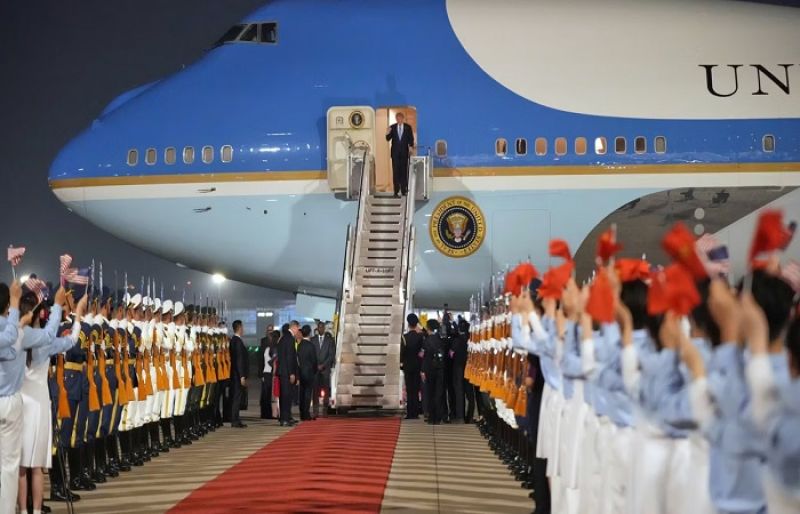
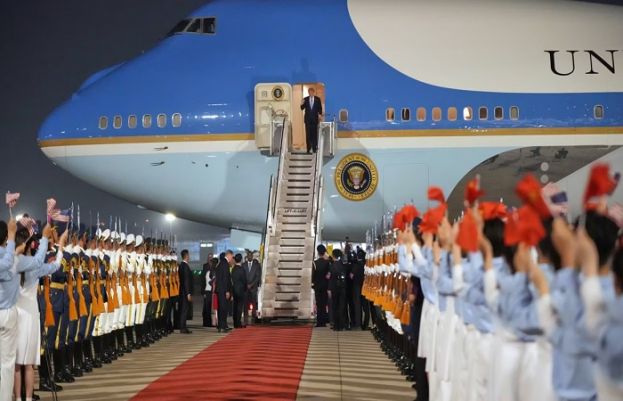
President Donald Trump landed in Beijing accompanied by an entourage that included Nvidia’s Jensen Huang and Elon Musk on Wednesday after pledging to urge China’s Xi Jinping to “open up” to US business at the start of their two-day summit.
Trump embarks on the first visit by a US president to China in nearly a decade eager to snag some deals, maintain a fragile trade truce with the world’s second economy, and prop up public approval ratings bruised by his war with Iran.
The CEOs accompanying Trump are drawn mainly from companies seeking to resolve business issues with China, such as Nvidia, which has struggled to get regulatory permission to sell its powerful H200 artificial intelligence chips there.
Trump asked Huang at the last minute to join the trip, said a source familiar with the matter who spoke on condition of anonymity, and he was spotted boarding Air Force One during a refuelling stop in Alaska en route to Beijing.
“I will be asking President Xi, a Leader of extraordinary distinction, to ‘open up’ China so that these brilliant people can work their magic,” he said in post on Truth Social, referring to the CEO delegation.
“I will make that my very first request.”
Asked about Trump’s post, Guo Jiakun, a spokesperson for China’s foreign ministry, said Beijing stands ready to “expand cooperation, manage differences and inject more stability and certainty into the turbulent world”.
As Trump prepared for the pomp-filled occasion, his trade negotiator Scott Bessent wrapped up three hours of preparatory talks with Chinese officials in South Korea. China’s official Xinhua news agency described them as “candid, in-depth and constructive”, but officials did not offer any detailed summary.
Trump’s two days of meetings will include a grand reception at The Great Hall of the People, a tour of Unesco heritage site Temple of Heaven and a state banquet.
Apart from trade, the talks will cover a host of sensitive subjects from the Iran war to US arms sales to Taiwan.
Trump is widely expected to encourage China to convince Tehran to make a deal with Washington to end the conflict, though he has said he did not think he would need its help.
China reiterated on Wednesday its strong opposition to US arms sales to Taiwan, with the status of a $14-billion package awaiting Trump’s approval still unclear.
Bessent preps in South Korea
While Trump rubbed shoulders with executives aboard Air Force One, Bessent held his latest round of trade negotiations with Chinese Vice Premier He Lifeng at a VIP reception room at South Korea’s Incheon airport.
The talks ran about three hours to end just before 4 p.m. (0700 GMT), a U.S. official said.
The two sides are eager to maintain a truce struck last October in which Trump suspended triple-digit tariffs on Chinese goods and Xi backed away from choking global supplies of rare earths, vital in making items from electric cars to weapons.
They are also expected to discuss forums to support mutual trade and investment and dialogue on AI issues, while Washington looks to sell Boeing BA.N airplanes, farm goods and energy to China to cut a trade deficit that has long irked Trump, U.S. officials have said.
Beijing, for its part, wants the U.S. to ease curbs on exports of chipmaking equipment and advanced semiconductors.
Trump enters the talks with a weakened hand.
Courts have hemmed in his ability to levy tariffs at will on exports from China and other countries.
The Iran war has also boosted inflation at home and escalated the risk that Trump’s Republican Party will lose control of one or both legislative branches in November’s midterm elections.
Though the Chinese economy has faltered, Xi does not face comparable economic or political pressure.
“The Trump administration needs this meeting more than China does, as it needs to show to American voters that deals are signed, money is made,” said Liu Qian, founder and CEO of Wusawa Advisory, a Beijing-based geopolitical advisory firm.
While Trump has lauded his personal rapport with Xi and respect for China, several Beijing residents told Reuters they viewed his visit with a mixture of hope and suspicion.
“I don’t know if he’s genuinely sincere,” Lou Huilian, a 44-year-old who works in the oil trade said outside a metro station as she headed to work on Wednesday.
“But speaking as a Chinese person, and as someone working in trade, I just hope some good policies can come out of this.”
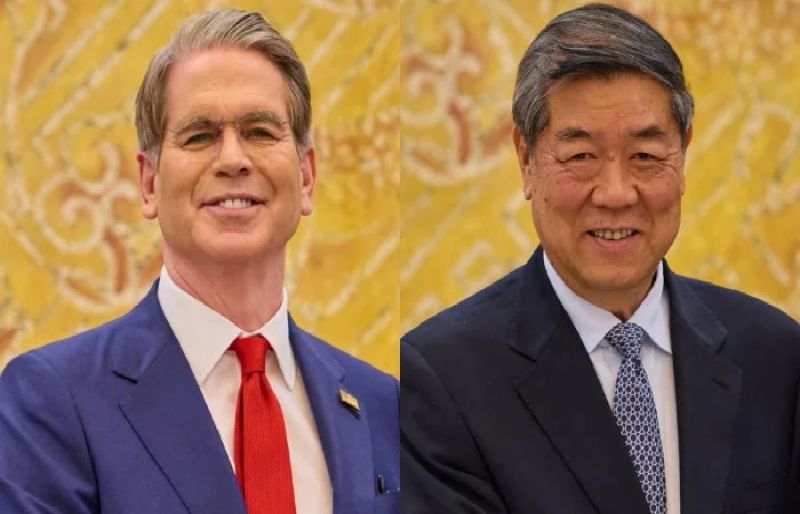
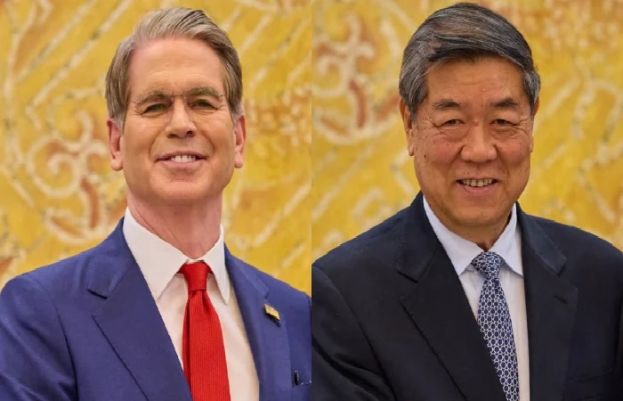
US Treasury Secretary Scott Bessent and Chinese Vice Premier He Lifeng started talks in South Korea on Wednesday to lay the groundwork ahead of this week’s summit of the leaders of the world’s two biggest economies in Beijing.
Bessent and He began the talks at Incheon airport after each met South Korean President Lee Jae Myung at the presidential Blue House, Reuters witnesses said.
The discussions are expected to cover a range of issues to prepare for talks in Beijing between US President Donald Trump and Chinese President Xi Jinping that are set to run from Thursday to Friday.
The talks between Bessent and He were likely to be exploratory with limited immediate outcomes, said Kim Tae-hwang, a professor of international trade at Myongji University in Seoul.
“Both sides are essentially in a holding pattern ahead of the summit, sounding each other out, rather than seeking breakthroughs,” he said.
China’s lead trade negotiator, Vice Commerce Minister Li Chenggang, and Vice Finance Minister Liao Min were among the officials accompanying He.
At the Beijing summit, the leaders are expected to agree to set up forums to ease mutual trade and investment, while China is expected to announce purchases related to Boeing aeroplanes, American agriculture and energy, US officials have said.
Beijing also wants the United States to relax curbs on exports of advanced semiconductors, and has raised concerns about a bill to keep critical chip-making equipment from China.
They are considering extending a truce on China’s export curbs on rare earths at the summit, but Chinese customs data shows Beijing is still throttling shipments of the materials vital for defence and manufacturing.
The summit talks may also encompass the Iran war, as China, which maintains ties with Iran, is a major buyer of its oil.
Trump said on Tuesday, however, he did not think he would need China’s help to end the conflict, even as hopes for a lasting peace deal dwindled and Tehran tightened its grip over the Strait of Hormuz.
Neither side has strong incentives to make early concessions, however, said Kim, the academic, adding that the United States is unlikely to ease curbs on key technologies such as semiconductors.
China, in turn, buoyed by relatively resilient growth and trade performance, is under less pressure to offer significant compromises, he said.
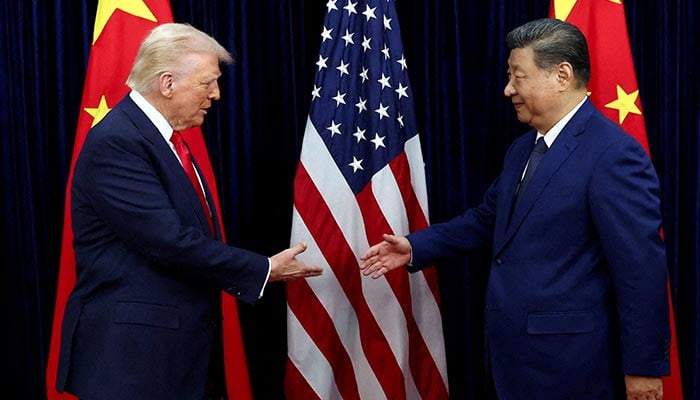
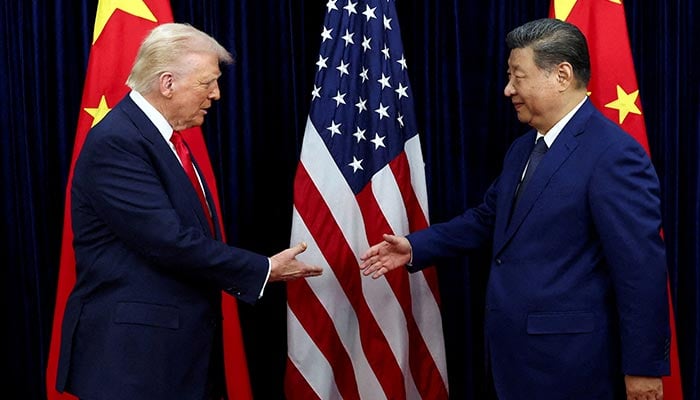
- Trump’s visit will be first by US president in nearly a decade.
- Trump says expects “long talk” with Xi about Iran.
- US, China set to discuss extending one-year truce in tariff war.
US President Donald Trump said he would ask Xi Jinping to “open up” China to American firms as he headed to Beijing on Wednesday for a high-stakes summit that will also bring up the Iran war.
In a sign of Trump’s focus on business, Nvidia chief Jensen Huang boarded Air Force One during a stopover in Alaska, with Tesla’s Elon Musk also travelling on the presidential plane to China.
“I will be asking President Xi, a Leader of extraordinary distinction, to ‘open up’ China so that these brilliant people can work their magic, and help bring the People’s Republic to an even higher level!” Trump wrote on social media after departing Washington.
A host of other top CEOs, including Apple’s Tim Cook, will also be in Beijing for the visit, the first by a US president to China in nearly a decade.
But Trump’s ambitions to ramp up trade will have to contend with political frictions over Taiwan and the war in the Middle East, which already delayed the trip from March.
As he departed the White House, Trump said he expected a “long talk” with Xi about Iran, which sells most of its US-sanctioned oil to China.
But he also downplayed disagreements, telling reporters that “I don’t think we need any help with Iran” from China and that Xi had been “relatively good” on the topic.
Yet Beijing is growing impatient for peace, with China’s foreign minister urging his Pakistani counterpart on Tuesday to step up mediation efforts between Iran and the United States.
‘Big deal’
This week’s trip — the first since Trump visited Beijing in 2017 — will involve highly anticipated talks with Xi on Thursday and Friday, as well as lavish pomp and ceremony.
The packed itinerary includes a state banquet in Beijing’s Great Hall of the People and a tea reception.
Trump said Monday he would speak to Xi about US arms sales to Taiwan, the self-governing democracy claimed by China — a departure from historic US insistence that it will not consult Beijing on its support to the island.
China’s controls on rare earth exports, AI rivalry and the countries’ raucous trade relationship are also among the topics expected to be taken up by the heads of the world’s top two economies.
The two sides are set to discuss extending a one-year truce in their tariff war, which Trump and Xi reached during their last meeting in South Korea in October.
The tense buildup to the superpower summit was already visible on the streets of Beijing, with police monitoring major intersections and checking the ID cards of passengers on the metro, AFP journalists saw.
“It’s definitely a big deal,” said Wen Wen, a 24-year-old woman travelling from the eastern city of Nanjing, when asked by AFP about Trump’s visit.
“Some progress will certainly be made,” she said, noting that she hopes China and the United States can ensure “lasting peace” despite “recent instability in the global situation”.
‘Very good relationship’
The United States and China have long sought to stabilise their relationship despite increasingly seeing each other as adversaries in trade and geopolitics.
Trump has repeatedly touted a strong personal relationship with Xi, which he insisted on Monday would prevent a Chinese invasion of Taiwan, the self-ruled island claimed by Beijing.
“I think we’ll be fine. I have a very good relationship with President Xi. He knows I don’t want that to happen,” he said.
Trump’s trip will be closely scrutinised by Taiwan and Asian allies for any sign of weakening US support.
Beijing has grown more confident and assertive since Trump’s 2017 trip and the US president finds himself in a weakened position as he seeks a way out of his Iran war.
But the summit also comes at an uncertain time for China’s economy, which has struggled in recent years with sluggish domestic spending and a protracted debt crisis in the once-booming property sector.
Politics
US-Iran deal: Trump reaffirms Iran must not have nuclear weapons, praises Shehbaz, Munir for diplomacy
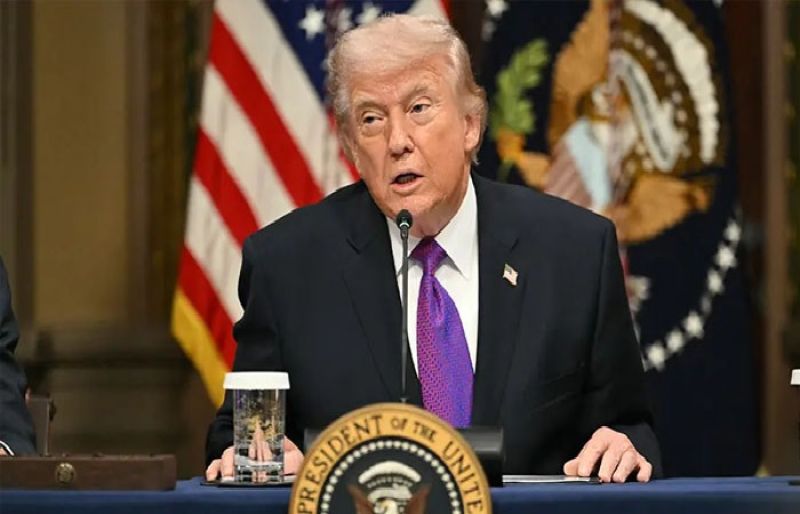
President Donald Trump said on Tuesday that the United States will not allow Iran to obtain a nuclear weapon, while praising Prime Minister Shehbaz Sharif and Field Marshal Asim Munir as “incredible people” amid progress in US-Iran peace talks.
President Trump earlier in the day said that the Iran issue is “not urgent,” urging patience and caution in ongoing negotiations during a telephonic interview with American media.
He said there was no need to rush into decisions or diplomatic steps, stressing that Washington should take its time in dealing with the matter.
Trump also said the US has imposed restrictions aimed at cutting off Iran’s access to funds, adding that Tehran must not be allowed to possess nuclear weapons, which he warned it could potentially use.
When asked whether Iran could be prevented from enriching uranium, Trump responded: “100 per cent, they are going to stop.”
He further claimed that Iran would have to deal with nuclear contamination at damaged facilities, saying their infrastructure had been destroyed by US Tomahawk missiles. He added that Iran lacks the capability to carry out such cleanup operations, suggesting that only China and the United States have the necessary expertise and equipment.


US Treasury’s Bessent, China’s He hold talks in South Korea ahead of Trump-Xi summit

Italy’s Zegna Group’s Q1 growth boosted by strong organic performance

Action film "Top Gun" celebrates 40th anniversary

-
 Tech1 week ago
DHS Demanded Google Surrender Data on Canadian’s Activity, Location Over Anti-ICE Posts
-

 Tech5 days ago
A new frontier: Identity stack evolves for agentic systems | Computer Weekly
-

 Tech5 days ago
‘Orbs,’ ‘Saucers,’ and ‘Flashes’ on the Moon: Pentagon Drops New UFO Files
-
 Tech6 days ago
What Microsoft Executives Really Thought About OpenAI in 2018
-

 Sports5 days ago
Shaheen Afridi achieves landmark feat during opening Test against Bangladesh
-
 Business1 week ago
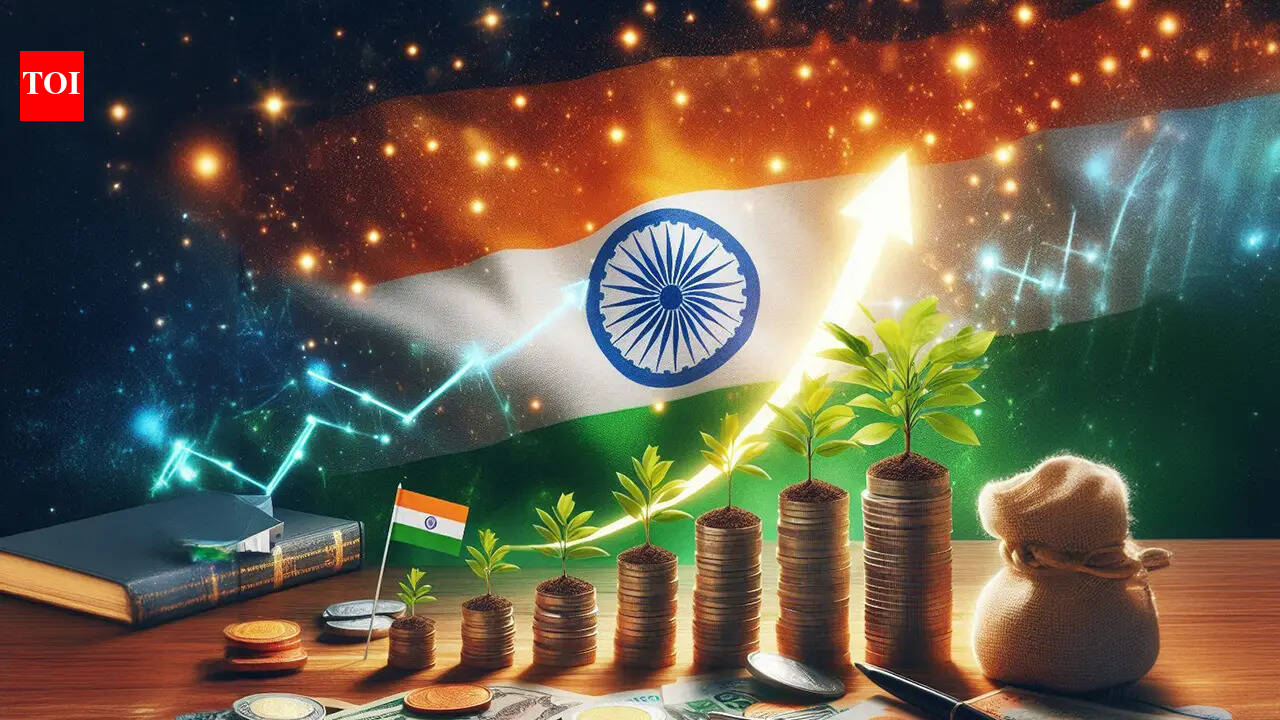
India among most resilient large EMs, better placed for future global shocks; policy reforms & strong buffers help: Moody’s – The Times of India
-
 Tech5 days ago
Nick Bostrom Has a Plan for Humanity’s ‘Big Retirement’
-

 Fashion5 days ago
New orders in German manufacturing up 5% MoM in Mar 2026: Destatis