

Politics
Trump puts off threat to bomb Iran power grid, Iranian agency denies report of talks

- Israel launches new wave of attacks on Tehran.
- Iran vows to strike Gulf infrastructure if US attacks power grid.
- Tehran says strait open to all but “enemies”.
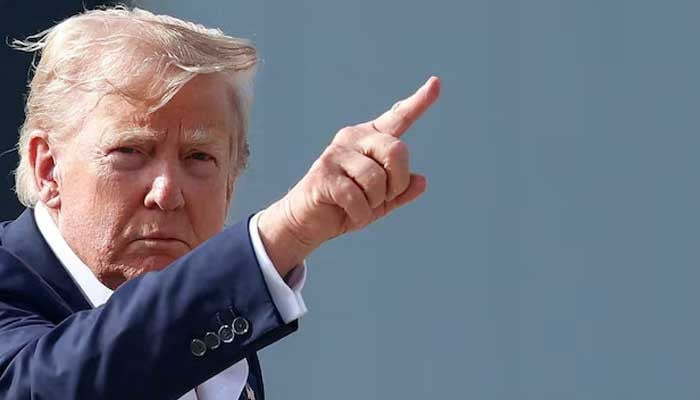
TEL AVIV/JERUSALEM/WASHINGTON: US President Donald Trump said on Monday he had given orders to postpone any military strikes against Iranian power plants for five days, hours ahead of a deadline that threatened further escalation in the conflict now in its fourth week.
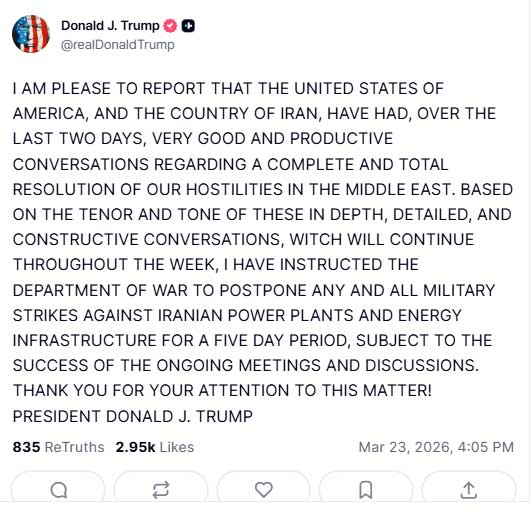
Trump said in a post on his Truth Social platform that the US and Iran had had “VERY GOOD AND PRODUCTIVE” conversations over the past two days about a “COMPLETE AND TOTAL RESOLUTION OF HOSTILITIES IN THE MIDDLE EAST”.
In his message, written entirely in capital letters, he said he had instructed the defense department to postpone the strikes pending the outcome of the talks.
However, Iran’s Fars news agency said after Trump’s post that there was no direct communication with the US or through intermediaries.
Citing an unnamed source, Fars said Trump had retreated after hearing that Iran would respond by attacking all power plants in the region.
A source briefed on Israel’s war plans said Washington had kept it informed of its talks with Tehran, and that Israel was likely to follow Washington in suspending any targeting of Iranian power plants and energy infrastructure.
The prime minister’s office did not immediately respond to a request for comment on US talks with Iran or Washington’s decision to hold off on striking some Iranian targets.
Oil drops, stocks recover on Trump comments
Trump’s comments briefly sent the price of the Brent crude oil benchmark LCOc1 down around 13% to back below $100 a barrel. By 1155 GMT, however, it was back around $105.
Global markets also recovered sharply, with US stock futures reversing losses to gain more than 2%.
On Saturday, Trump had warned that Iranian power plants would be destroyed if Tehran failed to “fully open” the Strait of Hormuz to all shipping within 48 hours. Trump set a deadline of around 7:44pm EDT (2344 GMT) on Monday.
Iran’s Revolutionary Guards on Monday threatened retaliation, saying they would attack Israel’s power plants and those supplying US bases across the Gulf region if Trump followed through with his threat.
More than 2,000 people have been killed in the war the US and Israel launched on February 28, which has upended markets, driven up fuel costs, accelerated global inflation fears and convulsed the Western defence alliance.
However, the threat of strikes on Gulf electricity grids raised fears of mass disruption to desalination for drinking water, and further rattled oil markets.
While attacks on electricity could hurt Iran, they could be catastrophic for its Gulf neighbours, which consume around five times as much power per capita.
Electricity makes their gleaming desert cities habitable, in part by powering the desalination plants that produce 100% of the water consumed in Bahrain and Qatar. Such plants use seawater to meet more than 80% of drinking water needs in the United Arab Emirates, and 50% of the water supply in Saudi Arabia.
Iran has effectively closed the key Strait of Hormuz, through which about a fifth of global oil and liquefied natural gas flows.
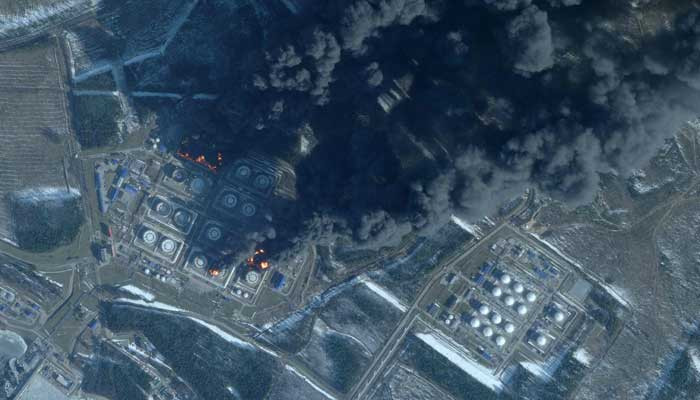
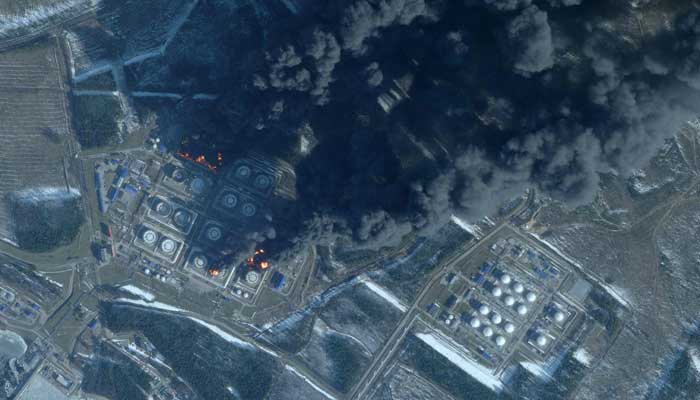
MOSCOW: Ukraine fired drones at a key Russian oil port near the Finnish border on Monday, both Moscow and Kyiv said, triggering a huge fire at the facility.
Satellite images showed flames and thick plumes of black smoke rising into the air from the oil terminal in the Russian town of Primorsk, which sits on the Gulf of Finland and is about 50 kilometres (30 miles) from the EU and NATO member.
Russia has been pummelling Ukraine with near-daily air strikes, repeatedly hitting its energy infrastructure and triggering blackouts that plunged millions into cold and darkness during the winter months.
Ukraine has retaliated by launching drone attacks at Russia, mainly at Moscow’s energy and military facilities.
“A fuel tank was damaged in the port of Primorsk, causing a fire,” said Alexander Drozdenko, governor of Russia’s western Leningrad region.
Drozdenko said Russian air defence systems had destroyed more than 70 drones over the region, which has not been a main front in Russia’s war with Ukraine.
The General Staff of the Armed Forces of Ukraine said it had “struck key fuel and energy infrastructure facilities in the Russian Federation”, including at Primorsk.
“According to preliminary information, both the tank farm and the oil loading infrastructure were hit,” the General Staff said on social media on Monday.
The satellite images appeared to show fires and smoke rising from several cylindrical fuel tanks at the site.
Ukraine said Primorsk handles approximately 60 million tonnes of oil per year.
“The aggressor country uses the proceeds from oil sales to continue the war against Ukraine,” it added.
The General Staff also claimed a hit on an oil refinery in the central Russian city of Ufa, around 1,400 kilometres (870 miles) from the front line.
It said the strike caused “a fire on the facility’s grounds”.
Ukraine’s air force said on Monday that Moscow fired 251 drones at Ukraine overnight, 234 of which were shot down.
Politics
Pilot, co-pilot killed after passenger jet hits ground fire truck at New York’s LaGuardia airport

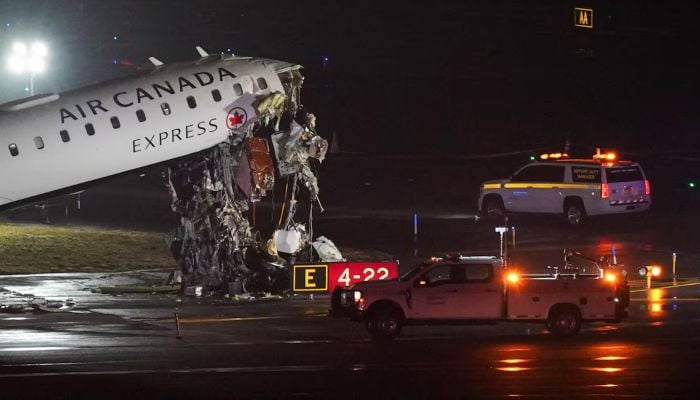
- NBC reports both pilots killed.
- LaGuardia airport closed until 2pm ET on Monday, FAA says.
- Photos taken after accident show damage to plane’s nose.
NEW YORK: The pilot and co-pilot of an Air Canada Express regional jet were killed after it collided with a fire truck while landing at New York’s LaGuardia airport late on Sunday, in an incident that closed the airport, authorities and US media said.
NBC News, which reported the deaths, said dozens others were injured in the incident.
The news channel said that the fire truck was manned by police officers, citing sources. It had earlier said a sergeant and an officer had broken limbs and were in stable condition at a hospital.
The Air Canada Express CRJ-900 plane, operated by its partner Jazz Aviation, was carrying 72 passengers and four crew members from Montreal, based on a preliminary passenger list that remained subject to confirmation. Jazz is owned by Chorus Aviation.
The aircraft struck the fire vehicle at a speed of about 24 miles per hour (39 kph), said flight tracking website Flightradar24, which last recorded data at 11:37pm ET (0337 GMT).
Photos taken by Reuters after the accident showed visible damage to the nose of the plane, which was tilted upward.
Authorities and emergency agencies did not offer any immediate comments on deaths or injuries.
The US Federal Aviation Administration (FAA) said the airport was expected to remain shut until 2pm ET on Monday (1800 GMT). Flightradar24 said 18 flights had been diverted to other airports, mostly in the New York area, or returned to their point of origin.
Air Canada referred Reuters to Jazz’s statement and said it was aware of the incident. The National Transportation Safety Board and the FAA did not immediately respond to requests for comment.
The Port Authority of New York and New Jersey said the firefighting vehicle was responding to a separate incident when it was struck by the aircraft at the airport’s Runway 4.
New York City’s emergency notification system said people could expect cancellations, road closures, traffic delays and emergency personnel near the airport.
LaGuardia served over 30 million annual passengers in 2025, according to the Port Authority of New York and New Jersey, and a wide range of US airlines operate at the airport.
- SPA unanimously re-elects Kim.
- 687 deputies elected to new SPA term.
- 99.93% backing for deputies, 0.07% against.
SEOUL: North Korea’s legislature has re-elected Kim Jong Un as president of state affairs, state media reported on Monday.
Kim’s reappointment as head of the nation’s highest policymaking and governing body, the State Affairs Commission, was announced by the state news agency KCNA.
Critics argue that elections in North Korea are pre-determined and designed to give the country’s leadership a veneer of democratic legitimacy.
“The Supreme People’s Assembly of the DPRK reelected Comrade Kim Jong Un as President of the State Affairs of the Democratic People’s Republic of Korea at the First Session, the first state affairs activity of its 15th term, on March 22,” KCNA reported.
The report said the decision to re-elect Kim to the “top post” reflected “the unanimous will and desire of all the Korean people”.
Kim is the third-generation ruler of the nuclear-armed state founded by his grandfather Kim Il Sung in 1948. He has ruled the country since his father’s death in 2011.
The election is a “highly choreographed event with a pre-determined outcome”, said Lee Ho-ryung of the Korea Institute for Defence Analyses.
“Throughout the third-generation rule, the North has staged such events to showcase a procedure in an attempt to achieve political legitimacy,” she said.
“But no one thinks any different outcome would emerge from it.”
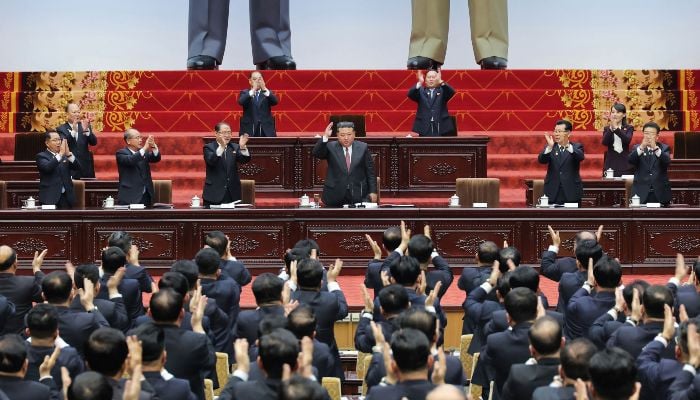
Photos released by KCNA show Kim dressed in a formal western suit and seated at the centre of a stage, flanked by top officials in front of two giant statues of his father Kim Jong Il and grandfather.
Barometer
Prior to the event, 687 deputies were elected to the SPA, with North Koreans over 17 given the choice of approving or rejecting the sole candidate put forward by the ruling party.
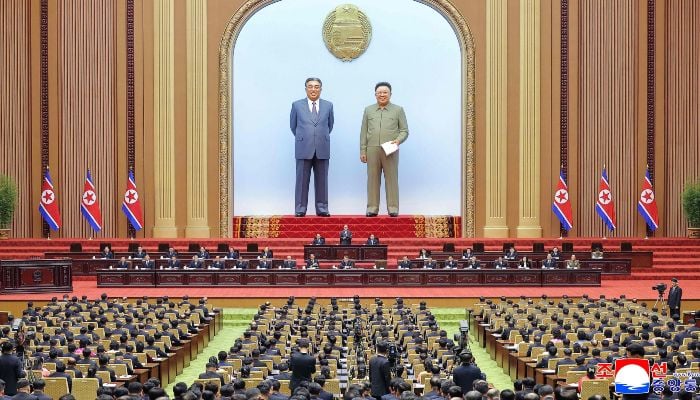
The new deputies were duly approved with 99.93% of votes in favour and 0.07% against, KCNA reported earlier, with turnout at 99.99%.
The Pyongyang assembly hall was “full of the extraordinary political awareness and revolutionary enthusiasm” by the newly elected members, it said.
Analysts say the current assembly session may also take up possible constitutional amendments that could include formally codifying inter-Korean relations as those between “two hostile states”.
The language Kim uses to describe his stance towards South Korea in his assembly speech will be a “barometer” of his inter-Korea plans, Hong Min, a senior analyst at the Korea Institute for National Unification, told AFP.
“The extent to which terms such as ‘national unification’ or ‘Korean unity’ are removed and replaced by aggressive expressions including ‘territorial control’ could serve as a barometer of his ideological framework,” he said.
The key point lies in how far he will “flesh out issues of territory, territorial waters and airspace” in dealing with Seoul, he added.
The gathering follows a five-yearly meeting of the ruling party last month.


Zinedine Zidane reaches verbal agreement to take France job – sources
A Mysterious Numbers Station Is Broadcasting Through the Iran War

Meghan Markle’s Aussie visit could be a soft launch for ‘As Ever’

-
 Entertainment1 week ago
Iran at war
-

 Sports1 week ago
Japan suffers shocking collapse to Venezuela in World Baseball Classic
-
 Entertainment1 week ago
Strategic oil stocks to be released ‘immediately’ in Asia and Oceania: IEA
-

 Sports1 week ago
Transfer rumors, news: Real Madrid open to Camavinga exit, as Premier League clubs circle
-
 Business1 week ago
‘Gruesome’ war bets fuel calls for Kalshi Polymarket crackdown
-
 Business1 week ago
New Income Tax Act 2025 To Take Effect From April 1: 10 Key Changes That Will Affect Your Money
-

 Sports1 week ago
PCB files complaint over allowing Bangladesh to take review on penultimate ball – SUCH TV
-
 Business6 days ago
Stocks and pound rise as US rate call approaches