

Business
Trump says Venezuela will be ‘turning over’ up to 50m barrels of oil to US

Kayla Epsteinand
Osmond Chia
 Getty Images
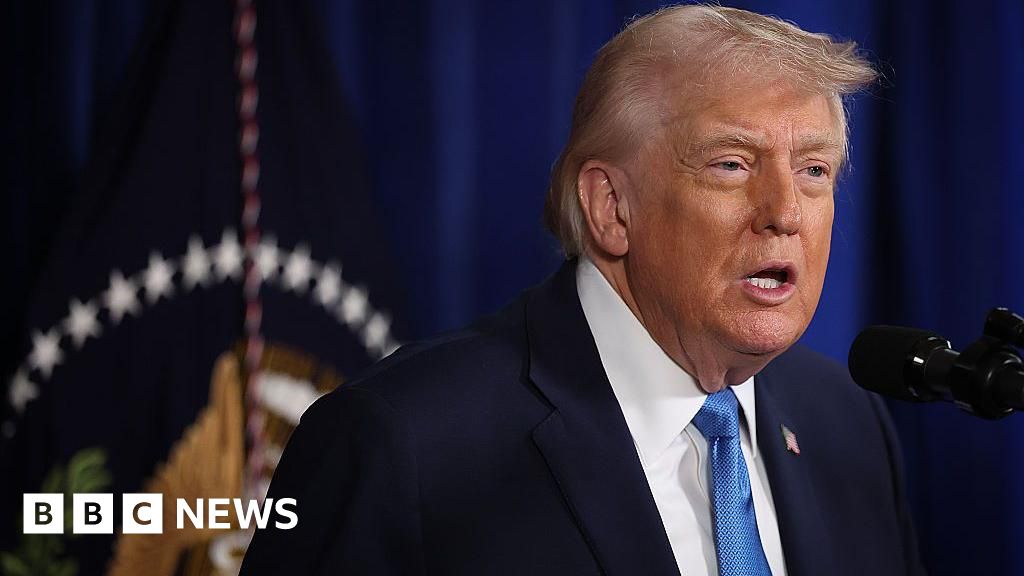
US President Donald Trump has said Venezuela “will be turning over” up to 50m barrels of oil to the US, after a surprise military operation that removed President Nicolás Maduro from power.
The oil will be sold at its market price, Trump posted on social media, adding that the money would be controlled by himself and used to benefit the people of Venezuela and the US.
His comments come after he said the US oil industry would be “up and running” in Venezuela within 18 months and that he expected huge investments to pour into the country.
Analysts previously told the BBC it could take tens of billions of dollars, and potentially a decade, to restore Venezuela’s former output.
Trump posted on Truth Social on Tuesday: “I am pleased to announce that the Interim Authorities in Venezuela will be turning over between 30 and 50 MILLION Barrels of High Quality, Sanctioned Oil, to the United States of America.
“This Oil will be sold at its Market Price, and that money will be controlled by me, as President of the United States of America, to ensure it is used to benefit the people of Venezuela and the United States!”
His comment came a day after Delcy Rodríguez, formerly Venezuela’s vice-president, was sworn in as its interim president. Maduro has been brought to the US to face drug-trafficking and weapons charges.
On Monday the US president told NBC News: “Having a Venezuela that’s an oil producer is good for the United States because it keeps the price of oil down.”
Representatives from major US petroleum companies planned to meet the Trump administration this week, the BBC’s US partner CBS reported.
Analysts who previously spoke to the BBC were sceptical that Trump’s plans would have a major impact on the global supply – and therefore price – of oil.
They suggested that firms would look for reassurance that a stable government was in place, and even when they did invest, their projects would not deliver for years.
Trump has argued in recent days that American oil companies can fix Venezuela’s oil infrastructure.
The country has an estimated 303bn barrels – the world’s largest proven reserve – but its oil production has been in decline since the early 2000s.
The Trump administration sees significant potential for its own energy prospects in Venezuela’s reserves.
Increasing the country’s production of oil would be expensive for US firms.
Venezuelan oil is also heavy and more difficult to refine. There is only one US firm, Chevron, currently operating in the country.
Asked for comment about Trump’s plans for US oil production in Venezuela, Chevron spokesman Bill Turenne said the company “remains focused on the safety and wellbeing of our employees, as well as the integrity of our assets”.
“We continue to operate in full compliance with all relevant laws and regulations,” Turenne added.
ConocoPhillips, a major US oil company that no longer has a presence in Venezuela, “is monitoring developments in Venezuela and their potential implications for global energy supply and stability”, said spokesman Dennis Nuss.
“It would be premature to speculate on any future business activities or investments,” Nuss said.
A third company, Exxon, did not immediately respond to requests for comment.
While justifying the seizure of Maduro from Caracas, Trump also claimed that Venezuela “unilaterally seized and stole American oil”.
Vice-President JD Vance echoed those claims on X after Maduro was taken, writing that “Venezuela expropriated American oil property and until recently used that stolen property to get rich and fund their narcoterrorist activities”.
The reality is more complex.
US oil companies have a long history in Venezuela, extracting oil under licence agreements.
Venezuela nationalised its oil industry in 1976 and in 2007, President Hugo Chavez exerted more state control over the remaining foreign-owned assets of US oil firms operating in the country.
In 2019, a World Bank tribunal ordered Venezuela to pay $8.7 billion to ConocoPhillips in compensation for this 2007 move.
That sum has not been paid by Venezuela, so at least one US oil company has outstanding compensation which is owed to it.
But BBC Verify’s Ben Chu said the claim Venezuela has “stolen” American oil is too simplistic, as experts said the oil itself was never actually owned by anyone except Venezuela.
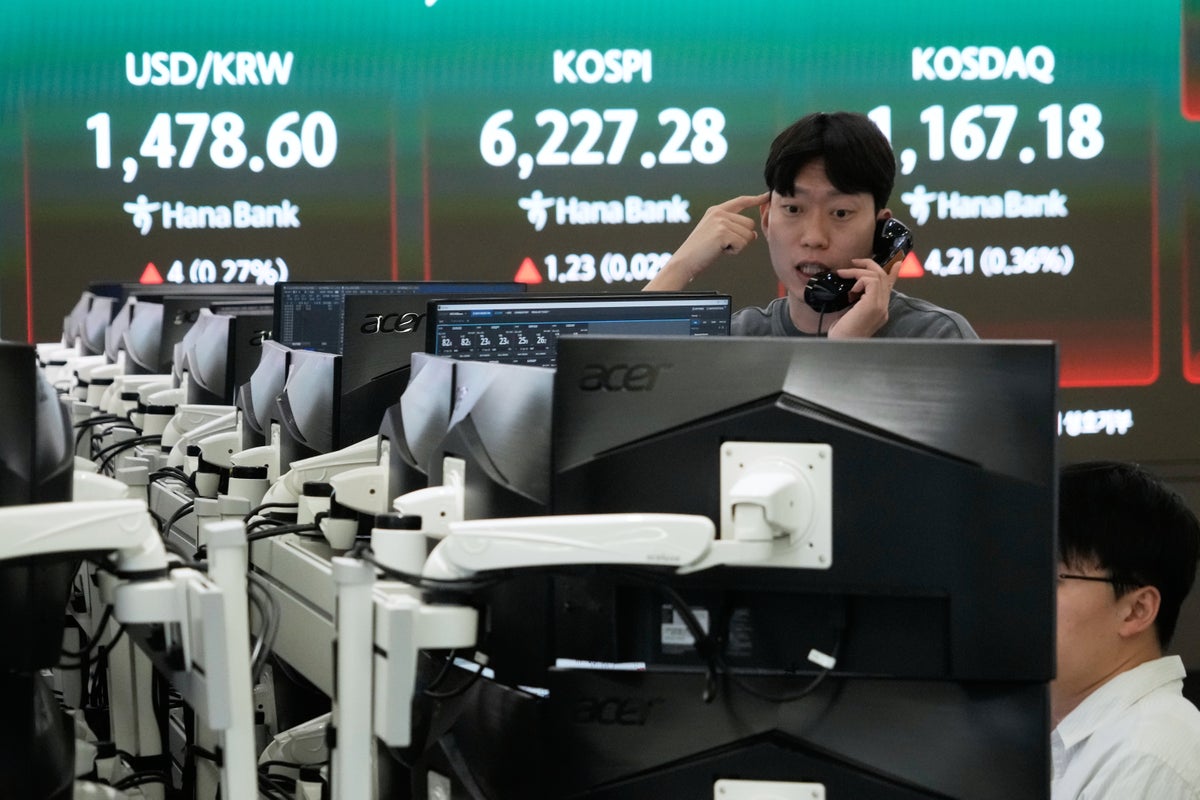
Oil prices remained below $100 a barrel on Friday as Wall Street set another record and Asian stocks headed for a second consecutive week of strong gains, with markets watching for signs that the Iran war ceasefire expiring next week would be extended.
Brent crude fell 1.1 per cent to $98.31 a barrel and US benchmark crude dropped 1.4 per cent to $89.90, after Donald Trump said the next meeting between the US and Iran could take place over the weekend and suggested he was open to extending the two-week ceasefire beyond its expiry next week.
Iran’s UN envoy said Tehran remained “cautiously optimistic” over negotiations with the US. A 10-day ceasefire between Lebanon and Israel also went into effect on Thursday.
Asian markets pulled back on Friday despite Wall Street setting another record the previous session. Tokyo’s Nikkei fell 1 per cent to 58,930 after hitting an all-time high on Thursday. South Korea’s Kospi was 0.6 per cent lower, Hong Kong‘s Hang Seng dropped 1 per cent and the Shanghai Composite edged down 0.1 per cent. Australia’s S&P/ASX 200 lost 0.3 per cent and Taiwan’s Taiex traded 0.5 per cent lower.
MSCI‘s broadest index of Asia-Pacific shares outside Japan remained close to its highest level since 2 March, the first trading day after the Iran war broke out. The index is up 14.5 per cent in April after dropping 13.5 per cent in March, with almost all stock markets now back to pre-war levels.
On Wall Street, the S&P 500 closed 0.3 per cent higher at 7,041 on Thursday, a day after eclipsing its previous all-time high set in January. The Dow Jones Industrial Average rose 0.2 per cent to 48,578 and the Nasdaq added 0.4 per cent to 24,102.
However, the speed of the recovery has surprised some analysts, who warned markets may be underpricing the risks.
“There’s quite a strong contrast between what policymakers and central bankers are saying about the risks that this conflict is creating versus what the market is implying,” Andrew Chorlton, chief investment officer for public fixed income at M&G, told Reuters.
“That seems somewhat complacent. It seems unlikely that there shouldn’t be some additional risk premium priced in, either to growth or to inflation.”
Others pointed to the strait as the critical test for whether the rally could hold.
“I think equity markets are remaining positive and some solid US earnings have helped, but — and it’s a big but — we need to see some concrete evidence that peace is going to last,” Nick Twidale, chief market strategist at ATFX Global, told Reuters.
“A full reopening of the Strait, or we could see some substantial corrections in global stocks in the coming days and weeks.”
The stakes on the energy side are rising. The head of the International Energy Agency warned on Thursday that Europe had “maybe six weeks or so” of jet fuel supplies remaining and that flight cancellations were coming “soon”.
The closure of the Strait of Hormuz has caused the worst oil price shock in history — Brent crude has surged roughly 40 per cent since the start of the Iran war in late February — and prompted the IMF to downgrade its global growth outlook, warning that a prolonged conflict could push the world to the brink of recession.
The US dollar, which had benefited from safe-haven demand in March, has since given up those gains, with the dollar index near its lowest level since 2 March after eight straight sessions of decline. The euro held at $1.1778 while the Australian dollar, considered a risk-sensitive currency, drifted near a four-year high. Gold edged up 0.1 per cent to $4,814.60 an ounce and silver gained 0.4 per cent to $79.04.
Business
Top stocks to buy today: Stock recommendations for April 17, 2026 – check list – The Times of India

Stock market recommendations: Reliance Industries, and Varun Beverages are the top stock recommendations by Bajaj Broking Research for April 17, 2026.Reliance IndustriesBuy in the range of ₹ 1330.00-1350.00
Reliance Industries stock has undergone a corrective phase over the past three months and is currently consolidating near a crucial support zone of ₹1270–₹1300. This technical setup offers a favorable risk-reward profile, positioning the stock for a potential bullish reversal and the next leg of uptrend.This ₹1270–₹1300 range serves as a crucial support area, reinforced by the convergence of multiple technical factors: (a) 61.8% retracement of the previous April 2025-January 2026 up move (1115-1611) (b) 200 weeks EMA placed around 1292, which has historically acted as strong demand area for the stockThe ongoing corrective phase appears to be nearing exhaustion, with price action indicating the potential for a fresh bullish reversal. We anticipate the stock to resume its uptrend and head towards ₹ 1474 levels in the coming quarters being the high of February 2026 and the 61.8% retracement of the recent decline of the last 3 months ₹ 1611-1290.Varun BeveragesBuy in the range of 455-465
The share price of Varun Beverages has generated a breakout above the falling channel containing last 3 months decline signaling strength and offers fresh entry opportunity.The stock has also formed a higher high and higher low signaling resumption of up move after recent corrective decline.We expect the stock to head higher towards 503 levels in the coming weeks being the 80% retracement of the previous decline from 534 to 381.(Disclaimer: Recommendations and views on the stock market, other asset classes or personal finance management tips given by experts are their own. These opinions do not represent the views of The Times of India)
Experts say Mythos potentially has an unprecedented ability to identify and exploit cybersecurity weaknesses.
Source link


Sources: NWSL expected to vote on calendar shift this month

Christina Applegate admitted to hospital amid MS battle: Report
Oil prices fall again amid Middle East ceasefire hopes

-

 Tech1 week ago
Azure customers up in arms over ‘full’ UK South region | Computer Weekly
-
 Tech1 week ago
As the Strait of Hormuz Reopens, Global Shipping Will Take Months to Recover
-

 Tech1 week ago
This AI Button Wearable From Ex-Apple Engineers Looks Like an iPod Shuffle
-
Uncategorized1 week ago
[CinePlex360] Please moderate: “Trump considers
-

 Politics7 days ago
Indian airlines hit hardest after Dubai limits foreign flights until May 31
-

 Entertainment4 days ago
Palace left in shock as Prince William cancels grand ceremony
-

 Politics7 days ago
Chinese, Taiwanese will unite, Xi tells Taiwan opposition leader
-

 Entertainment6 days ago
Dua Lipa hits major career high ahead of wedding with Callum Turner