

Business
Trump will meet with Putin in Alaska — here’s what we know

NEWYou can now listen to Fox News articles!
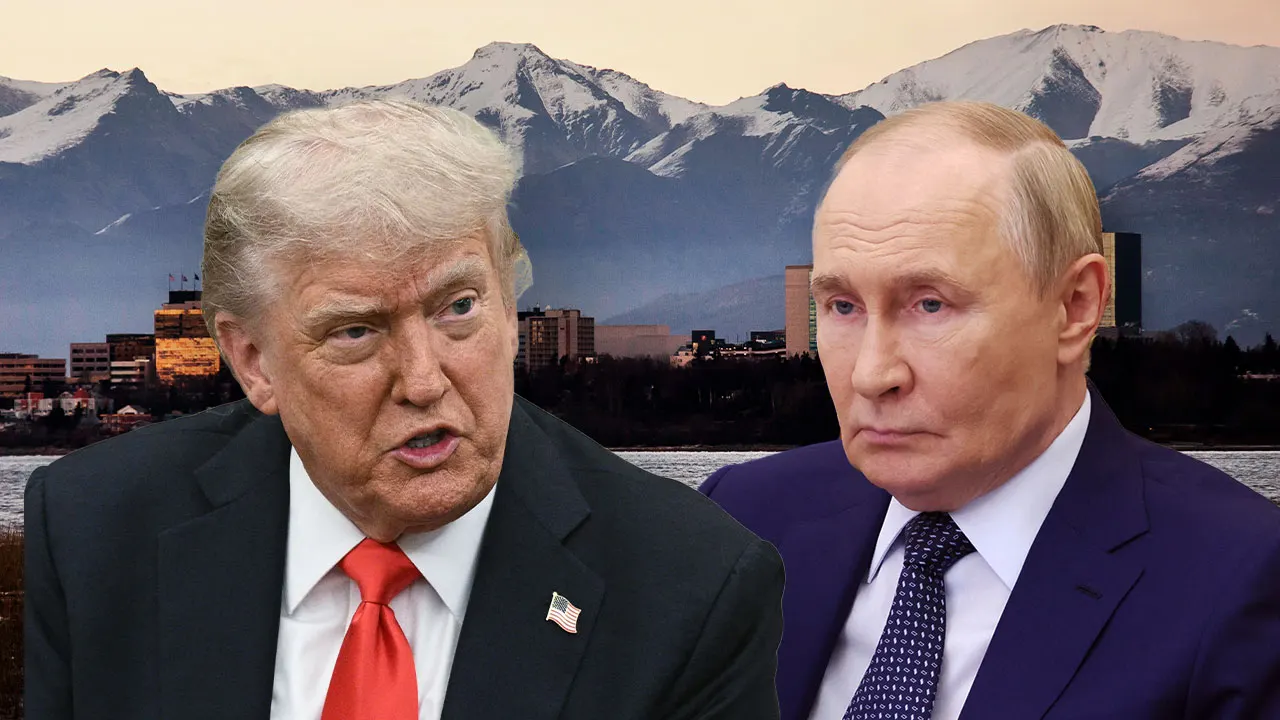
A historic summit is set to be held between President Donald Trump and Russian President Vladimir Putin in Alaska on Friday.
Though specifics on the summit like the time and exact location remain unknown, all eyes will be on the talks as world leaders wait to see what, if anything, can be accomplished in Putin’s first trip to the U.S. in a decade.
Here’s what we know:
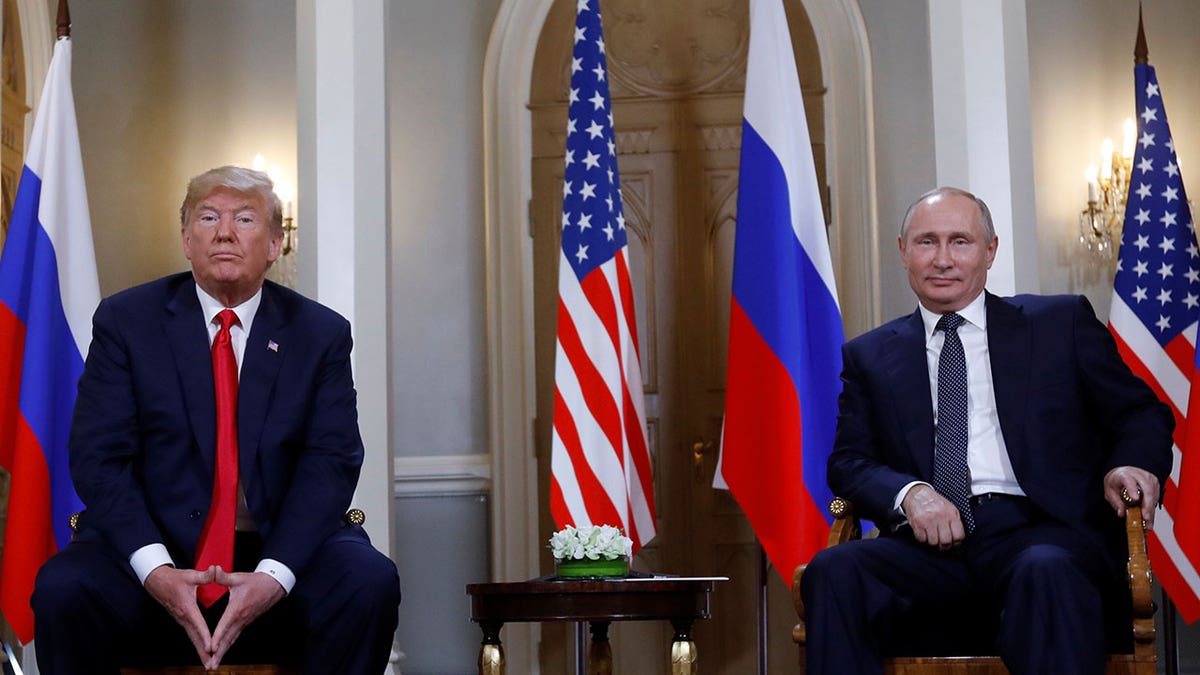
U.S. President Donald Trump meets with Russian President Vladimir Putin in Helsinki, Finland, July 16, 2018. (REUTERS/Kevin Lamarque)
VLADIMIR PUTIN TO RETURN TO US FOR THE FIRST TIME IN A DECADE
AGENDA
White House press secretary Karoline Leavitt confirmed on Tuesday that Trump will travel to Anchorage on Friday morning for what she described as a “listening exercise” with Putin.
Trump, who on Monday described the talks as a “feel-out meeting,” has made clear that his chief agenda item will be to determine whether a ceasefire in Ukraine is even possible.
When pressed by reporters this week as to what he specifically hopes to achieve from the in-person talks with Putin — particularly following seemingly positive calls that only resulted in a “frustrated” Trump and continued Russian bombardment in Ukraine — the president was light on specifics.
Though he told reporters that he thinks he will know whether a ceasefire deal with Putin is even possible within the first “two minutes.”
“I’m not going to make a deal. It’s not up to me to make a deal,” he said. “I think a deal should be made for both [Putin and Ukrainian President Volodymyr Zelenskyy].
“I’d like to see a ceasefire. I’d like to see the best deal that could be made for both parties. You know, it takes two to tango,” he added.
TRUMP GOES AFTER ZELENSKYY OVER ‘LAND SWAPPING’ DISPUTE, LAYS OUT ‘FEEL OUT MEETING’ WITH PUTIN
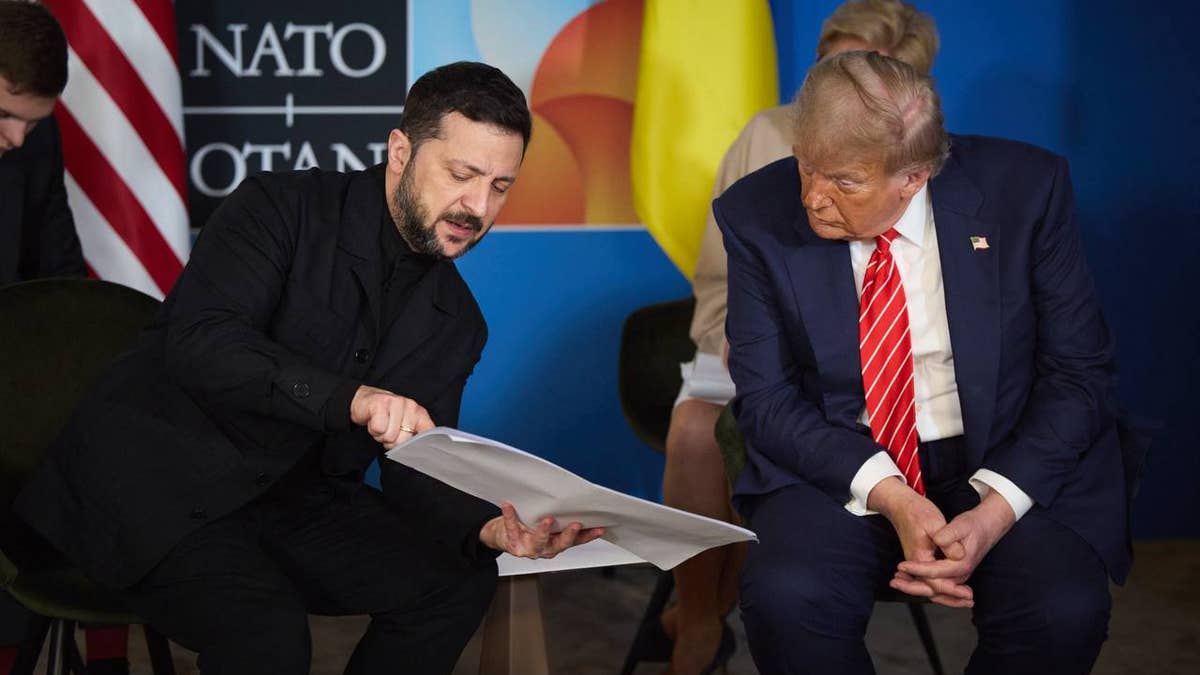
U.S. President Donald Trump and Ukrainian President Volodymyr Zelenskyy meet during the NATO Heads of State and Government Summit in The Hague, Netherlands on June 25, 2025. (Getty Images)
EXPECTATIONS
Trump has raised geopolitical eyebrows over the last week when he suggested there would be a land “swap” that Russia and Ukraine would need to agree to.
While it remains unclear which borders he thinks will likely be moved around, particularly which Russian borders he foresees Putin handing over to Kyiv, Ukrainian President Volodymyr Zelenskyy and his allies in NATO have made clear any deal forged without Ukraine will not be acceptable.
Zelenskyy over the weekend reiterated that he cannot unilaterally agree to cede territory illegally occupied by Russia without a national referendum under Ukraine’s Constitution.
“Any decisions that are without Ukraine are at the same time decisions against peace,” he added. “They will not bring anything. These are dead decisions. They will never work.”
Following a meeting with top EU officials on Monday, chief diplomat for the EU Kaja Kallas told Fox News Digital, “Ukraine’s right to exist as a sovereign nation is under attack, as well as the security of our European continent.”
“As far as Russia has not agreed to full and unconditional ceasefire, we should not even discuss any concessions,” she said. “It has never worked in the past with Russia, and will not work with Putin today.
Trump, who is slated to hold talks with Ukraine and NATO allies on Wednesday, said he will first call Zelenskyy following his talks with Putin, followed by calls to European leaders.
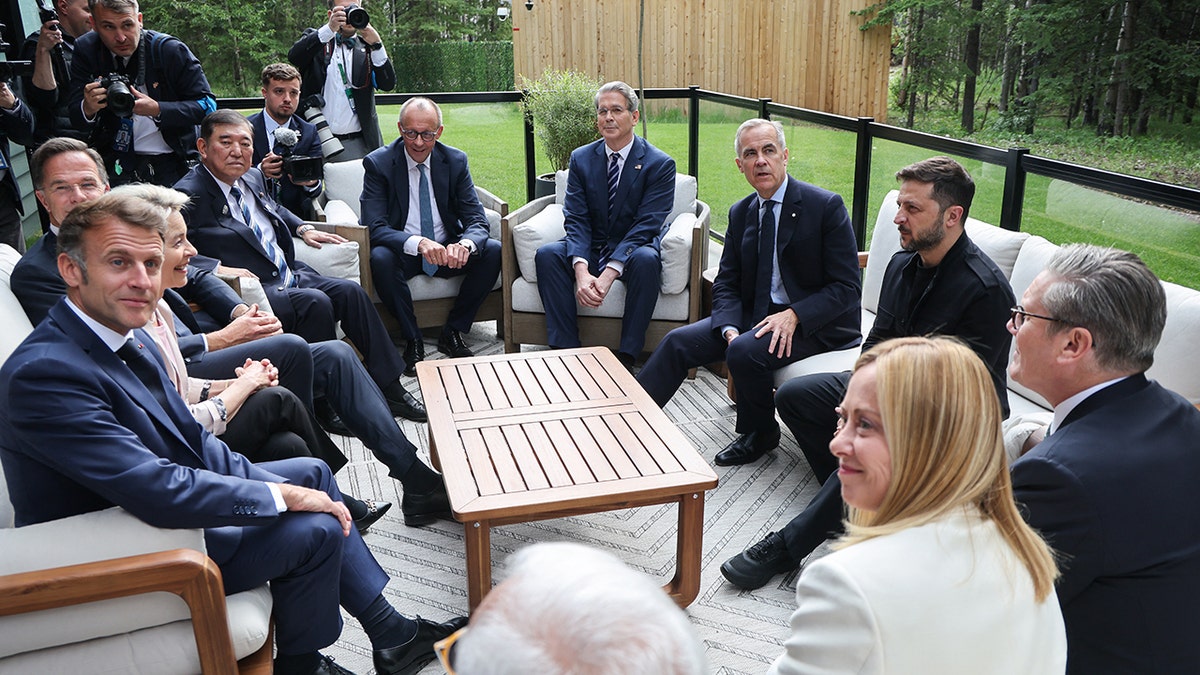
French President Emmanuel Macron, European Commission President Ursula Von der Leyen, NATO Secretary General Mark Rutte, Japanese Prime Minister Shigeru Ishiba, German Chancellor Friedrich Merz, US Secretary of Treasury Scott Bessent, Canadian Prime Minister Mark Carney, Ukrainian President Volodymyr Zelenskyy, British Prime Minister Keir Starmer, and Italian Prime Minister Giorgia Meloni meet during the Group of Seven (G7) Summit at the Pomeroy Kananaskis Mountain Lodge in Kananaskis, Alberta, Canada on June 17, 2025. (LUDOVIC MARIN/AFP via Getty Images)
WHY ALASKA
Though geographically speaking, Anchorage is a near equal distance from Moscow and Washington, D.C., the president prompted surprise when he said Putin had agreed to meet him in Alaska rather than a third-party state, like Switzerland or Hungary, both of which were floated as potential meeting locations.
However, both locations held dubious optics, as Switzerland, a member of the International Criminal Court, could be obligated to act on the 2023 ICC arrest warrant issued against Putin, and Hungary, though frequently seen as sympathetic to Russia, is a NATO member state.
“They probably avoided Europe, because if they included Europe, then Europe would have demanded that they’re actually at the table,” Dan Hoffman, former CIA Moscow Station Chief, told Fox News Digital. “Probably your two choices were go to Russia — which Trump would never do — or invite him here.
“It also exposes the challenge that you can’t solve this without Ukraine and without Europe,” he added.
But Alaska also has a shared history with the U.S., which Washington purchased from Saint Petersburg — then the capital of Russia — in 1867.
Though this shared past was championed by some in Russia and the U.S., like the Kremlin’s special economic envoy Kirill Dmitriev, who called it the “perfect stage” for the Putin-Trump talks, others took to social media to suggest it showed the precarious nature of sovereign borders.

Anchorage, Alaska is set to receive both President Donald Trump and Russian President Vladimir Putin for a high-level bilateral meeting on Friday Aug. 15, 2025. (Zihao Chen via Getty Images)
ZELENSKYY TELLS PUTIN TO ‘BE BRAVE’ AND FINALLY AGREE TO TRILATERAL MEETING WITH TRUMP
ZELENSKYY’S ROLE
Zelenskyy does not appear to have been officially invited to the talks, which the White House on Tuesday confirmed are the result of a direct invitation from Putin.
“The president is agreeing to this meeting at the request of President Putin,” Leavitt said Tuesday. “And the goal of this meeting for the president is to walk away with a better understanding of how we can end this war.”
Zelenskyy is set to hold talks with the U.S. president ahead of the high-level bilateral meeting on Wednesday alongside other European leaders.
Zelenskyy has repeatedly said he is open to meeting with Putin directly to end the war, though Putin has thus far refused.

Poland’s Prime Minister Donald Tusk, Ukrainian President Volodymyr Zelensky, French President Emmanuel Macron, Britain’s Prime Minister Keir Starmer and Germany’s Chancellor Friedrich Merz, hold a telephone conversation with US President Trump on the sidelines of a meeting at the 6th European Political Community summit on May 16, 2025 at Skanderbeg Square in Tirana, Albania. (KuglerSteffen/Bundesregierung via Getty Images)
WHAT’S NEXT
Trump on Monday said his goal is that following his meeting with Putin, the Kremlin chief will sit down with Zelenskyy to begin hashing out terms for a ceasefire — whether or not it includes him in direct negotiations.
“Ultimately, I’m going to put the two of them in a room. I’ll be there, or I won’t be there,” Trump said Monday. “And I think it’ll get solved.”
CLICK HERE TO GET THE FOX NEWS APP
Zelenskyy on Tuesday said he also discussed the possibility of holding high-level talks organized by Turkey, which has hosted previous diplomatic negotiations that have failed to secure any lasting ceasefire agreements, but have released thousands of Ukrainian and Russian prisoners of war (POWs).
“We are ready for any format of meeting aimed at stopping the killings and ending the war,” Zelenksyy said. “President Erdoğan confirmed his country’s readiness to organize a summit of the leaders of Ukraine, the United States, Russia, and Türkiye.”
Experts have warned it is too soon to tell what could come out of the talks with Putin on Friday.
Business
Stocks to buy: What’s the outlook for Nifty for April 20-April 24 week? Check list of top stock recommendations – The Times of India

Stock market recommendations: APL Apollo Tubes, and HDFC Asset Management Company are Sudeep Shah, Head – Technical Research and Derivatives, SBI Securities’ top stock picks for this week. Below are his stock picks and also views on Nifty.Nifty ViewThe benchmark index Nifty continues to inch higher; however, this phase of the rally is notably different, as the spotlight has shifted away from the headline index. While Nifty has extended its pullback rally for the second consecutive week and closed in the green, the real strength is emerging beneath the surface. The broader markets have taken the lead, with Nifty Midcap 100 and Nifty Smallcap 100 delivering a robust rally and clearly outperforming the frontline index. Both indices have decisively moved above their key moving averages, signalling trend strength, whereas Nifty is still trading below its 100day and 200day EMA. Most importantly, Nifty Midcap 100 is now just a short distance away from its alltime high, suggesting that the next leg of opportunity may be unfolding beyond the conventional largecap space.Focusing back on Nifty, the index has been sustaining above its 50day EMA for the last three trading sessions, while the 20day and 50day EMA have started to edge higher, reflecting improvement in the shortterm trend. Meanwhile, the downward momentum in the 100day and 200day EMA has slowed considerably, indicating a stabilisation in the mediumterm structure. Momentum indicators further support the constructive bias, with the daily RSI trading above the 57 mark and moving higher, and the daily MACD histogram signalling strong bullish momentum.Collectively, these technical factors suggest that the pullback rally is likely to continue in the short term. On the upside, the 24650–24700 zone is expected to act as a crucial hurdle for the index. A sustainable breakout above 24700 could lead to an extension of the pullback rally towards 25000, followed by 25200 in the near term. On the downside, the 24050–24000 zone will serve as immediate support, and as long as the index remains above the 24000 mark, the ongoing pullback rally is likely to stay intact.Bank Nifty ViewThe banking benchmark Bank Nifty also ended the week on a positive note, indicating the continuation of its ongoing pullback rally. However, over the last three trading sessions, the index has struggled to decisively cross its 200day EMA, suggesting a phase of consolidation near a key long-term resistance zone. This price behaviour reflects hesitation at higher levels and points towards a pause in momentum after the recent recovery.This consolidation largely indicates a degree of caution among market participants, as investors appear to be awaiting clarity on the Q4 earnings outcome of major banking heavyweights, namely ICICI Bank and HDFC Bank. With both results scheduled over the weekend, the index is likely to witness a directional move post the earnings announcements, depending on earnings performance and management commentary.From a technical perspective, the index continues to maintain a constructive short-term setup, as it is trading above its 20day and 50day EMA, reflecting underlying strength. Momentum indicators remain supportive, with the daily RSI placed above the 55 level and trending higher, suggesting improving buying momentum and positive shortterm bias.Looking ahead, the 57000–57100 zone is expected to act as a crucial resistance area, as it coincides with both the prior swing high and the 100day EMA, making it an important supply zone. A sustainable move above 57100 could lead to a further extension of the pullback rally towards 57800, followed by 58500 in the short term. On the downside, the 55800–55700 zone is placed as an important support band, and any dip towards this region is likely to attract buying interest as long as the structure remains intact.Stock recommendations:APL Apollo TubesAPL Apollo Tubes has shown strong bullish intent after a 14.5% pullback from its early April lows near the 200-day EMA, indicating solid support at lower levels. The recent consolidation between 2072–1961 acted as a base, with the stock now delivering a decisive breakout on strong footing. A positive DI crossover on ADX signals clear buyer dominance, while the MACD nearing a move above the zero line with rising histogram bars points to strengthening momentum.The overall setup suggests the stock is well-positioned to extend its uptrend in the near term. Hence, we recommend to accumulate the stock in the zone of 2110-2090 with a stoploss of 2020. On the upside, it is likely to test the level of 2255 in the short term.HDFC Asset Management CompanyHDFC Asset Management Company has exhibited strong bullish momentum, closing Friday’s session with an impressive 4.89% gain. The stock has surged nearly 26% from its March lows, indicating robust buying interest. Momentum indicators remain firmly supportive, with RSI sustaining above 60, reflecting strength. Additionally, a positive DI crossover on ADX highlights clear buyer dominance, while rising MACD histogram bars with the MACD line above the zero mark further reinforce the ongoing uptrend. The overall structure suggests the stock is well-positioned to extend its upward trajectory. Hence, we recommend to accumulate the stock in the zone of 2800-2770 with a stoploss of 2690. On the upside, it is likely to test the level of 2990 in the short term.(Disclaimer: Recommendations and views on the stock market, other asset classes or personal finance management tips given by experts are their own. These opinions do not represent the views of The Times of India)
Business
Stock market today (April 20, 2026): Nifty50 recovers from losses, goes above 24,400; BSE Sensex up over 300 points – The Times of India

Stock market today: Sensex and Nifty opened in red on Monday on weak global cues as the closure of Strait of Hormuz led to an increase in oil prices. However the market quickly revered losses to move in green territory. While Nifty50 went above 24,400, BSE Sensex was up over 300 points. At 11:00 AM, Nifty50 was trading at 24,430.50, up 77 points or 0.32%. BSE Sensex was at 78,805.37, up 312 points or 0.40%.A key factor to watch will be the next round of diplomatic talks between the US and Iran, particularly as the April 22 ceasefire deadline draws closer.Dr. VK Vijayakumar, Chief Investment Strategist, Geojit Investments Limited says, “With the deescalation- escalation drama in the West Asian conflict continuing, the market will remain volatile in the near-term. With Iran hardening its position again, closing the Strait of Hormuz and threatening to retaliate to US’ seizure of an Iranian ship ‘violating the US blockade’, there is potential for a flare up of the conflict when the ceasefire ends on 22nd April. However, the market signals do not reflect renewed concern and flare up of the conflict. Even though Brent crude has spiked back to $95 levels from below $90 on Friday, there is no panic in the crude market.” “A significant trend in the market now is the outperformance of the broader market. Nifty Midcap and Nifty Smallcap indices are back to pre-war levels. This is in contrast to the Nifty which is still 4% below pre-war levels. The market is responding positively to good results from the broader market space. Even with the uncertainty of the West Asia tensions weighing on the market, particular stocks will respond to good results, particularly when the results beat expectations.“At the start of the new week, oil prices climbed, the US dollar rebounded from recent lows, and global equities showed mixed movement as tensions in the Middle East disrupted shipping flows in and out of the Gulf. Even so, market participants continued to anticipate a possible resolution.Early Monday trends indicated declines in US equity futures, with S&P 500 futures down 0.6% by mid-morning in Tokyo. In Asia, Hang Seng futures rose 1.2%, Nikkei 225 futures edged up 0.3%, Japan’s Topix gained 0.5%, while Australia’s S&P/ASX 200 remained largely unchanged. In Europe, Euro Stoxx 50 futures slipped 1.2%.Crude oil prices rebounded by more than 6% on Monday after plunging over 9% on Friday, as reports emerged that the Strait of Hormuz had been shut again following mutual accusations by the US and Iran of ceasefire violations involving attacks on vessels over the weekend.Gold prices declined by over 1% on Monday as the strengthening dollar weighed on the metal, while uncertainty surrounding US-Iran negotiations pushed oil prices higher and reignited concerns about inflation.(Disclaimer: Recommendations and views on the stock market, other asset classes or personal finance management tips given by experts are their own. These opinions do not represent the views of The Times of India)

Britain is to “flirt” with recession and unemployment will be sent soaring amid the fallout of the Iran war, according to economic forecasters.
The latest Item Club report predicts the economy will flatline in the second and third quarters, which will leave gross domestic product (GDP) rising by 0.7% over the year as a whole, down from 1.4% expansion in 2025.
While the economy will “flirt with recession” – defined as two quarters or more in a row of falling GDP – it will also see higher oil and energy prices weigh on activity and the jobs market suffer its “biggest hit since the pandemic”, the Item Club warned.
But it predicted that interest rates will remain on hold throughout 2026 despite soaring inflation caused by the war.
Matt Swannell, chief economic adviser to the Item Club, said: “Spiralling energy costs and disruption to supply chains will push the UK to the brink of a technical recession in the middle of this year.
“Consumers’ spending power will be squeezed, while more expensive financing arrangements and a less certain global economic backdrop will pour cold water on companies’ investment plans.”
The independent forecasting group said the UK’s jobless rate will peak at 5.8% by the middle of 2027, with almost 250,000 more people without a job.
It follows a gloomy economic outlook report from the International Monetary Fund (IMF) last week showing the UK facing the biggest downgrade to growth among the G7 group of countries, with 0.8% forecast for 2026, down sharply from the 1.3% predicted in January.
But recent figures showed the UK economy had stronger-than-first thought momentum before the Iran war impact, with data showing GDP grew by 0.5% month-on-month in February – the fastest expansion since January 2024.
The Item Club said inflation is set to soar to almost 4% in the second half of 2026 – nearly double the Bank’s 2% target – but that Monetary Policy Committee (MPC) policymakers will hold off from knee-jerk hikes to interest rates.
Mr Swannell said: “We don’t expect the Bank of England to repeat the 2022 playbook and hike interest rates as energy prices rise.
“This time policy is already restrictive, and a more fragile economy means that businesses will find it harder to pass on higher costs to the consumer.
“Instead, the MPC can stand pat as it waits for inflation to fall back before it cuts interest rates a couple more times in the middle of next year.”


2026 NBA playoffs: Western Conference first-round takeaways

Sarah Ferguson speaks out over Beatrice, Eugenie troubles: ‘Difficult’
Stocks to buy: What’s the outlook for Nifty for April 20-April 24 week? Check list of top stock recommendations – The Times of India

-

 Fashion4 days ago
France’s LVMH Q1 revenue falls 6%, shows resilience amid Iran war
-

 Sports7 days ago
The case for Man United’s Fernandes as Premier League’s best
-

 Entertainment1 week ago
Palace left in shock as Prince William cancels grand ceremony
-
 Business7 days ago
UK could adopt EU single market rules under new legislation
-

 Entertainment1 week ago
Dua Lipa hits major career high ahead of wedding with Callum Turner
-

 Sports1 week ago
Lamar Jackson hits back at critics with faithful message on social media
-

 Entertainment5 days ago
Is Claude down? Here’s why users are seeing errors
-

 Fashion7 days ago
Energy emerges as biggest cost driver in textile margins