

Sports
Tucker to Dodgers? A reunion in Philly and Boston? Best fits for top MLB free agents

There is no Juan Soto in MLB free agency this year. There is definitely no Shohei Ohtani. But although there might not be a player who will inspire people to track the flight paths of private jets on social media, it’s an intriguing class of free agents nonetheless — one especially deep in power hitters.
Let’s look at 13 of the most interesting free agents, assuming a few likely player opt-outs, and some potential best fits for each player. We’ll leave out some of the top relievers — Edwin Diaz (opt-out), Robert Suarez (opt-out), Devin Williams — and instead focus on the top position players and starting pitchers available this winter.
Players are ranked in order of their Baseball-Reference WAR from 2025.
2025 stats: .272/.334/.480, 29 HR, 98 RBIs, 13 SB, 5.0 WAR
2026 age: 30

Best fit: New York Mets
Bellinger surprisingly tops the list in 2025 WAR, although that doesn’t by any means suggest he’s going to get the biggest contract. Indeed, although he offers positional versatility with his ability to play all three outfield positions as well as first base, teams will be skeptical of his 2025 numbers since he hit .302 with 18 home runs and a .909 OPS at Yankee Stadium with its short porch compared with .241 with 11 home runs and a .715 OPS on the road. Bellinger works for the Mets both in center field — heck, they were playing 33-year-old infielder Jeff McNeil out there at times — and at first, if they don’t re-sign Pete Alonso.

Another possible fit: New York Yankees
A reunion with the Yankees is possible, but if the Yankees are committed to Jasson Dominguez in left field and give Spencer Jones a shot in center, they’re going to be reluctant to give Bellinger a long-term contract. Given some of their recent returns on long deals (DJ LeMahieu, Aaron Hicks, Giancarlo Stanton), they probably don’t want to get sucked into another big contract for a non-superstar player, no matter how good Bellinger was in 2025.
2025 stats: .240/.365/.563, 56 HR, 132 RBIs, 4.7 WAR
2026 age: 33

Best fit: Philadelphia Phillies
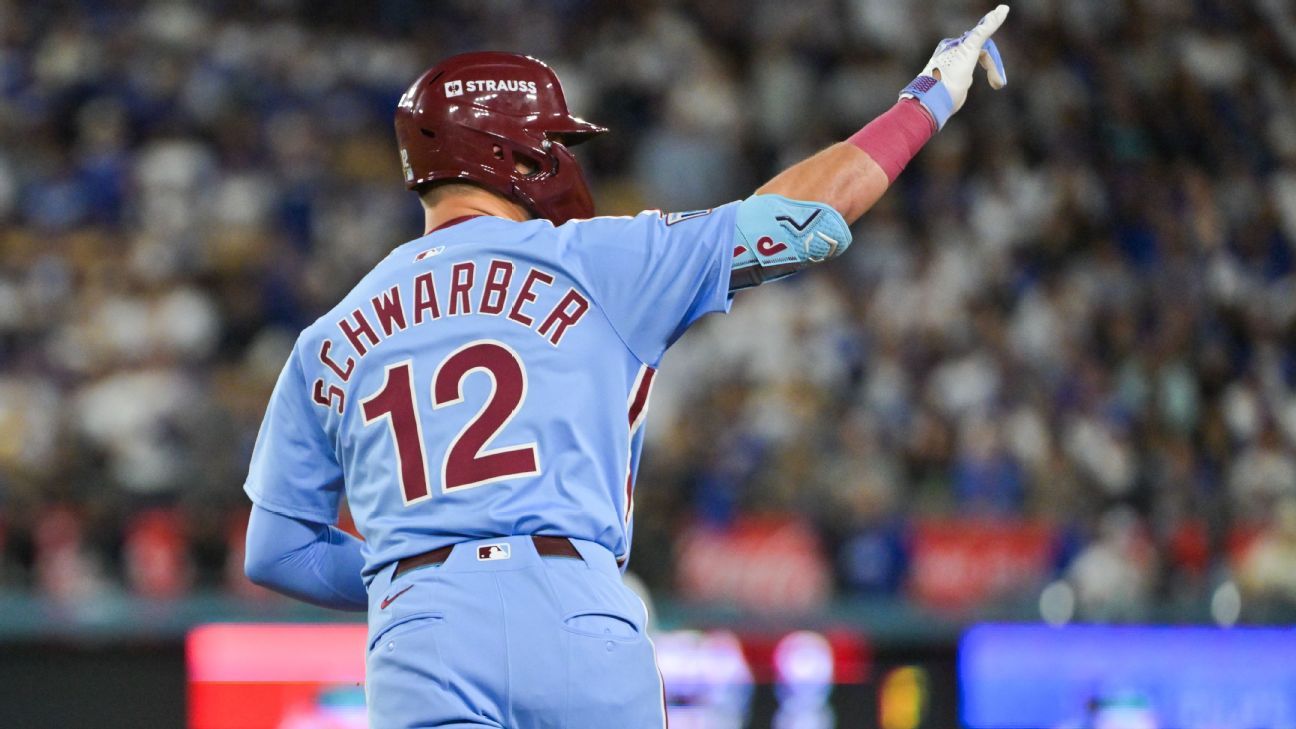
Everyone expects Schwarber to return to the Phillies, coming off his 56-homer season and with his added value as one of the best teammates in the game. Nothing is guaranteed, however, and president of baseball operations Dave Dombrowski is balancing a lot of decisions this offseason. J.T. Realmuto is also a free agent, Ranger Suarez is a free agent and Zack Wheeler‘s return is a question, plus the team in general is getting older. But it’s still a team in a championship window — if Schwarber remains in the lineup.
Another possible fit: Mets
Think the Mets would love to steal Schwarber away from the Phillies? Addition and then subtraction from your rival. Would Schwarber leave the Phillies for the enemy? Players are a lot less loyal than we’d like to believe. Starling Marte was the Mets’ primary DH and he’s a free agent, plus consider: The Mets signed Soto and Alonso had a better season — yet they still scored two fewer runs than in 2024. It was an above-average offense, fifth in the NL in runs, but it wasn’t a great offense. Adding Schwarber could take it to the next level.
2025 stats: 12-8. 3.20 ERA, 157 IP, 154 H, 38 BB, 151 SO, 4.7 WAR
2026 age: 30

Best fit: Detroit Tigers
Suarez has been a steady and underrated pitcher since 2021, with a 3.25 ERA over the past five seasons, relying on a six-pitch repertoire that allows him to overcome below-average fastball velocity. He always gets dinged up at some point, so he’s a 150-inning pitcher as opposed to a 180-inning guy, but that still makes him a good fit for the Tigers, who need rotation depth, should have plenty of room in the payroll and could trade Tarik Skubal (sorry, Tigers fans).

Another possible fit: Toronto Blue Jays
Suarez will have a lot of interest even though he lacks that blistering fastball. Indeed, his lack of No. 1-starter pedigree will bring more teams into the bidding, even if he’s expected to get a nine-figure deal. The Blue Jays are an interesting fit here. Chris Bassitt and Max Scherzer are free agents; Shane Bieber has a player option; and Kevin Gausman is a free agent after the 2026 season. They’ll be looking for some long-term stability in the rotation.
2025 stats: .266/.377/.464, 22 HR, 73 RBIs, 25 SB, 4.5 WAR
2026 age: 29

Best fit: Los Angeles Dodgers
If healthy, Tucker would have led this list in WAR — he was hitting .291/.395/.537 for the Chicago Cubs at the end of June when he suffered a fracture in his right hand, which he tried to play through. But he hit just .225 the rest of the way. Indeed, he’s projected to get the biggest contract of the offseason, perhaps as much as $400 million.
As good as he has been, there are some Anthony Rendon vibes here: Tucker has now been injured two years in a row (he also missed much of September with a calf injury); he’s turning 29; his speed/range Statcast metrics aren’t great (26th percentile in both categories); and he’s not a “face of the franchise” type of personality, which you normally expect for $400 million.
Could the Dodgers absorb another huge contract? Well, why not? The Dodgers are the best fit of “will spend money” and “have need,” considering they got nothing from left field in 2025 and suddenly have concerns about Mookie Betts‘ long-term impact at the plate after his subpar (for him) season.

Another possible fit: San Francisco Giants
The Giants, of course, have been trying to land an elite offensive player in free agency forever — finally trading for Rafael Devers last June. Giants corner outfielders hit just .237/.309/.378 with 37 home runs and 12 stolen bases, so adding Tucker to the lineup would give them a much-needed second lefty power hitter (with rookie slugger Bryce Eldridge likely to take over at first base, too).
2025 stats: 13-11, 3.66 ERA, 192 IP, 171 H, 68 BB, 187 SO, 3.8 WAR
2026 age: 32

Best fit: Baltimore Orioles
At some point, the Orioles will sign the front-line starter they need, right? Right?! They finished 24th in rotation ERA at 4.65 and had seven starters who made at least 10 starts in 2025 — and four of them had ERAs over 5.00. That’s not going to cut it in the AL East. Trevor Rogers (1.81 ERA in 18 starts) did emerge in the second half, and Kyle Bradish returned from Tommy John surgery at the end of the season, but the Orioles have lacked that durable No. 1-type starter and Valdez is second in innings pitched over the past four seasons.

Another possible fit: Houston Astros
The Astros have the need to bring Valdez back as the rotation was mostly a mess in 2025 aside from him and Hunter Brown. The payroll, however, looks pretty maxed out with the likes of Jose Altuve, Carlos Correa, Yordan Alvarez, Christian Walker and Josh Hader (they’re also paying Lance McCullers Jr. and Cristian Javier a combined $39 million in 2026). Don’t rule out a return, but the Astros have let other stars leave in free agency — Correa, Alex Bregman, George Springer, Gerrit Cole and Justin Verlander.
2025 stats: .228/.298/.526, 49 HR, 118 RBIs, 3.6 WAR
2026 age: 34

Best fit: Athletics
The A’s aren’t often included in lists like this one — especially for a player coming off 49 home runs — but a lot of factors could push Suarez to the A’s: his age, his below-average OBP and strikeout rate, his subpar production after he was traded to Seattle. The A’s started nine players at third base in 2025 (players who combined for just 10 home runs), and Suarez would certainly bring power and durability — he has missed just seven games the past three seasons. He’s also a good clubhouse guy who would fit in with the team’s younger players. The A’s surprised people by signing Luis Severino last offseason, so they could land Suarez in a similar scenario.


Other possible fits: Tigers, Milwaukee Brewers, Arizona Diamondbacks, Seattle Mariners
The Brewers (.234, 11 HR, .650 OPS) and Tigers (.221, 11 HR, .629) both made the playoffs despite subpar production at third base. Milwaukee loves high-contact offensive players, so maybe Suarez doesn’t fit there, and Detroit might not want to add another high-strikeout rate guy in the middle of the lineup on top of Riley Greene. The D-backs and Mariners are familiar with Suarez — he played for each in 2025 — but both have young players in Jordan Lawlar and Colt Emerson whom they could play at third.
2025 stats: .273/.360/.462, 18 HR, 62 RBIs, 3.5 WAR
2026 age: 32

Best fit: Boston Red Sox
Bregman hit free agency last year and didn’t sign until the middle of February, a three-year, $120 million deal with opt-outs after both 2025 and 2026. He played well enough with the Red Sox that he’s likely to test free agency, even though a quad strain limited him to 114 games. After a hot start, he didn’t hit nearly as well after returning in July — .250/.338/.386. The big surprise is that the pull-happy Bregman hit better on the road (.875 OPS) than at Fenway (.761 OPS).
Still, the Red Sox remain the best fit. He was an important veteran presence for Boston’s young position players, and he’s a right-handed bat in a lineup otherwise heavy in lefties (Jarren Duran, Roman Anthony, Wilyer Abreu, Masataka Yoshida). Bregman’s age presents some risk on a long-term deal, but although his speed metrics are sinking (17th percentile), he still has good range at third base and brought his OBP back up after it dropped to .315 in 2024.
Other possible fits: Tigers, Yankees, Phillies
Bregman’s contact ability makes him a likely fit for the Tigers — and he’ll be too expensive for the Brewers. The interesting long shot candidates would be the Yankees and Phillies. The Yankees have Ryan McMahon under contract, but he posted a .641 OPS after coming over from the Colorado Rockies at the trade deadline and his strikeout issues are a concern. The Phillies have Alec Bohm in his final year of team control, but Bohm produced just 1.3 WAR in 2025 and the Phillies are a little tired of his lack of postseason production (.225, 2 HR, 14 RBIs in 38 playoff games). Bregman’s fire might be what the Phillies need.
2025 stats: .272/.347/.524, 38 HR, 126 RBIs, 3.4 WAR
2026 age: 31
Best fit: Mets
Alonso’s stature — and ability to hit home runs and drive in runs — means he’s the highest-profile free agent alongside Schwarber, even if his WAR puts him lower on this list. Alonso has averaged 42 home runs per 162 games throughout his career, and his durability is one of his selling points — he hasn’t missed a game the past two seasons. Alonso was a free agent last year and there wasn’t much interest, so he went back to the Mets on a deal that gave him an opt-out and responded with a better campaign in 2025.
Will there be more demand this offseason? Perhaps. But Alonso is a 31-year-old first baseman who is a below-average defender. He has elite power but not elite on-base percentages. That all makes him a “high risk” category, and he’s not quite in the class of Vladimir Guerrero Jr., Freddie Freeman or Matt Olson, the first basemen who received big nine-figure deals since 2022. It’s hard to envision Alonso leaving the Mets, but president of baseball operations David Stearns won’t overpay to bring him back — and Alonso might not be so willing to give the Mets a sweetheart of a deal this time around.


Other possible fits: Miami Marlins, Washington Nationals
The Texas Rangers didn’t get the output they wanted from Jake Burger; the Red Sox could move on from Triston Casas; and the Phillies (if they don’t sign Schwarber) and Atlanta Braves might consider Alonso as a DH, but let’s toss out the Marlins. Their first basemen hit just .234 with 15 home runs. They haven’t had a 2-WAR first baseman since Justin Bour in 2017 or a 3-WAR first baseman since Derrek Lee in 2002. Teams always think they can fill first base with adequate offense, but the Marlins are proof that’s not always the case. Alonso is also from Florida, which might help. A more realistic long shot might be the Nationals, who need a big bopper and have plenty of room in the payroll.
2025 stats: .311/.357/.483, 18 HR, 94 RBIs, 3.4 WAR
2026 age: 28
Best fit: Giants
Bichette’s free agency will be fascinating. Given his poor defensive metrics at shortstop, it’s almost a certainty teams will be looking at him as a second or third baseman rather than a shortstop — even the Blue Jays (the team he has been with his entire career), who would move Andres Gimenez to shortstop. That’s not a bad thing for Bichette, as it opens up his possible destinations to more teams if he’s willing to change positions.
Although he is a .294 hitter, it will be interesting to see how he ages: He already doesn’t run well (21st percentile in speed) and he doesn’t walk much, so his offensive production is heavily reliant on his batting average. We mentioned the Giants as a potential fit for Kyle Tucker. The same goes for Bichette, as Giants second basemen hit just .216/.273/.342.

Another possible fit: Kansas City Royals
OK, can the Royals realistically afford to sign Bichette? Probably not, but a double-play combination of Bobby Witt Jr. and Bichette would be a lot of fun, and Bichette’s style of hitting would be a good fit for that park. Royals second basemen hit just .236 with 11 home runs, and we know the lineup needs something else. The Royals aren’t the Pittsburgh Pirates or Tampa Bay Rays. They will spend some money — although there isn’t much wiggle room based on the 2025 payroll — and there is a contention window right now with their current rotation.
2025 stats: .295/.353/.462, 20 HR, 92 RBIs, 30 SB, 3.1 WAR
2026 age: 29
Best fit: Mariners
Naylor was the perfect fit for the Mariners, who had not only struggled at first base but also needed a more contact-oriented hitter like Naylor for the middle of the lineup when they traded for him at this year’s deadline. He unveiled one of the most surprising secret weapons, going 30-for-32 as a base stealer despite being one of the slowest runners in baseball. Although many hitters are reluctant to sign with the Mariners, Naylor loves hitting at T-Mobile Park, with a career line of .304/.335/.534. The Mariners should have room to bring him back.

Another possible fit: Rangers
Rangers first basemen/DHs combined for a .657 OPS — only the Rockies were worse. Texas still has Jake Burger and Joc Pederson (who will probably exercise his $18.5 million player option), but both had sub-.290 OBPs, so the Rangers will consider upgrading.
2025 stats: 8-12, 4.55 ERA, 168 IP, 152 H, 71 BB, 215 SO, 1.1 WAR
2026 age: 30

Best fit: Cubs
Cease’s eventual contract will far outpace his ERA and low WAR from 2025. Teams will focus on the power arm (average fastball of 97.1 mph), the high strikeout rate and the durability (five straight seasons with at least 32 starts). A return to the Cubs would be full circle as they originally drafted Cease in the sixth round out of high school in 2014 before trading him to the Chicago White Sox in the Jose Quintana deal.
The 2025 Cubs were a prime example of why teams prefer those power arms in the postseason. With Cade Horton injured, Matthew Boyd and Shota Imanaga were their top two starters, two lefties without high K rates. They have plenty of payroll room to make a big rotation signing.

Another possible fit: San Diego Padres (and every other contender)
With Cease and Michael King (who has a player opt-out) in free agency, the Padres would have Nick Pivetta, Yu Darvish, Randy Vasquez, Joe Musgrove (returning from Tommy John surgery) and perhaps Mason Miller in their rotation — and the options thin out in a hurry after that. But is there room in a payroll that is already pushing $200 million heading into the offseason?
2025 stats: 13-15, 4.83 ERA, 192 IP, 176 H, 66 BB, 175 SO, 1.1 WAR
2026 age: 30
Best fit: Diamondbacks
Like Cease, Gallen is hitting free agency with a high ERA. Unlike Cease, he averages 93.5 mph with his fastball instead of 97. Gallen’s home run rate nearly doubled from 0.8 per nine innings in 2024 to 1.5 in 2025, and his strikeout rate plummeted to a career-low 21.5%, a notable 5-percentage-points decline from his career rate entering the season. He did pitch better the final two months with a 3.32 ERA. Still, maybe some of the questions push Gallen back to the Diamondbacks, who will enter the offseason down him, Merrill Kelly and Corbin Burnes (Tommy John surgery) from their initial 2025 rotation.

Another possible fit: Los Angeles Angels
Does anyone want to play for the Angels? Their recent free agent signings have been more of the third-tier type, but they have room in the payroll and two pitchers from their 2025 rotation hitting free agency in Tyler Anderson and Kyle Hendricks. They signed Yusei Kikuchi to a three-year, $63 million deal last offseason and might do something similar this offseason with a starter like Gallen.
Munetaka Murakami, 3B/1B (Japan)
2025 stats: .286/.392/.659, 24 HR, 52 RBIs
2026 age: 26
Best fit: Mariners
A big left-handed slugger, Murakami has been a star in Japan since he hit 36 home runs as a 19-year-old in 2019. He followed that up with a career-high 56 home runs in 2022. He missed time this past season with an oblique injury but hit 24 home runs in 69 games. He does strike out a concerning amount — 168 times in 140 games in 2023 and 180 times in 143 games in 2024 — so projects as more of a low-average, 30-homer slugger. Murakami’s defense is considered below average at both corner positions, but his age helps make him an attractive free agent.
We mentioned Colt Emerson as a replacement for Eugenio Suarez at third base for the Mariners, but a year in Triple-A wouldn’t hurt, and Emerson could then take over at shortstop in 2027. That leaves Murakami as a fit for third base, or a backup option to Josh Naylor at first base. The Mariners have certainly shown they’re OK with strikeouts if it comes with power.
Another possible fit: Dodgers
The Dodgers? Hey, you have to consider the Dodgers a possibility for any Japanese player. They obviously have Freddie Freeman locked into first base and have a $10 million option on Max Muncy, but note that Murakami did play a few games in the outfield in 2025. Given their hole in left field, maybe they fake left-field defense with Murakami for a year and then have him replace Muncy at third base in 2027. In the bigger picture, the Dodgers had the oldest group of position players in 2025. Only Andy Pages was younger than 30 among the top 11 regulars. They need to get younger, and Murakami is younger — and less expensive to sign — than Kyle Tucker.
The ball is tipped
And there you are
You’re running for your life
You’re a shooting star
David Barrett was sitting in a bar when the idea came to him. The 31-year-old musician had spent his entire young adult life grinding as a performer in the watering holes of Michigan. College bars. Dive bars. Even the occasional honky tonk. On this particular spring night in 1986, it was an East Lansing establishment known as the Varsity Inn and his set — a performance heard by perhaps two dozen patrons — was done.
And all the years
No one knows
Just how hard you worked
But now it shows
Barrett was unwinding over a drink. With one eye he watched the TV over the bar, watching Larry Bird’s Boston Celtics running over another unfortunate NBA opponent. His other eye was affixed on the woman who had served him that drink.
“The waitress was so beautiful, I thought, well, I’m a songwriter, so perhaps my only chance to catch her attention was through poetry,” Barrett says today. “If I could express to her the poetry of Larry Bird’s abilities at the height of his career, this special moment in his life creating so many special moments on the court, perhaps she would be impressed.”
Well, was she?
“No, she was rather busy.”
No offense to Barrett, but we should all be thankful that she had more critical tasks than posting up at the bar to admire the singer’s basketball spoken word. Because it was within that space of lonely time that, inspired by his own lesson about moments, he scribbled three words onto a cocktail napkin. The following morning, he expanded those words into a chorus, this time onto a stack of napkins at a brunch spot, The Knight Cap Too.
In one shining moment,
it’s all on the line
One shining moment,
there frozen in time
For nearly 40 years, those lyrics and the tune Barrett wrote to accompany them have been the soundtrack of our college basketball lives. On Monday night, shortly after the men’s college basketball national champion is crowned, the winning team will lock arms on the floor of Lucas Oil Stadium, gaze up at the jumbotron and soak up a three-minute montage of clips from this year’s tournament, set to Barrett’s song, building to the inevitable 30-second climax of images of them winning the very title that they are very much still celebrating.
“There are so many moments that make up a championship celebration,” explains Mike Krzyzewski, who won five national titles as Duke’s head coach. “There’s the moment the game ends. There’s hugging your family. There’s cutting down the nets. The moment of being handed the trophy. But the moment it feels real is when they play ‘One Shining Moment.'”
“It’s this literal life-flashing-before-your-eyes thing, watching that video set to that song,” adds John Calipari, who won it all with Kentucky in 2012. “It’s like watching a movie of your life, that you wrote, with the people who wrote it with you.”
“You also don’t just watch it if you win it,” says Tom Izzo, who celebrated with Michigan State in 2000. “If you are there at the game, you wait to see it. If you are home on the sofa, you wait to see it. The season isn’t done until you hear that song.”
And to think, the NFL almost intercepted it right out from under college basketball’s nose.
For that moment, let’s go back to ’86. That’s when Barrett met sports reporter Armen Keteyian. Keteyian, like Barrett, was a native of the Detroit area and had moved to New York to write for Sports Illustrated. Whenever Barrett went East, he’d stay at Keteyian’s apartment. During one of those visits, the two were watching the NBA Finals on TV — Larry Bird again, doing work against the Houston Rockets — and Barrett mentioned his basketball song from the napkins.
Keteyian told Barrett that if he got the song recorded, he’d love to hear it.
A few weeks later, a cassette was waiting in Keteyian’s mailbox, tracks laid down in a make-do studio used for local advertising jingles. The reporter loved it, so he walked the tape over to a colleague in TV production.
“One day my phone rang and the gentleman on the other end said he was Doug Towey and he was the creative director at CBS Sports,” Barrett recalls now, his throat catching to hold back tears. “Of course, I didn’t believe him at first. He sounded like a buddy of mine pulling a prank. But over the next 15 minutes, I made a friend for life over a phone call that changed my life.”
Towey, a sports television legend — the theme music for The Masters, the iconic CBS Sports college sports themes, you name it and Towey was probably behind it — had fallen in love with the song and told Barrett that he really, really wanted to use it for … Super Bowl XXI?
“Yes, it was a basketball song, but you know what you do not do in that situation?” Barrett says. “You do not say no to CBS. Why yes, Doug Towey, please use my song for the Super Bowl!”
CBS even flew Barrett out to Pasadena to watch the matchup between John Elway’s Denver Broncos and Lawrence Taylor’s New York Giants. During his postgame report, sportscaster Brent Musburger even quoted the song. “The New York Giants, their first Super Bowl triumph, a shining moment they will never forget…” The time had arrived. Barrett’s big break was happening!
But it never ran. The Super Bowl-winning Giants were a little too chatty in their postgame locker room interviews, so the broadcast ran long, and time ran out. Barrett was crushed — until a second call from Towey.
“He said they wanted to use it for March Madness,” Barrett’s voice nearly explodes as he tells the story. “So, my little song about basketball, you know what? It figured out a way to make sure it was still a basketball song.”
On March 30, 1987, “One Shining Moment” made its debut in the most perfectly shiny momentous manner.
Indiana’s Keith Smart had stroked a drifting corner jump shot with four seconds remaining to defeat Syracuse for the championship. CBS Sports editors scrambled to add nine shots from that game to the end of the montage they had already pieced together throughout the month. The seventh of those images was Smart’s dagger.
From a clunky makeshift video edit room next to the CBS production truck in the bowels of the Superdome, the instant those shots were added, the videotape was popped and sprinted by hand via a panicked young producer to the end of that truck, where tape machines had just spent hours turning around instant replays and interview clips for the telecast. It got crammed into one of those machines, cued, and ready to play.
Once again, it was Musburger who did the lead-in honors. And this time it aired.
“The idea of the song, that one moment can change everything. Well, that’s what happened to me in that moment,” says Barrett, who has since composed themes for CBS, ABC and PBS, melodic backdrops for the Olympics, U.S. Open tennis, the PGA Championship, and a documentary about C.S. Lewis. He’s won two Emmys.
His go-to joke now is to say: “After all those years, suddenly I had talent!”
Since that night, CBS Sports and now TNT have aired 38 editions of “One Shining Moment” performed by four different singers. Barrett himself did the honors over the first seven editions before Towey recruited Philadelphia soul legend Teddy Pendergrass for a new version. Bennett’s vocals returned in 2000, along with a bluesier overhaul of the tune. Two years after that, Barrett received another call from Towey, asking how he’d feel if Luther Vandross were to give the song a spin. Barrett said of course and asked when it would happen. Towey, clearly having already made up his mind before the call, told Barrett that Vandross was slated to be in the studio that very night.
Vandross laid down his vocals in the winter of 2002, captured by CBS cameras to be intercut with the hoops highlights in true music video fashion. The following spring Vandross suffered a massive stroke that forever altered his voice, meaning that “One Shining Moment” was the final song recorded by the legendary artist.
It has been Luther’s song ever since, with the exception of 2010, when Oscar winner Jennifer Hudson’s rendition was beloved for its sound but criticized because the internet claimed it was imbalanced, with too much of her and not enough college basketball. (At 3:12, it’s only a few seconds longer than average, and Hudson is featured for a total of about eight seconds.)
Screening all 38 editions of “One Shining Moment” (thanks, Internet!) is a history lesson not just on college basketball, but television production. Grainy standard definition video transitions into 4K HD as majestically as the images of 1980s feathered hairstyles morph into low burst fades. The production process has evolved not unlike the game being played on the floor of the arena. Digitized and fast-paced, with the ability to be nimble on the fly like UConn and Michigan on the break. But the spirit of how it is pieced together hasn’t changed at all.
“We have a dedicated team that travels to the Final Four. They are on site,” explains Drew Watkins, SVP and Creative Director of TNT Sports, from the sprawling TV production compound that sits outside the south gate of Lucas Oil Stadium.
Watkins has been with TNT since 2000; before that he was an entry-level producer at ESPN. On Monday night, he will be keeping an eye on his on-site producer and editor, George Adams and Chris Vining.
“They’re in one of our edit trucks and are linked in with the studio and the game production truck,” Watkins says of how it will all go down as the clock ticks down on the title game. “So, when we’re editing those plays, and we’re filling in those last few moments and winners are being decided and ‘One Shining Moment’ is minutes away from airing, there is a team on site in the TV compound that is putting those shots together, talking to the broadcast trucks to make sure everything is on track.”
There will actually be two edit suites running simultaneously, just in case. Because all it takes is one power outage, one video glitch or one computer deciding that it’s a great time for a restart, to turn the dream of Barrett’s song into one nightmare moment. Redundancy is a producer’s best friend. No one wants to be the person who ended a four-decade streak of making air.
“The good news is that we have backups in place,” Watkins said. “The better news is that nobody’s having to pop a tape and run it across a parking lot anymore.”
Once that final shot is added and the final click of the mouse sends the finished product to the truck, Adams, Vining, Watkins and their colleagues make sure to pause and watch their work go out into the world, collapsed back into the chairs of their respective production trucks, just like the 20-plus million viewers at home.
Meanwhile, the viewing of “One Shining Moment” as it airs on the arena’s big screen always feels downright intimate, even on a tiny basketball floor situated in the center of a 70,000-seat NFL stadium-turned-basketball gym.
That’s the part that chokes up Krzyzewski, Calipari and Izzo when they talk about it. The part that former players always remember as the pinnacle of their first minutes as champions.
On Monday night, the man who brought us the song will be right there with them. Because it’s his favorite part, too: David Barrett’s literal “One Shining Moment.”
“People ask me all the time which ‘One Shining Moment’ is my favorite one to watch, but I can’t answer that. That’s impossible,” he said on Saturday morning as he prepared to attend the semifinal games with his wife, Tracy. (No, she’s not the waitress from East Lansing, though that server, Jan Shoemaker, and Barrett were eventually reunited through a mutual friend.)
Tracy is a Michigan alum, and she and David still live in the Detroit area, where they raised two girls. As soon as they arrived in Indianapolis, they purchased some Block M Final Four gear before they witnessed the Wolverines’ devastation of the Arizona Wildcats to officially become the favorites to win the national title.
“No, I do not have a favorite ‘One Shining Moment,'” Barrett repeated. Then he laughed. “But Monday night, if we get to watch the home team watch themselves celebrate a championship, set to my little basketball song, well…”
That would be a moment.
“Yes, it would.”
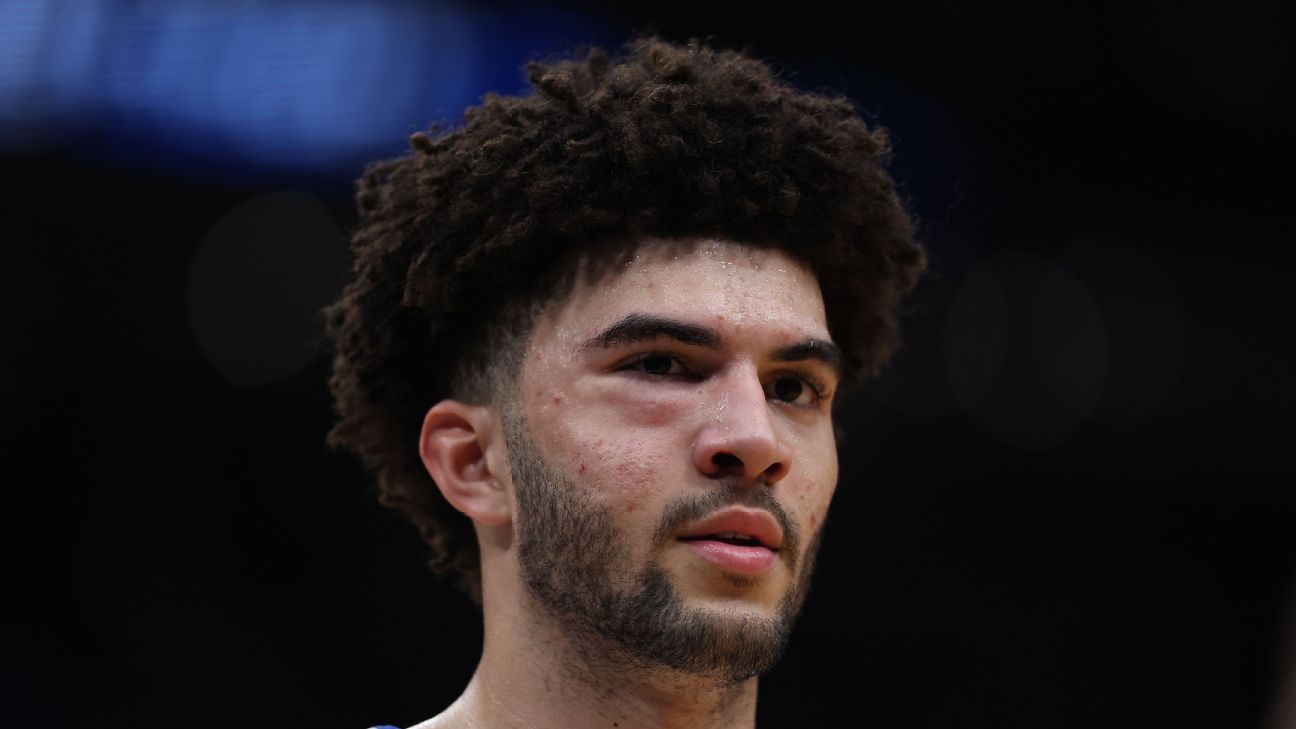
INDIANAPOLIS — Duke star freshman Cameron Boozer, a projected top-five pick in the 2026 NBA draft, said he suffered multiple fractures around one of his eyes during his team’s loss to UConn in the Elite Eight.
Boozer did not offer specifics about the injury but said he decided against surgery only two months before the NBA draft.
“I have a couple of fractures, but I’m all good,” Boozer said as he accepted The Associated Press and United States Basketball Writers Association player of the year awards. “I’m just going through the healing process. It hurt in the game, but I wish the outcome would have been better, but that’s not really what I’m here to focus on. We had a great year. Like I said, it’s an individual award, but I wouldn’t be here without my teammates and my coaches.”
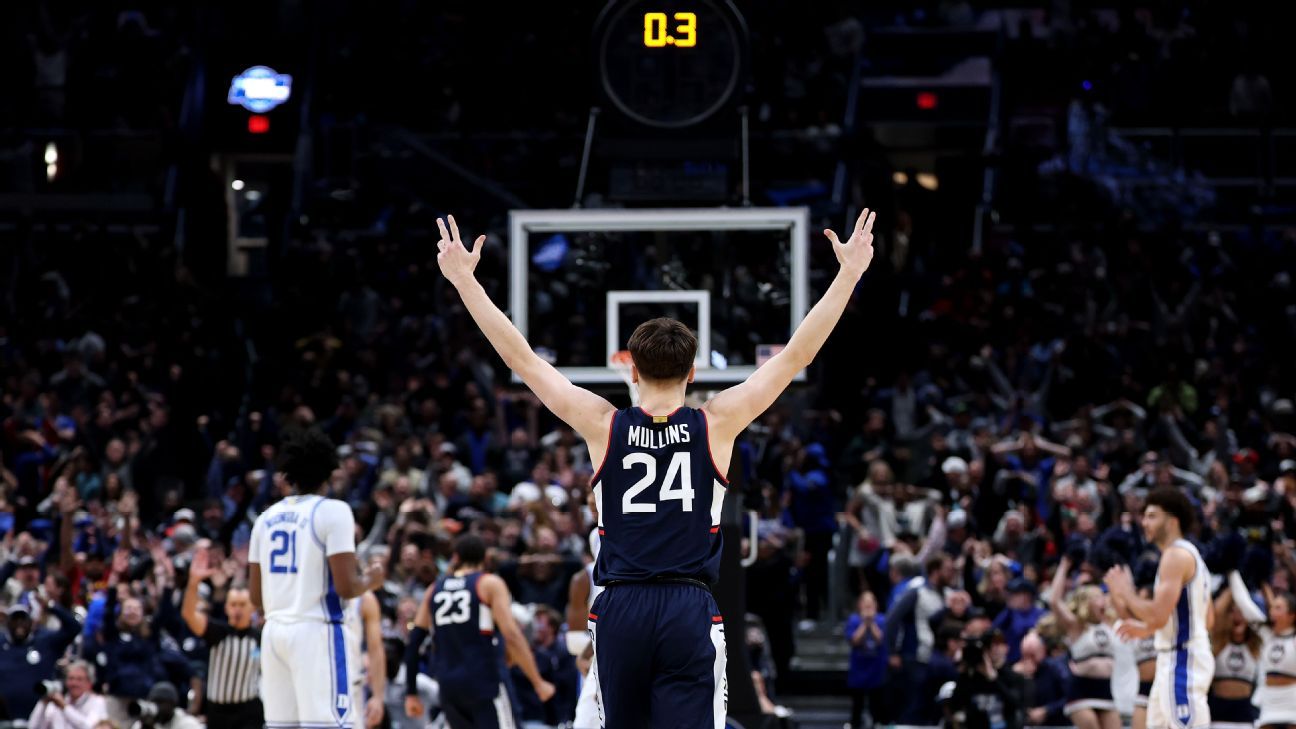
During Duke’s 73-72 loss to UConn on March 29 — decided on Braylon Mullins‘ 3-pointer with 0.4 seconds to play — Boozer took an elbow to the face as he drove to the rim on 7-foot-1 center Eric Reibe. Soon after the play, Boozer’s right eye began to swell and a Duke trainer applied a soda can to his face while he sat on the bench.
Depending on its severity, the eye injury could impact Boozer’s standing in the NBA draft. He is one of the most decorated players in college basketball history, but he has faced scrutiny about whether he has the next-level physical tools to compete against bigger, stronger and more athletic players in the NBA.
The 6-9, 250-pound forward said he is ready to “win” in the NBA, no matter where he’s picked.
“I think I’m just a winning player, all-around player. I think I impact the game in so many different ways,” Boozer said. “And I think my competitiveness translates to any level. I think any team who takes a chance on me is going to be very happy with the results they get from it.”
Boozer admitted that he had a lot of emotions accepting awards in Indianapolis, the site of this year’s Final Four, a week after his team had been eliminated by the Huskies, who will face Michigan in the national title game Monday night. But those emotions were secondary to his feelings after his twin brother, Cayden Boozer, faced backlash on social media following his turnover that preceded Mullins’ game-winning shot in the loss.
“First of all, I’d like to say it’s definitely nasty, but that’s not the reason, that one play is not the reason we lost,” Cameron Boozer said. “But just being there for him, obviously it’s tough. It’s going to be hard for anyone to go through that. There is not really that much I can say to make him feel better. We’re all hurting as a team, but we’re going to get through it together. We’re a super-connected group. It’s definitely a hard moment, but he’s a tough guy. We’re all tough. It’s going to make us so much better going forward. So it’s something you’ve got to take on a chin and learn and grow from.”
NEWYou can now listen to Fox News articles!
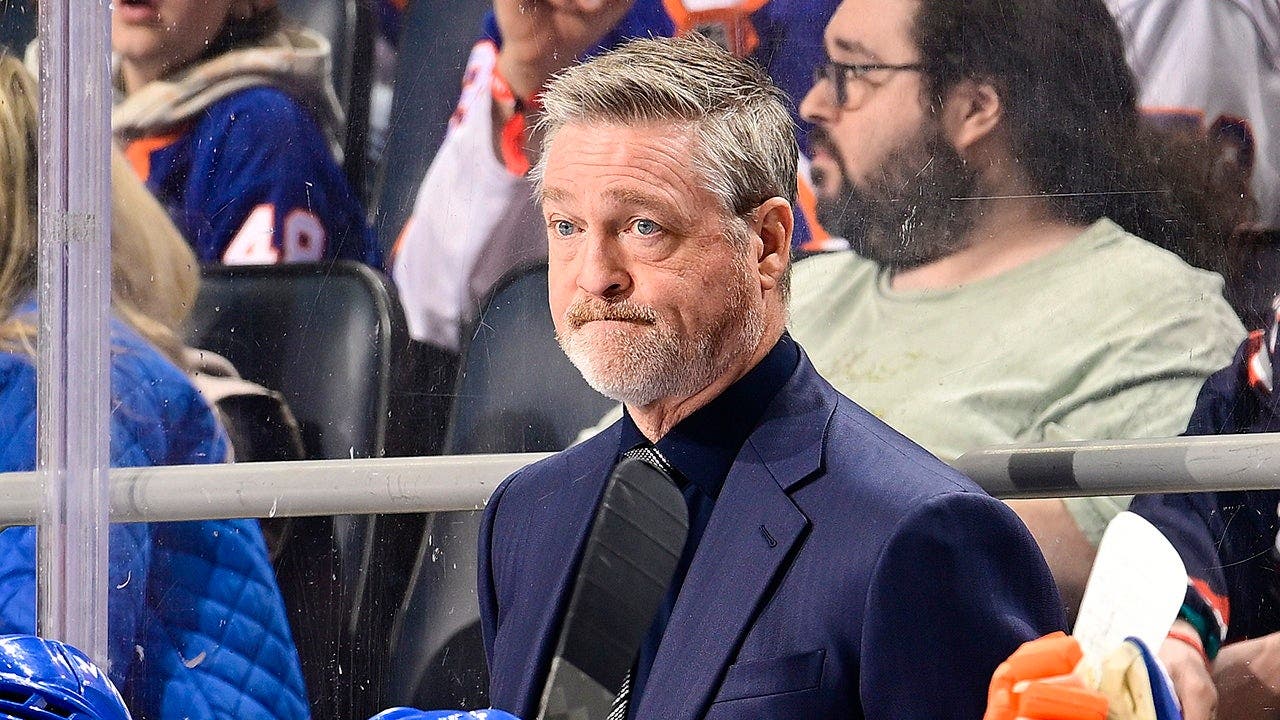
The New York Islanders have fired head coach Patrick Roy despite being in a tight playoff race.
Islanders GM Mathieu Darche announced the change from Roy to Peter DeBoer, who was fired by the Dallas Stars in June 2025.
The move comes with just four games left in the regular season for the Islanders, who sit on a four-game losing streak entering Sunday. And the streak comes with seven losses in their last 10 games.
CLICK HERE FOR MORE SPORTS COVERAGE ON FOXNEWS.COM
Head coach Patrick Roy of the New York Islanders manages bench duties during the first period against the Montreal Canadiens at the Bell Centre in Montreal, Quebec, on March 21, 2026. (Minas Panagiotakis/Getty Images)
As the NHL standings sit entering Sunday, the Islanders, who were once comfortably in position to reach the Stanley Cup Playoffs, sit third in the Metropolitan division with 89 points, which would give them a slot if the season ended today.
However, the Philadelphia Flyers (88 points) and Columbus Blue Jackets (88) are gunning for that third and final divisional spot in the few games remaining. As a result, the Islanders are making the surprise change in hopes DeBoer can get them into the playoffs over the next week.
HOCKEY OFFICIALS REJECT CANADIAN COACH’S COMPLAINTS OF 3-ON-3 OVERTIME RULES AFTER OLYMPIC LOSS
Roy’s exit comes after a loss where the Carolina Hurricanes, who already secured a playoff spot, out shot them 40-16 in a 4-3 loss for New York.
The Islanders are not the only NHL team making a change at head coach with just days left in the regular season. The Vegas Golden Knights axed Bruce Cassidy from his role, hiring veteran coach John Tortorella on an interim basis last week.
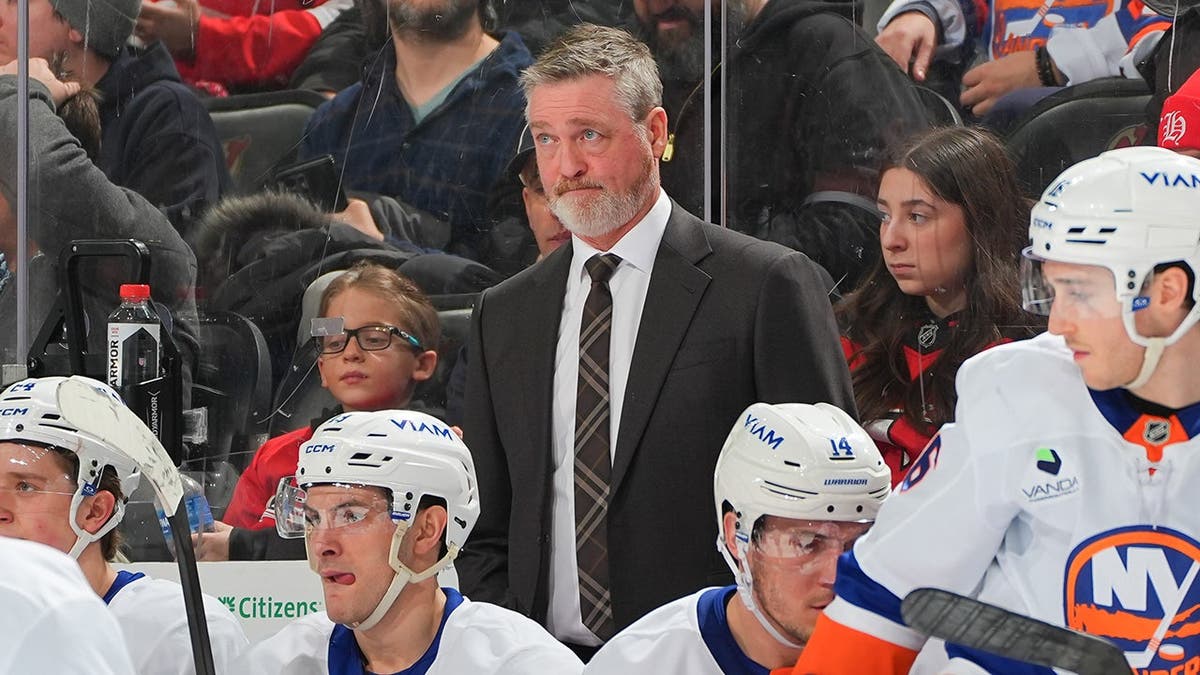
Patrick Roy coaches the New York Islanders during a game against the New Jersey Devils at the Prudential Center in Newark, N.J., on Feb. 5, 2026. (Rich Graessle/NHLI)
Like the Islanders, the Golden Knights (86) have the third and final position in their division, though the race is a bit more comfortable for Vegas with a five-point lead over the Los Angeles Kings.
But, while Tortorella is an interim move for Vegas, the Islanders are keeping DeBoer intact heading into the 2026-27 campaign.
DeBoer has been head coach of five different franchises over his extensive coaching career. He owns a career 662-447-152 record in 1,261 games with the Florida Panthers, New Jersey Devils, San Jose Sharks, Golden Knights and the Stars, who he led for the past three seasons before his firing.
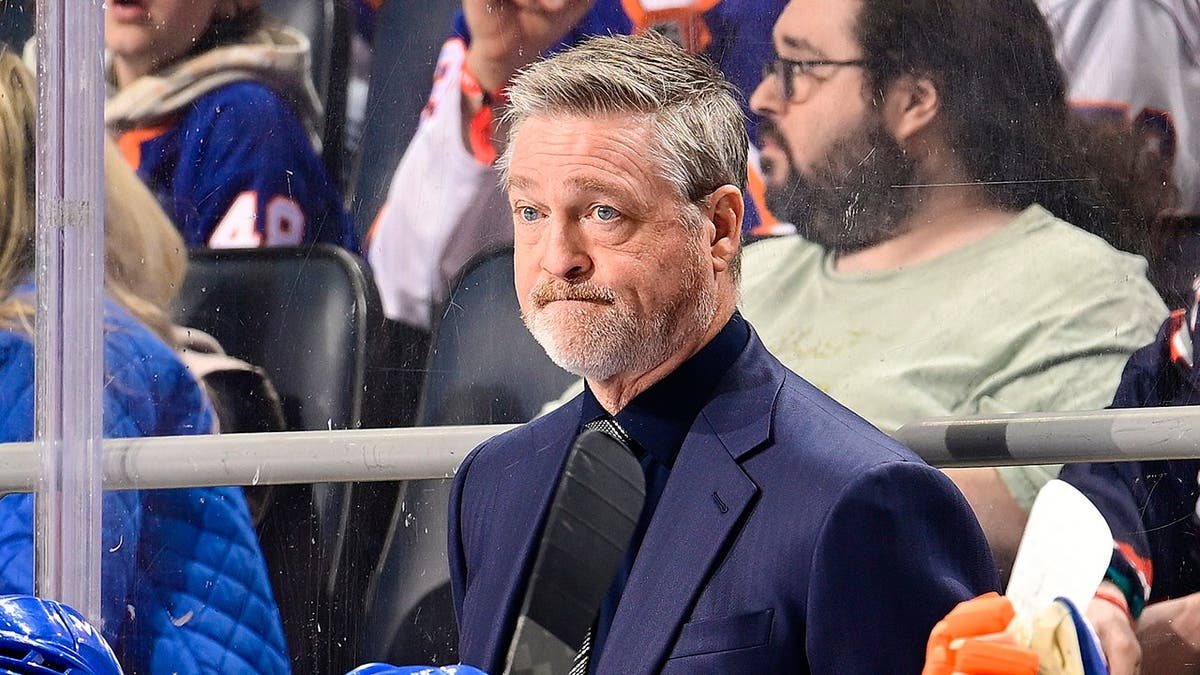
Head coach Patrick Roy of the New York Islanders looks on during a game against the Philadelphia Flyers at UBS Arena in Elmont, N.Y., on April 3, 2026. (Steven Ryan/NHLI)
CLICK HERE TO DOWNLOAD THE FOX NEWS APP
DeBoer wasn’t with a team this season, but he’s stepping up for the opportunity to help turn the tides on Long Island, as the Islanders hope to make the playoffs after missing out the previous two seasons.
While DeBoer hasn’t coached this season, he was a part of Jon Cooper’s Team Canada staff for the Milan Cortina Olympics earlier this year.
Follow Fox News Digital’s sports coverage on X and subscribe to the Fox News Sports Huddle newsletter.


Inside the origin story of ‘One Shining Moment’ — the highlight of March Madness
Oil back above $110 after expletive-laden Trump threat to Iran

Duke star Cam Boozer says he suffered fractures around eye

-
 Sports1 week ago
USMNT handed reality check by Doku, Belgium ahead of World Cup
-
 Sports1 week ago
2026 NCAA men’s hockey tournament: Schedule, results
-

 Fashion1 week ago
EU apparel imports slump 15.48% YoY in Jan; Bangladesh hardest hit
-
Uncategorized3 days ago
[CinePlex360] Please moderate: “Trump signals p
-
Uncategorized7 days ago
[CinePlex360] Please moderate: “Further tariff
-

 Tech2 days ago
Our Favorite iPad Is $50 Off
-
 Entertainment1 week ago
The Avett Brothers’ bassist explains why he wrote a book about John Quincy Adams
-
Uncategorized1 week ago
[CinePlex360] Please moderate: “Apple scrapping