

Business
Two charged after collapse of funeral firm Safe Hands affected 46,000 people


 Getty Images
Two people have been charged following the collapse of a pre-paid funeral firm that left tens of thousands of people out of pocket.
About 46,000 customers lost thousands of pounds when Safe Hands Plans Ltd collapsed in 2022 and went into administration.
The Serious Fraud Office (SFO) has charged two men – Richard Wells and Neil Debenham – with conspiracy to defraud. It said Wells was the former director of SHP Capital Holdings Ltd – the parent company of Safe Hands – with Debenham described as a “fellow senior executive”.
Wells and Debenham are due to appear at Westminster Magistrates’ Court on 5 February.
The SFO said the charges of Wells, 39, residing in Spain, and Debenham, 43, of Norwich, were a “critical step” in its investigation.
Emma Luxton, director of operations, added planholders were left “exposed, out of pocket and uncertain about their funeral arrangements”.
Pre-paid funeral plans are designed to allow people to pay for their own funeral in advance, in order to help their families financially when they die.
Since July 2022, pre-paid funeral providers have required approval to operate from the Financial Conduct Authority.
Safe Hands was one of dozens of companies operating in the previously unregulated sector, and collapsed four months before the measures came in.


The administrator for Safe Hands, FRP Advisory, initially said planholders could receive repayments of between 8.5p and 12.5p for every pound they lost by June 2025.
But after a six-month delay, the amount repaid to those affected by the funeral firm collapse proved to be much less – about 4p for every pound.
Planholders are owed an estimated £70.6m in total.
Among them are Denise Hudson, from Derby, who paid nearly £2,500 for a Safe Hands plan after seeing a TV advert in 2019, and was last year given a cheque for less than £100 by administrators.
“That was my savings. I gave it in good faith. I actually thought what it said on the tin, it is in safe hands,” she said.
Hudson told the BBC she might “frame” the cheque for £96.50, using it as a reminder to keep fighting.
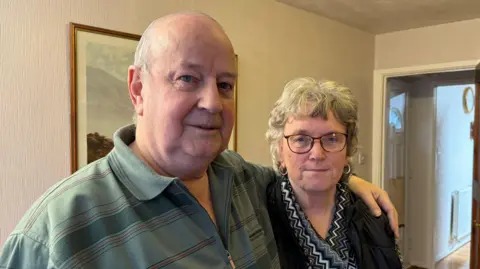
In 2017, Sandie and David Beatty, from Bingham in Nottinghamshire, paid Safe Hands £3,395 to cover the funeral costs for the first of them to die.
Sandie said they felt “angry, disappointed, sick” when the firm collapsed.
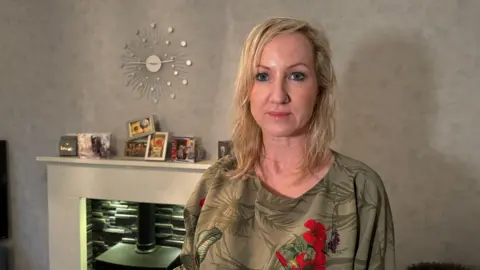
Aimee Geary, an NHS worker from Anstey in Leicestershire, paid £3,000 to Safe Hands in 2017.
Geary said: “Other people thought I was young [to be planning my funeral]. I’m very organised, and I didn’t want anyone else to have a job when I’m not here.
“It’s sad that you try to plan something and it has been taken away from you.”

Home sales made a small gain to start the year, but higher mortgage rates now could throw cold water on the spring season.
Existing home sales in February rose 1.7% from January to a seasonally adjusted, annualized rate of 4.09 million units, according to the National Association of Realtors. Sales were down 1.4% from February of last year.
This count represents closed sales, so deals were likely inked in December and January, when mortgage rates fell a bit and stayed solidly in a low range near 6% on the 30-year-fixed mortgage. Rates were about a full percentage point higher the year before.
“Despite the modest gain in home sales, actual housing demand remains muted relative to wage growth and job gains,” Lawrence Yun, chief economist for the Realtors, said in a release. “Wage growth is now outpacing home price growth by almost four percentage points. Mortgage rates are also measurably lower compared to a year ago.”
Yun also noted that there are over 6 million more jobs now than there were in 2019, yet home sales per year are down by 1 million.
Lower mortgage rates helped improve affordability slightly, but low inventory is still a significant headwind. There were 1.29 million units for sale at the end of February, an increase of 2.4% from January and 4.9% from February 2025. At the current sales pace, that is a 3.8-month supply, unchanged from January. A six-month supply is considered a balanced market between buyer and seller.
More sellers who delisted their homes last fall, due to slower sales and weak consumer confidence, are relisting their homes now, according to Redfin, a real estate brokerage. Nearly 45,000 homes that were delisted last year were relisted for sale in January. That is the highest January figure since Redfin began tracking this metric a decade ago and represents a record 3.6% of homes that were on the market in January.
“Inventory is growing, but sluggishly,” Yun said. “If demand picks up notably in the coming months and outpaces supply growth, home prices will inevitably rise. That is why increasing supply is so important to help limit home price growth, improve housing affordability, and boost transactions.”
Tight supply, however, is keeping prices just barely higher. The median price of a home sold in February was $398,000, an increase of 0.3% year over year. Sales continue to be strongest in the highest price category, properties listed at $1 million or above. Sales were down sharply on the lowest end of the market.
It continues to take longer to sell a home, at 47 days, up from 42 days one year ago. First-time buyers represented 34% of total sales, an increase from 31% a year ago. Investors made up 16% of sales, unchanged from a year ago.

Business
FDA approves leucovorin as first drug for rare genetic disorder, after touting it as autism treatment

The Food and Drug Administration on Tuesday approved a decades-old prescription vitamin called leucovorin as the first treatment for a rare genetic disorder in certain adults and children.
The move comes months after the Trump administration touted leucovorin as a potential therapy for a broader group of patients with autism spectrum disorder symptoms. The claim sparked skepticism among some in the medical and research community, but fueled excitement among families, spiking prescriptions of the drug in the U.S.
One FDA official told reporters Monday that “we don’t have sufficient data to say that we could establish efficacy for autism more broadly” but said the agency is open to interest from companies in studying leucovorin in the autism population.
The medication, also referred to as folinic acid, is a synthetic form of vitamin B9 that has been used to treat the toxic side effects of chemotherapy. Just a handful of small trials have suggested that leucovorin could be effective as an off-label treatment for children with autism, and some families have reported that it helped their nonverbal kids develop more language and social skills.
FDA officials, who requested anonymity to discuss the decision, told reporters Monday that they started with a broad review of leucovorin as an autism treatment before narrowing its approval to a smaller population with cerebral folate deficiency, a rare genetic mutation that prevents folate – a key vitamin – from properly reaching the brain.
The condition shares overlapping features with autism, typically develops in young children under age 2 and can cause severe developmental delays, seizures, a lack of muscle control and other serious neurological complications.
The officials said the FDA found that using leucovorin in patients with that condition produced the “highest quality data” to support an expanded approval, which will apply to both generic versions of the drug and GSK’s old branded medication, Wellcovorin.
“That was the data where we saw the largest effect sizes,” one FDA official said on the call. “So we narrowed in on that population, just because we felt like that was the strongest both scientific rationale and also the largest treatment effects that could be used to then overcome some of the limitations in the data sources.”
The approval was based on a systematic review of published literature on the area, including patient case reports, but not a randomized controlled clinical trial. The same official acknowledged there can be biases with systematic reviews, but emphasized that the treatment effects were so large that they outweighed those concerns.
The FDA is encouraging existing manufacturers of leucovorin to increase production to match higher demand for the drug, the officials added. While GSK originally marketed the drug from 1983 until 1997, the company said in September that it has no plans to relaunch and manufacture the product itself.
In a release Tuesday, Dr. Tracy Beth Hoeg, acting director of the FDA’s Center for Drug Evaluation and Research, said the approval demonstrates the FDA’s commitment to “rapidly identifying effective treatments for ultra rare diseases while maintaining the same evidentiary standards for approval.”


Pete Hegseth Is Pushing Defense Employees to Volunteer With DHS

White House contradicts claim of US Navy escort in Hormuz Strait
White House contradicts claim of US Navy escort in Hormuz Strait

-

 Politics3 days ago
India let Iran warship dock the day US sank another off Sri Lanka, say officials
-

 Sports4 days ago
Pakistan set for FIH Pro League debut | The Express Tribune
-

 Entertainment3 days ago
Harry Styles kicks off new era with ‘One Night Only’ comeback show
-
 Business4 days ago
Restaurant group changes name after bid to buys pubs across the UK
-
 Business1 week ago
Labour parliamentarians urge UK Government to oppose Rosebank oil field
-
 Business4 days ago
Home heating oil: ‘Most of my pension has gone on home heating oil’
-

 Sports4 days ago
Winners and losers of the 2026 NHL trade deadline
-

 Sports1 week ago
USA vs. Argentina (Mar 1, 2026) Live Score – ESPN