

Tech
Render Networks unveils synchronised agentic critical infrastructure architecture | Computer Weekly


Render Networks has made further expansion of its footprint as a system of execution for critical infrastructure with the ClearWay platform.
As infrastructure investment accelerates across fibre broadband, electric grid modernisation, distributed energy and AI-driven datacentre expansion, capital discipline has emerged as a defining concern, according to the company.
Render has stated that traditional methods of data analysis and manual decision-making often hamper progress, with deployment risk now consequentially translating directly into capital risk. It added that operators, utilities and builders must reduce variance, accelerate cash conversion and establish audit-grade accountability across increasingly complex, multi-asset deployments.
Originally establishing itself in telecommunications, Render now supports electric utilities and multi-utility environments where construction accuracy is a prerequisite for operational reliability. Built for infrastructure environments where governance is “non-negotiable”, ClearWay is claimed to advance automation without eroding engineering authority.
The new platform is built to transform design data into live scopes of work, to capture verified field progress in real-time and to econcile workflows to maintain financial integrity. This is seen as producing defensible as-built records that flow “seamlessly” into operations. Rather than a collection of isolated AI features, ClearWay is said to operate across a federated system of specialised agents designed to operate autonomously in identity, policy and audit controls.
Each agent operates with a uniquely defined degree of autonomy, managed identity and least-privilege access. As additional ClearWay agents are introduced, the system is built to support progressively higher levels of autonomy, bounded by deterministic guardrails derived from user-defined operational policies. The result is that decision-making choices are underpinned by controlled, auditable automation that preserves first-order accountability while also enabling meaningful scale.
The first release of ClearWay scheduled for release in the second quarter of 2026 and is scheduled to introduce field assurance and work approval capabilities across telecom and electric deployments with an assurance agent and approval agent.
The former is said to validate field-captured evidence against planned work in real-time, ensuring accuracy before crews leave the site. By contrast, the latter approves work autonomously based on a correlation of work type, planned vs. actual units, photos, and test results. When predefined criteria are met, the agent processes the approval and escalates exceptions only when human review is required.
By ensuring work is correct and defensible at the point of execution, Render is confident that ClearWay can accelerate design to build lead times, reduce construction rework, accelerate closeout and improve working capital velocity. This will be “particularly vital” in broadband and grid modernisation environments, where construction accuracy directly affects serviceability, network reliability and regulatory compliance.
“We have always focused on ensuring that work in the field becomes verified operational truth. The next step is ensuring that truth drives disciplined, governed and rapid action across the lifecycle,” said Stephen Rose, CEO of Render Networks.
“As capital efficiency becomes central to telecom and electric infrastructure, automation must ensure rapid decisions are made well to reinforce control and accountability. ClearWay is designed to do exactly that.”
Render will introduce additional specialised agents in the ClearWay architecture, spanning lifecycle management and financial reconciliation, service activation and operational monitoring, and predictive maintenance and sustainability governance.

David Silver gave the world its very first glimpse of superintelligence.
In 2016, an AI program he developed at Google DeepMind, AlphaGo, taught itself to play the famously difficult game of Go with a kind of mastery that went far beyond mimicry.
Silver has since founded his own company, Ineffable Intelligence, that aims to build more general forms of AI superintelligence. The company will do this, Silver says, by focusing on reinforcement learning, which involves AI models learning new capabilities through trial and error. The vision is to create “superlearners” that go beyond human intelligence in many domains.
This approach stands in contrast to how most AI companies plan to build superintelligence, by exploiting the coding and research capabilities of large-language models.
Silver, speaking to WIRED from his office in London, says he thinks this approach will fail. As amazing as LLMs are, they learn from human intelligence—rather than building their own.
“Human data is like a kind of fossil fuel that has provided an amazing shortcut,” Silver says. “You can think of systems that learn for themselves as a renewable fuel—something that can just learn and learn and learn forever, without limit,” he says.
I’ve met Silver a few times and—despite this proclamation—he’s always struck me as one of the more humble people in AI. Sometimes, when talking about ideas he considers silly, he flashes a puckish grin. Right now, though, he’s deadly serious.
“I think of our mission as making first contact with superintelligence,” he says. “By superintelligence I really mean something incredible. It should discover new forms of science or technology or government or economics for itself.”
Five years ago, such a mission might have seemed ridiculous. But tech CEOs now routinely talk about machines outpacing human intelligence and replacing entire categories of workers. The idea that some new technical twist might unlock superhuman AI capabilities has recently spawned a raft of billion-dollar startups.
Ineffable Intelligence has so far raised $1.1 billion in seed funding at a valuation of $5.1 billion—an enormous sum by European AI standards. Silver has also recruited top AI researchers from Google DeepMind and other frontier labs to join his endeavor.
Silver says he will give all of the money he makes from equity in Effable Intelligence—a sum that could amount to billions if he is successful—away to charity.
“It’s a huge responsibility to build a company focusing on superintelligence,” he tells me. “I think this is something that has to be done for the benefit of humanity, and any money that I make from Ineffable will will go to high-impact charities that save as many lives as possible.”
Total Focus
Silver met Demis Hassabis, the CEO of Google DeepMind, at a chess tournament when they were kids, and the pair later became lifelong friends and collaborators.
They remained close after Silver left Google DeepMind, which he did only because he wanted to chart a completely new path. “I feel it’s really important that there is an elite AI lab that actually focuses a hundred percent on this approach,” he says. “That it’s not just a corner of another place dedicated to LLMs.”
The limits of the LLM-based approach can be seen, Silver says, with a simple thought experiment. Imagine going back in time and releasing a large language model in a world that believed the world was flat. Without being able to interact with the real world, the system, he says, would remain an avid flat-earther, even if it continued to improve its own code.
An AI system that can learn about the world for itself, however, could make its own scientific discoveries.
The best iPhone charger depends on several factors. Are you topping off your battery on the go? Do you want to charge your iPhone as quickly as possible? Are you charging it overnight on your nightstand? The best gear recommendation is going to change with the situation. Luckily, the WIRED Reviews team tests iPhone chargers in the field all year long. There’s not a day that goes by that at least one of us is not assessing at least one iPhone charger. I’ve gathered up our favorite picks for every scenario.
Be sure to check out our related buying guides, like the Best Power Banks, the Best 3-in-1 Chargers, and the Best Wireless Chargers.
Table of Contents
The Best iPhone Chargers
Best Wall Charger for iPhone
This Anker charger is slick and has folding prongs so it’s easy to travel with, but the best part is that it can charge your phone at 40 watts (average is 20 to 27 watts). That means you can get up to 50 percent battery life in only 20 minutes. Not all iPhone models support charging this fast—it’s limited to iPhone 17, iPhone 17 Pro, and iPhone 17 Pro Max—but you may as well future-proof your gear if you’re shopping for a wall charger, even if your phone can’t take full advantage of those speeds yet.
Best Power Bank for iPhone
-Portable-Charger-Reviewer-Photo-(no-border)-SOURCE-Simon-Hill.jpg)
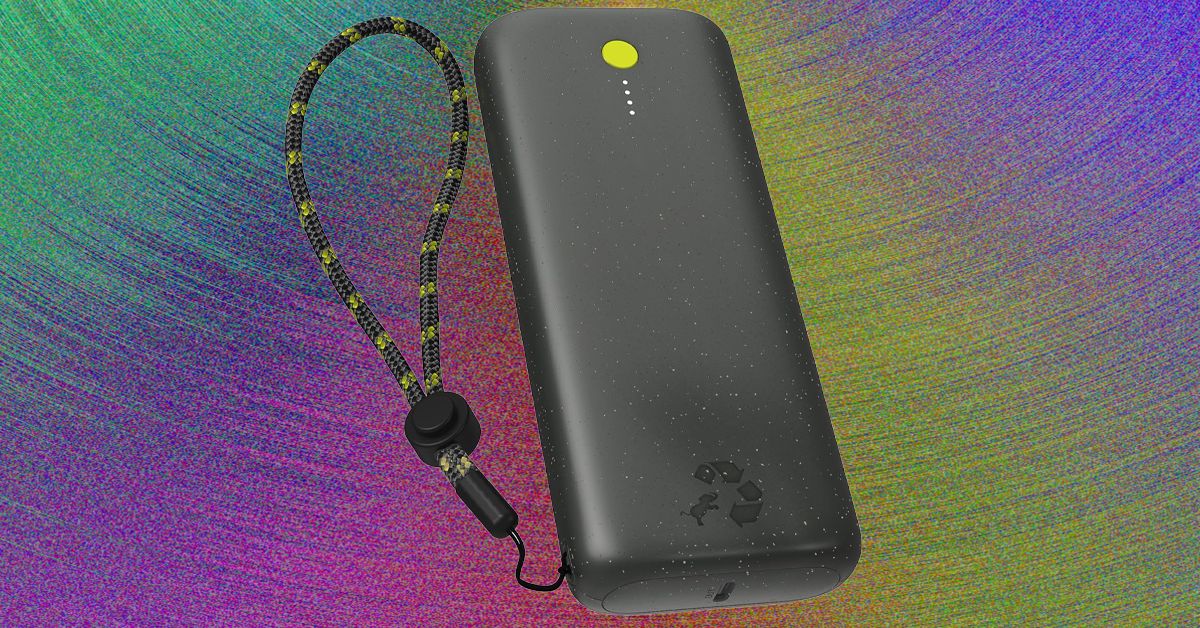
We do recommend the Anker Laptop Power Bank as our top-pick power bank, but if you’re only trying to top off your iPhone, this is a very reliable and neat-looking power bank. It’s svelte, smaller than a deck of cards, and can deliver 20 watts to two devices at once. Nimble also makes a slightly larger version, which has a larger capacity and can charge at up to 65 watts. Aside from the cool design featuring speckled colors and a lanyard loop, Nimble also uses bioplastics, recycled materials, and minimal packaging. A USB-C charger is included in the box.
Best MagSafe Portable Charger for iPhone
.jpg)
Anker
MagGo Power Bank (10K) (Qi2)
This 10,000-mAh power bank can charge your device at up to 15 watts, but it’ll also charge older devices at a slower rate. It has a built-in kickstand and an LED display that lets you know how much power is left at a glance. It works in portrait or landscape modes. Be aware that it won’t be able to charge most phones fully more than once, but it’s hard to beat if you’re seeking wireless charging on the go. If you want a bigger capacity or faster charging, you don’t want MagSafe.
Best 3-in-1 Charger for iPhone

Belkin
3-in-1 Qi2 Charging Stand
The Belkin 3-in-1 can charge your compatible iPhone at 15 watts, plus your AirPods and your Apple Watch at the same time. The charging pad can be tilted to your preferred angle, including in landscape orientation if you want to watch a video or put your phone in StandBy mode. The USB-C cable is permanently attached, which you may or may not like. Check our best 3-in-1 chargers buying guide for additional picks.
Best 2-in-1 Charger for iPhone

Photograph: Louryn Strampe
Mophie
2-in-1 Wireless Charging Stand
I love a 3-in-1 charger as much as the next tech nerd, but sometimes they’re overkill. My Apple Watch battery usually lasts all day long, but I can chew through my older AirPods battery before my lunch break hits, and my iPhone battery might be depleted too, depending on whether or not I’m streaming Max Velocity off to the side. This 2-in-1 charger has been my steadfast desktop companion. Mophie makes another version that tops off your Apple Watch and iPhone instead of your headphones, which might be what you want if you’re rocking wired headphones or you’re making intense use of a walking pad throughout the day. There’s a 40-watt wall charger in the box—a rarity these days!—plus a USB-C cable that winds neatly into the base. It’s easy to adjust the angle of your iPhone as well, and I’ve found the base very sturdy. If you want to charge, but not necessarily all of the possible devices simultaneously, these might be what you seek.

Anker
Prime USB-C to USB-C Cable
This braided nylon USB-C cable has a durable exterior made from recycled plastic. The cable is rugged, with Anker promising that it can operate in temperatures ranging from negative 40 degrees to 176 degrees Fahrenheit. It’s backed by a lifetime warranty. It’s got a built-in cable management loop. It’s more than enough cable for your iPhone. Read our guide to the Best USB-C Cables for more picks.

Ugreen
USB-C to Lightning Cable
If your iPhone is still rocking the Lightning cable, this is gonna be way better than whatever shoddy cable Apple sent you. It’s durable and is Made for iPhone-certified, so you won’t have any problems getting it to work. It comes in 3-, 6-, or 10-foot lengths with a two-year warranty. Best of all, the exterior casing will stay intact, unlike what you’d probably get with Apple’s cables.
Government figures for projected carbon footprint for datacentres have been miscalculated. New figures for the likely carbon output resulting from electricity use by datacentres published last week have been revised upwards by around 100x for the minimum and maximum projected.
Last July, the Department for Science, Innovation & Technology (DSIT) published its Compute evidence annex, which set out the future for AI, compute demand and implications for carbon footprint. The DSIT has since unpublished the original report, but it can still be found here.
The document said: “We estimate that by 2035, the UK’s greenhouse gas emissions from AI compute could range from 0.025 to 0.142 MtCO₂ [millions of tonnes of CO₂] – this is below 0.05% of the UK’s projected total emissions.”
But in a correction to that document, the DSIT said last week: “The UK’s cumulative 10-year greenhouse gas emissions from AI compute could range from 34 to 123 MtCO₂ – this is around 0.9-3.4% of the UK’s projected total emissions over the 10-year period.”
The figures were miscalculated to a staggering degree. The earlier numbers appear to have been annual and the recent revision a 10-year figure, which makes an increase in the estimate of around 100x.
Meanwhile, analysis by climate change science and policy research group Carbon Brief suggests even those figures might be optimistic. Core to that belief is that the government aim is for 50gCO2/kWh by 2030. That figure is what can be achieved by “clean” sources of energy, such as wind, nuclear, hydro and solar.
But figures from last month – researched by Carbon Brief and published with environmental campaigners Foxglove – suggest that is a wildly optimistic estimate if any of that power generation needs to be powered by gas, as gas-powered electricity generation comes with a carbon intensity of around 10x that of clean sources.
Carbon Brief has calculated that emissions could in fact be somewhere between 3.4 MtCO₂ using 5% gas, and 68.1 MtCO₂ if electricity was 95% gas-generated. The higher figure – not far off the annual carbon emissions of Sweden – comes from an estimate based on a recent Ofgem projection of 20GW of future datacentre electricity demand. The same document illustrated the scale of demand by reference to actual peak demand in February 2026 of 45GW.
Ofgem’s 20GW is a projection based on National Energy System Operator research that asked customers about future grid connection requirements.
Foxglove head of strategy Tim Squirrell said: “The government has a legally binding commitment to reach net zero by 2050. This already sat awkwardly alongside its hell-for-leather embrace of a hyperscale AI datacentre buildout, which unchecked could double the electricity consumption of the entire country.
“The situation has now been revealed to be much, much worse, given the fact the government doesn’t seem to have done even the most basic arithmetic needed to measure the potential new carbon emissions of these datacentres. The government urgently needs to confront the reality that it can’t rubber stamp hundreds of new datacentres, whilst keeping its manifesto promise to the country – and legal obligation – to combat the climate crisis.”
Computer Weekly has calculated that there is currently around 1.6GW of datacentre capacity in the UK, with just over 8GW currently in planning or under construction.


Domino’s Pizza stock falls on disappointing sales — and CEO thinks more chains will follow

Prince Harry makes key statement as King Charles heads to US visit

In meeting with Iranian FM, Putin pledges support for Iran

-

 Sports1 week ago
NCAA men’s gymnastics championship: All-time winners list
-

 Sports1 week ago
WWE WrestleMania 42 Night 2: Live match results and analysis
-

 Politics6 days ago
UK’s Starmer seeks to deflect blame over Mandelson appointment
-

 Fashion1 week ago
UK’s Sosandar returns to profitability amid robust FY26 performance
-
 Business1 week ago
No fuel shortage: Govt assures 100% domestic LPG, PNG, CNG supply amid Hormuz energy crunch – The Times of India
-

 Entertainment7 days ago
Lee Anderson, Zarah Sultana kicked out of UK Parliament for calling PM ‘liar’
-
 Business7 days ago
How Trump’s psychedelics executive order could unlock stalled cannabis reform
-
 Business1 week ago
Exercise to test response to offshore energy threat involving vessels and drones