Widespread concern about the use of creative works to train artificial intelligence (AI) systems has prompted the UK government to begin exploring how the country’s copyright rules can be changed to satisfy the complex, often conflicting demands of both the creative and tech sectors.
The options being assessed include keeping copyright and related laws remain as they are; strengthening copyright to require licenses in all cases; implementing a broad data mining exemption for AI companies; or creating a more limited data mining exemption that allows copyright holders to reserve their rights, underpinned by measures to promote and support greater transparency from developers.
However, given structural imbalances within existing copyright markets – which favour giant corporations over individual creators – it is unclear to what extent the AI-related reforms to the UK intellectual property rules being considered will help creative workers themselves.
Creators vs AI developers
Questions around the use of creative works to train AI systems have become one of the most intense areas of debate since the advent of generative AI (GenAI) and large language models (LLMs) with the release of OpenAI’s ChatGPT in November 2022.
Aside from a lack of transparency from AI companies about the data included in their training corpuses, creatives have variously complained about the absence of enforceable mechanisms to protect their copyrighted works within the context of scraping at scale, as well as the impacts of AI on creative job markets and competition.
For AI companies, on the other hand, access to vast amounts of high-quality data is of paramount importance, particularly when it comes to the development of LLMs such as Claude, ChatGPT or Gemini.
A submission to the US Copyright Office on 30 October 2023 by Amazon and Google-backed LLM developer Anthropic is indicative of how these firms view their use of copyrighted material, and how integral it is for creating generative AI models.
“To the extent copyrighted works are used in training data, it is for analysis (of statistical relationships between words and concepts) that is unrelated to any expressive purpose of the work,” it said. “This sort of transformative use has been recognised as lawful in the past and should continue to be considered lawful in this case.”
It added that using copyrighted works to train its Claude model would count as “fair use”, because “it does not prevent the sale of the original works, and, even where commercial, is still sufficiently transformative”.
As part of a separate legal case brought against Anthropic by major music publishers in November 2023, the firm took the argument further, claiming “it would not be possible to amass sufficient content to train an LLM like Claude in arm’s-length licensing transactions, at any price”.
It added that Anthropic is not alone in using data “broadly assembled from the publicly available internet”, and that “in practice, there is no other way to amass a training corpus with the scale and diversity necessary to train a complex LLM with a broad understanding of human language and the world in general”.
If licences were required to train LLMs on copyrighted content, today’s general-purpose AI tools simply could not exist Anthropic
“Any inclusion of plaintiffs’ song lyrics – or other content reflected in those datasets – would simply be a byproduct of the only viable approach to solving that technical challenge,” it said.
It further claimed that the scale of the datasets required to train LLMs is simply too large to for an effective licensing regime to operate: “One could not enter licensing transactions with enough rights owners to cover the billions of texts necessary to yield the trillions of tokens that general-purpose LLMs require for proper training. If licences were required to train LLMs on copyrighted content, today’s general-purpose AI tools simply could not exist.”
While the submission and the court case are specific to the US context, the application of “fair use” exemptions to copyright is not dissimilar in UK. Under current UK copyright laws, original works are automatically protected upon their creation, giving the creators exclusive rights to copy, distribute, perform or adapt their work.
There are, however, limited exemptions that allow the “fair dealing” of copyrighted material for the purposes of, for example, research, criticism, review and reporting. A further exemption was added in 2014, allowing text and data mining for purely non-commercial research purposes.
As it stands, unless one of these exemptions applies, AI companies would therefore need to obtain permission from copyright holders to use these works in their model’s training data.
UK government consultation backlash
According to a previous UK government consultation on the matter, which closed in February 2025, “the application of UK copyright law to the training of AI models is disputed”.
It said that while rights holders are finding it difficult to control the use of their works in training AI models, and are seeking to be remunerated for its use, AI developers are similarly finding it difficult to navigate copyright law in the UK. It noted “this legal uncertainty is undermining investment in and adoption of AI technology”.
In an attempt to solve the dispute, the UK government proposed a new policy in late 2024 that would allow AI companies to train their models on copyrighted works unless rights holders explicitly opted out. This means that, rather than requiring AI companies to seek permission from rights holders for the use of their work, the burden would be placed on the creators themselves to actively object.
The opt-out proposal provoked significant backlash from creatives, who viewed it as too conciliatory to the narrow interests of tech companies. Out of the more than 10,000 people that responded to the government’s consultation on these measures, just 3% backed it’s opt-out proposal, while 95% called for either called for copyright to be strengthened, a requirement for licensing in all cases, or no change to current copyright law.
Others cited issues around the practicality of such proposals, noting that in the context of the current digital landscape – where copyrighted content is scraped at scale and included in training datasets, often without attribution – it may be impossible for someone to know when their work has been used, let alone opt out.
In the wake of this widespread opposition, the UK government has since committed to exploring a licence-first system that would require AI companies to seek explicit permission from creatives and provide them with compensation.
Balancing interests?
A year later, in December 2025, technology secretary Liz Kendall told Parliament there was “no clear consensus” on the AI-copyright issue, saying that the government would “take the time to get this right” while promising to make policy proposals by 18 March 2026.
“Our approach to copyright and AI must support prosperity for all UK citizens, and drive innovation and growth for sectors across the economy, including the creative industries,” she said. “This means keeping the UK at the cutting edge of science and technology so UK citizens can benefit from major breakthroughs, transformative innovation and greater prosperity. It also means continuing to support our creative industries, which make a huge economic contribution, shape our national identity and give us a unique position on the world stage.”
While government rhetoric on AI and copyright has revolved around the need to support both the UK’s creative and tech sectors, there is a sense that – so far at least – it is prioritising the latter in its ambition to make the country a tech superpower.
Beeban Kidron, a crossbench peer and former film director, for example, has previously described the use of copyrighted material by AI companies as “state-sanctioned theft”, claiming ministers would be “knowingly throwing UK designers, artists, authors, musicians, media and nascent AI companies under the bus” if they don’t move to protect their output from being harvested by AI firms.
Owen Meredith, chief executive of the New Media Association, has also previously urged the UK government to rule out any new copyright exception. “This will send a clear message to AI developers that they must enter into licensing agreements with the UK’s media and creative copyright owners, unlocking investment and strengthening the market for the high-quality content that is the most valuable ingredient in producing safe, trustworthy AI models,” he said.
Ed Newton-Rex, a prominent commentator on AI and intellectual property, has also criticised the balance of UK government’s approach, noting that while the government described its consultation proposals at the time as a “win-win … this is very far from the truth. It would be a huge coup for AI companies, and the most damaging legislation for the creative industries in decades”.
He added that a broad copyright exception that allows unlicensed training on copyrighted “would hand the life’s work of the UK’s creators to AI companies, letting them use it to build highly scalable competitors to those creators with impunity”.
[A broad copyright exception] would hand the life’s work of the UK’s creators to AI companies, letting them use it to build highly scalable competitors to those creators with impunity Ed Newton-Rex, AI and intellectual property commentator
AI companies, of course, disagree. In its October 2023 submission to the US Copyright Office, Anthropic argued that requiring licences would be inappropriate, as it would lock up access to the vast majority of works and benefit “only the most highly resourced entities” that are able to pay their way into compliance
“Requiring a licence for non-expressive use of copyrighted works to train LLMs effectively means impeding use of ideas, facts and other non-copyrightable material,” it said. “Even assuming that aspects of the dataset may provide greater ‘weight’ to a particular output than others, the model is more than the sum of its parts. Thus, it will be difficult to set a royalty rate that is meaningful to individual creators without making it uneconomical to develop generative AI models in the first place.”
Others from the tech sector have also argued that diverging from other jurisdictions too greatly – for example, by implementing a UK-specific licensing arrangement preferred by the creative sector, or requiring firms to disclose detailed data inputs – would simply mean AI companies avoid deploying in the UK.
Trade association TechUK, for example, argued that in the context of AI-copyright related amendments to the government Data Use and Access Bill – which would have forced developers to publish their training corpuses but which were ultimately not included in the final Act of Parliament – departing too much from existing UK and international frameworks would risks companies being “discouraged from operating, training and deploying AI products and models in the UK”.
This was also recognised by the government in its consultation, which noted requiring licenses in all cases “is highly likely to make the UK significantly less competitive compared to other jurisdictions – such as the EU and US – which do not have such restrictive laws. This would make the UK a less attractive location for AI development, reducing investment in the sector. In doing so, it may not actually increase the level of licensing undertaken by AI firms.”
It added that models trained in other jurisdictions which do not meet any new UK standards may be difficult to restrict from the UK market, and risks some of the most capable AI models not being made available in the UK: “This would significantly limit innovation, consumer choice and wider benefits of AI adoptions across the UK economy.”
The technical caveats of copyright law
Under UK copyright law, it should be noted that creating “transient copies” of works is allowed if certain conditions are met. This includes if it’s not a permanent copy and serves a brief, ancillary purpose; if it’s a necessary step in a technological process; if its only goal is enabling lawful use or network transmission; and the copy itself doesn’t hold separate commercial value.
When looking at AI model training processes – which often, but not always, retain only a very small portion of each training item – this indicates it would be technically wrong to assert a copyright infringement has taken place, as Anthropic has argued in the context of the US.
However, this doesn’t mean that a model would never infringe copyright, as it is also technically possible for most models to “memorise” copyrighted works, turning a transitory copy into a permanent, infringing one.
Although the specificities of whether a particular model or AI-generated output infringes this current copyright regime will be hashed out in individual court cases, some have argued that looking for copyright to solve the tension between creatives and AI companies is a non-starter.
In their book Chokepoint capitalism: How big tech and big content captured creative labor markets and how we’ll win them back, for example, authors Cory Doctorow and Rebecca Giblin argue that while the past 40 years have been spent elaborating international copyright rules, the financial benefits of this have largely accrued to big business rather than creators themselves, whose share of growing entertainment industry profits have declined in that time.
In essence, their argument is that expanding copyright is very unlikely to protect the jobs or incomes of already underpaid creatives, who have themselves been exploited by entertainment behemoths wielding copyright laws against them for decades.
In their May 2024 book, Who owns this sentence? A history of copyright and wrongs, authors Alexandre Montagu and David Bellos similarly argue that copyright protections – which were originally intended to protect the livelihoods of individual creators – have since been transferred to giant corporations instead, which use them to extract a form of “rent” from consumers globally, while also locking the employees who helped contribute to the creation of the IP out from ownership and the consequent benefits.
It follows, then, that there is little reason to believe these same companies will now treat their creative workers more fairly if they receive compensation as a copyright holder from AI companies.
To alter this dynamic, Doctorow and others argue it would require changing the very structure of creatives markets so that the benefits accrue to creatives, rather than large corporations that essentially run “tollbooths” to facilitate and control access to creative’s work, which in turn allows them to extract disproportionally high profits for themselves.
Writing for the Electronic Frontier Foundation (EFF) in February 2025, Tori Noble argued that “expanding copyright will not mitigate” the harm to creative workers, and that “what neither Big Tech nor Big Media will say is that stronger antitrust rules and enforcement would be a much better solution”.
She added that looking beyond copyright can future-proof protections, including stronger environmental protections, comprehensive privacy laws, worker protections and media literacy, adding: “[This will] create an ecosystem where we will have defences against any new technology that might cause harm in those areas, not just generative AI. Expanding copyright, on the other hand, threatens socially beneficial uses of AI – for example, to conduct scientific research and generate new creative expression – without meaningfully addressing the harms.”
Collective copyright and labour law
As it currently stands, UK government looks to be on course to introduce a new licensing regime for AI companies’ use of copyrighted materials. Observers have said this would need to include mechanisms that allow creators to identify when and how their works are used, as well as to object or seek compensation as they see fit.
However, given the clear tensions that already exist between individual and corporate copyright holders, even a licensing regime could still disproportionally benefit the latter. It could also disproportionally benefit large AI developers, as the pool of actors with the ability to pay for enough copyright licenses to effectively train a model is vanishingly small.
The use of AI in creative endeavours throws up further issues around labour and competition: even if creators received compensation for the use of their copyrighted material, AI’s entire development is underpinned by a neoliberal logic of austerity. This means that, in the current political-economic context, those with the decision-making power to deploy AI largely do so because it allows them to cut labour costs – the biggest overhead for any capitalist enterprise.
In the current political-economic context, those with the decision-making power to deploy AI largely do so because it allows them to cut labour costs – the biggest overhead for any capitalist enterprise
In November 2024, data from the Harvard Business Review showed the impact that generative AI models were already having on labour markets, which highlights how creatives will essentially end up competing with the very models that ingest their data. Specifically, it highlighted how the introduction of ChatGPT decreased writing and coding jobs by 30% and 20% respectively, while AI image generators similarly decreased image creation jobs by 17%.
Given the sheer scale at which models ingest data, it is not hard to see how creatives – even with a licensing regime in place – could be undermined by bosses who would rather pay for a relatively cheap corporate licence to an AI model, rather than the comparatively expensive labour of human beings.
While many argue that the advent of AI is inevitable, its impacts are certainly not. In November 2023, for example, the Autonomy think tank in the UK argued that while automating jobs with LLMs could lead to significant reductions in working time without a loss of pay or productivity, realising the benefits of AI-driven productivity gains in this way will require concerted political action.
The think tank added this was because it is clear that productivity gains are not always shared evenly between employers and employees, and depend on “geographic, demographics, economic cycle and other intrinsic job market factors” such as workers’ access to collective bargaining.
To deliver positive AI-led changes for workers and not just employers, Autonomy recommended setting up “automation hubs”, underpinned by trade union and industry agreements, to boost the adoption of LLMs in ways that are equitable.
In the context of the creative industries and copyright, a similar situation has already taken place with the 2023 Hollywood writers’ strike, whose collective sector-wide action ended with an agreement from studios that AI cannot be used to write or rewrite scripts, and which gave them the ability to prohibit the use of their writing in model training.
Instead of replying purely on copyright law – which historically has been wielded against individual creatives by entertainment and media companies – the answer may be found in attempting to build up collective copyright mechanisms and improving the underlying labour protections for creative workers to stop them being ripped off by companies, with or without the help of AI.
The latest brain-computer interface could help people recover from severe depression. Motif Neurotech announced Monday that the US Food and Drug Administration has approved a human study to trial the company’s blueberry-sized brain implant that sits in the skull and delivers electrical stimulation to treat depression.
The Houston-based startup, founded in 2022, is part of a budding industry pursuing technology to read and interpret brain signals. While other companies exploring similar technology, like Elon Musk’s Neuralink, Paradromics, and Synchron, are developing devices to enable paralyzed people to communicate and use computers, Motif is aiming to ease depression in people who have not benefited from medication.
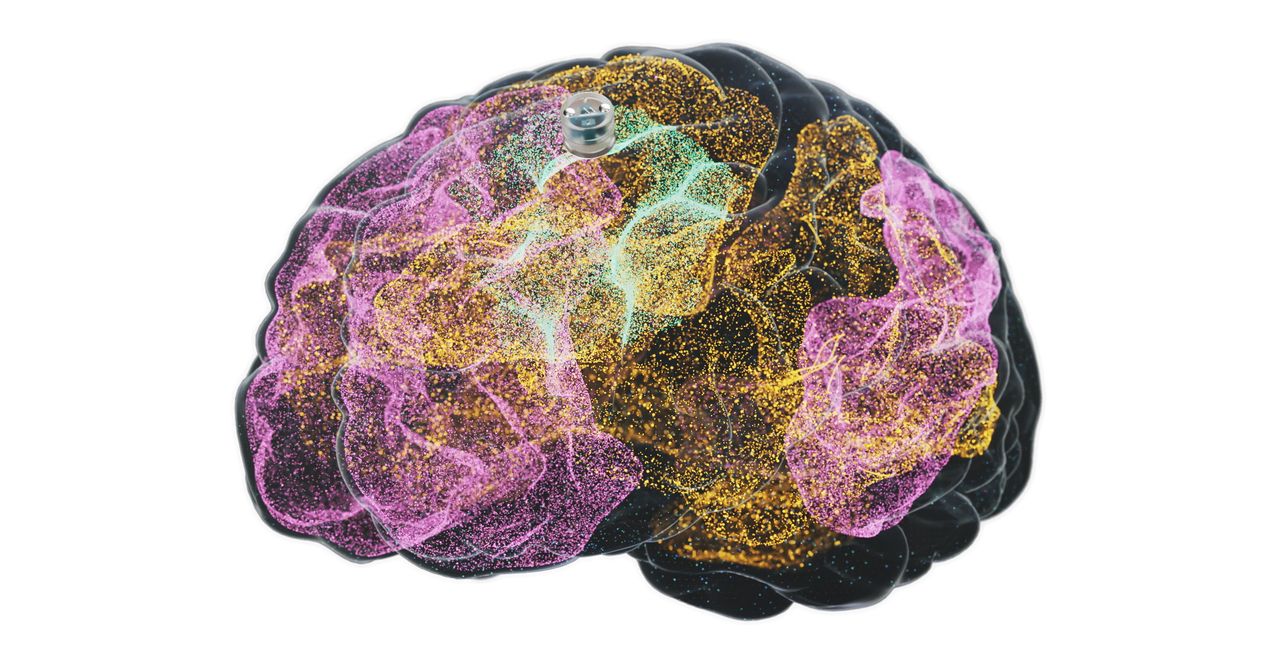
The company’s device is implanted in the skull just above the dura, the brain’s protective membrane. It targets the central executive network, a part of the brain that is responsible for high-level cognitive functions and is underactive in major depressive disorder. The implant emits specific patterns of stimulation to turn “on” this network.
Motif’s device would allow patients to receive therapeutic brain stimulation at home. “Through frequent electrical stimulation, we think we can drive that neuroplasticity that creates stronger connectivity within the central executive network for patients with depression, so that they can get out of bed in the morning, call their friends, go to the gym,” says Jacob Robinson, Motif’s cofounder and CEO.
Courtesy of Motif
Electrical stimulation has been used for decades to treat depression, and Motif’s approach is just the latest iteration. Electroconvulsive or “shock” therapy began in the 1930s and is still used today in cases where patients don’t benefit from antidepressants. Deep brain stimulation, which involves surgically implanting electrodes into the brain, is occasionally used experimentally but is not FDA approved. A much milder form of stimulation known as transcranial magnetic stimulation, or TMS, was approved in 2008. While it can be highly effective, it typically requires a lengthy treatment regimen of five treatments a week for six weeks.
A study from 2021 found that during a 12-month period in the United States, nearly 9 million adults were undergoing treatment for major depressive disorder, and of those, almost 3 million were considered to have treatment-resistant depression, when symptoms do not improve after at least two, and often more, antidepressant medications.
Motif’s device can be implanted in a 20-minute outpatient procedure without the need for brain surgery. It’s powered by wireless magnetoelectric technology that Robinson developed while at Rice University and is charged with a baseball cap that patients will wear when receiving the stimulation.
David Silver gave the world its very first glimpse of superintelligence.
In 2016, an AI program he developed at Google DeepMind, AlphaGo, taught itself to play the famously difficult game of Go with a kind of mastery that went far beyond mimicry.
Silver has since founded his own company, Ineffable Intelligence, that aims to build more general forms of AI superintelligence. The company will do this, Silver says, by focusing on reinforcement learning, which involves AI models learning new capabilities through trial and error. The vision is to create “superlearners” that go beyond human intelligence in many domains.
This approach stands in contrast to how most AI companies plan to build superintelligence, by exploiting the coding and research capabilities of large-language models.
Silver, speaking to WIRED from his office in London, says he thinks this approach will fail. As amazing as LLMs are, they learn from human intelligence—rather than building their own.
“Human data is like a kind of fossil fuel that has provided an amazing shortcut,” Silver says. “You can think of systems that learn for themselves as a renewable fuel—something that can just learn and learn and learn forever, without limit,” he says.
I’ve met Silver a few times and—despite this proclamation—he’s always struck me as one of the more humble people in AI. Sometimes, when talking about ideas he considers silly, he flashes a puckish grin. Right now, though, he’s deadly serious.
“I think of our mission as making first contact with superintelligence,” he says. “By superintelligence I really mean something incredible. It should discover new forms of science or technology or government or economics for itself.”
Five years ago, such a mission might have seemed ridiculous. But tech CEOs now routinely talk about machines outpacing human intelligence and replacing entire categories of workers. The idea that some new technical twist might unlock superhuman AI capabilities has recently spawned a raft of billion-dollar startups.
Ineffable Intelligence has so far raised $1.1 billion in seed funding at a valuation of $5.1 billion—an enormous sum by European AI standards. Silver has also recruited top AI researchers from Google DeepMind and other frontier labs to join his endeavor.
Silver says he will give all of the money he makes from equity in Effable Intelligence—a sum that could amount to billions if he is successful—away to charity.
“It’s a huge responsibility to build a company focusing on superintelligence,” he tells me. “I think this is something that has to be done for the benefit of humanity, and any money that I make from Ineffable will will go to high-impact charities that save as many lives as possible.”
Total Focus
Silver met Demis Hassabis, the CEO of Google DeepMind, at a chess tournament when they were kids, and the pair later became lifelong friends and collaborators.
They remained close after Silver left Google DeepMind, which he did only because he wanted to chart a completely new path. “I feel it’s really important that there is an elite AI lab that actually focuses a hundred percent on this approach,” he says. “That it’s not just a corner of another place dedicated to LLMs.”
The limits of the LLM-based approach can be seen, Silver says, with a simple thought experiment. Imagine going back in time and releasing a large language model in a world that believed the world was flat. Without being able to interact with the real world, the system, he says, would remain an avid flat-earther, even if it continued to improve its own code.
An AI system that can learn about the world for itself, however, could make its own scientific discoveries.
The best iPhone charger depends on several factors. Are you topping off your battery on the go? Do you want to charge your iPhone as quickly as possible? Are you charging it overnight on your nightstand? The best gear recommendation is going to change with the situation. Luckily, the WIRED Reviews team tests iPhone chargers in the field all year long. There’s not a day that goes by that at least one of us is not assessing at least one iPhone charger. I’ve gathered up our favorite picks for every scenario.
This Anker charger is slick and has folding prongs so it’s easy to travel with, but the best part is that it can charge your phone at 40 watts (average is 20 to 27 watts). That means you can get up to 50 percent battery life in only 20 minutes. Not all iPhone models support charging this fast—it’s limited to iPhone 17, iPhone 17 Pro, and iPhone 17 Pro Max—but you may as well future-proof your gear if you’re shopping for a wall charger, even if your phone can’t take full advantage of those speeds yet.
Best Power Bank for iPhone
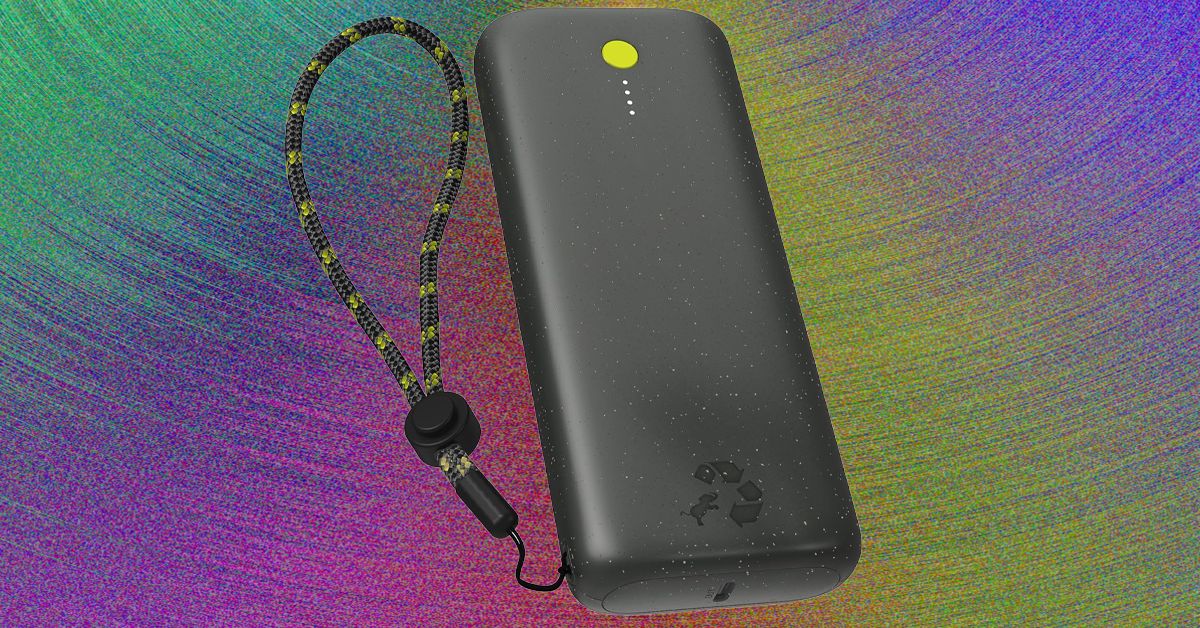
We do recommend the Anker Laptop Power Bank as our top-pick power bank, but if you’re only trying to top off your iPhone, this is a very reliable and neat-looking power bank. It’s svelte, smaller than a deck of cards, and can deliver 20 watts to two devices at once. Nimble also makes a slightly larger version, which has a larger capacity and can charge at up to 65 watts. Aside from the cool design featuring speckled colors and a lanyard loop, Nimble also uses bioplastics, recycled materials, and minimal packaging. A USB-C charger is included in the box.
Best MagSafe Portable Charger for iPhone
Anker
MagGo Power Bank (10K) (Qi2)
This 10,000-mAh power bank can charge your device at up to 15 watts, but it’ll also charge older devices at a slower rate. It has a built-in kickstand and an LED display that lets you know how much power is left at a glance. It works in portrait or landscape modes. Be aware that it won’t be able to charge most phones fully more than once, but it’s hard to beat if you’re seeking wireless charging on the go. If you want a bigger capacity or faster charging, you don’t want MagSafe.
Best 3-in-1 Charger for iPhone
Belkin
3-in-1 Qi2 Charging Stand
The Belkin 3-in-1 can charge your compatible iPhone at 15 watts, plus your AirPods and your Apple Watch at the same time. The charging pad can be tilted to your preferred angle, including in landscape orientation if you want to watch a video or put your phone in StandBy mode. The USB-C cable is permanently attached, which you may or may not like. Check our best 3-in-1 chargers buying guide for additional picks.
Best 2-in-1 Charger for iPhone
Photograph: Louryn Strampe
Mophie
2-in-1 Wireless Charging Stand
I love a 3-in-1 charger as much as the next tech nerd, but sometimes they’re overkill. My Apple Watch battery usually lasts all day long, but I can chew through my older AirPods battery before my lunch break hits, and my iPhone battery might be depleted too, depending on whether or not I’m streaming Max Velocity off to the side. This 2-in-1 charger has been my steadfast desktop companion. Mophie makes another version that tops off your Apple Watch and iPhone instead of your headphones, which might be what you want if you’re rocking wired headphones or you’re making intense use of a walking pad throughout the day. There’s a 40-watt wall charger in the box—a rarity these days!—plus a USB-C cable that winds neatly into the base. It’s easy to adjust the angle of your iPhone as well, and I’ve found the base very sturdy. If you want to charge, but not necessarily all of the possible devices simultaneously, these might be what you seek.
Anker
Prime USB-C to USB-C Cable
This braided nylon USB-C cable has a durable exterior made from recycled plastic. The cable is rugged, with Anker promising that it can operate in temperatures ranging from negative 40 degrees to 176 degrees Fahrenheit. It’s backed by a lifetime warranty. It’s got a built-in cable management loop. It’s more than enough cable for your iPhone. Read our guide to the Best USB-C Cables for more picks.
Ugreen
USB-C to Lightning Cable
If your iPhone is still rocking the Lightning cable, this is gonna be way better than whatever shoddy cable Apple sent you. It’s durable and is Made for iPhone-certified, so you won’t have any problems getting it to work. It comes in 3-, 6-, or 10-foot lengths with a two-year warranty. Best of all, the exterior casing will stay intact, unlike what you’d probably get with Apple’s cables.



-Portable-Charger-Reviewer-Photo-(no-border)-SOURCE-Simon-Hill.jpg)
.jpg)






 Sports1 week ago
 Sports1 week ago
 Politics7 days ago
 Fashion1 week ago
 Entertainment1 week ago


 Sports1 week ago