

Politics
US Navy drone fleet effort aimed at China runs aground in failed trials

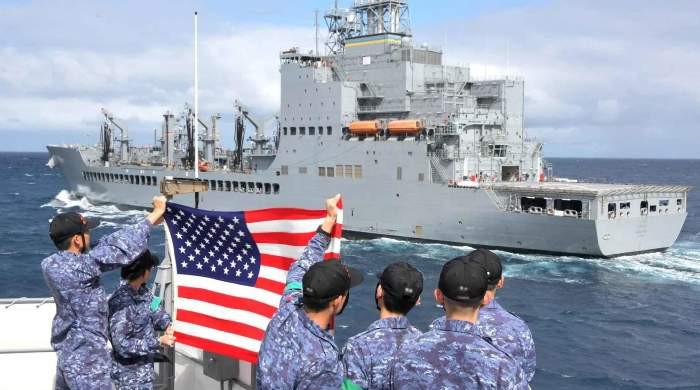
NEW YORK: During a US naval test off the California coast last month, which was designed to showcase the Pentagon’s top autonomous drone boats, one vessel stalled unexpectedly.
As officials scrambled to fix a software glitch, another drone vessel smashed into the idling boat’s starboard side, vaulted over the deck, and crashed back into the water – an incident captured in videos obtained by Reuters.
The previously unreported episode, which involved two vessels built by US defence tech rivals Saronic and BlackSea Technologies, is one of a series of recent setbacks in the Pentagon’s push to build a fleet of autonomous vessels, according to a dozen people familiar with the programme.
Weeks earlier, during a separate Navy test, the captain of a support boat was thrown into the water after another autonomous BlackSea vessel it was towing suddenly accelerated, capsizing the support boat, according to four people familiar with the matter. The captain was rescued and declined medical attention. The incident was first reported by Defence Scoop.
Both incidents stemmed from a combination of software failures and human error, including breakdowns in communication between onboard systems and external autonomous software, according to a person with direct knowledge of the matter, who requested anonymity to share sensitive information.
The Navy, Saronic and BlackSea declined to comment on the incidents.
The videos showing the drone crash were verified by two Reuters sources, the landscape matching terrain imagery, the GARC-096 name ID and structure of the boat matching file imagery of Global Autonomous Reconnaissance Craft (GARC).
US military leaders, seeing the outsized impact of maritime drones in the Ukraine war, have repeatedly said they need autonomous swarms of aerial and maritime drones to hinder a potential advance by China across the Taiwan Strait. Taiwan itself has begun acquiring its maritime drones.
The drones being developed in Ukraine, which often look like speedboats without seats, and are capable of carrying weapons, explosives and surveillance equipment, are primarily remote-controlled and cost close to $250,000 – making them optimal for kamikaze missions that have effectively neutralised Russia’s Black Sea Fleet.
The US, meanwhile, is aiming to build an autonomous naval fleet that can move in swarms and without human command – a more ambitious task at a higher price point; as much as a few million dollars per speedboat.
The recent test failures highlight the challenges facing the Navy’s effort to deploy the nascent technologies, said Bryan Clark, an autonomous warfare expert at the Hudson Institute. It will need to adapt its “tactics as it better understands what the systems can do and what they can’t do.”
But the Navy’s problems go beyond getting the boats to work: its autonomous maritime drone acquisition unit has also been rocked by the firing of its top admiral, and a top Pentagon official voiced concerns about the programme in a candid meeting with Navy brass last month, Reuters found.
Since the most recent incident, the Pentagon’s Defence Innovation Unit (DIU), which had acquired technology for the tests, has indefinitely paused a contract valued close to $20 million with L3Harris, one of the companies providing autonomous software used to control some of the vessels, according to two people familiar with the matter.
The Pentagon did not respond to questions about the cause of the accidents or the L3Harris contract being paused, which has not been previously reported.
A Pentagon spokesperson said it conducted drone tests as part of a “competitive and iterative approach, between operators and industry.”
L3Harris declined to comment on the contract and directed questions to the DIU. The DIU declined to comment.
“L3Harris stands behind the safety, integrity and capability of our autonomy command-and-control product,” said Toby Magsig, who oversees L3Harris’ autonomous software products.
Rise of sea drones
To accelerate its drone effort, the Pentagon in 2023 launched the $1 billion Replicator programme, through which branches like the US Navy and the DIU planned to acquire thousands of aerial and maritime drones, along with the software to control them. The first systems from this programme are due to be announced this month.
The Navy has committed at least $160 million to BlackSea, which is producing dozens of its Global Autonomous Reconnaissance Craft boats a month, according to procurement records.
Saronic, which was recently valued at $4 billion in a funding round backed by Andreessen Horowitz and 8VC, makes the competitive sea drone Corsair, but has yet to announce a major contract. Federal procurement records show the company has generated at least $20 million from prototype agreements.
“These systems will play a critical role in the future of naval warfare by extending fleet reach, improving situational awareness, and increasing combat effectiveness,” acting chief of naval operations Jim Kilby said during a visit to BlackSea’s facility in June.
Navy turmoil
Since returning to the office, President Donald Trump has made fielding swarms of drones a top military priority. Trump’s “Big Beautiful Bill” passed last month included almost $5 billion for maritime autonomous systems.
But, so far, the Navy’s approach has faced scepticism under the new administration.
In April, the Navy’s key drone boat procurement unit – known as Programme Executive Office Unmanned and Small Combatants (PEO USC) – touted a successful demonstration of the software used to control BlackSea’s vessels in a post on LinkedIn, hailing it as “a major step forward in advancing #maritime autonomy.”
In response, Colin Carroll, then-chief of staff to Deputy Secretary of Defence Steven Feinberg, suggested the programme was duplicating other efforts within the Pentagon. “I have a feeling that there are changes in this programme’s future,” he replied to the LinkedIn post. Carroll, who is no longer with the Pentagon, declined to comment further.
The PEO USC was recently placed under review, according to four people familiar with the matter, due to a series of setbacks, and could be restructured or shut down.
This comes two months after the Navy said it had sacked the unit’s leader, Rear Admiral Kevin Smith, due to a loss of confidence in his leadership after the Naval Inspector General substantiated a complaint against him. Reuters was unable to contact Smith.
During a meeting last month, Feinberg grilled Navy officials about their autonomous vessel capabilities, including those being fielded by the PEO USC, according to three people briefed on the meeting. Feinberg was unimpressed by some of the capabilities being acquired by the Navy and questioned whether they were cost-effective, the people said.
A Pentagon spokesperson said, “We’re not going to comment on private internal meetings” and directed questions about PEO USC to the Navy.
The Navy declined to comment on the meeting or the acquisition unit being put under review. Spokesperson Timothy Hawkins said the PEO USC stands by its mission, including its role as acquisition authority for the maintenance and modernisation of unmanned maritime systems.
The turmoil comes as shipbuilders and software providers are angling to secure even larger autonomous maritime projects, such as unmanned submarines and cargo-carrying ships.
Last week, the PEO USC started accepting proposals for the Modular Attack Surface Craft to acquire medium and large vessels capable of carrying containers, surveillance equipment, and conducting strikes.
TX Hammes, an autonomous weapons expert and Atlantic Council fellow, said the Navy is in uncharted waters, trying to overhaul decades of tradition at high speed.
“You’ve got a system that’s used to building big things, taking years to make a decision, and now suddenly you’re asking them to move fast,” he said.


- More than dozen tankers passed through when strait reopened.
- UK Navy reported that Iranian gunboats fired at some ships.
- Hundreds of ships remain stranded and oil flows disrupted.
OSLO: More than a dozen tankers, including three sanctioned vessels, passed through the Strait of Hormuz after a 50-day blockade was lifted on Friday, shipping data showed, before Iran reimposed restrictions on Saturday and fired at some vessels.
Reopening the strait is key for Gulf producers to resume full oil and gas supplies to the world, and end what the International Energy Agency has called the worst-ever supply disruption.
US President Donald Trump said on Friday Iran had agreed to open the strait, while Iranian officials said they wanted the US to fully lift its blockade of Iranian tankers.
Western shipping companies cautiously welcomed the announcements but said more clarity was needed, including on the presence of sea mines, before their vessels could transit.
Iran resumes restrictions
The ships that passed through the strait on Friday and Saturday via Iranian waters south of Larak island were mainly older, non-Western-owned vessels and included four sanctioned ships, according to ship-tracking data.
Iran arranged passage for a limited number of oil tankers and commercial ships following prior agreements in negotiations, a spokesperson for Iran’s Revolutionary Guards said.
Other ships have been seen approaching the strait and turning back as Iran said it would maintain strict controls as long as the US continues its blockade of Iranian ports.
The UK Navy reported on Saturday that Iranian gunboats fired at some ships attempting to cross the strait.
Some merchant vessels received radio messages from Iran’s navy saying the strait was shut again and that no ships were allowed to pass, shipping sources said on Saturday.
Ship-tracking data showed five vessels loaded with liquefied natural gas from Ras Laffan in Qatar approaching the strait on Saturday morning.
No LNG cargoes have transited the waterway since the US-Israeli war with Iran began on February 28.
Hundreds of ships have been stuck in the Gulf since the conflict started and Tehran closed the strait, forcing Gulf oil and gas producers to sharply cut production.
Top producers such as Saudi Arabia, the UAE, Iraq and Kuwait say they need steady tanker flows and unrestricted passage through the strait to resume normal export operations.
- Tehran seeks framework before new talks with US.
- Trump says more US-Iran talks likely this weekend.
- Iran warns of repercussions if US violates truce.
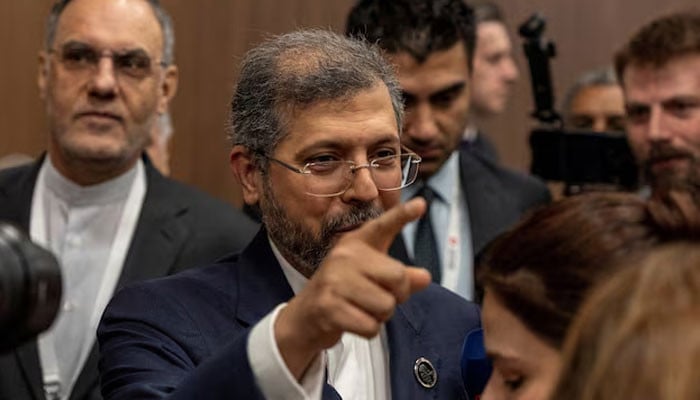
No date has been set for the next round of negotiations between Iran and the United States, Iran’s deputy foreign minister said on Saturday, adding that a framework of understanding must be agreed first.
The highest-level US-Iran talks since the 1979 Islamic Revolution ended in Islamabad without agreement last weekend.
US President Donald Trump has told Reuters there would probably be more direct talks this weekend, though some diplomats said that was unlikely given the logistics of convening in Islamabad, where the talks are expected to take place.
“We are now focusing on finalising the framework of understanding between the two sides. We don’t want to enter into any negotiation or meeting which is doomed to fail and which can be a pretext for another round of escalation,” Saeed Khatibzadeh told reporters on the sidelines of a diplomacy forum in the southern Turkish province of Antalya.
“Until we agree the framework, we cannot set the date… There was significant progress made, actually. But then the maximalist approach by the other side, trying to make Iran an exception from international law prevented us from reaching an agreement,” he said, referring to US demands over Iran’s nuclear programme.
“I have to be very crystal clear that Iran would not accept being an exception from international law. Anything that we are going to be committed to will be within the international regulations and international law.”
Asked about reports that Iran again closed the Strait of Hormuz on Saturday after its temporary reopening following a separate US-brokered 10-day ceasefire between Israel and Lebanon on Thursday, Khatibzadeh said Iran had announced it would allow the safe passage of commercial vessels in line with the terms of the truce.
“The other side, the American side, tried to sabotage that by saying that it is open except for Iranians. So that was the reason we said that ‘if you are going to violate the ceasefire terms and conditions, if Americans are not going to honour their words, there will be repercussions for them’,” he said.
Prime Minister Shehbaz Sharif and Chief of Army Staff (COAS) and Chief of Defence Forces (CDF) Field Marshal Asim Munir concluded separate visits aimed at ending the Iran war, with Field Marshal Munir leaving Tehran and premier Shehbaz headed home from Turkey.
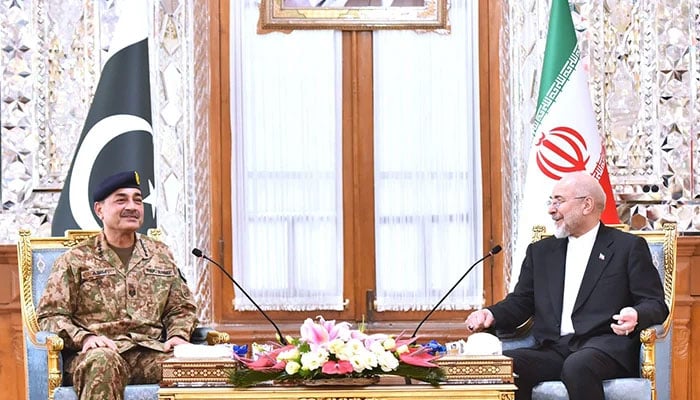
CDF Munir met Iran’s top leadership and peace negotiators during a three-day visit to Tehran, a military’s media wing statement said on Saturday.
Egypt and Pakistan were working “very hard” as mediators to bring about “a final agreement between the United States and Iran”, Egypt´s foreign minister told journalists at the Antalya Diplomacy Forum.
Egypt and Turkey has joined diplomatic efforts with Pakistan to help secure a ceasefire in the conflict.
“We hope to do so (reach an agreement) in the coming days,” Badr Abdelatty said, noting that “not only us in the region, but the whole world is suffering from the continuation of this war”.
“We are pushing very hard in order to move forward,” he said.
Trump ‘tweets a lot’
Iran dismissed US threats of fresh military action, with the senior Iranian official saying that Washington´s statements were inconsistent.
“The American side tweets a lot, talks a lot. Sometimes confusing, sometimes, you know, contradictory,” Khatibzadeh said, referring to US President Donald Trump and his frequent social media posts.
“It is up to the American people to decide whether these statements are consistent and in accordance with international law,” he added.
Khatibzadeh said Iran’s position was clear and vowed resistance to pressure from Washington.
“What we are going to do is quite clear. We will defend heroically and patriotically (our country) … as the oldest civilisation on earth,” he said.
The deputy minister also rejected US accusations that Iran was threatening freedom of navigation in the Strait of Hormuz, a critical route for global oil shipments, after Iran’s military again declared the waterway closed.
“Americans cannot impose their will to do a siege over Iran while Iran, with good intentions, is trying to facilitate safe passage through the Strait of Hormuz,” Khatibzadeh said.
He said Iran had announced safe passage for commercial vessels for the duration of Israel-Lebanon ceasefire, provided there was prior coordination with Iranian maritime authorities.
However, Khatibzadeh accused Washington of attempting to “sabotage” those efforts.
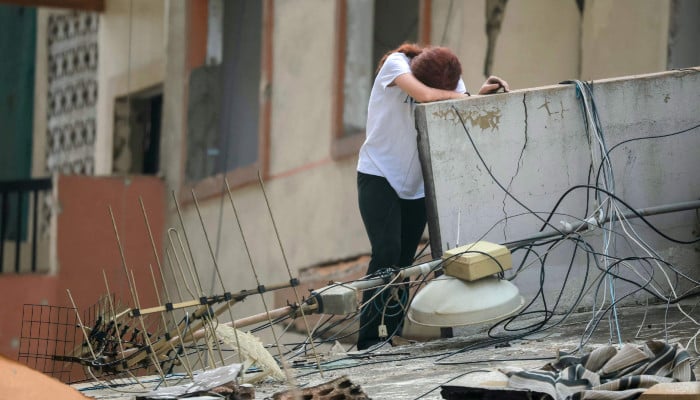
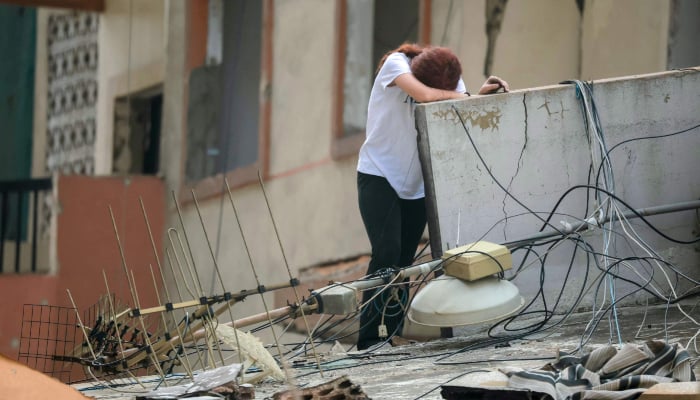
Khodr Sahmarani stood dazed beside the rubble of his south Lebanon home, his forehead in a white bandage, staring at the wreckage where his brother, nephew, and two neighbours died.
“I was upstairs, then I was underground. I screamed ‘Where are you, where are you?’, but there was no one,” he said after surviving an Israeli airstrike on the city of Nabatiyeh just hours before the ceasefire began at midnight on Thursday night.
The afternoon attack flattened what residents say was a five-storey building, creating a jumble of shattered concrete in the battered city.
Nabatiyeh rescuer Mohammad Sleiman told AFP they recovered one body from the strike site on Thursday night, and another three on Friday morning.
Sahmarani, 57, said rescuers “came and took me out of the rubble”.
Israel and Lebanon agreed to a 10-day ceasefire on Thursday in order to negotiate an end to six weeks of war between Israel and the Iran-backed group Hezbollah.

The conflict saw massive Israeli airstrikes across Lebanon and also a ground invasion in the south.
Lebanese authorities say the war that began on March 2 has killed nearly 2,300 people, and caused widespread devastation in southern towns and cities such as Nabatiyeh.
President Joseph Aoun said on Friday that “direct negotiations” with Israel “are crucial, and that the government aims to “consolidate a ceasefire, secure the withdrawal of Israeli forces from the occupied southern territories, recover prisoners, and address outstanding border disputes”.
Hezbollah halted military operations after the ceasefire came into effect, but warned that it was keeping its “finger on the trigger” in case Israel violated the truce.
‘For whose sake?’
Nabatiyeh’s streets were almost empty on Friday, and countless buildings in the city centre have been damaged or destroyed.
A few kilometres outside the city, a small group of Hezbollah supporters cheered on the trickle of cars coming from the direction of Beirut, flashing victory signs and waving the party’s yellow flag.
Deadly Israeli strikes were reported up to the final few minutes before the midnight Thursday deadline agreed upon by the two governments.
“It was the last hours. If it was the beginning of the war, the middle of the war, one can come to terms with it, but it was the last hours,” Sahmarani said, his eyes bloodshot and tearful.
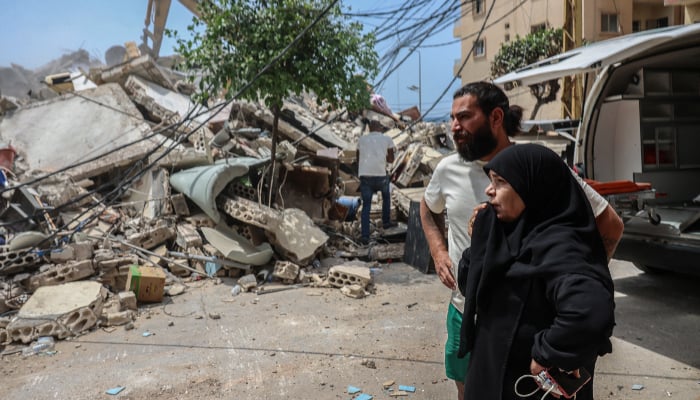
Fadel Hassan Zahri, a neighbour, said the people who were killed had been “lifelong friends of mine”.
“I wouldn’t eat without them, I wouldn’t drink without them.”
Zahri said he was appalled by the government’s willingness to negotiate potential peace and normalisation with Israel.
“We’ve been honourable all our lives… we do not normalise with Israel.”
Sahmarani said he has nowhere else to go and would probably crawl back into the rubble of his home at night and find a ledge or somewhere to lay his head.
“Where should I go now? Who will even look at me?” he asked, adding that he distrusted the Lebanese authorities.
“Let our leaders normalise; no one will listen to them and no one recognises them.
“For whose sake? For whose sake am I supposed to lose all of this?”


Some tankers cross Strait of Hormuz before shots fired, ship-tracking data shows

‘The Naked Gun’ actor Paul Walter Hauser bloodies opponent at Maple Leaf Pro’s first US show

Iran says no date set for next round of negotiations with US

-

 Politics1 week ago
Indian airlines hit hardest after Dubai limits foreign flights until May 31
-

 Entertainment5 days ago
Palace left in shock as Prince William cancels grand ceremony
-

 Sports5 days ago
The case for Man United’s Fernandes as Premier League’s best
-

 Politics1 week ago
Chinese, Taiwanese will unite, Xi tells Taiwan opposition leader
-
 Business5 days ago
UK could adopt EU single market rules under new legislation
-

 Entertainment1 week ago
Dua Lipa hits major career high ahead of wedding with Callum Turner
-

 Sports7 days ago
Lamar Jackson hits back at critics with faithful message on social media
-
 Business1 week ago
He paid $248 in illegal tariffs for this coat. Will he ever get it back?