

Business
US stocks slip as trading winds down for year-end

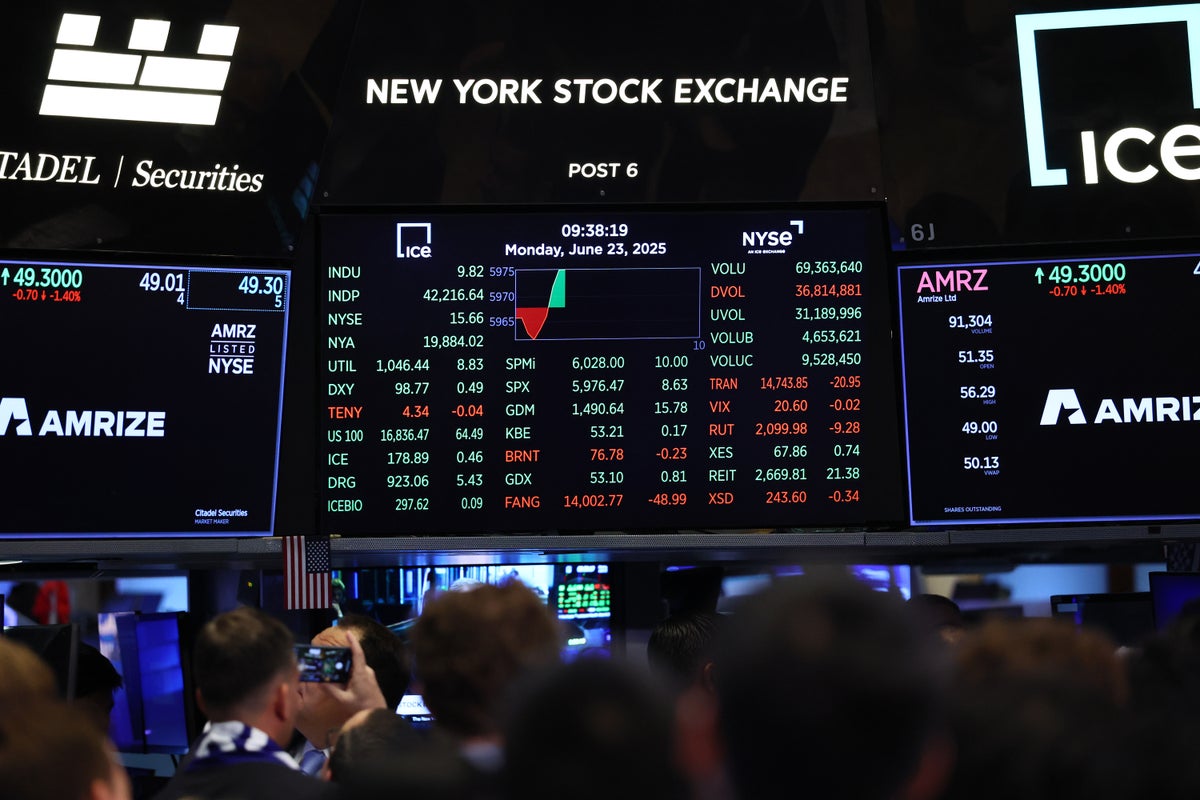
U.S. stocks slipped in early trading on Wednesday, as Wall Street closed out a year driven by both optimism and uncertainty.
The S&P 500 index fell 0.2 percent, while the Dow Jones Industrial Average shed 111 points, or 0.2 percent, by 10:0a.m. Eastern time. The Nasdaq composite similarly fell 0.2 percent, extending a three-day losing streak for the indexes.
Trading is expected to be light ahead of the New Year’s Day holiday, when markets will be closed. With just one trading day left before the year ends, most big investors have closed out their positions, leading to very thin trading volumes.
Even after their mini post-Christmas pullback, the indexes are on track for strong gains for the year.
The S&P 500 is up more than 17 percent this year, it’s third straight double-digit annual gain. The Nasdaq is up 21.3 percent and the Dow has gained 13.7 percent.
Wall Street’s 2025 gains came as investors embraced the optimism surrounding artificial intelligence and its potential for boosting profits across almost all sectors. But the market had no shortage of turbulence along the way amid President Donald Trump’s on-again, off-again tariffs on imported goods worldwide and uncertainty over the trajectory of interest rates.
The S&P 500 plunged nearly 5 percent on April 3, it’s worst day since the 2020 COVID crash. It fell another 6 percent a day later, after China’s response raised fears of an escalating trade war. Worries also gripped the U.S. Treasury market.
Trump eventually put his tariffs on pause and negotiated agreements with countries to lower his proposed tariff rates on their imports, helping calm investors’ nerves.
Strong profit reports from companies and three cuts to interest rates by the Federal Reserve also helped drive markets higher.
Still, the AI frenzy that drove markets in 2025 did not come without concerns. Chief among them is the worry that artificial intelligence technology may not produce enough profits and productivity to make all the investment worth it. That could keep the pressure on AI stocks like Nvidia and Broadcom, which were responsible for much of the market’s gains this year.
And it’s not just AI stocks that critics say are too pricey. Stocks across the market still look expensive after their prices climbed faster than profits.
On top of concerns that stocks are overvalued, the ongoing impact of the wide-ranging U.S.-led trade war threatens to add more fuel to inflation in the U.S. Despite the Fed cutting rates over concerns about the labor market, inflation remains solidly above the central bank’s 2 percent target.
Wall Street is betting that the Fed will hold interest rates steady at its next meeting in January.
Traders got an update on the state of the job market Wednesday. The Labor Department reported that fewer Americans applied for unemployment benefits last week with layoffs remaining low despite a weakening labor market.
Technology and communication services stocks were among the biggest weights of the market Wednesday.
Broadcom fell 1.1 percent and Micron Technology was 2 percent lower.
Treasury yields were mostly higher in the bond market. The yield on the 10-year Treasury rose to 4.14 percent from 4.13 percent late Tuesday. The yield on the two-year Treasury, which moves more closely with expectations for what the Federal Reserve will do, rose to 3.46 percent from 3.45percent.
Trading in precious metals continued to be volatile as the year winds down. Silver swung back to a big loss, giving back more than 6 percent early Wednesday after Tuesday’s gain of more than 10 percent. Following Friday’s 7.7 percent jump, silver lost nearly 9 percent on Monday. It’s still up more than 140 percent this year.
Gold was down 0.6 percent, but is still up 65 percent in 2025.
Elsewhere, global stock markets including Germany, Japan and South Korea were closed Wednesday for the New Year’s holidays, while trading was mixed in those that remained open.
U.S. crude picked up 39 cents to $58.34 per barrel. Brent crude, the international standard, added 36 cents to $61.69 per barrel.

Now one of the biggest sportswear firms, Anta’s rise follows a playbook adopted by many Chinese giants.
Source link
Business
Gold price prediction today: Will gold prices continue to be volatile? Key levels to watch out for April 27, 2026 week – The Times of India

Gold price prediction today: Gold prices will closely track movements on the rate decisions by several central banks, including the US Federal Reserve, this week, says Manav Modi, Senior Analyst, Commodity Research at Motilal Oswal Financial Services Ltd.Gold is currently consolidating after sharp swings in a broad range, indicating a pause rather than a reversal. Price action shows a higher-high structure intact, but the recent sideways movement suggests indecision near the upper supply zone around 158,000–160,000. The formation resembles a short-term flag/triangle continuation pattern, where a breakout on either side will define the next directional move. Volume has tapered slightly, reinforcing the consolidation narrative.Gold prices recently moved from the upper band toward the mid-band (20 DMA), and are now attempting to stabilize. The bands have started to contract, signaling a potential volatility expansion ahead. Sustaining above the mid-band (~150,500–151,000 zone) keeps bullish bias intact, while a breakdown below this could trigger a deeper mean reversion toward the lower band.For the week, immediate support for gold prices is placed at around Rs 150,500, which is followed by stronger support near Rs 148,500. On the upside, the resistance stands at around Rs 155,500, and after that the key supply zone is at Rs 158,000. A decisive close for gold above Rs 158,000 levels can then resume the broader uptrend. However, a break in gold prices below levels of Rs 148,500 may shift the momentum to bearish in the near term.The economic docket is filled with data points and events this week as the focus will be on FED, BOJ, ECB and ECB policy meetings. US consumer confidence, GDP, inflation and durable goods orders data will also be in radar.(Disclaimer: Recommendations and views on the stock market, other asset classes or personal finance management tips given by experts are their own. These opinions do not represent the views of The Times of India)

British families tell BBC Panorama how the Iran war is affecting their monthly budgets.
Source link


UNCTAD, Maritime and Port Authority of Singapore launch partnership

Lexie Brown denies Klay Thompson cheated on Megan Thee Stallion with her

Strait of Hormuz disruption ‘systemic shock’ threatening SE Asia: ERIA

-

 Sports1 week ago
WWE WrestleMania 42 Night 2: Live match results and analysis
-

 Sports1 week ago
NCAA men’s gymnastics championship: All-time winners list
-

 Fashion1 week ago
UK’s Sosandar returns to profitability amid robust FY26 performance
-

 Politics6 days ago
UK’s Starmer seeks to deflect blame over Mandelson appointment
-

 Entertainment1 week ago
Ruby Rose old essay resurfaces detailing night of alleged Katy Perry assault
-

 Entertainment7 days ago
Lee Anderson, Zarah Sultana kicked out of UK Parliament for calling PM ‘liar’
-
 Business1 week ago
No fuel shortage: Govt assures 100% domestic LPG, PNG, CNG supply amid Hormuz energy crunch – The Times of India
-
 Business7 days ago
How Trump’s psychedelics executive order could unlock stalled cannabis reform