

Tech
Vine-inspired robotic gripper gently lifts heavy and fragile objects

In the horticultural world, some vines are especially grabby. As they grow, the woody tendrils can wrap around obstacles with enough force to pull down entire fences and trees.
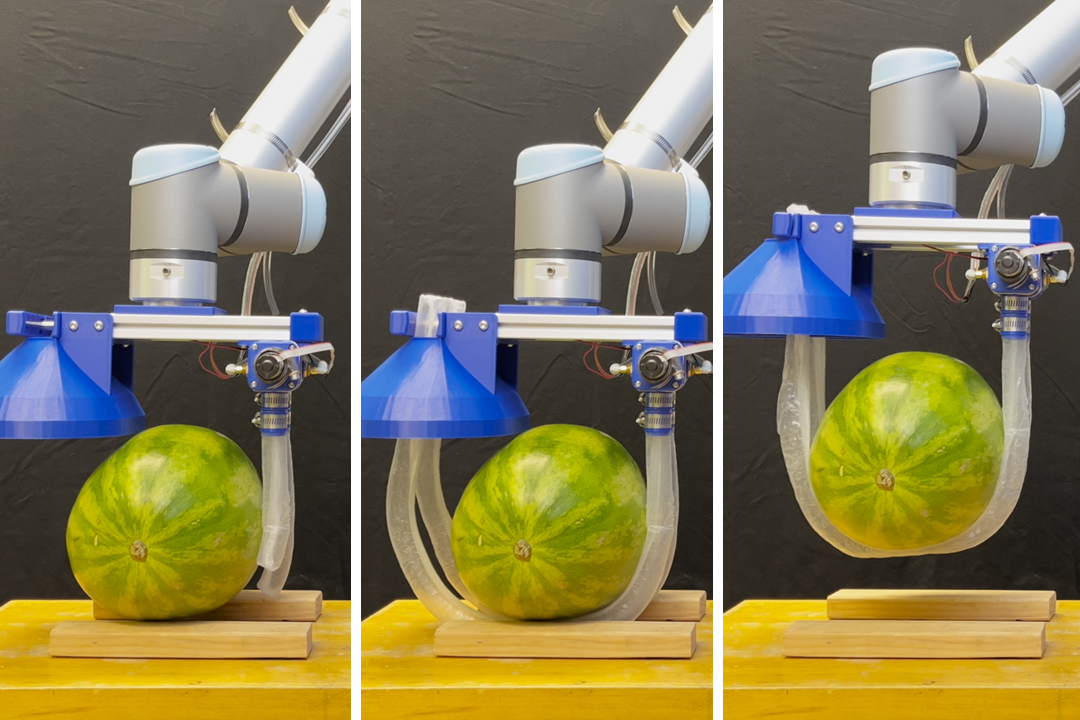
Inspired by vines’ twisty tenacity, engineers at MIT and Stanford University have developed a robotic gripper that can snake around and lift a variety of objects, including a glass vase and a watermelon, offering a gentler approach compared to conventional gripper designs. A larger version of the robo-tendrils can also safely lift a human out of bed.
The new bot consists of a pressurized box, positioned near the target object, from which long, vine-like tubes inflate and grow, like socks being turned inside out. As they extend, the vines twist and coil around the object before continuing back toward the box, where they are automatically clamped in place and mechanically wound back up to gently lift the object in a soft, sling-like grasp.
The researchers demonstrated that the vine robot can safely and stably lift a variety of heavy and fragile objects. The robot can also squeeze through tight quarters and push through clutter to reach and grasp a desired object.
The team envisions that this type of robot gripper could be used in a wide range of scenarios, from agricultural harvesting to loading and unloading heavy cargo. In the near term, the group is exploring applications in eldercare settings, where soft inflatable robotic vines could help to gently lift a person out of bed.
“Transferring a person out of bed is one of the most physically strenuous tasks that a caregiver carries out,” says Kentaro Barhydt, a PhD candidate in MIT’s Department of Mechanical Engineering. “This kind of robot can help relieve the caretaker, and can be gentler and more comfortable for the patient.”
Barhydt, along with his co-first author from Stanford, O. Godson Osele, and their colleagues, present the new robotic design today in the journal Science Advances. The study’s co-authors are Harry Asada, the Ford Professor of Engineering at MIT, and Allison Okamura, the Richard W. Weiland Professor of Engineering at Stanford University, along with Sreela Kodali and Cosmia du Pasquier at Stanford University, and former MIT graduate student Chase Hartquist, now at the University of Florida, Gainesville.
Open and closed
Credit: Courtesy of the researchers
The team’s Stanford collaborators, led by Okamura, pioneered the development of soft, vine-inspired robots that grow outward from their tips. These designs are largely built from thin yet sturdy pneumatic tubes that grow and inflate with controlled air pressure. As they grow, the tubes can twist, bend, and snake their way through the environment, and squeeze through tight and cluttered spaces.
Researchers have mostly explored vine robots for use in safety inspections and search and rescue operations. But at MIT, Barhydt and Asada, whose group has developed robotic aides for the elderly, wondered whether such vine-inspired robots could address certain challenges in eldercare — specifically, the challenge of safely lifting a person out of bed. Often in nursing and rehabilitation settings, this transfer process is done with a patient lift, operated by a caretaker who must first physically move a patient onto their side, then back onto a hammock-like sheet. The caretaker straps the sheet around the patient and hooks it onto the mechanical lift, which then can gently hoist the patient out of bed, similar to suspending a hammock or sling.
The MIT and Stanford team imagined that as an alternative, a vine-like robot could gently snake under and around a patient to create its own sort of sling, without a caretaker having to physically maneuver the patient. But in order to lift the sling, the researchers realized they would have to add an element that was missing in existing vine robot designs: Essentially, they would have to close the loop.
Most vine-inspired robots are designed as “open-loop” systems, meaning they act as open-ended strings that can extend and bend in different configurations, but they are not designed to secure themselves to anything to form a closed loop. If a vine robot could be made to transform from an open loop to a closed loop, Barhydt surmised that it could make itself into a sling around the object and pull itself up, along with whatever, or whomever, it might hold.
For their new study, Barhydt, Osele, and their colleagues outline the design for a new vine-inspired robotic gripper that combines both open- and closed-loop actions. In an open-loop configuration, a robotic vine can grow and twist around an object to create a firm grasp. It can even burrow under a human lying on a bed. Once a grasp is made, the vine can continue to grow back toward and attach to its source, creating a closed loop that can then be retracted to retrieve the object.
“People might assume that in order to grab something, you just reach out and grab it,” Barhydt says. “But there are different stages, such as positioning and holding. By transforming between open and closed loops, we can achieve new levels of performance by leveraging the advantages of both forms for their respective stages.”
Gentle suspension
As a demonstration of their new open- and closed-loop concept, the team built a large-scale robotic system designed to safely lift a person up from a bed. The system comprises a set of pressurized boxes attached on either end of an overhead bar. An air pump inside the boxes slowly inflates and unfurls thin vine-like tubes that extend down toward the head and foot of a bed. The air pressure can be controlled to gently work the tubes under and around a person, before stretching back up to their respective boxes. The vines then thread through a clamping mechanism that secures the vines to each box. A winch winds the vines back up toward the boxes, gently lifting the person up in the process.
“Heavy but fragile objects, such as a human body, are difficult to grasp with the robotic hands that are available today,” Asada says. “We have developed a vine-like, growing robot gripper that can wrap around an object and suspend it gently and securely.”
“There’s an entire design space we hope this work inspires our colleagues to continue to explore,” says co-lead author Osele. “I especially look forward to the implications for patient transfer applications in health care.”
“I am very excited about future work to use robots like these for physically assisting people with mobility challenges,” adds co-author Okamura. “Soft robots can be relatively safe, low-cost, and optimally designed for specific human needs, in contrast to other approaches like humanoid robots.”
While the team’s design was motivated by challenges in eldercare, the researchers realized the new design could also be adapted to perform other grasping tasks. In addition to their large-scale system, they have built a smaller version that can attach to a commercial robotic arm. With this version, the team has shown that the vine robot can grasp and lift a variety of heavy and fragile objects, including a watermelon, a glass vase, a kettle bell, a stack of metal rods, and a playground ball. The vines can also snake through a cluttered bin to pull out a desired object.
“We think this kind of robot design can be adapted to many applications,” Barhydt says. “We are also thinking about applying this to heavy industry, and things like automating the operation of cranes at ports and warehouses.”
This work was supported, in part, by the National Science Foundation and the Ford Foundation.









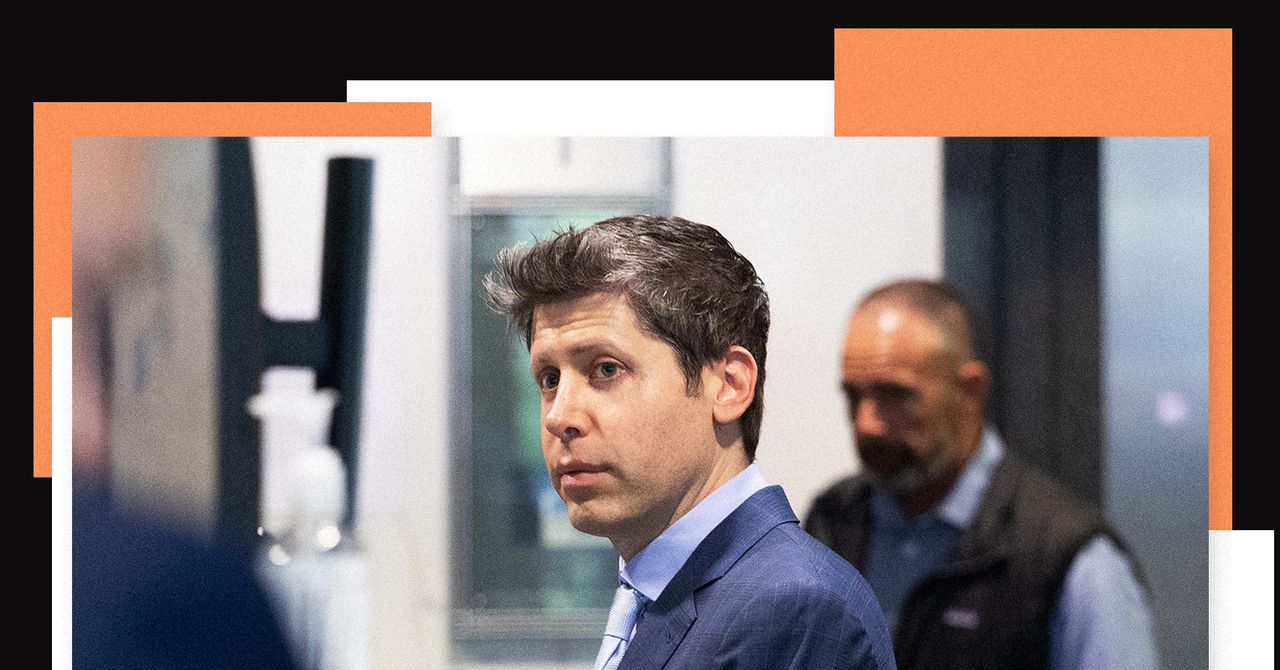
Sam Altman took to the witness stand to defend his reputation in the Musk v. Altman trial on Tuesday, as Elon Musk’s lawyers peppered the OpenAI CEO with hours of questions regarding his alleged history of deceptive behavior.
The cross-examination was a much needed win for Musk, who has so far struggled to make a convincing case. Tuesday’s testimony included several heated exchanges in which the OpenAI CEO had to respond to allegations from former colleagues suggesting he’s untrustworthy.
Highlighting this evidence is not only important for Musk winning over a jury, but also for beating OpenAI in the court of public opinion. Days before the trial started, Musk texted OpenAI president Greg Brockman and told him that he and Altman would soon “be the most hated men in America.”
Musk’s lawsuit accuses Altman of effectively stealing the OpenAI charity, and taking the $38 million Musk donated to the nonprofit organization and using it to create a for-profit business worth more than $850 billion.
However, there was little evidence on Tuesday to address the gaps in Musk’s legal case. Altman and Sam Teller, Musk’s former chief of staff, testified on Tuesday that they did not recall Musk ever attaching any special conditions to his donations to OpenAI. Additionally, it appears increasingly likely that Musk filed his case too late, years after he made his last donation to OpenAI and developed suspicion that the organization had breached its charitable trust. By then, the statute of limitations had already expired.
Brockman and his wife, Anna, sat in the gallery alongside OpenAI’s chief futurist, Joshua Achiam. While Altman and Brockman were present to watch Musk on the witness stand, Musk did not stay for Altman’s testimony. (Flight records suggest he was traveling to the Washington, DC, area on Tuesday to fly to China with President Donald Trump.)
Before fielding questions from Musk’s lawyers, Altman had the chance to tell his side of the story, answering gentle questions from OpenAI’s lawyers. Wearing a purple tie, Altman painted himself as an entrepreneur and investor who’s always been fascinated by, and concerned about, the power of artificial intelligence.
Altman testified that Musk has long been obsessed with controlling OpenAI. He recalled “a particularly hair-raising moment” when Musk suggested that control of OpenAI should pass to his children if Musk were to die. “We didn’t feel comfortable with that,” Altman said. Altman also suggested that Musk’s attempt in 2018 to start an AI unit within Tesla—and offering him the chance to run it—felt like a “vague, lightweight threat” that Musk would effectively crush OpenAI with or without him.
Bombarding Altman
Steven Molo, Musk’s lawyer, wasted no time in his cross-examination, asking Altman: “Are you completely trustworthy?” as his first question. Altman responded that he believes so, and then Molo immediately asked whether the jury should trust the testimony he just gave. Altman responded, “That’s up to them. I’m not going to tell the jury what to think.” Here’s the heated exchange that followed, as best as WIRED could capture it:
Molo: Do you always tell the truth?
Altman: I’m sure there is some time in my life where I have not.
Molo: Do you tell lies to advance your business interests?
Altman: No.
Molo: Have you misled people with whom you do business?

Datacentre capacity has reached 67.7GW globally, with five countries accounting for 69% of that total, and the US alone accounting for 43%, according to the International Datacentre Authority’s (IDCA) Datacentre report 2026.
The study based its research on data from organisations such as the International Energy Agency, World Bank, United Nations and International Telecommunications Union, as well as governments, datacentre developers and operators.
It discovered that where datacentres account for 5% or more of electricity grid usage, there seemed to be a threshold at which public opposition rises significantly and governments move from incentives to regulation.
And while there was huge growth in the datacentre industry, whether a nation or region can profit optimally depended on using its resources wisely and attaining tech sector skills among 2.5% of the workforce, it found.
The US was the site for the most datacentre capacity, with 29.2GW of a global total 67.7GW. US datacentres accounted for 6% of the country’s electricity supply. Behind the US are: China, 8.5GW and 0.8% of electricity use; Germany, 5.5GW (9.5%), UK, 2GW (5.8%), and Japan, 1.7GW (1.5%). Those five states accounted for 69% of global datacentre capacity.
In the US, however, the IDCA research estimated that 13% of datacentre consumption – around 3GW – was unused but still live capacity.
China emerged as the “sleeping giant”, according to the report, because less than 1% of electricity production was devoted to datacentres, despite producing almost twice the amount of electricity as the US.
International haves and have-nots
The report concluded that 5% of electricity grid usage going to datacentres was the threshold at which public concern, government regulation and grid supply can be seen to increase. It pointed to the US, which has seen community pushback and connection difficulties in the Midwest, Texas and California, with multi-year delays in the ability to provision power new facilities.
Meanwhile, in Europe, the Netherlands, Germany, and Switzerland have exceeded the 9% consumption level, while that’s also the case for Singapore.
Also in Europe, the report found that countries with electricity grids driven by nuclear power – such as France, Slovakia and Slovenia – may relieve these constraints.
At the other end of the scale, it discovered that more than 70 countries devoted less than 0.1% of their power to datacentres, and for more than 30 countries that figure was less than 0.01%.
Datacentre energy use league table
Singapore used the highest proportion of its electricity to power datacentres at 19.5% of the total generated. Next in the IDCA report was Lithuania (11.1%), the Netherlands (9.7%), Denmark (8.4%), Ireland (8.2%), Estonia (6.9%), Luxembourg (6.3%), Germany (6.1%), Hong Kong (6%) and the US (6%). Further down the rankings are Australia (5.1%), the UK (3.6%), South Korea (2%), Japan (1.2%), and India and China (both 0.8%).
IDCA built what it described as an optimised national model of ideal consumption levels for each nation, noting that construction of new datacentres was contingent on stronger electricity grids and robust fibre-optic networks.
For developed nations, IDCA said 6.25% of national electricity consumption was an effective cap on datacentre growth – i.e., it was the point at which the correlation was very strong between datacentre consumption and political actions and community pushback that result in projects being cancelled or slowed.
Meanwhile, IDCA ranked countries by the headroom they possess to build datacentres without significantly needing to develop new electricity generation. Here, IDCA ranked countries by headroom measured in GW. China led the way with 58.9GW of headroom, followed by India (12.7GW), Russia (6.7GW), Japan (5.5GW), Brazil (4.5GW), Canada (3.6GW), South Korea (3.2GW), Saudi Arabia (2.6GW), Iran (2.4GW) and Mexico (2.4GW).
The water stress scale
IDCA pointed out that modern AI datacentres require liquid cooling but that a lot of pushback around perceived worries over water use are misguided. That’s because the latest direct-to-chip cooling systems are closed systems that recycle water somewhat similar to a car radiator.
Having said that, the IDCA report stated: “The vast majority of existing traditional cloud and enterprise facilities rely on older, less efficient cooling architectures like water-cooled chillers or evaporative cooling towers. In these legacy designs, water is evaporated to remove the latent heat of vaporisation from the air, and that evaporated water is never recovered.”
The IDCA report ranked countries on a “water stress” scale of 0-100, where those with deserts are unsurprisingly high on the scale and mountainous and riverine states at the low end. Most at risk are Bahrain (100), Belize (86), Libya (80), Kuwait (80) and South Sudan (73). The least at risk are Norway (0), New Zealand (0), Iceland (1), Canada (2) and Bhutan (3).
Servers per head differential of 100,000x
The IDCA report said there was a difference of 100,000x in the number of servers per head of population between the most and least dense in this respect. Providing connectivity alongside this, IDCA said there was an estimated 1.3 to 1.5 million km of subsea cables, in around 550 systems, with about 1,200 landing stations.
Out of these, there are around 70 landing stations in the US, 50 in the UK and more than 12 in countries that include the Philippines, Indonesia, Japan, Spain, Denmark, Sweden and some Middle Eastern countries. Meanwhile, there are around 14 million km of terrestrial cables in main networks.
IT jobs deficit
IDCA found that IT jobs worldwide account for between 0.1% and 4% of populations. According to IDCA, 2.5% of the workforce employed in tech was optimum to “to ensure a thorough, successful digital economy creation and management”, though this varied based on local conditions and expectations.
Overall, the IDCA found that there was a deficit of 100 million IT-related jobs worldwide, with developing nations accounting for 80% of that.
Ranking countries with the most deficit, top of the list was India, with a shortfall of 28.8 million in the IT workforce, followed by China (17.5 million), Pakistan (5.8 million), Nigeria (5.8 million), and Indonesia (5.3 million).
Gamma, Sigma and Goldilocks
The report covered a number of other areas in connection with datacentres that include datacentre security, standards, design, investment and community pushback. It also provided three indexes: Gamma, Sigma and Goldilocks, with countries ranked 0-100.
The Gamma index looked at technological and social factors in digital readiness. Top of the list was: Finland at 85 (with Scandinavia collectively ranking 83), the Netherlands (83), Estonia (80), New Zealand (79) and Switzerland (79). Bottom of the list was: Equatorial Guinea (4), South Sudan (12), Turkmenistan (17), Haiti (17), and Democratic Republic of Congo (19). The UK ranked 14th, with a score of 74.
The Sigma index integrated the Gamma index, with adjustments for stress on water and electricity grids, such as the amount of headroom they possess, for example. The Sigma index was topped by Finland (99), followed by Sweden (97), Norway (97), New Zealand (94) and Iceland (94). The UK was ranked 15th (84).
“The Sigma Index is useful in determining a nation’s overall suitability for rapid datacentre growth and the digital infrastructure that would accompany it,” the report said.
Finally, the IDCA report provided a Goldilocks index, which technological factors are separated from the rest then comparing those to the cost of living and income. That way, it hoped to provide an idea of countries for whom rapid development would not be disruptive and would hit “just right”. Top of the Goldilocks index was Colombia with a score of 5.2, followed by North Macedonia, China, South Africa and Montenegro, all on 5.2 except the last of these (5.1).

Microsoft has addressed around 140 newly discovered common vulnerabilities and exposures (CVEs) in its May Patch Tuesday update, but for the first time in a long time, the latest monthly drop contains no zero-day flaws, meaning that none of the issues in scope have been actively exploited or publicly disclosed.
But while a less panic-inducing drop will be welcomed by security teams around the world, the May 2026 Patch Tuesday update contains almost 20 critical severity flaws that will inevitably draw the attention of threat actors in the coming days and weeks.
Jack Bicer, Action1 director of vulnerability research, said: “Although the absence of zero-days is a positive sign, the high number of critical vulnerabilities – particularly compared to recent months – means organisations should still move quickly to evaluate and deploy updates across affected systems.”
This month’s update is also particularly significant as it heralds a critical Secure Boot certificate expiration deadline on 26 June, a few weeks from now. Devices that fail to receive updated Secure Boot certificates – which are now rolling out – face potentially catastrophic failures or as-yet-undiscovered security flaws that may prove impossible to fix.
“The May 2026 update cycle is a high-stakes bridge to the 26 June certificate expiration deadline, making fleet-wide rotation to new trust anchors the month’s absolute priority,” said Rain Baker, senior incident response specialist at Nightwing’s ShadowScout team.
“For those who haven’t patched for last month’s releases for the Windows Shell and Microsoft Defender bypass flaws, it is imperative that security teams give these the highest priority,” added Baker.
Bugs abounding
Among some of the critical updates issued this month is a fix for a Windows DNS Client remote code execution (RCE) flaw tracked as CVE-2026-41096. This vulnerability stems from a heap-based buffer overflow condition in Windows NetLogon and could enable an unauthenticated actor to take over the target system by sending it a malicious DNS response.
“Because DNS is a core networking service used across enterprise environments, exploitation could impact a large number of systems rapidly,” said Action1’s Bicer.
“Successful attacks may lead to widespread endpoint compromise, ransomware deployment, credential harvesting, and operational disruption across corporate networks.
Bicer added: “This CVE requires immediate attention considering its severity rating, network-based attack vector, no authentication requirements, and no user interaction. DNS-related vulnerabilities are especially dangerous because they target foundational network services that are broadly exposed across enterprise infrastructure.”
Also drawing attention this evening is CVE-2026-42898, another RCE issue, this one in on-prem versions of Microsoft Dynamics 365, which bears a common vulnerability scoring system (CVSS) score of 9.9. Again, this issue requires no user interaction and because it can impact systems beyond the original security scope of the vulnerable component, carries an extreme risk to enterprises.
Previous attacks on Dynamics 365 infrastructure have exposed important, privileged data, and because CRM environments plug into so many other important systems, successful exploitation could lead to wholesale compromise.
Meanwhile, Automox chief technology officer Jason Kikta weighed in on CVE-2026-41089, an RCE flaw in Windows Netlogon, and CVE-2026-40402, an elevation of privilege (EoP) vulnerability in Hyper-V.
“CVE-2026-41089 – CVSS 9.8 out of 10 – is a stack-based buffer overflow in Windows Netlogon,” explained Kikta. “An attacker sends a crafted network request to a domain controller. No authentication required. No user interaction required. If you’ve been doing this long enough, the description language sounds sadly familiar.
“I’d be careful drawing a direct line to Zerologon. The underlying bug is a stack overflow, not a crypto protocol flaw, and Microsoft has not labeled this one as wormable. The mechanism is different, but the blast radius is still ugly when you’re talking about pre-auth code execution on a domain controller.”
The Hyper-V issue can be exploited by a low-privileged account inside a guest virtual machine (VM) to execute code on the host with system-level privileges. Kikta warned that one compromised guest could serve as a pivot point for every other VM on the same host, and the host fabric into the bargain. Hosted desktop environments and shared virtualisation platforms are likely to be swiftly targeted.
“Multi-tenant VDI, on-premises virtualisation with untrusted workloads, or any Hyper-V host running guests you don’t fully control. Same-week, same-day patch depending on what’s on top of it,” Kikta advised.
Patch apocalypse?
Lacking though it is in zero-days, Redmond’s latest meaty update will do little to assuage the concerns of onlookers alarmed at the supposedly earth-shattering vulnerability discovery capabilities of Anthropic’s Claude Mythos frontier AI model.
Chris Goettl, vice president of security product management at Ivanti, said that these concerns were being taken seriously by many key software suppliers and other tech firms that are becoming far more aggressive in their patching in response to the changes of the past few weeks.
“Oracle announced a new release cadence starting in May 2026 to address the acceleration of vulnerability detection introduced by Mythos and other AI security models; monthly Critical Security Patch Update (CSPUs) will fill in the two-month gap between their quarterly Critical Patch Update (CPU),” he said.
“Apple is another early participant in Project Glasswing and has seen a recent spike in the number of exposures resolved. They typically average around 20 CVEs per iOS security update [but] for their most recent update on May 11, there is a spike of 52 CVEs resolved. Across the 11 Apple updates, the CVE counts range from 25 at the low end to 52 on the high end and Apple backported changes all the way to iPhone 6s and iOS 15. While there are not actively exploited vulnerabilities, there are a lot of updates to manage.”
Meanwhile, Mozilla, the backers of the Firefox browser, which is said to have had over 270 vulnerabilities identified after Claude Mythos was applied to it, has also moved to a more aggressive weekly cadence for its security updates since the release of Firefox 150.0.0 in April 2026 – version 150.0.3 of Firefox dropped earlier today (12 May).


India’s apparel sourcing window reopens—for now

Will LeBron James retire after current season?

South Korea reviews phased support for Strait of Hormuz security efforts

-

 Tech1 week ago
DHS Demanded Google Surrender Data on Canadian’s Activity, Location Over Anti-ICE Posts
-
 Business1 week ago
Heineken plans huge investment in hundreds of UK pubs ahead of World Cup
-

 Tech5 days ago
A new frontier: Identity stack evolves for agentic systems | Computer Weekly
-

 Tech4 days ago
‘Orbs,’ ‘Saucers,’ and ‘Flashes’ on the Moon: Pentagon Drops New UFO Files
-
 Business1 week ago
India among most resilient large EMs, better placed for future global shocks; policy reforms & strong buffers help: Moody’s – The Times of India
-

 Sports5 days ago
Shaheen Afridi achieves landmark feat during opening Test against Bangladesh
-

 Tech5 days ago
What Microsoft Executives Really Thought About OpenAI in 2018
-
 Fashion5 days ago
New orders in German manufacturing up 5% MoM in Mar 2026: Destatis