

Tech
Artificial tendons give muscle-powered robots a boost


Our muscles are nature’s actuators. The sinewy tissue is what generates the forces that make our bodies move. In recent years, engineers have used real muscle tissue to actuate “biohybrid robots” made from both living tissue and synthetic parts. By pairing lab-grown muscles with synthetic skeletons, researchers are engineering a menagerie of muscle-powered crawlers, walkers, swimmers, and grippers.
But for the most part, these designs are limited in the amount of motion and power they can produce. Now, MIT engineers are aiming to give bio-bots a power lift with artificial tendons.
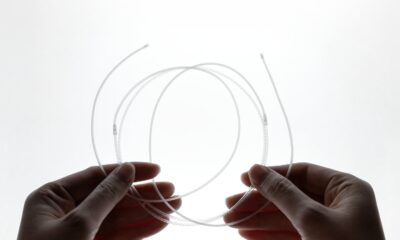
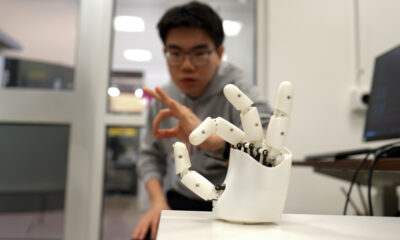
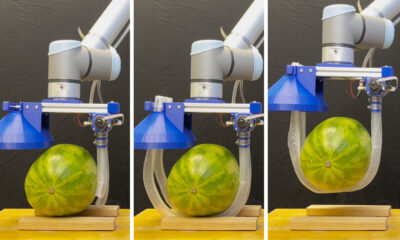
In a study appearing today in the journal Advanced Science, the researchers developed artificial tendons made from tough and flexible hydrogel. They attached the rubber band-like tendons to either end of a small piece of lab-grown muscle, forming a “muscle-tendon unit.” Then they connected the ends of each artificial tendon to the fingers of a robotic gripper.
When they stimulated the central muscle to contract, the tendons pulled the gripper’s fingers together. The robot pinched its fingers together three times faster, and with 30 times greater force, compared with the same design without the connecting tendons.
The researchers envision the new muscle-tendon unit can be fit to a wide range of biohybrid robot designs, much like a universal engineering element.
“We are introducing artificial tendons as interchangeable connectors between muscle actuators and robotic skeletons,” says lead author Ritu Raman, an assistant professor of mechanical engineering (MechE) at MIT. “Such modularity could make it easier to design a wide range of robotic applications, from microscale surgical tools to adaptive, autonomous exploratory machines.”
The study’s MIT co-authors include graduate students Nicolas Castro, Maheera Bawa, Bastien Aymon, Sonika Kohli, and Angel Bu; undergraduate Annika Marschner; postdoc Ronald Heisser; alumni Sarah J. Wu ’19, SM ’21, PhD ’24 and Laura Rosado ’22, SM ’25; and MechE professors Martin Culpepper and Xuanhe Zhao.
Muscle’s gains
Raman and her colleagues at MIT are at the forefront of biohybrid robotics, a relatively new field that has emerged in the last decade. They focus on combining synthetic, structural robotic parts with living muscle tissue as natural actuators.
“Most actuators that engineers typically work with are really hard to make small,” Raman says. “Past a certain size, the basic physics doesn’t work. The nice thing about muscle is, each cell is an independent actuator that generates force and produces motion. So you could, in principle, make robots that are really small.”
Muscle actuators also come with other advantages, which Raman’s team has already demonstrated: The tissue can grow stronger as it works out, and can naturally heal when injured. For these reasons, Raman and others envision that muscly droids could one day be sent out to explore environments that are too remote or dangerous for humans. Such muscle-bound bots could build up their strength for unforeseen traverses or heal themselves when help is unavailable. Biohybrid bots could also serve as small, surgical assistants that perform delicate, microscale procedures inside the body.
All these future scenarios are motivating Raman and others to find ways to pair living muscles with synthetic skeletons. Designs to date have involved growing a band of muscle and attaching either end to a synthetic skeleton, similar to looping a rubber band around two posts. When the muscle is stimulated to contract, it can pull the parts of a skeleton together to generate a desired motion.
But Raman says this method produces a lot of wasted muscle that is used to attach the tissue to the skeleton rather than to make it move. And that connection isn’t always secure. Muscle is quite soft compared with skeletal structures, and the difference can cause muscle to tear or detach. What’s more, it is often only the contractions in the central part of the muscle that end up doing any work — an amount that’s relatively small and generates little force.
“We thought, how do we stop wasting muscle material, make it more modular so it can attach to anything, and make it work more efficiently?” Raman says. “The solution the body has come up with is to have tendons that are halfway in stiffness between muscle and bone, that allow you to bridge this mechanical mismatch between soft muscle and rigid skeleton. They’re like thin cables that wrap around joints efficiently.”
“Smartly connected”
In their new work, Raman and her colleagues designed artificial tendons to connect natural muscle tissue with a synthetic gripper skeleton. Their material of choice was hydrogel — a squishy yet sturdy polymer-based gel. Raman obtained hydrogel samples from her colleague and co-author Xuanhe Zhao, who has pioneered the development of hydrogels at MIT. Zhao’s group has derived recipes for hydrogels of varying toughness and stretch that can stick to many surfaces, including synthetic and biological materials.
To figure out how tough and stretchy artificial tendons should be in order to work in their gripper design, Raman’s team first modeled the design as a simple system of three types of springs, each representing the central muscle, the two connecting tendons, and the gripper skeleton. They assigned a certain stiffness to the muscle and skeleton, which were previously known, and used this to calculate the stiffness of the connecting tendons that would be required in order to move the gripper by a desired amount.
From this modeling, the team derived a recipe for hydrogel of a certain stiffness. Once the gel was made, the researchers carefully etched the gel into thin cables to form artificial tendons. They attached two tendons to either end of a small sample of muscle tissue, which they grew using lab-standard techniques. They then wrapped each tendon around a small post at the end of each finger of the robotic gripper — a skeleton design that was developed by MechE professor Martin Culpepper, an expert in designing and building precision machines.
When the team stimulated the muscle to contract, the tendons in turn pulled on the gripper to pinch its fingers together. Over multiple experiments, the researchers found that the muscle-tendon gripper worked three times faster and produced 30 times more force compared to when the gripper is actuated just with a band of muscle tissue (and without any artificial tendons). The new tendon-based design also was able to keep up this performance over 7,000 cycles, or muscle contractions.
Overall, Raman saw that the addition of artificial tendons increased the robot’s power-to-weight ratio by 11 times, meaning that the system required far less muscle to do just as much work.
“You just need a small piece of actuator that’s smartly connected to the skeleton,” Raman says. “Normally, if a muscle is really soft and attached to something with high resistance, it will just tear itself before moving anything. But if you attach it to something like a tendon that can resist tearing, it can really transmit its force through the tendon, and it can move a skeleton that it wouldn’t have been able to move otherwise.”
The team’s new muscle-tendon design successfully merges biology with robotics, says biomedical engineer Simone Schürle-Finke, associate professor of health sciences and technology at ETH Zürich.
“The tough-hydrogel tendons create a more physiological muscle–tendon–bone architecture, which greatly improves force transmission, durability, and modularity,” says Schürle-Finke, who was not involved with the study. “This moves the field toward biohybrid systems that can operate repeatably and eventually function outside the lab.”
With the new artificial tendons in place, Raman’s group is moving forward to develop other elements, such as skin-like protective casings, to enable muscle-powered robots in practical, real-world settings.
This research was supported, in part, by the U.S. Department of Defense Army Research Office, the MIT Research Support Committee, and the National Science Foundation.







I was delighted to see that the Acer Chromebook Plus 516 didn’t skimp on a crappy touchpad. That goes a long way toward improving the experiencing of actually using the laptop on a moment-by-moment basis. I wasn’t annoyed every time I had to click-and-drag or select a bit of text. This one’s biggest weakness is definitely the screen, which is true of just about every cheap Chromebook I’ve tested. The colors are ugly and desaturated, giving the whole thing a sickly green tint. It’s also not the sharpest in the world, as it’s stretching 1920 x 1200 pixels across a large, 16-inch screen. But in terms of usability and performance, the Acer Chromebook Plus 516 is a great value, combining an Intel Core i3 processor with 8 GB of RAM and a 128 GB of storage. For a Chromebook that’s often on sale for $350, it’s a steal.
While we’re here, let’s go even cheaper, shall we? Asus has two dirt-cheap Chromebooks that I tested last year that I was mildly impressed by. The Asus Chromebook CX14 and CX15. Notice in the name that these are not “Chromebook Plus” models, meaning they can be configured with less RAM and storage, and even use lower-powered processors. That’s exactly what you get on the cheaper configurations of the CX14 and CX15, which is how you sometimes get prices down to as low as $130. I definitely recommend the version with 8 GB of RAM, but regardless of which you choose, the both the CX14 and larger CX15 are mildly attractive laptops. You’d know that’s a big compliment if you’ve seen just how ugly Chromebooks of this price have been in the past.
With these, though, I appreciate the relatively thin bezels and chassis thickness, as well as the larger touchpad and comfortable keyboard. The CX15 even comes in a striking blue color. The touchpad isn’t great, nor is the display. Like the Acer Chromebook Plus 516, it suffers from poor color reproduction and only goes up to 250 nits of brightness. It only has a 720p webcam too, which makes video calls a bit rough. But that’s going to be true of nearly all the competition (and there isn’t much).
Of the two models, I definitely prefer the CX14 though, as it doesn’t have a numberpad and off-center touchpad, which I’ve always found to be awkward to use. Look—no one’s going to love using a computer that costs the less than $200, but if it’s what you can afford, the Asus Chromebook CX14 will at least get you by without too much frustration.
Whatever you do, don’t just head over to Amazon and buy whatever ancient Chromebook is selling for $100 for your kid. It’s worth the extra cash to get something with better battery life, a more modern look, and decent performance.
Other Good Chromebooks We’ve Tested
We’ve tested dozens and dozens of Chromebooks over the past years, having reviewed every major release across the spectrum of price. Unlike Macs and Windows laptops, Chromebooks tends to stick around a bit longer though, and aren’t refreshed as often. I stand by my picks above, but here are a few standouts from our testing that are still worth buying for the right person.
Photograph: Daniel Thorp-Lancaster
Tech
Interview: Critical local infrastructure is missing link in UK cyber resilience | Computer Weekly

Critical local infrastructure that supports council services, social care services and local transport in the UK is falling through the gaps in government and business planning for cyber resilience, claims Jonathan Lee, director of cyber strategy at cyber security company TrendAI.
In an interview with Computer Weekly, Lee says that municipal areas, such as London or Greater Manchester, could be at risk from multiple cyber attacks that could damage local infrastructure, causing escalating problems for residents that could add up to severe disruption.
“We need to be thinking about what would happen if multiple attacks happened at the same time across the city region – and the human impact of not being able to do your job properly, not being able to travel around and not being able to deliver public services,” he says.
The Cyber Security and Resilience Bill (CSRB), which is currently going through Parliament, aims to ensure that critical national services, such as healthcare, water, transport and energy, are protected against cyber attacks that cost the economy billions of pounds a year. But local infrastructure has been relatively neglected, claims Lee.
The National Cyber Security Centre’s (NCSC) Cyber Assurance Framework, for example, aims to help operators of critical national infrastructure (CNI) demonstrate a base level of cyber security preparedness – but it is not mandatory, and not every organisation that should implement it is implementing it.
Whole of society risk
“We need to be more stringent in making sure that people are taking this seriously and are looking not just at their own organisation, but are looking at the whole of society risk,” says Lee.
Attacks on public services, such as council-run social care, can have a catastrophic, knock-on effect on the NHS and patient care, he adds.
There is a need for more “top-down” advice for regional infrastructure providers, from organisations such as the NCSC, which is not as well known as it could be among the companies and public sector bodies that provide local infrastructure.
“The message has got to be diffused down into local levels to ensure that a consistent message is spread out, and that can also be through industry partners. That is something I feel quite strongly about,” says Lee.
The Cyber Essentials programme, which has been updated to include new requirements for organisations to use multifactor authentication (MFA), and requirements for cloud providers to patch vulnerabilities within 14 days, has helped build resilience, but only for organisations that choose to adhere to it.
Keeping the resilience score
The UK government is also intending to publish a Cyber Action Plan in the coming months, which will guide organisations to get basic security right and improve their cyber security over time.
Although there is no shortage of initiatives and action plans, there is a danger that many of these plans will be left on a shelf.
One approach is for organisations to rate themselves on a scorecard for cyber resilience, on a scale of, say, 1 to 100, and to report their progress back to board-level directors.
“We need a mechanism to measure how impactful these interventions are, whether it be things like the Cyber Assessment Framework, Cyber Essentials or legislation,” says Lee.

Two of Big Tech’s most influential billionaires, Sam Altman and Elon Musk, will go head-to-head in a highly anticipated trial beginning April 27. In Musk v. Altman, a judge, advised by a jury, will ultimately determine whether OpenAI has strayed from its founding mission to ensure that artificial general intelligence (AGI) benefits humanity, and the ruling could influence how the world’s leading AI developer controls and distributes its technology. For now, you can learn more about the trial here.
On the Panel
On May 8, a panel of WIRED experts will go live to answer your questions about this consequential case.
- Zoë Schiffer: WIRED’s director of business and industry, who oversees coverage of business and Silicon Valley.
- Maxwell Zeff: a senior writer at WIRED covering the business of artificial intelligence. He writes the weekly Model Behavior newsletter, which focuses on the people, communities, and companies behind Silicon Valley’s AI scene.
- Paresh Dave: a senior writer at WIRED covering the inner workings of Big Tech companies. He writes about how apps and gadgets are built and about their impacts while giving voice to the stories of the underappreciated and disadvantaged.
Ask a Question
Submit all your burning questions about this historic legal battle at WIRED’s next, subscriber-only livestream scheduled for May 8 at noon ET / 9 PT. To leave questions in advance as the trial unfolds, head to the comment section below.
Become a Subscriber
The event will be streamed right here. For subscribers who are not able to join, a replay of the livestream will be available after the event. Not a subscriber yet? Subscribe now to get access to this livestream, plus full access to WIRED.
In the meantime, check out past livestreams on Big Tech and the military, the future of electric vehicles, and more.


Men’s college basketball buzz: State of blue blood rebuilds

Cambodia & Canada discuss strengthening economic ties

Trump administration in advanced talks for a rescue package for Spirit Airlines, source says

-

 Fashion6 days ago
France’s LVMH Q1 revenue falls 6%, shows resilience amid Iran war
-

 Entertainment1 week ago
Is Claude down? Here’s why users are seeing errors
-

 Sports1 week ago
PSL 11: Peshawar Zalmi win toss, opt to field first against Quetta Gladiators
-

 Tech1 week ago
The Deepfake Nudes Crisis in Schools Is Much Worse Than You Thought
-

 Tech1 week ago
Bremont Is Sending a Watch to the Moon’s Surface
-

 Tech1 week ago
Human-machine teaming dives underwater
-
 Business1 week ago
BP sees ‘exceptional’ oil trading result as Iran war sends crude costs soaring
-

 Fashion1 week ago
What no one is saying about the 2026 apparel slowdown