

Tech
Virtual reality merges with robotics to create seamless physical interactions

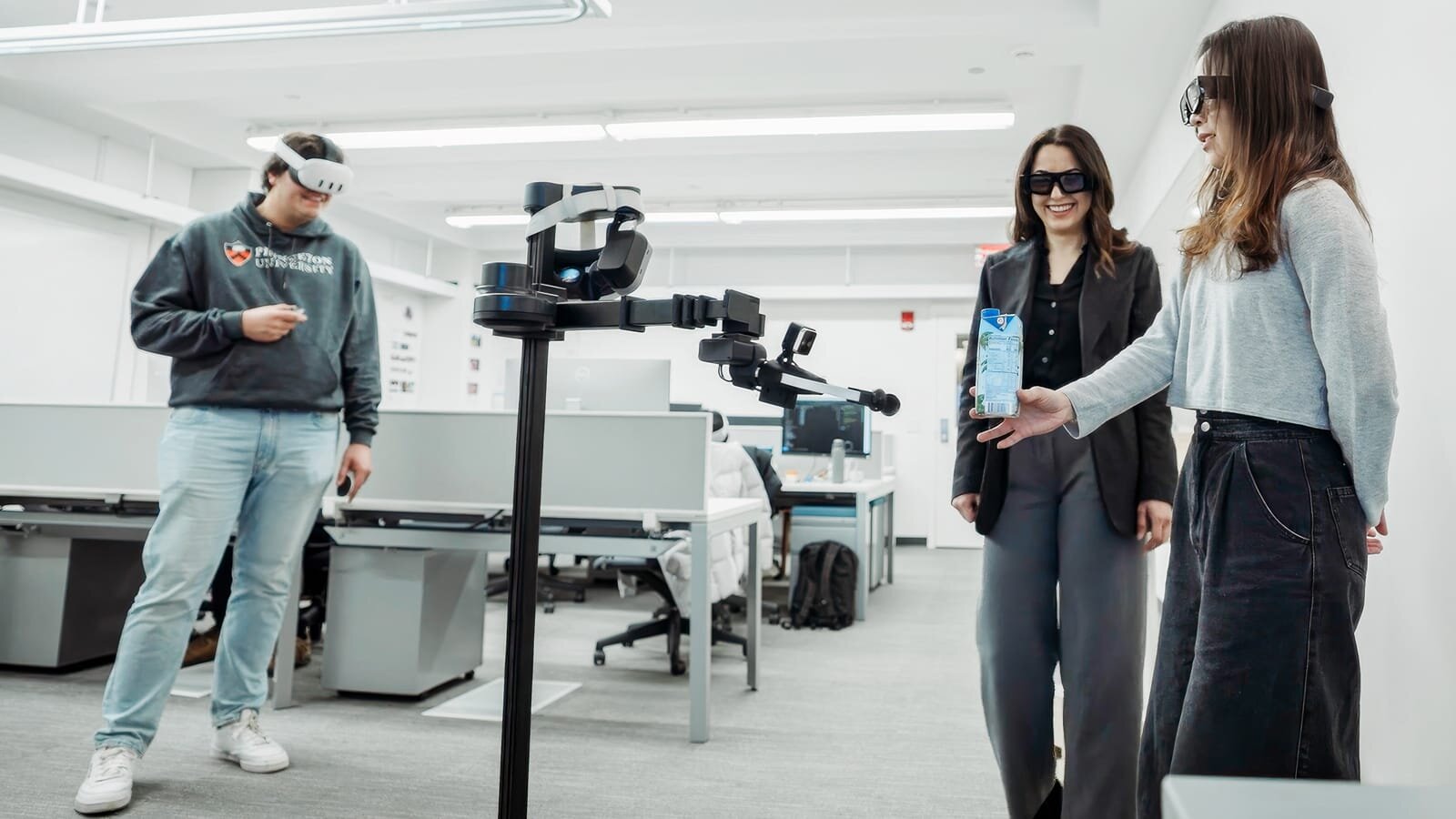
Computer scientists at Princeton are working to bring virtual reality into the physical world, with the potential to enhance a variety of experiences, including remote collaboration, education, entertainment and gaming.
Someday virtual and augmented reality technology will likely be commonplace, said Parastoo Abtahi, assistant professor of computer science. It will be important that users of this technology are able to seamlessly interact with the physical world.
Abtahi and postdoctoral research associate Mohamed Kari are working to make this possible by pairing virtual reality technology with a physical robot that the user can control. Their research will be presented next month at the ACM Symposium on User Interface Software and Technology in Busan, Korea.
Someone using this system can, while wearing a mixed reality headset, select a drink from a list of options and then place it, virtually, on the desk in front of them. Or, more fantastically, they can ask an animated bee to deliver a bag of chips to them on the sofa.
At first, the drink and the chips might be only pixels. But after a minute or so, they will physically materialize, as if by magic. But it’s not magic—it’s a robot, rendered invisible to the user, that has delivered the snack. “Visually, it feels instantaneous,” said Abtahi.
By removing “all unnecessary technical details, even the robot itself,” said Kari, the experience appears seamless. The goal is to make the technology disappear and have the interaction between human and computer feel intuitive.
A key technical challenge in this system is communication. The user must be able to communicate their desires simply—selecting a pen across the room, for example, and moving it to the table in front of them. Kari and Abtahi created an interaction technique where a simple hand gesture allows the user to select an object, even from far away.
These gestures are then translated into commands for the robot to execute. The robot is outfitted with its own mixed reality headset, so it knows where to place objects within the virtual environment.
Another technical challenge is adding and erasing physical objects from the user’s field of view. Using a technology called 3D Gaussian splatting, Abtahi and Kari create a realistic digital copy of the physical space. Once everything in the room has been scanned, it allows the system to erase something from view, like a moving robot, or add something, like an animated bee.
To achieve this, every inch of the room and every object within it must be scanned and rendered digitally. Right now, the process is somewhat tedious, said Abtahi. Streamlining it, perhaps by assigning the task to a robot, is a subject for future research in her lab.
More information:
Paper: Reality Promises: Virtual-Physical Decoupling Illusions in Mixed Reality via Invisible Mobile Robots
Citation:
Virtual reality merges with robotics to create seamless physical interactions (2025, August 25)
retrieved 25 August 2025
from https://techxplore.com/news/2025-08-virtual-reality-merges-robotics-seamless.html
This document is subject to copyright. Apart from any fair dealing for the purpose of private study or research, no
part may be reproduced without the written permission. The content is provided for information purposes only.











Alongside its price-friendly iPhone 17e and M4 iPad Air yesterday, Apple just announced a few updates to the MacBook Pro, MacBook Air, and its rarely-refreshed desktop display line.
The MacBook Air has now been updated to the latest M5 chip. It’s a fairly modest upgrade, but it brings it up to speed with Apple’s latest processor that debuted in the MacBook Pro last fall. There are no other major hardware changes—it now comes with 512 GB of starting storage with “faster SSD technology”—but you can still get the Air in either a 13- or 15-inch screen size.
This laptop also features Apple’s N1 wireless chip, which includes Wi-Fi 7 and Bluetooth 6 for the latest connectivity standards. It still comes with the standard 16 GB of RAM, and sadly, there’s a $100 price bump to account for the extra storage. It now starts at $1,099 for the 13-inch model and $1,299 for the 15-inch model. Apple says you can preorder it tomorrow, with sales kicking off on March 11.
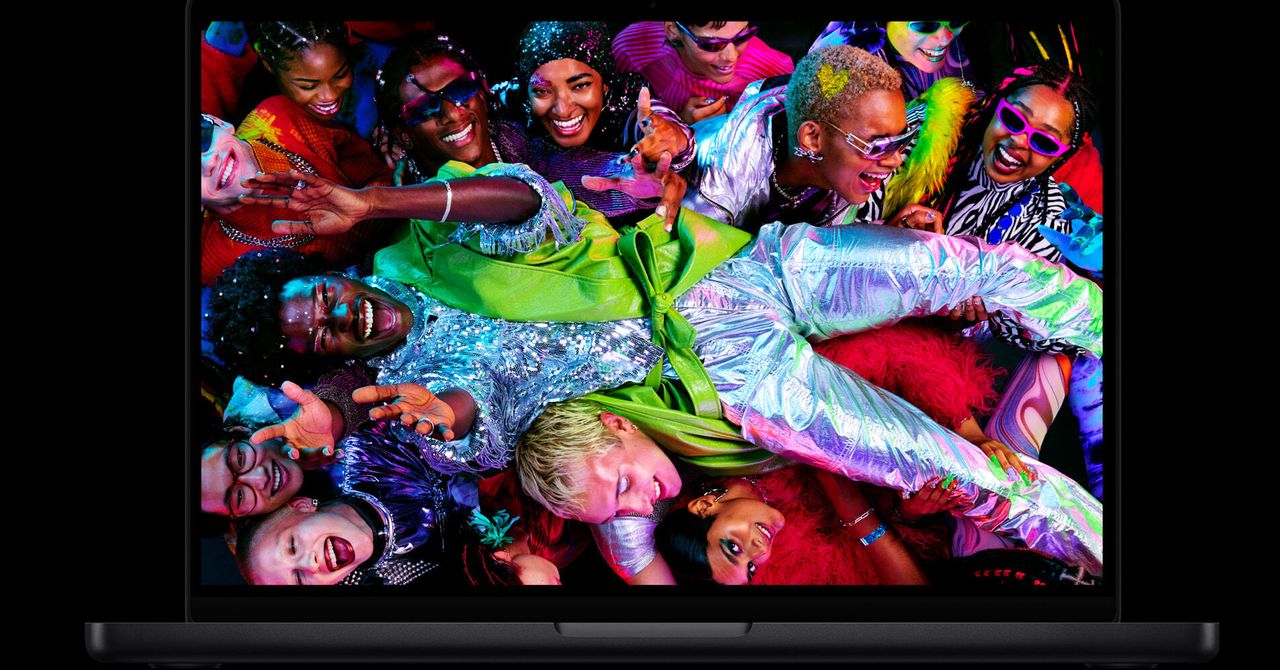
More interestingly, Apple is expanding the M5 chip series with the M5 Pro and M5 Max, now available in the 14-inch and 16-inch MacBook Pro. Like previous generations of Apple silicon, the “Pro” and “Max” configurations add significantly improved multi-core CPU and graphics performance.
The M5 Pro and M5 Max can be configured with up to 18 CPU cores (12 performance cores and 6 “super” cores), up from 16 on the M4 Max. The M5 Pro can scale up to 20 GPU cores, while the M5 Max extends up to 40 GPU cores. Thanks to higher memory bandwidth, more efficient Neural Engine, and improved GPU architecture, Apple says the M5 Pro and M5 Max have “over 4X the peak CPU compute for AI” compared to the last generation and offer 20 percent better GPU performance.
The new MacBook Pros don’t include any other hardware changes; things have stayed largely the same since 2021—same port selection, Mini-LED display, speakers, and webcam. Even the claimed 24-hour battery life hasn’t changed from the M4 models, which came out in late 2024. Interestingly, as recently as last week, Bloomberg reported that Apple plans to launch a more significant update to the MacBook Pro later this fall, which will reportedly debut the M6 chip, an OLED touchscreen, and a thinner chassis.
Like the MacBook Air, all versions of the M5 Pro or M5 Max MacBook Pros come with twice the storage and a slightly higher starting price. Coming with 1 TB, the 14-inch M5 Pro now starts at $2,199, and the 16-inch model at $2,699. That’s $200 more than last year’s machines. Meanwhile, M5 Max prices start at $3,599.

Vendor or supplier lock-in has been a longstanding topic of discussion, as far back as my first days in IT all the way back in 2002, and probably before. It was a common complaint of many large enterprises who felt penalised by multi-year managed service contracts that didn’t quite deliver on all the things they were promised, yet had no real means to do anything about it.
This was also an issue during the formative years of hyperscale cloud. People didn’t forget the pain they had experienced. As a result many discussions have focused on how to prevent vendor lock-in, concerned by the lack of interoperability to pick and choose solutions which were largely limited by the cloud providers’ ecosystem and service offerings.
Platformisation faces the same challenges, where financial efficiencies are weighed against functional and innovation limitations. Having worked for a hyperscale cloud company previously, the general consensus was “multi-cloud lowers capabilities to the lowest common denominator”, while customers complained “make it easier for us to do multi-cloud”. So where does the happy medium sit between these two ideas?
This is where open standards play such an important and pivotal role. Open standards are the common language that allow different software systems, hardware, and platforms to talk to one another without needing a translator. They are the antithesis of vendor lock-in and are critical for cross-platform integration for several key reasons:
- Interoperability: Open standards (like IPSIE or Oauth) operate across vendors and allow customers to pick and choose which solutions they can use, without being limited to a single vendor or technology stack. Developers don’t have to reverse-engineer how a proprietary system works. If a platform supports an open standard (like Oauth for logging in), the integration path is already documented and understood.
- Future-proofing and longevity: Proprietary integrations are fragile. If a vendor changes their internal code or goes out of business, the integration breaks. Open standards bring stability. Open standards are maintained by independent bodies (like the OpenID Foundation for IPSIE). They evolve slowly and deliberately, ensuring backward compatibility.
- Avoiding the ‘translation tax’: Without open standards, every integration requires a custom translation layer. When two platforms speak the same open standard (e.g., two email servers using SMTP), they communicate directly. You avoid the processing overhead and potential for errors that come with converting data from one proprietary format to another constantly.
- Innovation and competition: Open standards lower the barrier to entry for new competitors, which benefits the ecosystem as a whole. You can build a best-in-class tech stack. You might use a CRM from Salesforce, email from Google, and a database from Amazon. They all support open standards (like RESTful APIs), so you can stitch them together into a unified workflow.
Open standards are the fundamental bedrock of modern platformisation strategies. They shift the architectural paradigm from monolithic silos – where one vendor does everything – to modular ecosystems (where distinct, best-in-class tools connect seamlessly). This allows organisations to grow and adapt their technology stack when needed and ensures platformisation is not a one-way decision.
Stephen McDermid is EMEA CSO at Okta
Read more on Cloud security

L.L. Bean is infamous for its outdoorsy appeal, ranging from outerwear and supplies to withstand the elements to laid-back lifestyle products. The company was established in 1912 by Leon Leonwood Bean in Maine. It remains headquartered there today, continually rolling out revered classics and updated essentials for today’s nature lovers. Take the Bean Boots: what started as L.L. Bean’s premier product ultimately helped shape the brand into what it is today. This definitive shoe, which can be worn on hiking trails and rain-slicked city streets alike, has remained true to the original version. If you’ve ever wanted to capture the essence of being a rugged Mainer or recreate a cozy cabin at home, here are plenty of L.L. Bean promo code options at your fingertips.
Get 10% Off Your First Order With an L.L.Bean Promo Code
You may bemoan email updates, but in terms of sales, this L.L. Bean coupon is a pretty low lift. Sign up for email updates from the company, and you get 10% off your first order. This offer is valid only once per email address, so choose your purchase wisely.
Take Up to 75% Off Outdoor Gear in the L.L.Bean Sale Section
Sales mean stocking up, especially on outdoor equipment and camping supplies ahead of your next adventure. Whether you’re about to take up fishing and need supplies, or have Noah Kahan concert tickets in sight and want extras from his L.L. Bean collaboration collection for the event, all of that is available to you. You can save 75% off these L.L. Bean sale items, no promo code needed.
This is a different sort of two-for-one special: twice a day, L.L. Bean posts new sales at 6 AM and 2 PM sharp, Eastern time. While the two-a-day daily markdown is not super expansive in terms of inventory up for grabs, what is posted for sale usually comes at a heavily discounted price akin to deals you’d see on Black Friday.
This L.L. Bean sale is like an online treasure hunt. The daily markdown sale involves a new deal posted daily from 6 AM to midnight Eastern time. Inventory leans toward gear, such as backpacks, blankets, and shoes.
Score Free Shipping on Orders Over $75
We’ve all abandoned our online shopping carts at one point or another once we saw how much shipping was going to cost. Shipping usually costs $8 for a standard L.L. Bean order—that is, if you are under $75. If you hit that threshold or more, you immediately score free shipping on your order.
Military, First Responders, Medical Workers, and Students Can Save an Additional 10%
Being in the medical field or a first responder can often be a tough, thankless job. But, there’s a special L.L. Bean sale for medical workers and first responders so that you can stock up on supplies for when you rest and recharge in your down time. Use the L.L. Bean first responder discount for 10% off—be sure to verify your license status through SheerID.
L.L. Bean military discount offers 10% for military personnel, current or former. This discount also applies to family members—if you or a family member would like to partake, verify your status via SheerID.
Teachers deserve their (wild)flowers. To make sure you have what you need for your next outdoor adventure and say thanks, you can get 10% off with the special L.L. Bean teacher discount. College students, there’s also the L.L. Bean student discount where you 10% off, too. To redeem either of these discounts, make sure to verify your teaching or student (or both!) status via SheerID.
Earn 20% Off With the L.L.Bean Mastercard
If you’re hunting for a potential credit card candidate, and already are an avid L.L. Bean fan, this is the opportunity for you. You can earn 20% off once approved for an L.L. Bean Mastercard, along with free shipping on all orders when you use it—no minimum purchase necessary.


Reeves says her plan is working as growth forecast cut for this year

UAE Says Airspace Will Not Be Used for Attacks on Iran

ICE cotton drops 1% on Middle East war, stronger US dollar

-

 Politics5 days ago
What are Iran’s ballistic missile capabilities?
-
 Business7 days ago
Households set for lower energy bills amid price cap shake-up
-

 Politics5 days ago
US arrests ex-Air Force pilot for ‘training’ Chinese military
-

 Sports1 week ago
Top 50 USMNT players of 2026, ranked by club form: USMNT Player Performance Index returns
-

 Sports5 days ago
Sri Lanka’s Shanaka says constant criticism has affected players’ mental health
-
 Business7 days ago
Lucid widely misses earnings expectations, forecasts continued EV growth in 2026
-

 Sports1 week ago
South Africa thrash India by 76 runs in T20 World Cup Super 8 – SUCH TV
-

 Fashion7 days ago
New Zealand’s apparel imports steady at $1.2 bn in 2025