

Business
Walmart and Alquist strike landmark deal, jump-starting 3D-printed commercial real estate


Construction company Alquist 3D worked with Walmart last year to build a nearly 8,000-square-foot 3D printed addition to its store in Athens, Tennessee.
Alquist
A version of this article first appeared in the CNBC Property Play newsletter with Diana Olick. Property Play covers new and evolving opportunities for the real estate investor, from individuals to venture capitalists, private equity funds, family offices, institutional investors and large public companies. Sign up to receive future editions, straight to your inbox.
Walmart partnered with construction company Alquist 3D last year to build an almost 8,000-square-foot addition to its store in Athens, Tennessee, for online order pickup and delivery services. It is the largest 3D-printed commercial structure in the U.S. and, despite a bumpy start, a key proof of concept for the technology’s commercial viability.
Alquist, based in Greeley, Colorado, just announced it will now print more than a dozen new Walmart buildings, as well as buildings for other commercial retailers, in what is arguably the largest-scale commercial real estate deployment of this technology, which has mostly been used in residential construction so far.
As part of that deal, Sika, one of the world’s largest construction materials companies, with a heavy focus on sustainability, will provide materials to Alquist for all future 3D-printed projects and licensees. This will streamline Alquist’s national pipeline, lower material and freight costs, and accelerate development of more sustainable mixes for large-scale 3D-printed construction — including the commercial projects rolling out with Walmart, according to Alquist.
“This collaboration positions Sika at the forefront of next-generation construction, opening new markets and creating long-term growth opportunities,” said Noah Callantine, 3D concrete printing engineer and field service specialist with Sika.
It is a clear turning point in CRE construction, which has been notoriously slow to modernize. The new technology has started to grow in the homebuilding market, but has been far slower in commercial construction, simply due to the size of the printers needed to create larger buildings.
Alquist, which designs and builds the larger-scale printers, as well as develops the code and software to operate them, started in the residential sector. It is now partnering with a large equipment rental dealer and a full-service general contractor to scale the technology commercially nationwide. Doing so helps to lower the high cost of materials, as well as the labor, which needs to be both trained and local, according to Alquist.
“The way to bring prices down [for] anything is to get volume, and as you get volume, you get the attention of suppliers. They see that it matters, and the more that they make, the cheaper that they can bring their supply chain down,” said Patrick Callahan, CEO of Alquist.
Growing pains
Construction company Alquist 3D worked with Walmart last year to build a nearly 8,000-square-foot 3D printed addition to its store in Athens, Tennessee.
Alquist
Callahan’s background is in defense technology, not construction, and he has positioned Alquist as a tech company. He said he follows the mandate of company founder Zach Mannheimer to find ways to build residential and commercial buildings and infrastructure faster, cheaper, better and greener.
He admitted the first project in Athens took far too long, as they worked out the kinks in both managing the materials and implementing the technology to print their first commercial building.
“It was a sort of classic Silicon Valley failing forward job,” Callahan said. “We were not part of the design process. They changed permitting. … The general contractor that we fell under met us about a week before we started, and nobody had ever done this before.”
The second project, a 5,000-square-foot Walmart pickup center in Huntsville, Alabama, took just seven days to complete.
3D labor
While the projects take far fewer workers, they need to be more highly trained than typical construction trades. Alquist partners with trade schools for its curriculum, introducing robotics and green materials. Callahan said that has been more attractive to what has been a severely reduced construction labor market in recent years.
“You’re not necessarily throwing rocks around up on a scaffolding, but using robotics in a safe, clean environment,” Callahan said. “We’ve seen a lot of what used to be traditional construction folks that kind of pushed back, they’re now leaning in.”
Growing competition
Icon Build, the largest residential 3D printing technology company, is also starting to dip its toes into commercial construction. It has completed a hotel project and is now in talks with potential commercial partners, including for construction of data centers. Its forthcoming Titan printer will be able to handle those larger-scale projects.
“I think once that’s out in the world, showing what it can do, verifying the cost estimations that we’re making to customers, I think that’ll probably open a lot of people’s eyes,” said Jason Ballard, co-founder and CEO of Icon. “I think we should expect to see a lot of interest in alternative ways of construction, data centers and other kinds of commercial things as well.”
But Ballard sees more headwinds than Callahan, particularly when it comes to labor. He said data centers are already “sucking up a lot of the labor in the market.” He added that 3D printing for commercial buildings will have similar pressures as residential to build more affordably and more quickly relative to conventional construction methods.
That said, Ballard said next year Icon will be manufacturing at least one of the new Titan printers each month, setting itself up to scale construction dramatically. Those printers will be able to create most types of industrial commercial buildings, although they are not ready for high rises.
“If we do what I expect that we’re going to be able to do next year and show, both on the revenue side, the cost side, the technology advancement side — I think we’ll grow over 300% next year, and we were already pretty busy this year,” Ballard said. “I think the world’s going to start to say, perhaps there are real opportunities to do better, beyond the pilot scale.”



Three-month waiver on bank guarantees, credit letters covers rice, seafood, pharmaceuticals among other commodities
Increased sourcing from the US reduces reliance on the Strait of Hormuz — a narrow maritime corridor through which a substantial proportion of global oil trade passes and which remains vulnerable to geopolitical tensions. Photo: Reuters
ISLAMABAD:
The Ministry of Commerce has approved a temporary exemption from financial instruments, including bank guarantees and letters of credit, for exports to Iran, the Central Asian Republics and Azerbaijan via Iran’s land route, it emerged on Saturday.
The development arose from a March 24 notification by the Ministry of Commerce received by The Express Tribune.
The exemption, issued under the Import and Export Control Act 1950, waived the requirement under Paragraph 3 of the Export Policy Order 2022, which mandates that all exports from Pakistan be made in compliance with Foreign Exchange Rules, regulations, and procedures notified by the State Bank of Pakistan (SBP).
The concession will remain effective for three months, from March 24 to June 21. The ministry stated that the federal government had taken the step to facilitate exporters and enhance regional trade.
Read: Local exports hit by ‘triple threat’
Under the exemption, rice may be exported to the Central Asian Republics and Azerbaijan through Iran’s land route. Exports of the following commodities to Iran via land route were also permitted: rice (milled), seafood, potatoes, meat, onions, maize, citrus, banana, tomato, frozen chicken, pharmaceuticals and tents.
However, the exemption from financial instruments, according to the notification, would be subject to the submission of an undertaking by the exporter that the export proceeds would be submitted within the stipulated time period.
Commerce Minister Jam Kamal Khan said Pakistan would now be able to export rice to Central Asia and Azerbaijan via Iran, adding that removing barriers to pharmaceutical exports was the government’s top priority.
He added that trade through Iran would significantly reduce exporters’ costs and time, and that increasing exports would steer the country towards economic stability.
Read More: Attack on Iran jolts Pakistan’s economy
The Ministry of Commerce said it was utilising all resources to enhance regional connectivity and increase trade volume, adding that the measure would strengthen trade links in the region.
A week ago, Pakistan’s Ambassador to Iran, Mudassir Tipu, said bilateral and transit trade between the two countries remained operational despite ongoing regional tensions.
The envoy expressed gratitude to the Iranian government for extending “full facilitation” to Pakistan’s trade, including transit trade through Iran during “challenging times”.
He added that land border crossings between Pakistan and Iran were functioning “optimally”, with green channels at multiple routes ensuring swift movement of goods on both sides. Further, Tipu said that Pakistan was extending maximum cooperation to Tehran to ensure trade flows remain unaffected by the evolving situation.
Business
Noida International Airport inauguration: Delhi-NCR gets new airport – all you need to know – The Times of India

NEW DELHI: Prime Minister Narendra Modi on Saturday inaugurated Phase I of the Noida International Airport at Jewar in Uttar Pradesh, marking a significant milestone in India’s expanding aviation infrastructure.PM Modi was accompanied by Uttar Pradesh chief minister Yogi Adityanath and Governor Anandiben Patel.
Developed at an investment of around Rs 11,200 crore under a Public–Private Partnership (PPP) model, the project is expected to enhance both regional and international connectivity for the National Capital Region (NCR).The airport is being positioned as a key addition to India’s aviation network, aimed at easing pressure on existing infrastructure while supporting the country’s ambition of becoming a global aviation hub.
Second international gateway for Delhi NCR
Noida International Airport has been developed as the second international gateway for Delhi NCR, complementing the existing Indira Gandhi International Airport, which currently handles the majority of the region’s air traffic.

.
With rising passenger demand and capacity constraints at IGI Airport, the new facility is expected to play a crucial role in distributing traffic more efficiently.Together, the two airports will function as an integrated aviation system, helping reduce congestion, improve connectivity, and enhance the region’s standing among leading global aviation hubs.
Phase I capacity and future expansion plans
Phase I of the airport is designed to handle 12 million passengers per annum (MPPA), providing immediate relief to the region’s growing air travel demand.The project has been planned with scalability in mind, with provisions to expand capacity to 70 million passengers annually in subsequent phases. This long-term vision reflects the government’s strategy to future-proof infrastructure and accommodate sustained growth in air travel.
Modern infrastructure and all-weather operations
The airport features a 3,900-metre runway capable of handling wide-body aircraft, making it suitable for both domestic and international long-haul operations.
.
Equipped with advanced navigation systems such as the Instrument Landing System (ILS) and modern airfield lighting, the facility is designed to support efficient, all-weather, round-the-clock operations. These features ensure operational reliability even under challenging weather conditions.
Cargo hub and logistics ecosystem
In addition to passenger services, the airport includes a comprehensive cargo ecosystem aimed at strengthening logistics and trade.The Multi-Modal Cargo Hub comprises an Integrated Cargo Terminal and dedicated logistics zones, with an initial handling capacity of over 2.5 lakh metric tonnes annually. This capacity is expected to expand significantly to around 18 lakh metric tonnes in the future, positioning the airport as a major cargo and logistics centre in North India.
Dedicated MRO facility to enhance efficiency
A key component of the airport’s infrastructure is a 40-acre Maintenance, Repair and Overhaul (MRO) facility.This dedicated facility is expected to improve operational efficiency by enabling airlines to service and maintain aircraft locally, reducing turnaround times and operational costs. It also strengthens India’s capabilities in aviation maintenance services.
Sustainability and future-ready design
Noida International Airport has been designed as a sustainable and future-ready infrastructure project, with a focus on achieving net-zero emissions.The project incorporates energy-efficient systems and environmentally responsible practices, aligning with India’s broader climate goals. The airport’s development reflects a growing emphasis on green infrastructure in large-scale projects.
Architecture inspired by Indian heritage
Blending modern infrastructure with cultural aesthetics, the airport’s architectural design draws inspiration from traditional Indian elements such as ghats and havelis.This approach aims to create a distinctive identity for the airport while offering passengers a sense of place rooted in Indian heritage.
Strategic location and multi-modal connectivity
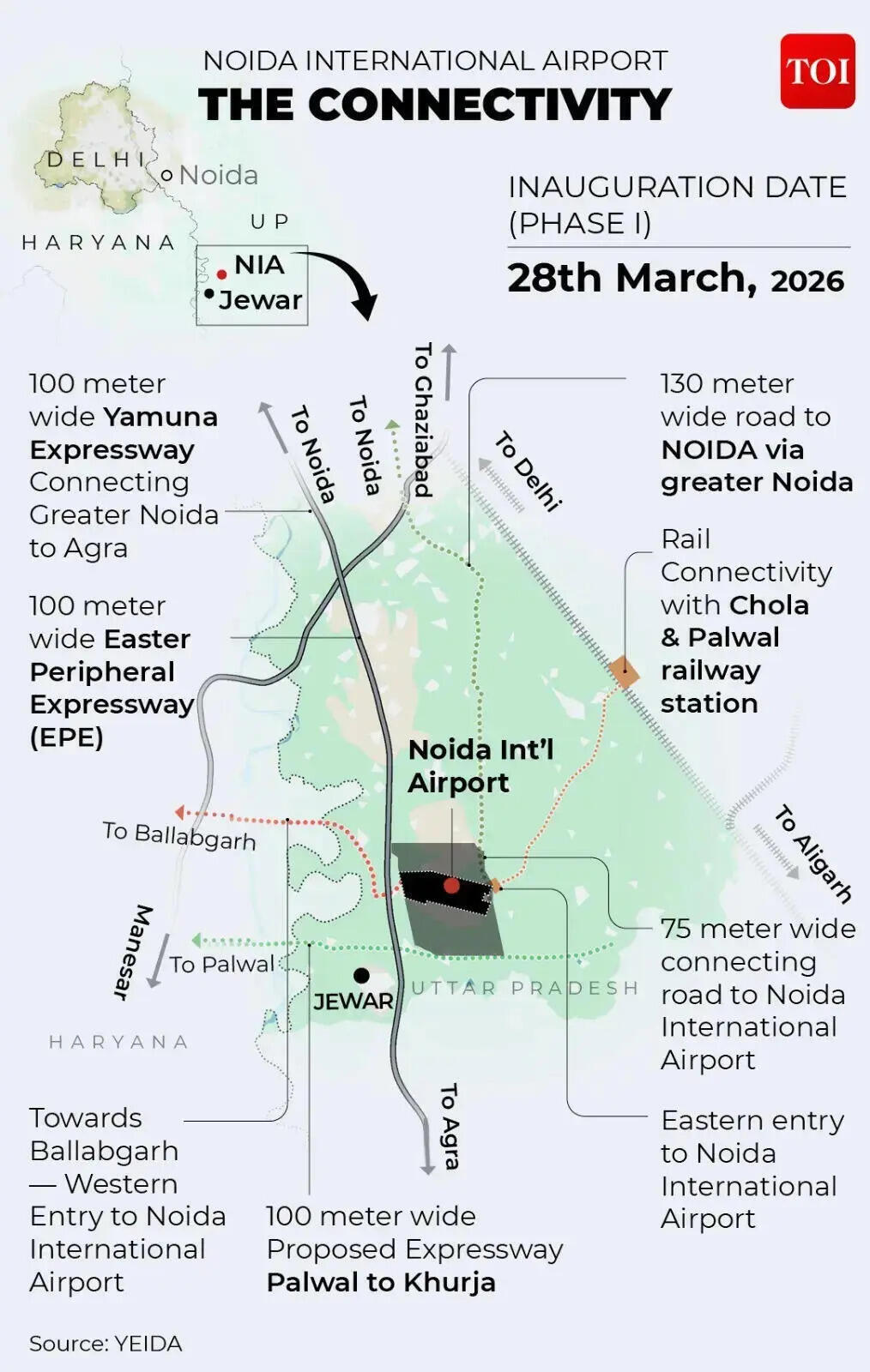
Strategically located along the Yamuna Expressway in Gautam Buddha Nagar district, the airport is planned as a multi-modal transport hub.It will feature seamless integration with road, rail, metro and regional transit systems, ensuring smooth connectivity for passengers and cargo. This connectivity is expected to significantly improve accessibility for travellers across Delhi NCR and neighbouring regions.
Boost to India’s aviation ambitions
The inauguration of Phase I of Noida International Airport is being seen as a major step in strengthening India’s aviation ecosystem.By expanding capacity, improving connectivity, and integrating modern infrastructure with sustainability, the project is expected to play a key role in positioning Delhi NCR as a major global aviation hub while supporting economic growth and regional development
Business
Iran permits 2 Pakistani cargo ships to pass through Strait of Hormuz | The Express Tribune

Iran has permitted two Pakistani cargo ships to transit through the Strait of Hormuz, sources in the Ministry of Maritime Affairs confirmed on Saturday.
The vessels, Multan and P-Akili, which were previously held after Iranian forces took control of the strait — a key global oil supply route — have now crossed and are en route to Karachi. They are expected to dock at Karachi port on March 31, a source familiar with the matter said.
Multan is a general cargo ship, while P-Akili is carrying over 80 million litres of crude oil. Sources added that Iranian authorities not only allowed the vessels to pass but also provided an escort until they cleared the strait’s flashpoint line.
Read: Global poll says Iran war leaves US increasingly isolated internationally
This move comes amid ongoing mediation efforts by Islamabad, in coordination with Turkiye and Egypt, to curb the escalating conflict in the Middle East.
It is the second time Tehran has permitted a Pakistani ship to pass through the Strait of Hormuz since the conflict began on February 28. Previously, a Pakistani oil tanker transited the strait on March 16.
The Middle East region remains on high alert following the joint US-Israel offensive on Iran that began on February 28, which has resulted in over 1,900 deaths, including then-Supreme Leader Ali Khamenei.
Tehran has retaliated with drone and missile strikes targeting Israel, Jordan, Iraq, and Gulf countries hosting US military assets, causing casualties, infrastructure damage, and disruption to global markets and aviation.


The Avett Brothers’ bassist explains why he wrote a book about John Quincy Adams

Ukraine’s Zelenskiy agrees defence cooperation with UAE, Qatar during Gulf visit

Transfer rumors, news: Salah eyes Roma after Liverpool exit

-
 Business1 week ago
Flipkart group CFO to leave co amid IPO plans – The Times of India
-
 Business1 week ago
Video: The Effects of High Oil Prices
-

 Fashion1 week ago
China’s textile & apparel exports surge 17% to $50 bn in Jan-Feb 2026
-

 Sports1 week ago
Rating Adidas’ 2026 World Cup away shirts: Argentina, Spain, Mexico and more
-

 Sports1 week ago
American Conference Commissioner Tim Pernetti thanks Trump for Army-Navy game executive order
-
Tech1 week ago
The Corsair 4000D RS PC Case Keeps Your System Cool
-

 Tech1 week ago
Gamers Hate Nvidia’s DLSS 5. Developers Aren’t Crazy About It, Either
-

 Tech1 week ago
‘Uncanny Valley’: Nvidia’s ‘Super Bowl of AI,’ Tesla Disappoints, and Meta’s VR Metaverse ‘Shutdown’