

Tech
When the Internet Goes Dark, the Truth Goes With It


Alaqad says that because traditional media outlets pick and choose what to show their audiences, losing on-the-ground journalists means losing parts of the truth. “When the people are being silenced and censored, and they don’t have a space for them to talk or a platform to express what’s happening, and for us to see what’s happening through their eyes, there will always be limitations [on] how much we know,” she says.
In every crisis, when communication breaks down, accountability is lost and injustice becomes easier to ignore. “Injustice is super loud,” Alaqad says. “Justice needs to be louder.”
Targeted
Journalists are also silenced permanently. Reporters Without Borders (RSF) wrote in December 2025 that 67 media professionals were killed that year, 43 percent of whom were killed in Gaza by Israeli armed forces. The total number of journalists killed in Gaza since October 7, 2023 has risen to over 220, according to the RSF. The UN estimate sits at more than 260.
“When we look at it within the framework of imposing a ban on the foreign press entering Gaza now, more than two years into that war, when they are restricting the free movement of journalists within Gaza and into Gaza, when we are talking about an unprecedented massacre of journalists, the targeting of media offices and the targeting of communication infrastructure just becomes another piece of that puzzle, which aims at imposing a media blackout,” Dagher says. Israel has repeatedly denied claims that it targets journalists or media infrastructure.
“Killing journalists means killing and silencing the truth,” Alaqad says. In her experience, this strategy works on multiple levels—killing journalists means fewer people reporting on the ground, but equally, it turns journalists into a threat to the people. “This is also sending a message to the people that all journalists are a threat, don’t talk to journalists, stay away from journalists,” she explains.
She recalls her mother begging her not to wear her press vest and helmet. Meant to signify neutrality and protect journalists in the field, instead, it made her feel like a target. “It’s supposed to protect, but on the contrary, it actually puts risk on your life and even on your beloved ones and the ones around you,” she explains.
Alaqad says it was not always this way. Early on, people would greet journalists, offer them food, and thank them for their work. “After a couple of months, when they’d seen journalists getting targeted, Palestinians started treating journalists differently,” she says.
To report in Gaza was to work inside a landscape where time itself was unstable and not guaranteed. Plans rarely extended beyond daylight. Conversations ended abruptly. Addresses became memorials overnight. “The only certainty in Gaza is uncertainty,” Alaqad says.
She recalls interviewing families and planning to return the next day, only to find that the people she spoke with had been killed in airstrikes.
She has since left Gaza, and is pursuing a master’s degree in media studies at the American University of Beirut. She received the Shireen Abu Akleh Memorial Endowed Scholarship, named for the Palestinian journalist killed by Israeli forces in May 2022.
Digital Truths
Going viral on social media helped her reach people, but it also put her at risk. “It showed millions of people around the world what’s happening in Gaza, but at what cost? Being in Gaza could cost you your life, especially as a journalist,” she says.
Despite the reach of digital reporting, she does not trust its permanence. Accounts disappear, posts are removed and videos are lost. What is available today may be gone tomorrow.











HOKA’s max-stacked Rocket X Trail combines road race shoe energy with boosted grip from a 3-mm lugged outsole. If you’re looking for a fast shoe to go on the attack, this is it. It’s also fantastic for all round comfort. In testing, I laced up the Rocket X Trail and ran 3 hours (just short of 19 miles) fresh out of the box, across roads, forest gravel trails, some grass and through some serious water. It delivered efficiency and energy whether I was moving at marathon pace or with heavier, tired, ragged footfalls in the latter miles.
The rockered, supercritical midsole uses HOKA’s liveliest foam, similar to those you find in its race-ready road shoes, along with a carbon plate. That combines for a really fun ride that’s smooth, springy and fast and really consistent. It’s also highly cushioned, so you will sacrifice a lot of ground feel for that big stack springy softness. It’s also less stable over very lumpy terrain. But on open, flat, runnable mixed terrain, it’s excellent.
The lightweight uppers have a race-shoe-ready feel and after running through ankle-deep flooded sections, they shed water really quickly. This is a pricey road-to-trail shoe, it’s versatile and there’s plenty of winter road potential, too.
| Specs | |
|---|---|
| Weight | 9.45 oz |
| Heel-to-toe drop | 6 mm |
| Lug depth | 3 mm |
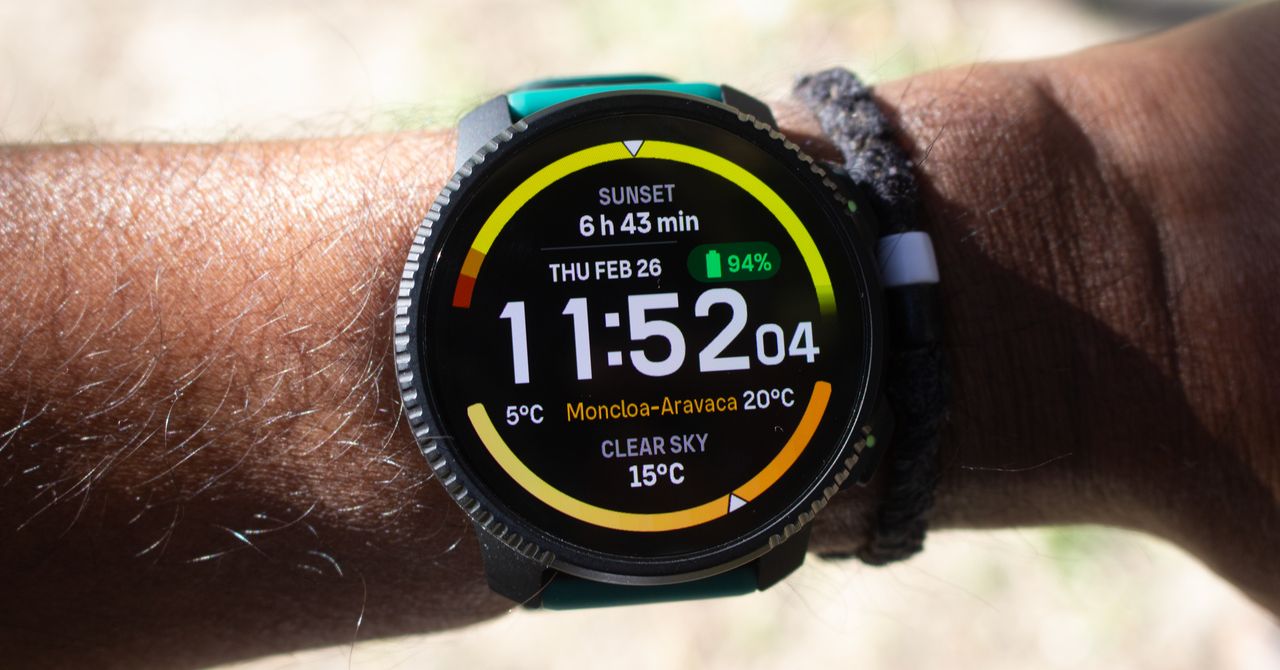
It’s always pleasing to see an array of physical buttons, and you get sizable ones too. You’re not going to miss these wide flat ones even when picking the pace up. The silicone strap has a nice stretch to it and while the button clasp is a bit awkward to get into place, this watch does not budge.
Suunto has jumped on the flashlight trend, with an LED light strip sat on the front of the case. You can adjust brightness levels and there’s SOS and alert modes to emit a very noticeable pulsating light pattern. This is a light I found useful rooting around indoors as well as on nighttime outings.
The biggest change is the introduction of a 1.5-inch, 466 x 466 AMOLED display. This replaces the dull, albeit very visible, memory-in-pixel (MIP) display. Suunto also ditched the solar charging that did require spending a significant amount of time outside to reap its battery benefits.
Adding AMOLED screens to outdoor watches has been contentious. The older MIP displays are just more power-efficient. The Vertical 2 is down by about 10 days from the older Vertical for what Suunto calls daily use.
Still, even if you’re putting its tracking and mapping features to use, you’re not going to be reaching for the charger every few days. After two hours of tracking in optimal GPS mode, the battery only dropped by 2 to 3 percent. The battery drop outside of tracking is also small and the standby performance is excellent as well.
Software Updates
Photograph: Michael Sawh
A more streamlined set of smartwatch features helps reserve battery for when it really matters. Unfortunately, I probably got better battery life because you don’t get phone notifications or responses if it’s paired to an iPhone instead of an Android. There’s also no onboard music player, but you do get a pretty slick set of music playback controls that are accessible during tracking.

Every NHS trust in England needs an electronic patient record (EPR) system in place by March 2026, as part of a government push to digitise the healthcare system.
In many ways, this is long overdue: some trusts have still been using pen-and-paper record-keeping until very recently.
EPRs have the potential to massively improve efficiency in the NHS. If working properly, they allow doctors to keep all of their records in one place, speed up prescribing and diagnostics, and make it easier for patients to access their own health information.
But these roll-outs have not been without problems. Concerns have been raised about how far these benefits can actually be realised. Some NHS trusts have experienced issues with integrating new systems and training staff on how to use them.
In the extreme, there have been reports of EPRs creating new problems for hospitals, with evidence suggesting these systems may have contributed to serious harm and even deaths among patients.
NHS trusts have been put in charge of procuring their own EPRs, meaning there are numerous different technology companies involved. Some providers of these systems are large US firms. This includes Oracle Health, provided by the Larry Ellison-led tech giant, and Epic, a tech firm based in Wisconsin.
Contracts can run into nine figures: Guy’s and St Thomas’, a trust in South London, launched a £450m system from Epic in late 2023. Some parts of the NHS have been using them for more than a decade, but a handful are still set to miss the government’s March deadline.
Data access
Pritesh Mistry is a fellow at the King’s Fund, where he researches the impact of digital transformation in the NHS. He says it has had “both positive and negative impacts”.
“In the last few years, we’ve seen doubling down on the focus around digital records,” says Mistry. These are now in place in more than 90% of all trusts, and every GP practice.
“That means we’ve now got [new] data that’s within the healthcare system, which allows us to do other things, like treat populations, and understand and track patient safety,” he says.
Despite this, he cautions some patients are still struggling to get hold of their own data.
“We’ve got a lot of data that’s in silos,” says Mistry. “It doesn’t flow. That’s the biggest challenge: making the data accessible and usable for patients and healthcare professionals to be able to provide care in a way that is joined up and meets with modern expectations.”
He says complaints with new technology haven’t just come from patients.
“We need to recognise that staff are really frustrated,” says Mistry. “Software often crashes. Computers are really slow, and technology adds to their workload, instead of simplifying things.” He caveats that some parts of the NHS are better than others on this.
Safeguarding patient data
Mistry adds that there are safeguards in place to ensure patient data isn’t ending up where it shouldn’t be – such as through data protection rules and procurement requirements.
However, he warns that “we need to make sure we move with the times in terms of what technology is available”. Mistry is more concerned about medical staff inadvertently putting personal information into a large language model, for instance.
“Digital exclusion remains a barrier as well,” he says, adding that these systems have the potential to widen inequalities in healthcare. Those less able to use new technology might struggle to access their records.
“People tend to assume it’s old people [who are most impacted], but that isn’t necessarily true,” says Mistry, instead highlighting the impact of poverty and deprivation, with some still unable to afford internet access.
He argues the NHS should be working to meet people where they are, and provide more “tailored” technology services.
Patient safety
Nick Woodier is a doctor and investigator at the Health Services Safety Investigations Body (HSSIB), which looks into issues with healthcare in the UK. He sees problems arising from how EPRs are deployed by trusts, especially when medical staff overestimate their capabilities.
He uses the example of prescribing medicines: “There’s an assumption that these electronic prescribing systems will stop you [from] doing something catastrophic.”
But this isn’t always the case. In one investigation, the HSSIB found a child had been prescribed nearly 10 times the recommended dose of an anti-coagulant medication, with doctors having assumed the EPR would flag an issue. The child ended up with a bleed on their brain.
Woodier also worries hospitals are not always picking up on when these systems are at fault.
“We will often see where incidents have happened and the contribution of the electronic system has not been recognised,” he says.
Woodier sees this as coming from a culture which prefers to put the blame for safety failures on individuals.
A 2024 investigation by the BBC found there were more than 126 instances of serious harm registered by NHS trusts across 31 trusts, including three deaths related to EPR problems.
The HSSIB has also encountered problems from patients being unable to access their digital records.
“We’ve seen in general practice, for example, some patients telling us that they’ve gone without care – because in their mind, they thought the only way they could access their GP was to fill in an electronic form,” says Woodier.
A spokesperson for NHS England says EPRs are “already having a significant impact on improving safety and care for patients”, for instance, by helping to identify conditions such as sepsis, and preventing medication errors.
“They have replaced outdated and often less-safe paper-based systems, and we are working closely with NHS trusts to ensure they are implemented safely alongside other systems with appropriate training – and are used to the highest quality and safety standards,” the spokesperson adds.
Interoperability
The EPR roll-out has also been criticised for problems with “interoperability” – the ability of different programs and modes of data collection to converse with each other. The patchwork of different systems used by different trusts means data stored in one system might not be useful for a system used by a different part of the NHS.
Woodier says this often happens in communications between hospitals and GP surgeries. This can involve someone manually inputting information from one system to another, which can create risks when data is not being transferred properly, or is missed completely.
“When you introduce a manual operation, that risk increases,” he warns. “The odds are that at some point, somebody won’t do the right thing, because that’s the reality of being human.”
Alex Lawrence, a fellow at the Health Foundation, describes interoperability as a “significant challenge”, which the NHS and technology companies have been “grappling with for a really long time”.
“Some trusts have found it much harder to access their own EPR data than they anticipated, because of where that data is stored,” she adds, referring to research the organisation carried out in 2024.
“If it’s taking you days to pull the data that you need, then it’s already not going to be useful for a lot of the purposes that you might want it for.”
However, Lawrence adds that there have been some steps made in the right direction, notably with the Data (Use and Access) Act, which was passed last year.
“The government is making information standards mandatory for EPR providers, as well as trusts, with the Secretary of State potentially having more powers to enforce those standards,” she says.
The longer term
Going forward, Lawrence would like to see a system involving “patients being empowered with access to their own data, and as far as appropriate, clinicians being able to see all of the history that they need for their patients”.
In an ideal system, different parts of the healthcare system would be able to “share a patient’s data where necessary and appropriate, in an easy and timely way”.
She says they have the “potential to offer enormous value”, but much of their functionality is going unused. “What our qualitative research suggested was that a lot of these systems are still functioning as digital notebooks,” says Lawrence.
Matthew Taylor is the head of the NHS Confederation and NHS Providers, membership bodies for healthcare organisations.
“NHS leaders say the gap between trusts on digital maturity is still stark – and it’s shaping how quickly organisations can move to modern EPRs,” he says.
This gap – combined with the organisational complexity of the healthcare system – means interoperability has “long been a thorn in the NHS’s side”.
Taylor adds that EPRs are not a “once-and-done” job, and argues they will result in savings in the long term, but that it may take around five years to see the benefits.
“Hospitals are housing a huge amount of paper records, and the cost of storing, retrieving and managing those records can run into millions of pounds each year,” he says.
These systems are part of a larger picture, and one facet of the conversation, around the use of artificial intelligence in the NHS. AI models for areas such as research and diagnostics will require extensive and standardised medical data.
Mistry warns these AI tools operate on the basis of “garbage in, garbage out”.
“There is a risk that we roll out AI tools without the underpinning data quality it needs,” he says, adding that this could exacerbate inequalities or biases from using AI.
As Woodier puts it: “We’ve got organisations who are still using archaic computers, have got infrastructure that’s not working, are still on old web systems, or have EPRs that don’t talk to each other. A few [trusts] don’t have EPRs.
“So, actually, are we trying to run before we’ve even managed to walk?”


The new economics of fashion: Trust, longevity and price discipline

California school hired a coach, but police say he moonlighted as a pimp

US brand Calvin Klein unveils Spring 2026 denim with Jung Kook

What are Iran’s ballistic missile capabilities?

India Us Trade Deal: Fresh look at India-US trade deal? May be ‘rebalanced’ if circumstances change, says Piyush Goyal – The Times of India

US arrests ex-Air Force pilot for ‘training’ Chinese military

-
 Politics1 week ago
What are Iran’s ballistic missile capabilities?
-
Business6 days ago
India Us Trade Deal: Fresh look at India-US trade deal? May be ‘rebalanced’ if circumstances change, says Piyush Goyal – The Times of India
-
 Politics1 week ago
US arrests ex-Air Force pilot for ‘training’ Chinese military
-
 Business7 days ago
Attock Cement’s acquisition approved | The Express Tribune
-
 Business1 week ago
Households set for lower energy bills amid price cap shake-up
-

 Fashion7 days ago
Policy easing drives Argentina’s garment import surge in 2025
-

 Sports6 days ago
LPGA legend shares her feelings about US women’s Olympic wins: ‘Gets me really emotional’
-

 Fashion7 days ago
Texwin Spinning showcasing premium cotton yarn range at VIATT 2026