Business
Why the US is buying icebreakers from Finland
Adrienne MurrayBusiness reporter, Helsinki

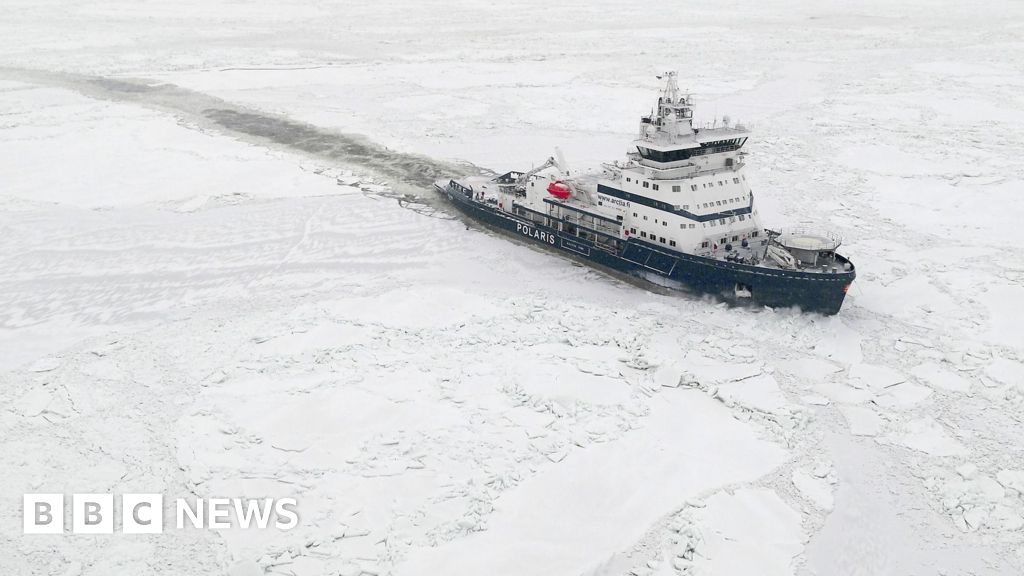
Aker Arctic TechnologyAs President Donald Trump continues to insist that the US needs to own Greenland, his wider focus on the Arctic region has seen Washington order new icebreakers.
For these ships, which can sail through seas covered in solid ice, the US has gone to the world expert – Finland.
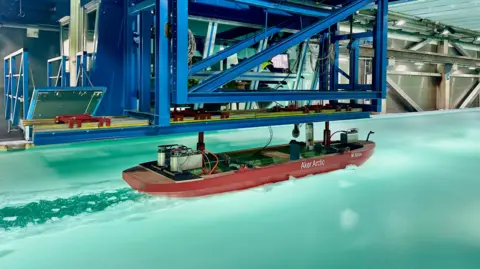
Temperatures are sub-zero inside Aker Arctic Technology’s ice laboratory, as the scale model of an icebreaker cruises down a 70m-long simulation tank.
It ploughs a neat channel through the frozen surface of the water.
Undergoing testing at a facility in Helsinki, Finland’s capital, this is a design for the next generation of the country’s icebreakers.
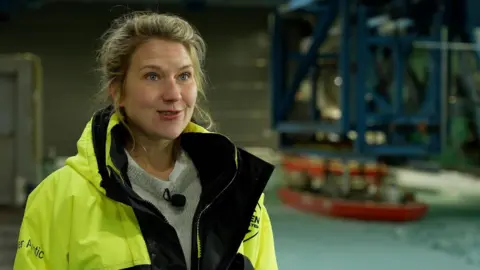
“It’s crucial that it has sufficient structural strength and engine power,” says ice performance engineer, Riikka Matala.
Mika Hovilainen, the firm’s chief executive, adds that the shape of the vessel is also crucial. “You have to have a hull form that breaks ice by bending it downwards,” he says. “It’s not cutting, it’s not slicing.”
Finland is the undisputed world leader when it comes to icebreakers. Finnish companies have designed 80% of all those currently in operation, and 60% were built at shipyards in Finland.
The country leads the way out of necessity, explains Maunu Visuri, president and chief executive of Finnish state-owned company Arctia, which operates a fleet of eight icebreakers.
“Finland is the only country in the world where all the harbours may freeze during wintertime,” he says, adding that 97% of all goods to the country are imported by sea.
During the coldest months, icebreakers keep Finland’s ports open, and work as pathfinders for big cargo ships. “It’s really a necessity for Finland. We say that Finland is an island.”
It was this expertise that saw Trump announce in October that the US planned to order four icebreakers from Finland for the US Coast Guard.
A further seven of the vessels, which the US is calling “Arctic Security Cutters”, are to be built in the US, using Finnish designs and expertise.
“We’re buying the finest icebreakers in the world, and Finland is known for making them,” said Trump.

Adrienne MurrayUnder US law, the country’s naval and coastguard ships must be domestically-built, but in this case the president waived that requirement on national security grounds. He cited “aggressive military posturing, and economic encroachment by foreign adversaries”, by which he means Russia and China.
This US concern comes as climate change continues to make the Arctic Ocean more navigable for cargo ships, at least if icebreakers lead the way by cutting a path. This opens up commercial trade routes from Asia to Europe, either above Russia, or north of Alaska and Canada’s mainland, and down past Greenland.
Reduced ice levels also mean that oil and gas fields beneath the Arctic are more accessible.
“There’s simply a lot more traffic in that part of the world now,” notes Peter Rybski, a retired US Navy officer and Helsinki-based, Arctic expert.
“You have an active oil and gas exploration and extraction industry in Russia, as well as a newly-emerging trans-shipment route from Europe to Asia.”
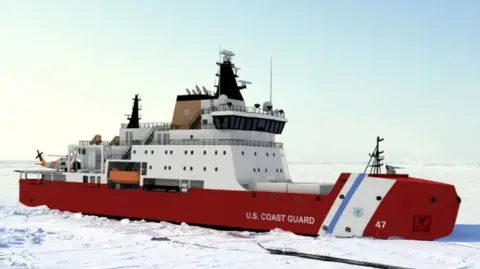
Rauma Marine ConstructionsFollowing Trump’s outline announcement last autumn, the first contracts were awarded on 29 December.
Finland’s Rauma Marine Constructions is to build two icebreakers for the US Coast Guard at its shipyard in the Finnish port of Rauma. The first ship is due to be delivered in 2028.
A further four will be constructed in Louisiana, with all six using an Aker Arctic Technology diesel-electric powered design.
The US orders are part of an effort to catch up with the number of Russian icebreakers. Currently Russia has around 40, including eight that are nuclear powered.
By contrast, the US presently only has three in operation.
Meanwhile China operates around five polar-capable vessels. “None of them are technically icebreakers,” says Rybski, pointing to their design not meeting the strict criteria. “But they are increasing their fleet.”
He adds that China has increasingly been sending these “research” ships into Arctic waters between Alaska and the far east of Russia, including areas that the US considers its “exclusive economic zone”.
“With limited means to respond this becomes a problem [for the US].”
Trump’s desire to enlarge its icebreaker fleet goes beyond the practicalities of operating in ice-clad Arctic seas, assesses Lin Mortensgaard, a researcher at the Danish Institute of International Studies. She says it is also about projecting power.
“No matter how many aircraft carriers you have and how much you use them to threaten states with, you cannot sail your aircraft carrier into the central Arctic Ocean,” she says.
“Icebreakers are really the only kind of naval vessel to signal that you are an Arctic state, with Arctic capabilities. And I think this is what much of the US discourse is about.”
James BrooksBack in Finland, Helsinki Shipyard occupies a dock on the capital’s waterfront. It is where half of the world’s icebreakers have been made. Today owned by Canadian firm Davie, it also hopes to win new contracts from the US Coast Guard.
“The geopolitical situation has changed definitely,” says the shipyard’s managing director, Kim Salmi.
“We have our eastern neighbour here [Russia]. They are building their own [new] fleet. And the Chinese are building their fleet.”
He adds: “The US, Canada and the western allies in general, are looking for the power balance.”
Inside a cavernous shipbuilding hangar, workers cut and weld steel for the yard’s latest icebreaker, a heavy-duty Arctic vessel, called Polarmax that’s destined for the Canadian coastguard.
The Finns can build these complex vessels remarkably swiftly – it takes between two-and-a-half and three years – thanks to a streamlined production method, and decades of experience.
“Over 100 years, we have practised this,” says Arctia’s Visuri. “You’ve got this cycle of designers, operators, builders. That’s why Finland is the superpower of icebreakers.”
Business
German media group Axel Springer to buy Telegraph for £575m
German media firm Axel Springer has agreed to buy the Telegraph Media Group (TMG) for £575 million, scuppering efforts by the owner of the Daily Mail to snap up its UK newspaper rival.
It is the latest major twist in a roughly three-year ownership tussle for the politically influential newspaper group.
Daily Mail and General Trust (DMGT) had previously agreed a £500 million deal to buy The Telegraph last year.
However, Abu Dhabi-backed consortium RedBird IMI said it now plans to sell the business to the Berlin-based Politico owner.
Axel Springer and TMG said the deal will “preserve the integrity” of the brand and help provide a platform for growth.
The companies stressed their commitment to independent journalism in the UK and said they look forward to further discussions with the Department for Culture, Media and Sport (DCMS) and other stakeholders in the coming weeks.
Culture Secretary Lisa Nandy had launched an intervention and competition probe into the previous deal agreed with DMGT, amid concerns of the size of the newspaper market taken up through a merger deal.
Bosses at Axel Springer, which also owns the German newspaper Bild, said they will back an investment programme in TMG to expand the business to help it “become the leading centre-right media outlet in the English-speaking world”.
They also plan to expand the company’s footprint in the US market, potentially leveraging expertise from its Politico and Business Insider titles.
Axel Springer chief executive Mathias Dopfner said: “More than 20 years ago, we tried to acquire The Telegraph and did not succeed.
“Now our dream comes true.
“To be the owner of this institution of quality British journalism is a privilege and a duty.”
In a statement, RedBird IMI said the German business is partly well placed to buy the Telegraph due to the “straightforward regulatory path to ownership” involved in the deal.
“Our team is now working closely with the UK Government to obtain the necessary approvals to finalise this transaction,” the company added.
RedBird IMI is having to sell the Telegraph business after its own takeover move was blocked by the then-Tory government over foreign ownership concerns.
RedBird IMI, which was partly backed by US firm RedBird Capital but majority-owned by Sheikh Mansour bin Zayed Al Nahyan, vice president of the United Arab Emirates, originally agreed to buy the media firm and fellow title The Spectator in 2023.
The Spectator has since been sold to hedge fund tycoon Sir Paul Marshall’s OQS Ventures business for £100 million.
Lengthy talks were then held to find a new suitor after RedBird IMI was forced to sell, with New York Sun publisher Dovid Efune in exclusive discussions to take control.
These collapsed before DMGT struck an agreement with RedBird IMI.
Reports last month indicated that Axel Springer was considering backing a deal with Mr Efune.
On Friday, Axel Springer said it would “like to acknowledge” Mr Efune for “his essential support and assistance on this transaction”.
It is understood that Axel Springer will gain full ownership of TMG as part of the deal.
Business
Maharashtra’s Rs 7.69-Lakh-Crore Budget: Who Gains? Who Pays More?
Last Updated:
The Maharashtra government presented a budget that seeks to balance economic expansion with social welfare, while laying the groundwork for the state’s long-term economic goals

According to Fadnavis, the state’s revenue deficit has consistently remained below 1% of the GSDP.
Maharashtra CM and Finance Minister Devendra Fadnavis on Friday, March 6, presented the state budget for 2026-27 in the Assembly, announcing a series of measures spanning agriculture, infrastructure, industry, urban development, health, and social welfare. The Maharashtra Budget 2026, with a total outlay of Rs 7.69 lakh crore, lays out an ambitious roadmap to accelerate the state’s economic growth while expanding welfare schemes for farmers and women.
From farm loan waivers and incentives for timely repayments to large-scale infrastructure projects and plans to reshape urban development across the state, the budget outlines the government’s vision of building a progressive, sustainable and inclusive Maharashtra.
The Maharashtra government has also set a long-term goal of helping the state economy move toward becoming a one trillion-dollar economy in the coming years and a $5 trillion economy by 2047.
There were also emotional moments in the Maharashtra Assembly as Fadnavis began presenting the budget. Members raised slogans of “Ajit Dada Amar Rahe”, paying tribute to former state finance minister Ajit Pawar, who died in an air crash in January. Fadnavis announced that a memorial will be built for the late NCP leader.
Relief for farmers: Loan waiver and incentives
One of the most significant announcements in the Maharashtra budget was a farm loan waiver scheme aimed at easing financial pressure on farmers. Under the Punyashlok Ahilyadevi Holkar Shetkari Karjmafi Yojana, crop loans of up to Rs 2 lakh taken until September 30, 2025 will be waived for eligible farmers. The government also announced a Rs 50,000 incentive for farmers who regularly repay their crop loans on time.
Alongside financial relief, the government also unveiled plans to strengthen the agricultural sector through technology and sustainability. Natural farming will be promoted across 5 lakh hectares, while value chains for 10-15 crops will be strengthened to help farmers access global markets.
Artificial intelligence (AI) and digital platforms will be introduced in farming practices, and AI innovation centres will be set up at four agricultural universities to support research and technological advancement in agriculture.
Women’s welfare schemes to continue
The government confirmed that the Mukhyamantri Majhi Ladki Bahin Yojana, launched in 2024, will continue with adequate funding. Under the scheme, eligible women from economically weaker sections receive Rs 1,500 per month as financial assistance. The government also plans to expand initiatives aimed at creating more “Lakhpati Didis”, with a target of developing 25 lakh new women entrepreneurs in 2026-27.
Major push for education, startups and health
In the education sector, the state government proposed the development of a large EduCity in Navi Mumbai, which will house six international universities. In addition, eight to ten educational cities will be developed across Maharashtra.
To boost entrepreneurship, the government plans to nurture 1.25 lakh entrepreneurs and strengthen 50,000 startups over the next five years, strengthening the state’s innovation ecosystem.
In healthcare, a Maharashtra Institute of Public Health will be established in Nagpur. The Mahatma Phule Jan Arogya Yojana will also be expanded to cover more treatments and hospitals. The government also announced a Rs 4,500 crore rural disease detection programme, supported by the Asian Development Bank, which will focus on early screening for cancer, diabetes, and heart disease in rural areas.
Water, irrigation and rural development
The government announced plans for river-linking projects and measures to improve water availability across the state. By 2047, the aim is to ensure 55 litres of water per person per day in rural areas and 135 litres per person per day in urban areas.
In rural infrastructure, villages with populations of more than 1,000 people will be connected by concrete roads, improving connectivity and accessibility.
Mumbai and urban development roadmap
A significant part of the budget focused on the development of the Mumbai Metropolitan Region (MMR) and the broader urbanisation strategy for Maharashtra. With projections suggesting that 70% of the state’s population may live in urban areas in the coming decades, the government has proposed large-scale expansion and digitisation of civic services.
One of the most ambitious plans is the development of “Fourth Mumbai” or Mumbai 4.0 at Vadhavan in Palghar, which will function as a major logistics and warehousing hub. The government is also planning “Third Mumbai” (Mumbai 3.0) in the Atal Setu area, which is expected to become another major urban centre.
To prevent the formation of new slums in Mumbai, the government will introduce a “No New Slum Framework” using GIS technology, and this model may later be extended to other cities across Maharashtra. The Slum Rehabilitation Authority will prepare a plan to redevelop about 20 lakh slum houses and construct 10 lakh affordable homes under various housing schemes.
Transport and infrastructure expansion
Metro rail projects in Mumbai and Pune will continue, and the government plans to expand the metro network to 1,200 kilometres in the coming years. Progress on the Mumbai-Ahmedabad bullet train project was also highlighted. The government aims to complete work on three stations up to Thane and Talasari by 2027, with separate development plans for areas around Dadar, Thane, and Virar bullet train stations.
Additional expressways and transport corridors are also planned to strengthen connectivity across the state.
New growth hubs and industrial expansion
To boost industrial growth and employment, the government plans to establish 18 mega industrial hubs across the state. In addition, MSME centres will be set up in every district, which the government estimates could help generate up to 50 lakh jobs.
A major steel hub is proposed in Gadchiroli, expected to attract significant investment and strengthen the state’s industrial base. With support from NITI Aayog, the government also plans to develop separate growth hubs in Pune, Nashik, Nagpur, and Chhatrapati Sambhajinagar, following the development model being implemented in the Mumbai Metropolitan Region.
Another project under consideration is the creation of a world-class stadium and innovation hub on 130 acres in Taloja.
Green energy and sustainability push
The government aims to achieve 50% green energy by 2029 and 65% by 2035. The plan includes large-scale tree plantation drives and rooftop solar initiatives to promote sustainability.
Budget figures and fiscal targets
For the financial year 2026-27, the state budget estimates:
- Revenue receipts: Rs 6,16,099 crore
- Revenue expenditure: Rs 6,56,651 crore
- Revenue deficit: Rs 40,552 crore
The fiscal deficit is estimated at Rs 1,50,491 crore, and the government said it has kept the fiscal deficit below 3% of the Gross State Domestic Product (GSDP). According to Fadnavis, the state’s revenue deficit has consistently remained below 1% of the GSDP.
The government also aims to expand the Mumbai Metropolitan Region’s economy from the current $140 billion to $300 billion, positioning it as a major global economic hub.
Through a combination of welfare schemes, large-scale infrastructure investments, and ambitious urban development plans, the Fadnavis government has presented a budget that seeks to balance economic expansion with social welfare, while laying the groundwork for Maharashtra’s long-term economic ambitions.
Maharashtra, India, India
March 06, 2026, 18:29 IST
Read More
Business
From Gridlock To Global City: How Karnataka Budget Charts Bengaluru’s Next Leap
Last Updated:
Recognising Bengaluru as both a global startup hub and a land of immense aspiration, the government has maintained an aggressive development grant of Rs 7,000 crore

Addressing the city’s burgeoning population of 1.40 crore, the government has formalised the Cauvery Phase VI project. File image
The Karnataka State Budget for 2026-27 has unveiled a transformative financial roadmap for Bengaluru, aimed at elevating the state capital into a “world-class liveable city.” Recognising the metropolis as both a global startup hub and a land of immense aspiration, the government has maintained an aggressive development grant of Rs 7,000 crore. This sustained investment seeks to address the twin challenges of urban sprawl and traffic congestion that have long shadowed the city’s rapid economic rise.
The Rs 40,000 Crore Subterranean Shift
In perhaps the most ambitious infrastructure proposal in the city’s history, the government has approved a 40 km tunnel road network. Designed to cut through the city’s densest areas, the network will feature north-south and east-west corridors at an estimated cost of Rs 40,000 crore.
The project will be executed under a Build-Own-Operate-Transfer (BOOT) model, with the first phase—a 17 km stretch of the North-South corridor—already moving toward implementation. Tenders for this initial phase have been invited at a cost of Rs 17,780 crore. This subterranean strategy is complemented by the Bengaluru Business Corridor Phase-1, a 73 km stretch connecting Tumakuru Road to Hosur Road, which the government aims to complete within four years.
Scaling Mass Transit and Pedestrian Access
“Namma Metro” continues its trajectory as India’s second-largest network. The budget proposes the completion of an additional 41 km of metro lines within the current financial year, a milestone expected to push daily ridership to 15 lakh commuters. Notably, the government highlighted a significant fiscal imbalance in the project’s funding, pointing out that the state has shouldered 88% (Rs 59,376 crore) of the total expenditure to date, compared to the central government’s 12% contribution.
To bridge the gap between mass transit and the “last mile”, a new 9 km pedestrian walkway will be constructed along the Outer Ring Road (ORR) metro viaduct. This Rs 160 crore initiative is a landmark partnership with the Outer Ring Road Companies Association, reflecting a new model of corporate-government collaboration in urban design.
Durability and Urban Aesthetics
The budget moves away from quick-fix road repairs towards long-term durability. Over the next three years, the government plans to white-top more than 450 km of roads at a cost of Rs 3,000 crore. The urban experience will be further enhanced through:
- The beautification of 175 major junctions.
- The construction of 100 new skywalks.
- The renovation of 500 km of footpaths using city corporation resources.
- An investment of Rs 450 crore to upgrade the Silk Board to KR Puram corridor into a global-standard thoroughfare.
Water Security and Environmental Resilience
Addressing the city’s burgeoning population of 1.40 crore, the government has formalised the Cauvery Phase VI project. Assisted by JICA, this Rs 6,939 crore initiative will secure an additional six TMC of drinking water. To mitigate the recurring threat of urban flooding, Rs 2,000 crore has been earmarked for storm water drain upgrades under a World Bank-assisted programme. The city’s long-term growth will be guided by the Revised Master Plan-2041, scheduled for completion by late 2027.
Sports and Cultural Landmarks
In a move to bolster Bengaluru’s status as a sporting and cultural capital, the budget announced two massive landmark projects:
Anekal Cricket Stadium: A new, state-of-the-art 80,000-seater cricket stadium will be built in Anekal, significantly expanding the city’s capacity for international sporting events.
Malleswaram Convention Centre: A world-class convention centre will be developed on land owned by the Mysore Lamp Works in Malleswaram under a Public-Private Partnership (PPP) model.
By combining deep-tunnel engineering with massive mass transit expansion and environmental safeguards, the 2026-27 budget represents a definitive attempt to future-proof Bengaluru against the pressures of its own success.
March 06, 2026, 18:00 IST
Read More
-
Business1 week agoAttock Cement’s acquisition approved | The Express Tribune
-
Fashion1 week agoPolicy easing drives Argentina’s garment import surge in 2025
-
Business1 week agoIndia Us Trade Deal: Fresh look at India-US trade deal? May be ‘rebalanced’ if circumstances change, says Piyush Goyal – The Times of India
-
Politics1 week agoWhat are Iran’s ballistic missile capabilities?
-
Sports1 week agoLPGA legend shares her feelings about US women’s Olympic wins: ‘Gets me really emotional’
-
Politics1 week agoUS arrests ex-Air Force pilot for ‘training’ Chinese military
-
Business1 week agoGreggs to reveal trading amid pressure from cost of living and weight loss drugs
-
Sports1 week agoSri Lanka’s Shanaka says constant criticism has affected players’ mental health