Connect with us

Business

Why your chocolate is getting smaller, more expensive and less chocolatey

Published

on

Why your chocolate is getting smaller, more expensive and less chocolatey


Archie MitchellBusiness reporter

Getty Images Woman holding a bar of chocolate, she has long black hair and is wearing a white t-shirt and it standing in front of a bright pink backgroundGetty Images

Crack open a tub of Celebrations or pull a Terry’s Chocolate Orange from a stocking these days, and have you noticed, there seems to be a little less to go around?

Not only that, you might find – no, it is not your imagination – that some popular treats taste a little different, a little less “chocolatey”.

To top it all the prices have risen too.

So will your festive favourites still hit the sweet spot this Christmas?

Chocs away

Many of the companies making popular bars and chocolates admit they have been looking for ways to save money. A tried-and-tested one is to replace some of the more expensive ingredients, like cocoa, with cheaper ones, a strategy that’s been dubbed “skimpflation”.

Some recipes have changed so much that bars like Toffee Crisp, Penguin and others can no longer be called chocolate.

There is even a debate among some chocolate fans over whether the year-round classic Cadbury’s Dairy Milk has changed its recipe.

Becca Amy Stock, a TikTok influencer who goes by the name Becca Eats Everything, set herself the task of reviewing every milk chocolate bar at Britain’s major supermarkets. The 29-year-old spent six hours and £100 on her rigorous research.

She concluded Dairy Milk was “more oily” since Cadbury’s takeover by the American company Mondelez in 2010. And the brand, famous for its “glass and a half” of milk, was less milky, she said.

“You do notice the difference,” Becca says, “Cadbury’s does not taste how it used to taste.”

Becca Amy Stock Becca Amy Stock is smiling and looking at the camera. In front of her she is holding a tray of milk chocolate bars, all different brands.Becca Amy Stock

Milk chocolate in the UK must have at least 20% cocoa solids and 20% milk solids to earn the name chocolate. Without that it has to be labelled “chocolate flavour” not chocolate. Cadbury’s Dairy Milk still meets that standard.

Mondelez says it has not been fiddling with the recipe, at least not recently.

“Our Cadbury Dairy Milk products continue to be made with the same delicious recipes that consumers know and love,” its spokesperson said. “The cocoa content has not changed for many years.”

Crunching the numbers

But it is still one which you’ll be paying more for.

Plenty of food manufacturers have been reducing the size of their products, without dropping prices, known as shrinkflation.

And some are also putting prices up, too.

Chocolate prices in supermarkets have risen by more than 18% on average from this time last year, according to market researchers Kantar.
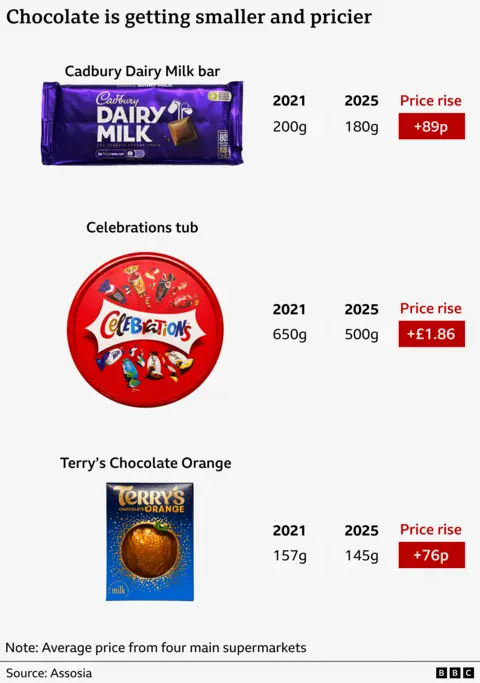
Graphic showing three different chocolate products under the heading: Chocolate is getting smaller and pricier.
Cadbury's Dairy Milk bar is accompanied by the data: in 2021 it was 200g, in 2025 it was 180g. Its price has risen by 89p
Celebrations tub is accompanied by the data: 2021 it weighed 650g in 2025 it weighed 500g. Price rise of £1.86
Terry's chocolate orange is accompanied by the data: In 2021 it weighed 157g in 2025 it weighed 145g. Price rise of 76p.

We got these figures by analysing price data collected by market researchers Assosia across four of the UK’s biggest grocers, Tesco, Sainsbury’s, Asda and Morrisons, between December 2021 and December 2025.

They show:

  • Cadbury’s Dairy Milk weighs 10% less, while the cost jumped from £1.86 to £2.75 – a 48% price increase
  • Mars Celebrations has shrunk by 23%. The price has risen from £4.25 to £6.11 – a 44% jump
  • Terry’s Chocolate Orange is 8% smaller, while the cost has risen from £1.49 to £2.25 – a 51% price rise

Getty Images In this photograph illustration a bar of Cadbury's Dairy Milk chocolate without a wrapper is broken in halfGetty Images

Mondelez’s spokesperson said putting up prices was a “last resort” but ingredients are costing more – in particular cocoa and dairy.

“This means our products continue to be much more expensive to make.

“As a result of this difficult environment, we have had to make the decision to slightly reduce the weight and increase the list price of some of our Cadbury products,” they said.

Mars Wrigley told the BBC higher cocoa prices and manufacturing costs meant they had to “adjust some… product sizes… without compromising on quality or taste.”

Sticky costs

So what has caused the price of cocoa and milk to shoot up?

Extreme weather caused by climate change has hit cocoa farmers’ crop yields in Africa, says Ghadafi Razak, an academic at Warwick Business School.

Extreme rainfall in India, Brazil and Thailand in 2023, followed by droughts the following year have meant poor harvests in those countries too, pushing up prices.

The extra costs take time to feed through to customers, says Christian Jaccarini, a senior food analyst at the Energy & Climate Intelligence Unit think tank, which means those extra costs are hitting shop shelves now.

“It takes about 18 months for the impact of a shock to be felt by consumers, so we still have quite a long time with higher prices for chocolate,” he said.

Milk prices have shot up too. Diarmaid Mac Colgáin, founder of the Concept Dairy consultancy blames the rising cost of feed, fuel and fertilisers as well as farmers facing higher wage bills and production costs.

He says some brands have substituted palm oil and shea oil for some of the milk to make up the fat content of their chocolate.

Bad taste

Shoppers are becoming increasingly aware of these cost-saving tactics, but that does not mean they are happy about it.

It is the element of unwanted surprise that can leave a bad taste, according to Reena Sewraz, retail editor at consumer champion, Which?

It can feel “especially sneaky” when companies shrink products or downgrade their ingredients she said.

“With Christmas not far away, shoppers will be looking to get the best value from what they buy,” she said. “Supermarkets and manufacturers should be more upfront about making these changes. Customers may not love the news – but [then] at least they don’t feel misled.”

Alamy A mix of celebrations chocolates sold in the UK in a celebrations gift box. Maltesers teasers, bounty, snickers, galaxy, twix, mars bar and milky wayAlamy

But there is not much you can do about it. For Becca, who insists she’s not “chocolated out” despite her chocolate-tasting marathon, quality not quantity is the way to go.

She suggests fellow chocoholics treat themselves to smaller premium bars such as Tony’s Chocolonely. They’ll cost more but she finds them more satisfying.

She also plans to treat herself to a selection-box on Christmas day.

Otherwise she generally advises against “food snobbery”.

“I think supermarket own-brands are actually a much better way to get better quality chocolate.”


Source link

Continue Reading
Click to comment

Leave a Reply

Your email address will not be published. Required fields are marked *

Business

Petrol, Diesel Fresh Prices Announced: Check Rates In Your City On December 13

Published

on

Petrol, Diesel Fresh Prices Announced: Check Rates In Your City On December 13


Last Updated:

Petrol, Diesel Price On December 13: Check City-Wise Rates Across India Including In Delhi, Mumbai and Chennai.

Petrol, Diesel Prices On December 13.

Petrol, Diesel Prices On December 13.

Petrol and Diesel Prices on December 13, 2025: OMCs update petrol and diesel prices daily at 6 am, aligning them with fluctuations in global crude oil prices and currency exchange rates. This daily revision promotes transparency and ensures consumers have access to the most up-to-date and accurate fuel prices.

Petrol Diesel Price Today In India

Check city-wise petrol and diesel prices on December 13:

City Petrol (₹/L) Diesel (₹/L)
New Delhi 94.72 87.62
Mumbai 104.21 92.15
Kolkata 103.94 90.76
Chennai 100.75 92.34
Ahmedabad 94.49 90.17
Bengaluru 102.92 89.02
Hyderabad 107.46 95.70
Jaipur 104.72 90.21
Lucknow 94.69 87.80
Pune 104.04 90.57
Chandigarh 94.30 82.45
Indore 106.48 91.88
Patna 105.58 93.80
Surat 95.00 89.00
Nashik 95.50 89.50

Key Factors Behind Petrol and Diesel Rates

Petrol and diesel prices in India have remained unchanged since May 2022, following tax reductions by the central and several state governments.

Oil Marketing Companies (OMCs) update fuel prices daily at 6 am, adjusting for fluctuations in global crude oil markets. While these rates are technically market-linked, they are also influenced by regulatory measures such as excise duties, base pricing frameworks, and informal price caps.

Key Factors Influencing Fuel Prices in India

  • Crude Oil Prices: Global crude oil prices are a primary driver of fuel prices, as crude is the main input in petrol and diesel production.

  • Exchange Rate: Since India relies heavily on crude oil imports, the value of the Indian rupee against the US dollar significantly affects fuel costs. A weaker rupee typically translates to higher prices.

  • Taxes: Central and state-level taxes constitute a major portion of retail fuel prices. Tax rates vary across states, leading to regional price differences.

  • Refining Costs: The cost of processing crude oil into usable fuel impacts retail prices. These costs can fluctuate depending on crude quality and refinery efficiency.

  • Demand-Supply Dynamics: Market demand also influences fuel pricing. Higher demand can push prices up as supply adjusts to consumption trends.

How to Check Petrol and Diesel Prices via SMS

You can easily check the latest petrol and diesel prices in your city through SMS. For Indian Oil customers, text the city code followed by “RSP” to 9224992249. BPCL customers can send “RSP” to 9223112222, and HPCL customers can text “HP Price” to 9222201122 to receive the current fuel prices.

Click here to add News18 as your preferred news source on Google.
Follow News18 on Google. Join the fun, play games on News18. Stay updated with all the latest business news, including market trendsstock updatestax, IPO, banking finance, real estate, savings and investments. To Get in-depth analysis, expert opinions, and real-time updates. Also Download the News18 App to stay updated.
News business economy Petrol, Diesel Fresh Prices Announced: Check Rates In Your City On December 13
Disclaimer: Comments reflect users’ views, not News18’s. Please keep discussions respectful and constructive. Abusive, defamatory, or illegal comments will be removed. News18 may disable any comment at its discretion. By posting, you agree to our Terms of Use and Privacy Policy.

Read More


Source link

Continue Reading

Business

Rivian’s AI, autonomy impress Wall Street, but EV and capital concerns remain

Published

on

Rivian’s AI, autonomy impress Wall Street, but EV and capital concerns remain


Rivian CEO RJ Scaringe at the company’s first “Autonomy and AI Day” on Dec. 11, 2025, in Palo Alto, California.

Lora Kolodny | CNBC

Rivian Automotive impressed Wall Street on Thursday with its plans for artificial intelligence, automation and an internally developed silicon chip, but significant challenges involving demand and capital remain for the electric vehicle maker.

Despite Wall Street analysts expressing some optimism following Rivian’s first “Autonomy and AI Day,” the company’s stock fell 6.1% to close Thursday at $16.43 per share. But shares recovered Friday to close at $18.42, up 12.1%

While the event didn’t cause many analysts to change ratings or price targets, Needham raised its price target on Rivian by 64% to $23 per share. The firm did so on the tech announcements and potential for future licensing deals, as well as higher-than-consensus expectations on deliveries next year of the company’s new midsize R2 SUV.

“RIVN signaled a shift from an [automaker] adopting autonomy to one leveraging AI to build end-to-end autonomy,” Needham analyst Chris Pierce said in a Friday investor note.

The company’s stock had ramped up heading into the AI Day, but many analysts believed the announcements from the event were already “priced in.” Shares also fell as OpenAI made its own AI announcement Thursday, revealing its most advanced model yet.

“We attended Rivian’s Autonomy & AI Day yesterday in Palo Alto and came away mostly impressed with the strategic direction outlined by management,” Deutsche Bank analyst Edison Yu said Friday in an investor note. “However, the stock’s weakness seems warranted given the run-up since earnings and lack of a major AI partnership/deal announcement.”

Rivian’s announcements included a proprietary chip, RAP1, designed for “physical AI,” namely autonomous driving; an evolved software architecture, or “brains” of the vehicle; a new AI assistant; and a road map for getting to “personal L4,” or fully self-driving personally owned vehicles.

The latter begins later this month with an update involving its hands-free driving system, followed by plans to continue to expand capabilities until vehicles reach full autonomy in the years ahead. Rivian did not disclose a time frame for the full autonomy or potential robotaxi fleet autonomous vehicles.

Leading up to the event, Rivian shares were up more than 30% to $17.50. Despite those gains, shares remain well off the levels of the company’s IPO of $78 per share in 2021.

Barclays analyst Dan Levy and others said while Rivian’s technology announcements, including the surprise proprietary chip, were impressive, the company remains a “show me” story amid more challenging market conditions.

“With RIVN facing a tougher path to breakeven on core vehicle sales alone, we believe with enhanced AV/AI capabilities RIVN is further paving the path to additional software/service revenues, which would be margin accretive,” Levy said Friday in an investor note. “To be clear, there is certainly a ‘show me’ element for RIVN on its capabilities.”

Challenges include slumping EV demand following the end of up to $7,500 tax credits in September, lack of other support under the Trump administration and internal struggles at the company involving products and capital.

Several analysts noted the adoption of advanced driver assistance systems remains low across the industry, even at U.S. EV leader Tesla, and Rivian is continuing to play catch-up to other companies that have offered such systems for years.

Stock Chart IconStock chart icon

hide content

Shares of “pure EV” plays Tesla, Rivian and Lucid in 2025.

Rivian founder and CEO RJ Scaringe and other executives argued that the company’s vertical integration of in-house capabilities including software, AI, vehicle platforms and other technologies will enable the automaker to be more efficient, quicker and better than others.

“AI is enabling us to create technology and customer experiences at a rate that is completely different from what we’ve seen in the past,” Scaringe said during the event.

Such arguments, as well as the automaker’s prior $5.8 billion joint venture software deal with Volkswagen, have led Wall Street to price Rivian’s software business higher than its core of producing and selling EVs, given market conditions.

A $12 price target for Rivian shares from Morgan Stanley, which recently downgraded the company to underweight, includes $7 for software and services and $5 for its core automotive business. Several analysts added that Rivian might be able to license or sell its newest technologies, including chips.

“RIVN is developing a suite of hardware and software offerings to remain competitive in an Auto 2.0 world. However, several risks remain around demand, potentially limiting data capture needed to reach higher levels of autonomy,” Morgan Stanley’s Andrew Percoco said in a Friday note.

Morgan Stanley raised concerns about autonomy adoption rates, lackluster EV demand ahead of Rivian’s new “R2” vehicle next year and a prolonged path to profitability as reasoning for the rating confirmation.

Rivian R2 is showcased at the company’s first Autonomy and AI Day showcasing developments in self-driving technology, in Palo Alto, California, Dec. 11, 2025.

Carlos Barria | Reuters

RBC Capital Markets analyst Tom Narayan agreed: “The advancements enhance Rivian’s product offering but do not address ongoing concerns around liquidity and R2/R3 profitability.”

Rivian continues to lose billions of dollars annually, despite significant cost reductions and gains in software revenue thanks to its deal with VW.

Rivian ended the third quarter with $7.7 billion in total liquidity, including nearly $7.1 billion in cash, cash equivalents and short-term investments that Scaringe has said position the company “really well” for the R2 launch.

The R2 midsize SUV is crucial for Rivian — especially since it’s a major market in the U.S. With expectations of a $45,000 starting price, it is anticipated to broaden Rivian’s customer base and be a proof-point for the company’s efforts regarding profitability and cost savings.

Rivian’s current R1 pickup truck and SUV consumer models start at more than $70,000. It also builds electric delivery vans, largely for its biggest shareholder, Amazon, that start at around $80,000.

“Profitability pressure will likely intensify as Rivian rolls out its ~$45K R2 platform in the highly competitive mid-size SUV segment,” Narayan said. “While targeting a lower price point could increase market reach, the R1 platform’s struggles with profitability despite being nearly double the price of the R2 raise.”

Shares of Rivian, with a $22.5 billion market cap, are rated hold with a $15.43 per share price target, according to average ratings and estimates compiled by FactSet.

— CNBC’s Michael Bloom contributed to this report.


Source link

Continue Reading

Business

EU backs indefinite freeze on Russia’s frozen cash ahead of big loan plan for Ukraine

Published

on

EU backs indefinite freeze on Russia’s frozen cash ahead of big loan plan for Ukraine


Paul KirbyEurope digital editor

Thierry Monasse/Getty Images President of Ukraine Volodymyr Zelenskyy (L) and the EU Commission President Ursula von der Leyen (R) walk in front of blue and yellow-starred European Union flagsThierry Monasse/Getty Images

Ukraine’s president says it is right for Russia’s frozen assets to be used to rebuild his country

European Union governments have agreed to immobilise indefinitely Russian assets of up to €210bn (£185bn) that have been frozen in the EU since the start of Russia’s full-scale invasion of Ukraine.

Most of Moscow’s cash is held in Belgian bank Euroclear, and European leaders are hoping to agree a deal at next week’s crunch EU summit that would use the money for a loan to help Kyiv fund its military and economy.

After almost four years of Russia’s full-scale war Ukraine is running out of cash, and needs an estimated €135.7bn (£119bn; $159bn) over the next two years.

Europe aims to provide two-thirds of that, but Russian officials accuse the EU of theft.

The Russian Central Bank said on Friday it was suing Belgian bank Euroclear in a Moscow court, in response to the EU loan plan.

‘Only fair’ to use Russia’s assets

Russia’s assets in the EU were frozen within days of the full-scale invasion of Ukraine in February 2022, and €185bn of that is held by Euroclear.

The EU and Ukraine argue that money should be used to rebuild what Russia has destroyed: Brussels calls it a “reparations loan” and has come up with a plan to prop up Ukraine’s economy to the tune of €90bn.

“It’s only fair that Russia’s frozen assets should be used to rebuild what Russia has destroyed – and that money then becomes ours,” says Ukraine’s Volodymyr Zelensky.

German Chancellor Friedrich Merz says the assets will “enable Ukraine to protect itself effectively against future Russian attacks”.

Russia’s court action was expected in Brussels and European Economic Commissioner Valdis Dombrovskis said on Friday that EU financial institutions were “fully protected” from legal proceedings.

But it is not just Moscow that is unhappy.

Belgium is worried it will be saddled with an enormous bill if it all goes wrong and Euroclear chief executive Valérie Urbain says using it could “destabilise the international financial system”.

Euroclear also has an estimated €16-17bn immobilised in Russia.

Belgian Prime Minister Bart De Wever has set the EU a series of “rational, reasonable, and justified conditions” before he will accept the reparations plan, and he has refused to rule out legal action if it “poses significant risks” for his country.

EPA/Shutterstock Belgian Prime Minister Bart De Wever, on the left in a dark three-piece suit visits 10 Downing Street and shakes hands with Sir Keir Starmer, wearing a maroon tieEPA/Shutterstock

Belgian Prime Minister Bart De Wever discussed Europe’s frozen assets plan with UK Prime Minister Sir Keir Starmer on Friday

What is the EU’s plan?

The EU is working to the wire ahead of next Thursday’s summit to come up with a solution that Belgium can accept.

Until now the EU has held off touching the assets themselves directly but since last year has paid the “windfall profits” from them to Ukraine. In 2024 that was €3.7bn. Legally using the interest is seen as safe as Russia is under sanction and the proceeds are not Russian sovereign property.

But international military aid for Ukraine has slipped dramatically in 2025, and Europe has struggled to make up the shortfall left by the US decision to all but stop funding Ukraine under President Donald Trump.

There are currently two EU proposals aimed at providing Ukraine with €90bn, to cover two-thirds of its funding needs.

One is to raise the money on capital markets, backed by the EU budget as a guarantee. This is Belgium’s preferred option but it requires a unanimous vote by EU leaders and that would be difficult when Hungary and Slovakia object to funding Ukraine’s military.

That leaves loaning Ukraine cash from the Russian assets, which were originally held in securities but have now largely matured into cash. That money is Euroclear property held in the European Central Bank.

The EU’s executive, the European Commission, accepts Belgium has legitimate concerns and says it is confident it has dealt with them.

The plan is for Belgium to be protected with a guarantee covering all the €210bn of Russian assets in the EU.

Should Euroclear suffer a loss of its own assets in Russia, a Commission source explained that would be offset from assets belonging to Russia’s own clearing house which are in the EU.

If Russia went after Belgium itself, any ruling by a Russian court would not be recognised in the EU.

In a key development, EU ambassadors have agreed that Russia’s central bank assets held in Europe should be immobilised indefinitely.

Until now they have had to vote unanimously every six months to renew the freeze, which could have meant a repeated risk to Belgium.

The EU ambassadors used an emergency clause under Article 122 of the EU Treaties so the assets remain frozen as long as an “immediate threat to the economic interests of the union” continues, or until Russia pays war reparations to Ukraine in full.

Swedish Finance Minister Elisabeth Svantesson said the decision was an “important step in enabling more support for Ukraine and protecting our democracy”.

Thierry Monasse/Getty Images German Chancellor Friedrich Merz (L) is welcomed by the President of the European Commission, Ursula von der Leyen (R)Thierry Monasse/Getty Images

The German chancellor (L) says the EU’s plan will enable Ukraine to defend itself

Why Belgium is not yet satisfied

Belgium is adamant it remains a staunch ally of Ukraine, but sees legal risks in the plan and fears being left to handle the repercussions if things go wrong.

A usually divided political landscape in this case has rallied behind Prime Minister Bart De Wever, who is under pressure from European colleagues.

“Very important decisions” would be made by the EU in the coming week, he said during a meeting with UK Prime Minister Sir Keir Starmer in London on Friday. He added that Belgium and the UK would work together to “get the certainty that we can support Ukraine to stay a free, democratic and sovereign country”.

The EU believes it can secure sufficient guarantees for the loan itself, but Belgium fears an added risk of being exposed to extra damages or penalties.

“Belgium is a small economy. Belgian GDP is about €565bn – imagine if it would need to shoulder a €185bn bill,” says Veerle Colaert, professor of financial law at KU Leuven University.

She also believes the requirement for Euroclear to grant a loan to the EU would violate EU banking regulations.

“Banks need to comply with capital and liquidity requirements and shouldn’t put all their eggs in one basket. Now the EU is telling Euroclear to do just that.

“Why do we have these bank rules? It’s because we want banks to be stable. And if things go wrong it would fall to Belgium to bail out Euroclear. That’s another reason why it’s so important for Belgium to secure water-tight guarantees for Euroclear.”

Europe under pressure from every direction

There is no time to lose, warn seven EU member states including those closest geographically to Russia such as the Baltics, Finland and Poland. They believe the frozen assets plan is “the most financially feasible and politically realistic solution”.

“It’s a matter of destiny for us,” says leading German conservative MP Norbert Röttgen. “If we fail, I don’t know what we’ll do afterwards. That’s why we have to succeed in a week’s time”.

While Russia is adamant its money should not be touched, there are added concerns among European figures that the US may want to use Russia’s frozen billions differently, as part of its own peace plan.

Zelensky has said Ukraine is working with Europe and the US on a reconstruction fund, but he is also aware the US has been talking to Russia about future co-operation.

An early draft of the US peace plan referred to $100bn of Russia’s frozen assets being used by the US for reconstruction, with the US taking 50% of the profits and Europe adding another $100bn. The remaining assets would then be used in some kind of US-Russia joint investment project.

An EU source said the added advantage of Friday’s expected vote to immobilise Russia’s assets indefinitely made it harder for anyone to take the money away. Implicit is that the US would then have to win over a majority of EU member states to vote for a plan that would financially cost them an enormous sum.

Hungary’s Viktor Orban, seen as Russia’s closest partner in the EU, said Europe’s leaders were “placing themselves above the rules” and replacing the rule of law with the rule of bureaucrats.


Source link

Continue Reading

Trending