

Business
Woman felt ‘dehumanised’ after Musk’s Grok AI used to digitally remove her clothes


A woman has told the BBC she felt “dehumanised and reduced into a sexual stereotype” after Elon Musk’s AI Grok was used to digitally remove her clothing.
The BBC has seen several examples on the social media platform X of people asking the chatbot to undress women to make them appear in bikinis without their consent, as well as putting them in sexual situations.
XAI, the company behind Grok, did not respond to a request for comment, other than with an automatically-generated reply stating “legacy media lies”.
Samantha Smith shared a post on X about her image being altered, which was met with comments from those who had experienced the same – before others asked Grok to generate more of her.
“Women are not consenting to this,” she said.
“While it wasn’t me that was in states of undress, it looked like me and it felt like me and it felt as violating as if someone had actually posted a nude or a bikini picture of me.”
A Home Office spokesperson said it was legislating to ban nudification tools, and under a new criminal offence, anyone who supplied such tech would “face a prison sentence and substantial fines”.
The regulator Ofcom said tech firms must “assess the risk” of people in the UK viewing illegal content on their platforms, but did not confirm whether it was currently investigating X or Grok in relation to AI images.
Grok is a free AI assistant – with some paid for premium features – which responds to X users’ prompts when they tag it in a post.
It is often used to give reaction or more context to other posters’ remarks, but people on X are also able to edit an uploaded image through its AI image editing feature.
It has been criticised for allowing users to generate photos and videos with nudity and sexualised content, and it was previously accused of making a sexually explicit clip of Taylor Swift.
Clare McGlynn, a law professor at Durham University, said X or Grok “could prevent these forms of abuse if they wanted to”, adding they “appear to enjoy impunity”.
“The platform has been allowing the creation and distribution of these images for months without taking any action and we have yet to see any challenge by regulators,” she said.
XAI’s own acceptable use policy prohibits “depicting likenesses of persons in a pornographic manner”.
In a statement to the BBC, Ofcom said it was illegal to “create or share non-consensual intimate images or child sexual abuse material” and confirmed this included sexual deepfakes created with AI.
It said platforms such as X were required to take “appropriate steps” to “reduce the risk” of UK users encountering illegal content on their platforms, and take it down quickly when they become aware of it.
Additional reporting by Chris Vallance.
Business
Chip ambitions: India targets top-four semiconductor rank by 2032; Ashwini Vaishnaw outlines 2035 roadmap – The Times of India
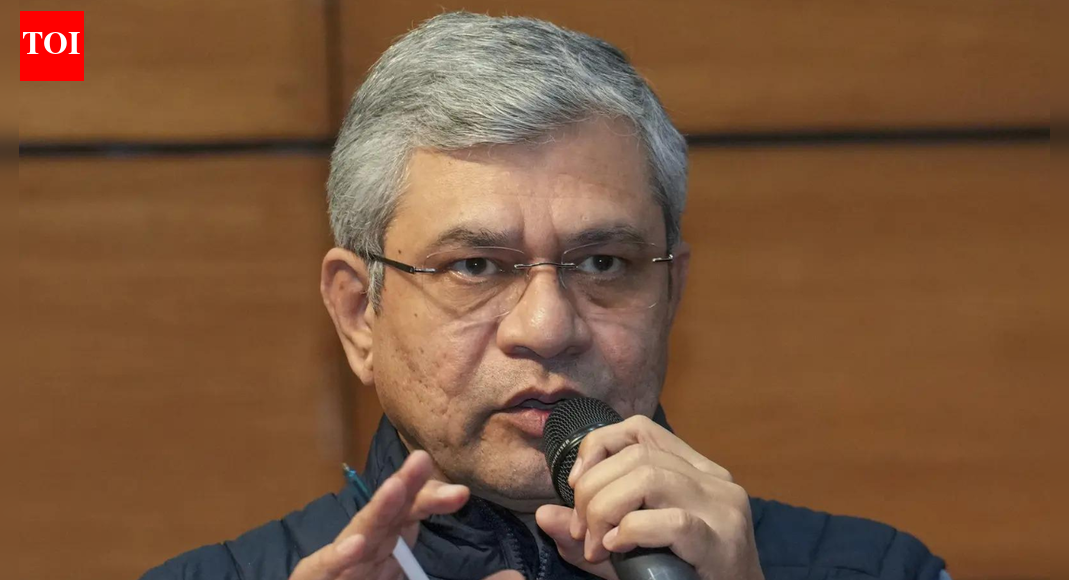
India is set to emerge as one of the world’s top four semiconductor manufacturing nations by 2032 and aims to become the best by 2035, driven by its talent base and expanding ecosystem, Union minister for electronics and IT Ashwini Vaishnaw said on Friday, reported PTI .Speaking on the sidelines of an event announcing approval of 22 projects worth Rs 41,863 crore under the Electronics Components Manufacturing Scheme (ECMS), Vaishnaw said four chip companies will begin commercial production in 2026, with major automobile and telecom firms expected to source semiconductors domestically.“I think by 2032, we would be very significant among the top 4 nations of the semiconductor industry, and by 2035, we would be among the best. This direction is clearly visible. This can be clearly predicted,” Vaishnaw said .Under the Semicon India Programme, the government has so far approved 10 manufacturing units — including two fabrication plants and eight assembly, testing and packaging units — involving investments of about Rs 1.6 lakh crore, according to the minister.Detailing the production timeline, Vaishnaw said, “The plants which started pilot production last year, they are the ones that will get into commercial production earlier, which is Kaynes and CG Semi. Micron has also started pilot production very recently. They will also go next month. Tata plant in Assam will start pilot production by middle of the year, and by the end of the year they will start the commercial production,” he said .In parallel, India’s chip design capabilities are also expanding. Under the Design Linked Incentive (DLI) scheme, 24 chip design projects are being supported through startups, representing a total project value of Rs 920 crore.Vaishnaw attributed India’s growing prominence in semiconductors to a strong focus on talent development. He said students across 298 universities in the country are now designing chips that are being validated.“We could not count more than 20 universities in the whole world, including the US, China, Japan, Taiwan and South Korea, where students can design a chip, manufacture it, and validate the product. India has, because of our focus on silicon, 298 universities,” Vaishnaw said .The minister said this expanding talent pipeline, combined with large-scale manufacturing investments, is positioning India to play a decisive role in the global semiconductor value chain over the next decade.

New Delhi: 2025 emerged as a defining chapter in the public and personal journey of Anant Ambani, a year where faith, leadership, seva, and conservation came together with rare clarity and purpose. It was a year that reflected not just milestones, but a deeper alignment between belief, responsibility, and long-term vision.
At the heart of this journey was a 140-kilometre padyatra from Jamnagar to Dwarka, undertaken as an act of devotion, discipline, and spiritual reflection. The walk resonated with millions, symbolising humility, perseverance, and an unwavering connection to India’s civilisational ethos. Far from being symbolic alone, the padyatra underscored the belief that leadership begins with inner conviction and service.
Professionally, 2025 also marked a significant expansion of responsibilities as Anant Ambani took on a larger leadership role as Executive Director at Reliance Industries Ltd. His growing involvement reflected a focus on sustainable growth, long-term stewardship, and aligning enterprise with societal impact—values increasingly central to modern corporate leadership.
2025 Marked A Year Of Faith, Leadership, Seva, And Conservation For Anant Ambani#AnantAmbani #SevaAndConservation #Vantara #WildlifeConservation pic.twitter.com/Or0ikzi2GU
— Zee News English (@ZeeNewsEnglish) January 2, 2026
A major highlight of the year was large-scale pilgrim welfare initiatives during the Maha Kumbh, where efforts were directed toward healthcare, logistics, and support services for millions of devotees. These initiatives reinforced the spirit of seva, placing service to people at the centre of action.
Equally significant was the national recognition received by Vantara, India’s ambitious wildlife rescue, rehabilitation, and conservation initiative. Its inauguration by Prime Minister Narendra Modi marked a watershed moment for conservation in the country. Throughout the year, Vantara also became a global showcase, with prominent international personalities witnessing India’s commitment to ecological responsibility and compassionate conservation.
Together, these moments defined 2025 as a year of convergence—where devotion met duty, leadership embraced service, and conservation became a shared national and global mission.
Business
Export push: Govt unveils Rs 7,295 crore credit support package; interest subvention, collateral guarantee for exporters – The Times of India
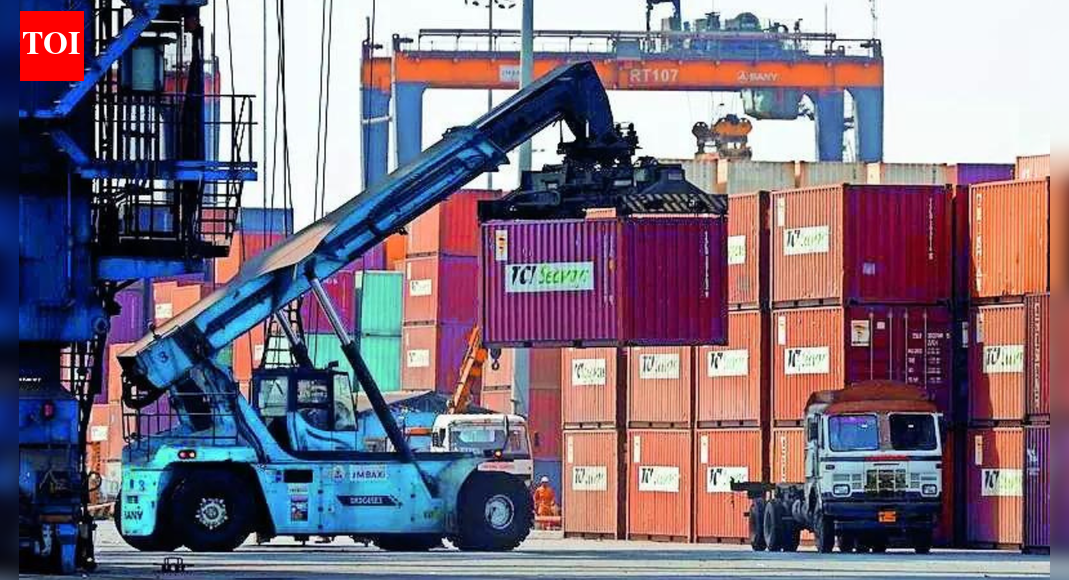
The government on Friday announced a Rs 7,295-crore export support package aimed at improving exporters’ access to credit, comprising a Rs 5,181-crore interest subvention scheme and a Rs 2,114-crore collateral support measure, officials said.Both interventions will be implemented over a six-year period from 2025 to 2031 and form part of the Rs 25,060-crore Export Promotion Mission (EPM) approved by the Cabinet in November 2025, PTI reported.Additional Secretary in the Commerce Ministry Ajay Bhadoo said the measures are designed to address trade finance challenges faced by exporters, especially at a time when global trade is under pressure.Under the interest subvention scheme, exporters will receive subsidy support on both pre-shipment and post-shipment export credit. The scheme will help exporters from identified sectors access rupee export credit at competitive rates.The government will provide interest subvention in the range of 2.75 per cent to eligible micro, small and medium exporters. The annual benefit under the scheme will be capped at Rs 50 lakh per firm, the commerce ministry said.The subvention rates will be reviewed twice a year, in March and September, based on domestic and global benchmarks. The Reserve Bank of India, in coordination with the Directorate General of Foreign Trade (DGFT), will be the implementing agency, and detailed guidelines will be issued separately.A pilot roll-out of the scheme will be undertaken initially, with scope for refinements based on implementation feedback.In addition, the government announced a Rs 2,114-crore collateral support scheme for export credit, under which credit guarantee cover will be provided to MSMEs for export-linked working capital loans.Under this support measure, collateral guarantee of up to Rs 10 crore per firm will be available. The guarantee coverage will be up to 85 per cent for micro and small exporters and up to 65 per cent for medium exporters.According to the DGFT, both the interest subvention and collateral support schemes will apply only to exports from a selected positive list of products. Defence and SCOMET (Special Chemicals, Organisms, Materials, Equipment and Technologies) items are covered, while restricted products, waste and scrap, and goods covered under the production-linked incentive (PLI) schemes will be excluded.The package complements existing credit-guarantee mechanisms and is aimed at boosting bank lending to export-oriented MSMEs, the ministry said. Guidelines for the collateral support scheme will be notified by the Credit Guarantee Fund Trust for Micro and Small Enterprises (CGTMSE), followed by a pilot phase and integration into a broader overhaul of export-promotion frameworks.


NHL’s holiday on ice amid balmy Miami’s swaying palm trees

Sabrina Carpenter teases ‘The Muppet Show’ alongside Miss Piggy

67 points and a ‘transfer portal’ surprise: Nonconference hoops superlatives

-

 Sports7 days ago
Brooks Koepka should face penalty if he rejoins PGA Tour, golf pundit says
-
 Business1 week ago
Govt registers 144olive startups | The Express Tribune
-

 Politics7 days ago
Thailand, Cambodia agree to ‘immediate’ ceasefire: joint statement
-

 Politics7 days ago
Heavy rains, flash floods leave Southern California homes caked in mud
-

 Entertainment7 days ago
Second actor accuses Tyler Perry of sexual assault in new lawsuit
-
 Fashion7 days ago
Climate change may hit RMG export earnings of 4 nations by 2030: Study
-

 Fashion1 week ago
Area CG’s Fernando Rius says luxury is not about buying something expensive, it is about understanding the culture, history, and time invested
-

 Tech5 days ago
How Much Melatonin Should You Be Taking? And Should You Be Taking It at All?