

Fashion
WOW expands Spain’s retail scene with Dimas Gimeno’s “phygital” vision

Translated by
Nazia BIBI KEENOO
Published
October 31, 2025
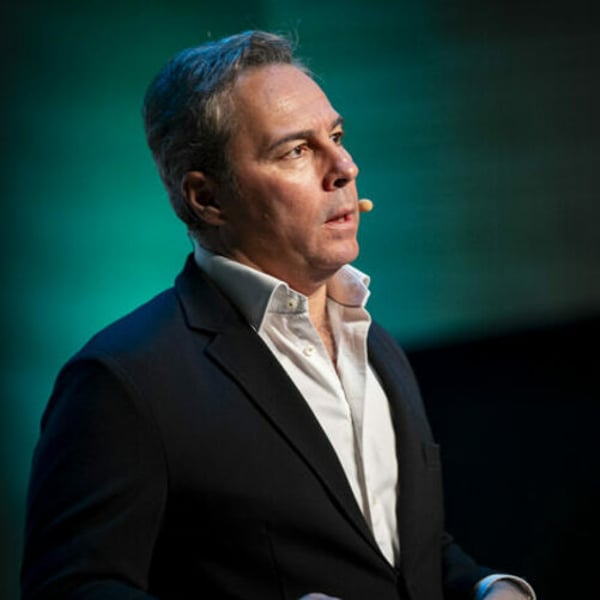
WOW opened its doors on Madrid’s Gran Vía in 2022, introducing a new department store concept to the heart of the Spanish capital. In 2023, it launched a second location on Calle Serrano and, by 2025, the company aims to reach €30 million ($32 million) in sales, with long-awaited profitability expected between 2026 and early 2027. Its founder, Dimas Gimeno—former president of El Corte Inglés—spoke on Oct. 30 at the 4th Aragonese Congress on Commerce and Innovation, held in Zaragoza and organized by the Government of Aragon. FashionNetwork.com spoke with Gimeno about his vision for the retail sector, the key challenges it faces, and the evolution of the WOW platform.
FashionNetwork.com: You mentioned at the beginning of your talk that retail defines a city’s identity. How can that identity be maintained in a world where commerce is increasingly uniform?
Dimas Gimeno: By focusing on the local. It’s essential to recognize that a city—and its retail scene—should showcase local products. Spain is particularly privileged because it offers extraordinary craftsmanship and gastronomy. We are also manufacturers and home to thriving brands—that’s what tourists are looking for.
FNW: You maintain that omnichannel hasn’t worked, despite being the major focus of many brands, and that we must move toward the “phygital” model. Why?
D. G.: Omnichannel was a logical idea at the time, but poorly executed. The mistake was trying to digitize the physical world instead of starting from a fully digital mindset. Businesses attempted to adapt new tools to an old model rather than redesigning their approach entirely. It’s not about digitizing the physical—it’s about thinking 100% digitally and, from there, building the physical presence. Some call this “unified commerce”; I call it “phygital.”
The key is understanding that channels no longer exist. We must stop separating “physical” and “digital.” Today’s customer moves fluidly, interacting with your brand across multiple touchpoints.
FNW: Do customers no longer make that distinction between channels?
D. G.: If you ask them, they likely don’t care. A customer might discover a brand on social media, purchase through e-commerce, and then visit the physical store. The store is where loyalty forms and brand relationships deepen—conversion rates are also higher as a result.
Think of the online shopping cart: the ideal would be for the same cart to be accessible both online and in-store. Omnichannel fails when it simply digitizes a physical process. The first step toward true unification is making your entire range available online—a goal many brands still struggle with.
FNW: How can small businesses face this challenge, given that they define cities’ identities?
D. G.: By staying authentic and unique. Small businesses excel in this area because they offer a unique personality, a sense of legacy, and genuine relationships with customers. Their main obstacle is technology: they often can’t invest in digital tools. The solution lies in collaborative platforms that bring small retailers together to create shared online marketplaces. Public funding should help support the development of these initiatives.

FNW: Why do you believe physical stores represent the future of retail?
D. G.: Because I’m a shopkeeper at heart—and a former salesperson. I’ve seen firsthand how a well-executed store can inspire customers to buy everything. That’s something digital alone can’t achieve. Add a distinctive product range and motivated, well-trained sales staff equipped with the right tools, and you create something unbeatable. That’s how you compete with major platforms—by offering what they can’t.
FNW: Customer experience has been a buzzword in recent years. What does it really mean for retailers?
D. G.: The experience is everything. You can have a beautiful store, but if the salesperson doesn’t treat the customer well, it fails. It’s about creating an environment that feels welcoming, where staff connect with shoppers on a personal level. When a customer plans to buy one thing and ends up buying seven, that’s customer experience. It’s about knowing your customer, anticipating their needs, and giving them reasons to return.
FNW: You emphasize sales staff. Is it difficult to find those profiles in retail today, as in hospitality?
D. G.: It is. The service industry is often not viewed as a prestigious career path, which makes hiring challenging. At WOW, we attract talented young salespeople by providing solid training, motivation, and clear career growth opportunities. If companies hire people for a year and then replace them without offering opportunities for advancement, no one will stay. Retail needs to value sales as a long-term profession.
FNW: Speaking of WOW, what’s the company’s current status?
D. G.: We’ve been operating for three and a half years. Our vision hasn’t changed, but we’ve learned how to translate innovation into profitability. You can have an original concept, but you also need a business model that works. We’re not profitable yet, but we can see it on the horizon—expected by next year or early the following year.
Our growth strategy centers on physical retail. Barcelona is the next obvious step, but our digital channel is our biggest opportunity. Online expansion enables us to reach new markets faster and with reduced risk. Ultimately, growth only matters if it’s profitable.
FNW: What share does online currently represent in your sales?
D. G.: Less than a year ago, we migrated our e-commerce operations to Shopify, which meant resetting the digital system. Online sales are now growing fast, and by 2026, we expect them to account for over 15% of total business—and eventually, much more.
FNW: Is your platform available outside Spain?
D. G.: Yes, though for now we only ship within the European Union. By 2026, we plan to expand into new markets.
FNW: Which store performs better—Gran Vía or Serrano?
D. G.: Serrano performs better overall because it’s larger and more consistent, but Gran Vía continues to surprise us. It’s visually striking and benefits from Madrid’s bustling retail corridor. Serrano attracts repeat customers, while Gran Vía gains strong visibility from tourists.
FNW: You talk about curating the assortment. What does that mean?
D. G.: Curation was WOW’s starting point—it’s about building a distinctive product selection. But we’re not just a showcase of brands; we’re a commercial platform. We initially carried high-end luxury and semi-luxury labels but shifted toward a more profitable model. It’s not about expensive versus affordable—it’s about offering originality and innovation. We aim to feature brands that are not typically found in most physical stores. That’s the essence of WOW’s value proposition.
This article is an automatic translation.
Click here to read the original article.
Copyright © 2025 FashionNetwork.com All rights reserved.










According to the informal agreement, there will be a new handling fee for each item entering the EU from non-EU countries and sent directly to EU consumers, to cover the extra cost of handling an ever-increasing number of individual parcels.
This will be paid by the same entity responsible for paying other customs charges for the same parcel, to avoid shifting the cost to consumers.
The European Parliament and European Council have reached a deal on a major reform of the EU Customs Code to address problems relating to e-commerce, safety of goods and efficiency.
A new handling fee will be charged for each item entering the EU from non-EU nations and sent directly to EU consumers.
The European Commission will establish the level of the fee and reassess it every two years.
The European Commission will establish the level of the fee and reassess it every two years. Member states will start collecting it as soon as the necessary information technology (IT) system becomes operational, and in any case no later than November 1, this year.
Under the new rules, sellers and platforms that facilitate distance sales of goods from non-EU countries directly to EU customers will be treated as importers. This will oblige them to provide customs authorities with all the necessary data, pay or guarantee any charges, and make sure that the goods comply with EU laws, an official release said.
These companies must be established in the EU or be represented by an EU-based entity having either authorised economic operator (AEO) or trusted trader status. This should prevent the use of shell companies.
To incentivise bulk shipments that are easier for customs authorities to check, non-EU country sellers and platforms are encouraged to operate warehouses in the EU. Their intra-EU client shipments would benefit from a lower handling fee, provided their goods were imported in collective packaging and large enough quantities to make customs checks more efficient.
Companies that repeatedly ignore EU rules could be punished with a fine of at least 1 per cent (and up to 6 per cent) of the total value of goods imported into the EU in the previous 12 months.
Additionally, customs authorities may suspend, revoke, or annul their trusted trader or AEO status and flag them as high-risk operators.
Import-export companies that follow the rules and agree to cooperate transparently with the customs authorities may benefit from a simplified ‘trust and check’ regime. This would initially require them to go through thorough vetting and grant customs authorities access to their electronic systems.
In exchange, their shipments would be checked less frequently and they would have more flexibility regarding the payment of duties and fees.
The current AEO qualification will remain in place to keep customs status accessible to smaller economic operators.
The reform also establishes a new customs data hub to be managed by the new EU Customs Authority (EUCA). It will be available for optional use by 2031 and mandatory by 2034.
The data hub will replace at least 111 software systems currently used by customs.
The provisional agreement needs to be officially approved by Parliament in plenary as well as by the EU Council, before it will become law.
Fibre2Fashion News Desk (DS)
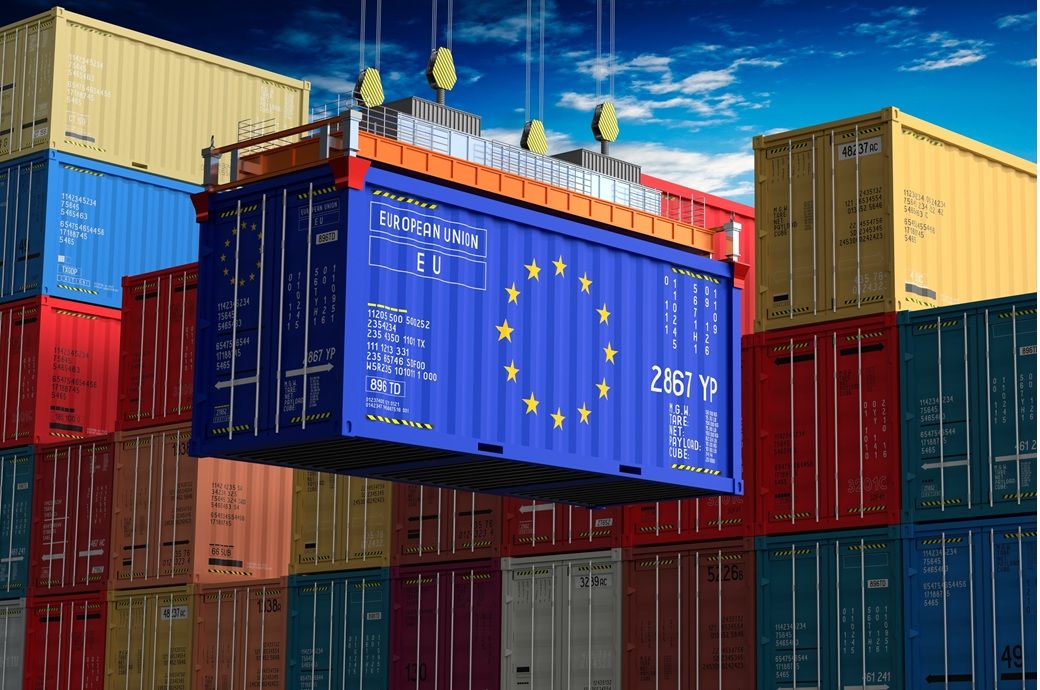
This was driven by an 8.36-per cent YoY decline in import volume and a 7.76-per cent YoY decrease in average unit prices.
The EU’s apparel imports fell by 15.48 per cent YoY in January to €7.03 billion, according to Eurostat.
Bangladesh’s apparel exports to the EU fell to €1.43 billion in January—a 25.25-per cent drop in value.
China remained the top exporter of apparel to the EU (€2.22 billion), but still saw a 6.9-per cent decline YoY in value.
India, Pakistan, Vietnam and Cambodia also remained in negative territory.
Bangladesh’s apparel exports to the bloc fell to €1.43 billion in January—a sharp 25.25-per cent drop in value. It saw a 17.49-per cent YoY decrease in the quantity of goods shipped, coupled with a 9.41 per cent drop in the unit price per kilogram.
China remained the top exporter of apparel to the EU (€2.22 billion), but still saw a 6.9-per cent decline YoY in value. Its unit prices dropped by 8.01 per cent YoY, while its export volume grew a bit by 1.21 per cent YoY.
Turkey faced a severe hit with a 29.12-per cent YoY decrease in apparel export value to the EU in the month, totaling €619.98 million.
Other countries like India, Pakistan, Vietnam and Cambodia remained in negative territory, reflecting a broad-based slowdown in the European fashion retail market.
Fibre2Fashion News Desk (DS)
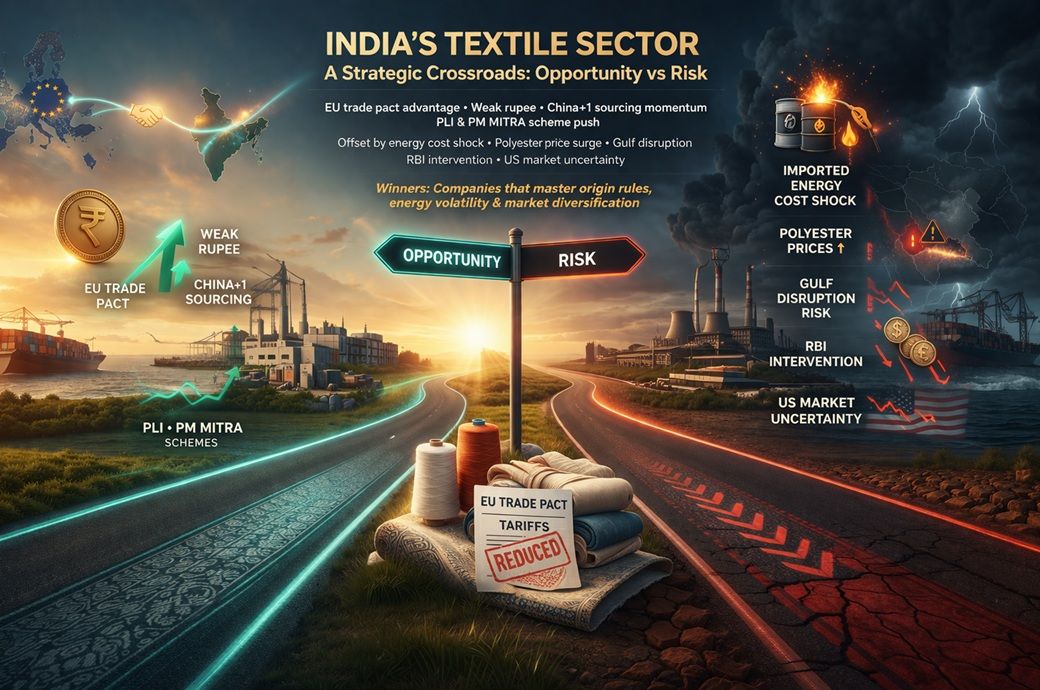
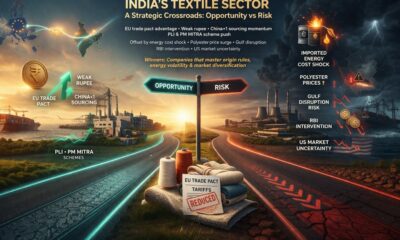
India’s textile outlook is turning structurally complex.
The EU pact targets ~99.5 per cent trade coverage with phased duty relief, while rupee weakness supports exports.
However, crude volatility, >80 per cent import energy dependence, polyester cost inflation and US market softness (≈28 per cent share) are fragmenting performance, reinforcing a shift towards cotton-led, EU-focused exporters.
Source link


Transfer rumors, news: Salah eyes Roma after Liverpool exit

NHL playoff watch: Guide to all 15 games on Showdown Saturday

I Tested Garmin Watches for a Decade While Hiking, Biking, and Climbing. Here’s What You Should Buy

-
 Business1 week ago
Flipkart group CFO to leave co amid IPO plans – The Times of India
-
 Business1 week ago
Video: The Effects of High Oil Prices
-

 Fashion1 week ago
China’s textile & apparel exports surge 17% to $50 bn in Jan-Feb 2026
-

 Sports1 week ago
Rating Adidas’ 2026 World Cup away shirts: Argentina, Spain, Mexico and more
-

 Sports1 week ago
American Conference Commissioner Tim Pernetti thanks Trump for Army-Navy game executive order
-
Tech1 week ago
The Corsair 4000D RS PC Case Keeps Your System Cool
-

 Tech1 week ago
Gamers Hate Nvidia’s DLSS 5. Developers Aren’t Crazy About It, Either
-

 Tech1 week ago
‘Uncanny Valley’: Nvidia’s ‘Super Bowl of AI,’ Tesla Disappoints, and Meta’s VR Metaverse ‘Shutdown’