

Business
‘Zero faith’: If Trump’s tariffs are overturned, how easily will businesses get back billions in refunds? It could be a nightmare! – The Times of India

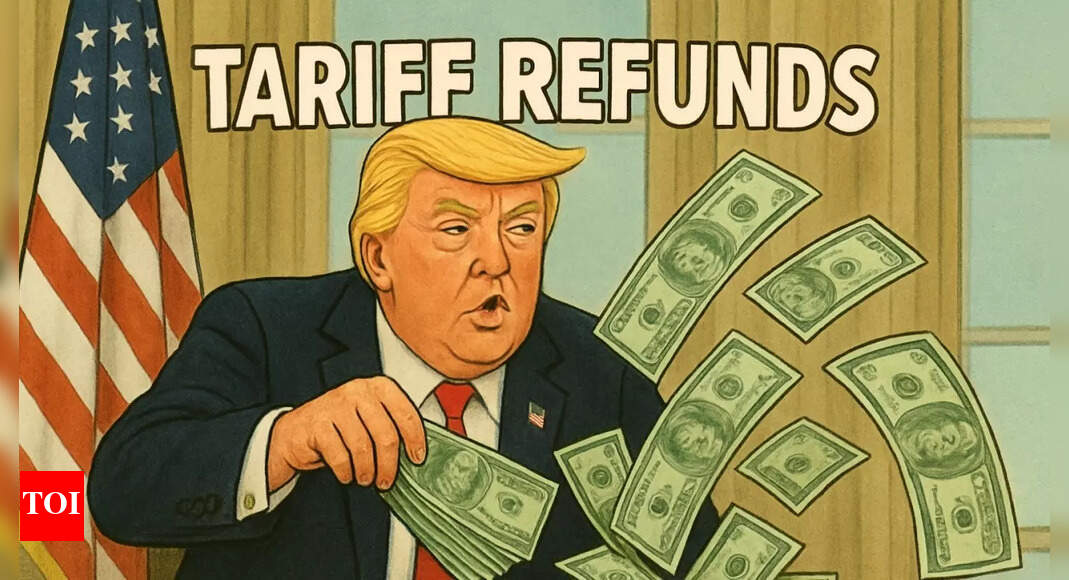
Donald Trump administration’s tariff collections – running into billions of dollars – is threatened in case the Supreme Court decides to strike down the US President’s tariff policies. Trump himself has warned that any decision against his tariff policies would spell disaster.Businesses, which have paid huge amounts in the last few months due to country-based tariffs, believe that getting back refunds in case the tariffs are deemed illegal by the Supreme Court, would be a nightmare.
Tariff refund nightmare
To begin with, this would create administrative challenges involving extensive refund processing. If these nation-specific tariffs are ruled unlawful, the United States might need to return most of the $165 billion in customs duties collected in the current fiscal year to the businesses that paid them, according to a Bloomberg report.However, obtaining refunds will be complicated; reimbursements typically come via paper cheques through a slow process, and whilst the government could expedite mass repayments, experts believe this is doubtful.“The customs authorities won’t simply distribute refunds to importers freely,” Lynlee Brown, global trade partner at EY was quoted as saying by Bloomberg.The uncertainty surrounding the potential refund process exemplifies the broader confusion that businesses and financial markets have experienced since the implementation of Trump’s tariff policies.Several importers have abandoned expectations of receiving reimbursements, even if the court rules in their favour.“I have zero faith we’d ever get anything. Just zero,” expressed Harley Sitner, who owns Peace Vans, a Seattle-based classic camper van repair and restoration business.
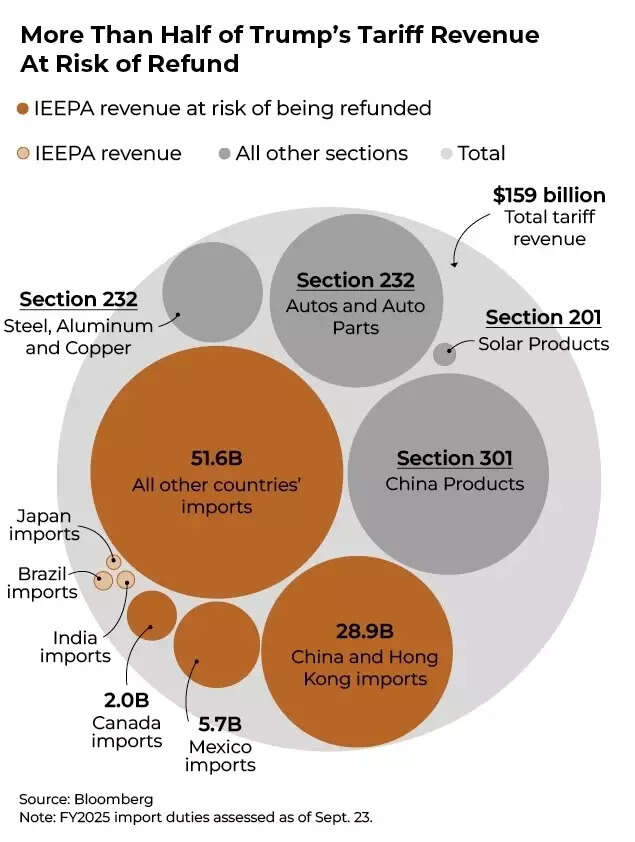
More than half of tariff revenue at risk of refund
Sitner told Bloomberg that the unpredictability of Trump’s trade policies is more problematic than the actual tariff payments, which he views as irretrievable expenses. Following unexpected tariff charges ranging from $221 to $17,000, sometimes arriving months after receiving goods, Sitner has discontinued importing international inventory.“Just yesterday we got a small shipment from Germany worth $2,324 and it came with a $1,164 tariff charge. We can’t back out,” Sitner stated.Various customs brokers report being approached by Wall Street organisations interested in purchasing rights to potential refunds, offering importers an opportunity to recover a portion of their possible entitlements.The significant increase in customs duties – a rise of $95 billion compared to the previous year – is primarily attributed to Trump’s import tariffs affecting multiple economies, which became effective in August, as analysed by Bloomberg Economics. Two lower judicial bodies have ruled that Trump lacked the authority to implement tariffs under the International Emergency Economic Powers Act.Should the Supreme Court uphold these earlier decisions, approximately 50% of the customs duties collected by the United States this year could be subject to refund. However, the process for businesses to reclaim these funds remains uncertain. Despite the government shutdown, tariff-related operations have largely continued uninterrupted.The United States Customs and Border Protection regularly processes refunds for importers in cases of overpayment or regulatory changes, with the Treasury Department issuing the payments. However, this reimbursement process is not automatically initiated.In line with statutory requirements, importers and their customs brokers must adhere to precise timelines and documentation procedures to maintain eligibility for refunds. Currently, the system predominantly relies on paper cheques for disbursement.Despite the Treasury’s directive from the Trump administration to discontinue cheque payments by September 30, the Customs and Border Protection (CBP) only initiated its first phase last Tuesday in what will be an extended implementation process. The system’s completion before any court decision appears unlikely without accelerated efforts.Tom Gould, a customs consultant from Seattle, suggests that potential refunds might result in “it’s possible that we’ll see millions and millions of paper checks being mailed out because each shipment, each customs entry, will have its own.”The process could be problematic. According to the Bloomberg report, due to regulatory requirements, customs refunds are exclusively sent to sanctioned domestic banks in dollars, requiring foreign importers to receive their refunds through international postal services or utilise a broker’s account within the United States.Worryingly, there has been a series of stolen cheque incidents in recent years. According to Gould, refund cheques were intercepted during postal delivery and traded on the dark web before being encashed.The administration possesses various options to expedite refunds, including automated processing of claims using existing system data. CBP has previously implemented refund rationalisation measures.Customs officials developed a framework to facilitate refund disbursement for items eligible under duty exemptions through the Generalised System of Preferences. Despite Congress allowing this programme to expire multiple times since the 1980s, it was subsequently renewed retroactively.Importers would input specific codes indicating GSP eligibility, even during programme inactivity. Gould suggested that the agency could similarly analyse internal data to identify IEEPA code-related tariff payments.Alternative procedures exist, though they might be complex. Legal experts indicate individual importers could be compelled to initiate separate legal proceedings to recover their funds.The authorities might require submission of protests or post-summary amendments, accompanied by comprehensive payment documentation and importer records, despite the government already possessing this information.EY’s Brown recommends importers maintain complete records from CBP’s Automated Commercial Environment platform, documenting entry dates and deadlines systematically to enhance refund possibilities.Despite potential simplified procedures by CBP, the complex nature of financial transactions within supply chains presents additional challenges.For shipments managed through commercial carriers like FedEx Corp. and United Parcel Service Inc., who handle documentation and tariff payments, CBP would direct refunds to the registered importer – the courier service rather than the goods’ owner.This arrangement could generate complications between the actual importers and courier services, creating another obstacle for businesses seeking reimbursement.
Tariff collections: Trump admin may not let go easily
Trump has valued the tariff income, declaring it has restored national wealth. He and his supporters have suggested various uses for these funds, including reducing national debt, supporting struggling agricultural sectors, and potentially distributing payment cheques to US citizens.This suggests the Trump administration will be reluctant to release these funds if the tariffs are invalidated, and they are likely to swiftly implement new levies using alternative legal frameworks should this occur. The Supreme Court is scheduled to review arguments in November regarding this matter.




Business
Rs 20,000 crore gold, silver rush: What will people buy this Akshaya Tritiya? – The Times of India

This Akshaya Tritiya, India’s gold and silver markets are heading for bumper purchases, with overall trade likely to cross Rs 20,000 crore even as record-high prices reshape buying patterns. The estimate, shared by the Confederation of All India Traders (CAIT), is higher than last year’s Rs 16,000 crore, signalling growth in value despite a sharp rise in bullion rates.Prices for the yellow metal have surged sharply over the past year, going from Rs 1,00,000 per 10 grams, to Rs 1.58 lakh. Meanwhile, silver has shown a steeper rally, jumping from Rs 85,000 per kilogram to Rs 2.55 lakh per kilogram. According to CAIT, this sharp escalation has not weakened demand, but is instead prompting consumers to make more deliberate and value-oriented purchases.Praveen Khandelwal, member of parliament from Chandni Chowk and secretary general of CAIT told ANI, “Akshaya Tritiya has traditionally been one of India’s most auspicious occasions for purchasing gold… While gold continues to dominate, the nature of purchasing is evolving significantly in response to steep price escalation.”Commenting on customer preference, CAIT national president BC Bhartia highlighted, “There is a clear shift towards lightweight, wearable jewellery, alongside a stronger focus on silver and diamond products. Attractive incentives such as reduced making charges and complimentary gold coins are also helping sustain consumer interest.”Despite the increase in overall trade value, the quantity of metals being sold tells a different story. Pankaj Arora, National President of the All India Jewellers and Goldsmith Federation (AIJGF), an associate of CAIT, explained that the projected Rs 16,000 crore gold trade amounts to nearly 10,000 kilograms (10 tonnes) at current rates. The value, spread across an estimated 2 to 4 lakh jewellers, translates to average sales of only 25 to 50 grams per jeweller, “clearly indicating a sharp decline in volume”.Meanwhile for silver, the estimated Rs 4,000 crore trade corresponds to around 1,56,800 kilograms (157 tonnes), resulting in average sales of about 400 to 800 grams per jeweller during the festival period. “These figures underline a critical shift: while the value of business is expanding due to rising prices, actual consumption is contracting,” Khandelwal said.This gap between value and volume is also reshaping consumer’s buying pattern, with smaller items and lightweight jewellery gaining popularity. At the same time, jewellers are facing challenges due to fluctuating prices, especially when it comes to managing inventory.Even so, festive demand remains steady, with markets witnessing healthy footfall. “Consumers are now adopting a more cautious and pragmatic approach, balancing traditional beliefs with financial discipline,” Khandelwal added.At the same time, it’s not just about physical gold anymore as consumers are increasingly exploring alternatives like digital gold, Sovereign Gold Bonds and gold ETFs, drawn by the promise of liquidity, safety and flexibility when prices are volatile.CAIT and AIJGF have urged jewellers to comply with mandatory hallmarking standards, including HUID certification, and advised buyers to verify the purity and authenticity of their purchases.

Lauren Elcock is among the young Londoners who say rising rents are forcing them to quit the capital.
Source link

As governments across the world restricted the movements of their citizens during Covid lockdowns from 2020, people spent more time online. We bought more online and socialised more online, and this brought us closer to the people who want to scam us. At the same time, realistic video impersonations, voices, websites, and texts became more commonplace, and scammers increased their use of social media including WhatsApp.

Rs 20,000 crore gold, silver rush: What will people buy this Akshaya Tritiya? – The Times of India

Prince Harry corrects blunder before peace with King Charles suffers again
The cost of rising rents: Working four jobs and pushed on to benefits

-

 Entertainment6 days ago
Palace left in shock as Prince William cancels grand ceremony
-

 Sports6 days ago
The case for Man United’s Fernandes as Premier League’s best
-

 Politics1 week ago
Chinese, Taiwanese will unite, Xi tells Taiwan opposition leader
-

 Entertainment1 week ago
Dua Lipa hits major career high ahead of wedding with Callum Turner
-
 Business1 week ago
100% road tax waiver for electric cars, new rules for 2, 3 and 4 wheelers – what Delhi govt’s draft EV policy says – The Times of India
-
 Business6 days ago
UK could adopt EU single market rules under new legislation
-
 Business1 week ago
The FAA wants gamers to apply for air traffic control jobs
-

 Sports1 week ago
Lamar Jackson hits back at critics with faithful message on social media