

Business
#1 RANKED GRIND















Pakistan’s inflation rose to 7% in February 2026, marking the highest level since October 2024, as electricity price hikes and rising global uncertainty pushed consumer costs upward.
According to the Pakistan Bureau of Statistics, the Consumer Price Index (CPI) increased 6.98% year-on-year, compared to 5.8% in January and 1.5% in February last year.
Electricity Tariffs Drive Surge
The biggest impact came from higher electricity prices after subsidy cuts and revised tariff structures.
Housing, water, electricity, gas & fuels index rose 9.65% annually
Electricity prices alone increased 10.03% month-on-month
These adjustments significantly burdened households already coping with high living costs.
Core Inflation & Interest Rates
Core inflation showed slight easing:
Urban core inflation: 7.1% (down from 7.2%)
Rural core inflation: Stable at 8.3%
The rise in CPI reduced real interest rates by around 120 basis points. The State Bank of Pakistan kept its policy rate unchanged at 10.5% last month.
Food Prices Mixed
Food inflation rose to 5.8%, up from 3.9% in January.
Major increases:
Tomatoes: +82%
Wheat: +42.6%
Wheat flour: +25.9%
Meat: +11.3%
Milk powder: +9.4%
Price declines:
Potatoes: -40%
Chicken: -21.8%
Gram pulse: -21.7%
Onions: -17%
Wholesale Pressure Rising
The Wholesale Price Index (WPI) increased to 1.0%, signaling growing producer-level cost pressures that could pass on to consumers in coming months.
External Risks Loom
Analysts warn that escalating Middle East tensions could:
Raise global oil prices
Increase Pakistan’s import bill
Pressure the rupee
Worsen inflation further
With millions of Pakistanis working in Gulf countries, any prolonged instability could also affect remittances — a key pillar of the economy.
Business
Asian stocks today: Nikkei falls over 1,400 points, Kospi plunges 4%; markets continue to fall amid Middle East tensions – The Times of India
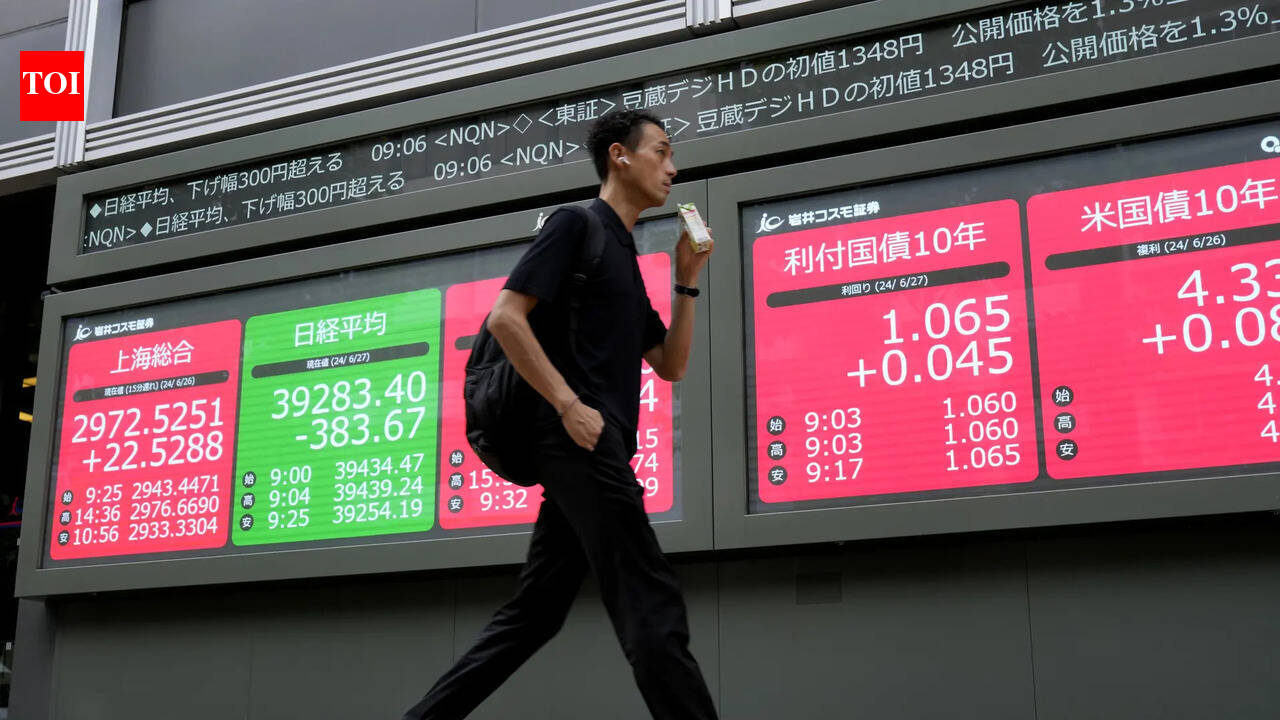
Asian stocks plunged on Tuesday as investors reacted to the ongoing tensions in Iran and its potential impact of regional energy supplies. In Hong Kong, HSI was down 74 points or 0.29% to 25,985. South Korea’s Kospi index also opened sharply lower after Monday’s holiday, plunging 4.88% to 5,939.Shanghai and Shenzhen also fell 0.07% and 1.05% respectively. Japan’s Nikkei 225 declined 2.4% or 1,427 points, landing at 56,629 by 10:10 am. Analysts noted that Japan, which relies heavily on oil and natural gas shipments through the Strait of Hormuz, could face supply challenges. However, the country’s stockpile of over 200 days of energy means the immediate threat remains limited. Japanese energy shares were hit particularly hard, with Eneos Corp. falling nearly 6% and Idemitsu Kosan down almost 4%. Defence stocks, which had recently gained on expectations of increased spending under Prime Minister Sanae Takaichi, retreated, with Mitsubishi Heavy Industries down 5% and IHI losing 4%. Oil prices continued to climb amid concerns over supply disruptions. Benchmark US crude rose 77 cents to $72.00 a barrel, while Brent crude added $1.10 to $78.84 a barrel. Both contracts remain higher than pre-conflict levels despite Monday’s fluctuations. On Wall Street trading, airline stocks were among the hardest hit, pressured by rising fuel costs and regional travel disruptions. In Asia, ANA shares fell 2.4%, Japan Airlines dropped 5.2%, Korean Air lost 8.9%, and Qantas Airways declined 2.9%. On Monday, the S&P 500 fluctuated but ended nearly unchanged at 6,881.62. The Dow Jones Industrial Average dipped 0.1% to 48,904.78, while the Nasdaq rose 0.4% to 22,748.86. Gold climbed 1.2% as investors sought safer assets, while US officials reassured markets that the conflict is unlikely to be prolonged. Rising oil prices boosted energy stocks, with Exxon Mobil up 1.1% and Marathon Petroleum rising 5.9%. Defence contractors also strengthened: Northrop Grumman climbed 5.9%, RTX gained 4.7%, and Palantir Technologies rose 5.8%. Nvidia led Big Tech gains with a 2.9% increase. In the bond market, the 10-year Treasury yield rose to 4.04% from 3.97%, aided by stronger-than-expected US manufacturing data. In currencies, the US dollar slipped to 157.32 yen from 157.47 yen, while the euro inched up to $1.1693 from $1.1690.

Last Updated:
Gold and silver prices in India eased after a rally driven by Middle East conflict. 24-carat gold is Rs 1,70,020 per 10gm, silver below Rs 3,00,000.




Amid escalating tensions in the Middle East, gold and silver prices have witnessed a sharp surge, with market experts warning of further increases if the conflict intensifies.
Gold and silver prices: Gold and silver prices across India eased slightly after rallying as investors rushed towards safe havens due to the conflict in the Middle East. The price of 24-carat gold stood at Rs 1,70,020 per 10 grams, while 22k gold was available at Rs 1,55,850 per 10 grams. These rates do not include GST and making charges.
Silver also fell by Rs 20,000 to come down below Rs 3,00,000.
On MCX, gold futures, whose expiry is on April 02, 2026, was traded at Rs 1,66,199 per 10 gram, with a rise of 2.53 per cent. While silver futures expiring on March 05, 2026, were trading at Rs 2,80,090 per kg, with a fall of 0.90 per cent.
What Is The Price Of 22kt, 24kt Gold Rates Today In India Across Key Cities On March 03?
| City | 22K Gold (per 10gm) | 24K Gold (per 10gm) |
|---|---|---|
| Delhi | Rs 1,56,000 | Rs 1,70,170 |
| Jaipur | Rs 1,56,000 | Rs 1,70,170 |
| Ahmedabad | Rs 1,55,900 | Rs 1,70,070 |
| Pune | Rs 1,55,900 | Rs 1,70,070 |
| Mumbai | Rs 1,55,850 | Rs 1,70,020 |
| Hyderabad | Rs 1,55,850 | Rs 1,70,020 |
| Chennai | Rs 1,55,850 | Rs 1,70,020 |
| Bengaluru | Rs 1,55,850 | Rs 1,70,020 |
| Kolkata | Rs 1,55,850 | Rs 1,70,020 |
What Factors Affect Gold Prices In India?
International market rates, import duties, taxes, and fluctuations in exchange rates primarily influence gold prices in India. Together, these factors determine the daily gold rates across the country.
In India, gold is deeply cultural and financial. It is a preferred investment option and is key to celebrations, particularly weddings and festivals.
With constantly changing market conditions, investors and traders monitor fluctuations closely. Staying updated is crucial for effectively navigating dynamic trends.
 Click here to add News18 as your preferred news source on Google.
Follow News18 on Google. Join the fun, play games on News18. Stay updated with all the latest business news, including market trends, stock updates, tax, IPO, banking finance, real estate, savings and investments. To Get in-depth analysis, expert opinions, and real-time updates. Also Download the News18 App to stay updated.
March 03, 2026, 09:52 IST
Read More


Thailand’s Indorama Ventures’ revenue, profit decline in 2025

L.L.Bean Promo Codes and Coupons: Up to 75% Off

Retech to showcase precision godet technology at Techtextil 2026

-

 Politics5 days ago
What are Iran’s ballistic missile capabilities?
-
 Business6 days ago
Households set for lower energy bills amid price cap shake-up
-

 Sports5 days ago
Sri Lanka’s Shanaka says constant criticism has affected players’ mental health
-
 Business6 days ago
Lucid widely misses earnings expectations, forecasts continued EV growth in 2026
-

 Tech6 days ago
Here’s What a Google Subpoena Response Looks Like, Courtesy of the Epstein Files
-
 Business6 days ago
Income Tax Draft Rules 2026: Key Changes On How And When Pan Card Will Be Required?
-

 Fashion4 days ago
Policy easing drives Argentina’s garment import surge in 2025
-

 Sports5 days ago
Cristiano Ronaldo purchases 25% stake in Spanish club Almeria