

Business
The wealth of the top 1% reaches a record $52 trillion


A version of this article first appeared in CNBC’s Inside Wealth newsletter with Robert Frank, a weekly guide to the high-net-worth investor and consumer. Sign up to receive future editions, straight to your inbox.
The top 10% of Americans added $5 trillion to their wealth in the second quarter as the stock market rally continued to benefit the biggest investors, according to new data from the Federal Reserve.
The total wealth of the top 10% — or those with a net worth of more than $2 million — reached a record $113 trillion in the second quarter, up from $108 trillion in the first quarter, according to the Fed. The increase follows three years of continued growth for those at the top, with the top 10% adding over $40 trillion to their wealth since 2020.
All wealth groups saw gains over the past year, with the net worth of the bottom half of Americans increasing 6% over the past 12 months, according to the Fed data. Yet the growth has been fastest for those at the very top. The top 1% have seen their wealth increase by $4 trillion over the past year, an increase of 7%. Their wealth hit a record $52 trillion in the second quarter.
The top 0.1% saw their wealth grow by 10% over the past year. Since the pandemic, the top 0.1%, or those with a net worth of at least $46 million, have seen their total wealth nearly double to over $23 trillion.
Despite the recent faster growth at the top, the total shares of wealth held by the upper echelon has remained fairly stable for decades. The top 1% held 29% of total household wealth in the second quarter, compared with 28% in 2000. The top 10% held 67% of total household wealth in the quarter while the bottom 90% held 33%.
The biggest driver of wealth gains at the top this year has been the stock market. The value of the corporate equities and mutual fund shares held by the top 10% increased from $39 trillion to over $44 trillion over the past year. The top 10% of Americans hold over 87% of corporate equities and mutual fund shares.
The population of the ultra-wealthy is also growing rapidly. The number of ultra-high-net-worth Americans, or those worth $30 million or more, grew 6.5% in the first half of 2025, after surging 21% last year, according to a new report from Altrata. There are now 208,090 ultra-high-net-worth individuals in the U.S., accounting for 41% of the world’s total.
The surging wealth at the top has created an increasingly bifurcated consumer economy, with the wealthy accounting for a growing share of overall spending. Consumers in the top 10% of the income distribution accounted for 49.2% of consumer spending in the second quarter, marking the highest level since data started being compiled in 1989, according to Mark Zandi at Moody’s Analytics.
The so-called “K-shaped economy” has performed well so far, at least according to broad economic measures such as GDP and consumption. Yet the growing dependence on a small sliver of consumers at the top carries risks.
Zandi said a deep and prolonged decline in the stock market, which is driving almost all of the wealth gains at the top, could send wider ripples through the economy.
“The economy is being powered in big part by the spending of the extraordinarily well-to-do, who are cheered by the surging value of their stock portfolios,” he said. “If the richly (over) valued stock market were to stumble, for whatever reason, and the well-to-do see more red on their stock tickers than green, they will quickly turn more cautious in their spending, posing a serious threat to the already fragile economy.”




Business
Iran Conflict: Middle East tensions: Global insurers exit Iranian waters as conflict deepens – The Times of India
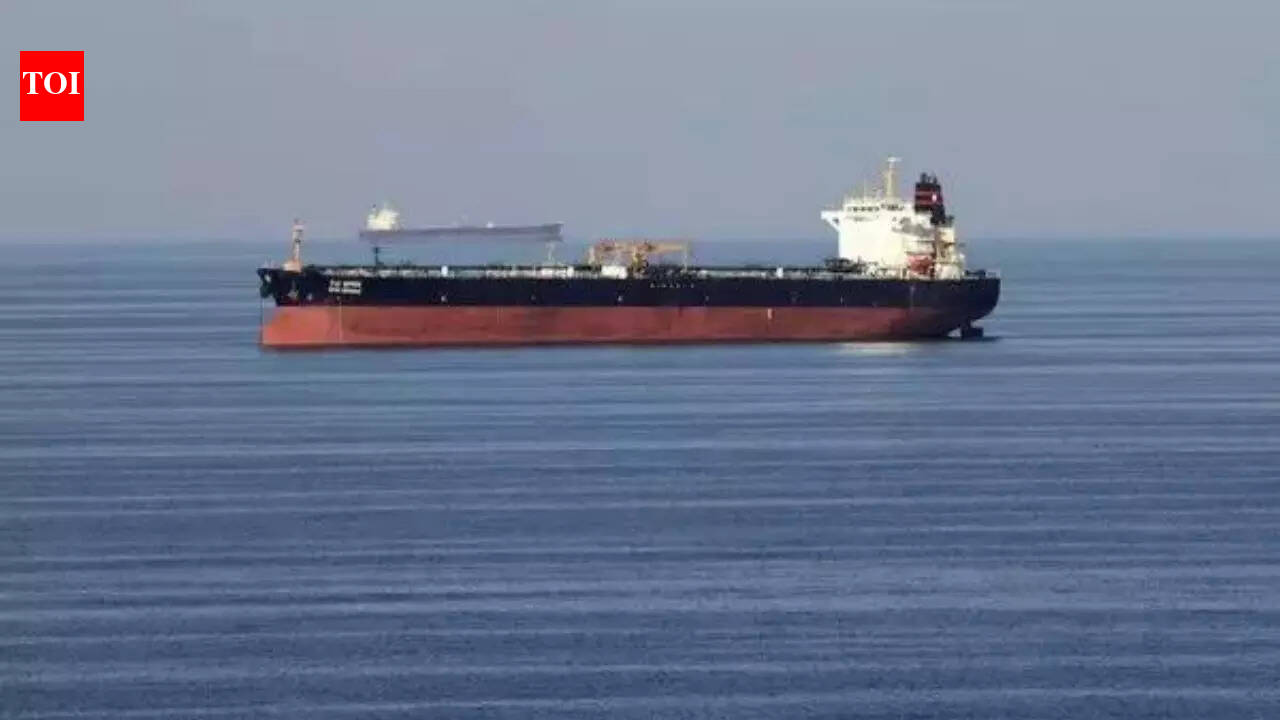
MUMBAI: India’s trade and energy supplies face fresh risks after reinsurers and Protection & Indemnity (P&I) clubs announced cancellation of war risk insurance for vessels transiting the Strait of Hormuz and Iranian waters, following an escalation in the Iran conflict. The cancellations, effective from this week, have left over 150 vessels stranded and disrupted a corridor that handles nearly one-fifth of global oil flows.P&I clubs are mutual, non-profit insurance associations owned by shipowners. They provide third-party liability cover through a pooled premium for risks such as cargo damage, pollution, crew injuries and collisions that are not covered under hull insurance. The clubs also provide legal support and dispute resolution across jurisdictions.“The industry is currently in a wait-and-watch mode, as much depends on how long the conflict persists. If it turns prolonged, insurers are likely to come together to create additional capacity for war-risk cover. Typically, there is an immediate surge in demand when hostilities break out, but that demand tends to ease quickly if the situation stabilises in a short span,” said Tapan Singhel, MD & CEO, Bajaj General Insurance.
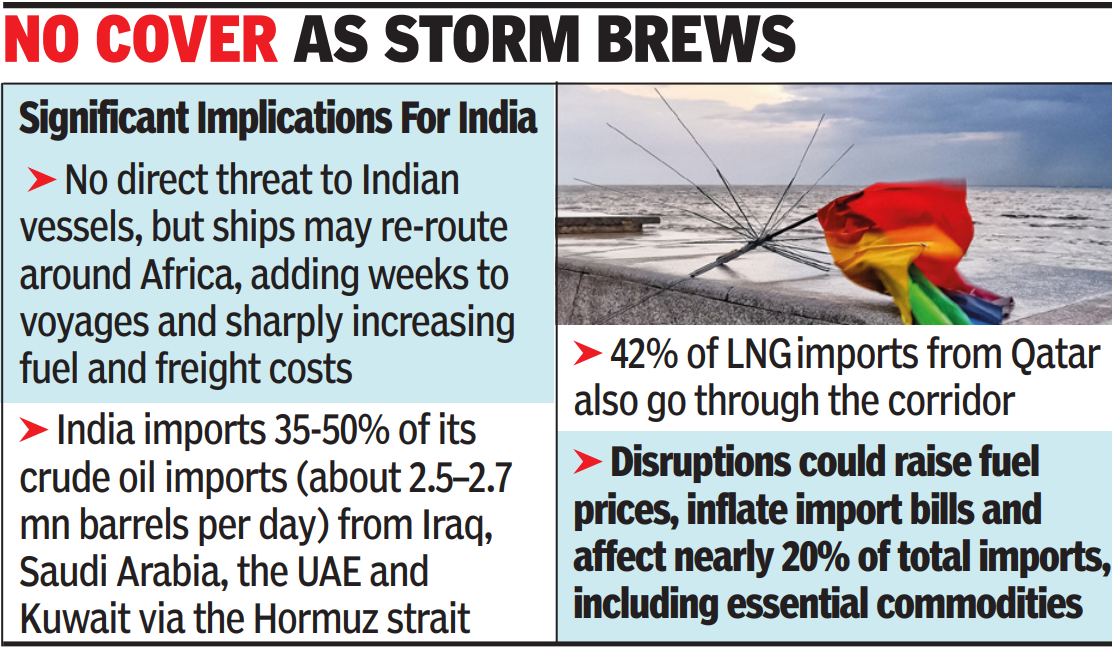
Brokers said that in the past when international reinsurers ceased to provide cover for some risks like terrorism the Indian market had provided the capacity by building an insurance pool where domestic companies come together and share the risks. However, this tie state-owned reinsurer GIC Re, which leads domestic marine pools, has itself issued cancellation notices for marine hull war risk covers effective March 3, 2026, mirroring global reinsurers and P&I clubs. The crisis has brought marine insurance centerstage, the share of this line of non-life had shrunk to around 2% of industry premium as risks ebbed due to containarisation and more safety in transport. The size of the premium also determines the capacity of the industry to provide large covers.Their role is central to global shipping. Without P&I cover, shipowners face potentially unlimited liabilities in the event of accidents, pollution or war-related damage. In high-risk zones, the absence of insurance effectively halts voyages, as operators are unwilling to expose vessels to uninsured losses. In previous crises in the Red Sea, war risk exclusions by insurers sharply curtailed traffic and drove up freight rates.In the current episode, major P&I clubs and reinsurers have issued notices cancelling war risk cover for Iranian waters, the Persian Gulf and the Strait of Hormuz, citing tanker damage, casualties and threats from Iranian forces. Reports of VHF warnings and GPS disruptions have added to concerns. Insurers have invoked standard cancellation clauses following US and Israeli strikes on Iran, with broader policy implications if the conflict further widens.Fresh war risk cover may be available, but at sharply higher premiums. Rates that were around 0.25% of vessel value have surged multiple times, rendering transits commercially unviable for many operators. Even where cover is available, shipowners remain wary of risks such as seizures or missile strikes.

The UK economy could face a “very significant” hit from the conflict in Iran, the official budget watchdog has warned.
The Office for Budget Responsibility (OBR) said that the outlook for inflation would be “particularly uncertain” following spikes in gas and oil prices in recent days following attacks in the Middle East.
It came as the budget watchdog reduced its inflation forecast for this year, indicating that UK inflation will drop to target levels quicker than previously expected.
The OBR also cut its economic growth forecast for this year and revealed a worsening unemployment outlook for the next three years.
In its latest projections alongside the Chancellor’s spring statement, the organisation however highlighted that recent volatility in the Middle East could have an impact on a number of its projections.
The forecasts were prepared before days of recent attacks as part of an intensifying conflict between US-Israeli forces and Iran.
On Tuesday, the OBR said: “Conflict in the Middle East, which escalated as we were finalising this document, could have very significant impacts on the global and UK economies.”
David Miles, from the OBR’s budget responsibility committee, said its predictions that inflation will fall to target levels early this year have become more uncertain after jumps in oil and gas prices linked to recent attacks in the Middle East.
He said: “I think what will happen to inflation is particularly uncertain in the past few days.
“Our central expectation had been that inflation would fall back towards the Bank of England’s 2% target early this year and will be around that level at the end of the year.
“There must be more uncertainty around that right now.”
The trimmed-down inflation projections indicated that this will slow to 2.3% for 2026, down from a previous 2.5% forecast.
Experts said the lower-than-expected rate is partly down to “greater slack in the economy” and falling food and energy prices.
As a result, the OBR indicated that inflation will drop to the 2% target rate set by the Bank of England and the Government later this year.
The Bank has already suggested that inflation – the rate at which the price of goods and services rises – could fall below 2% by April.
The OBR said inflation is expected to remain at the 2% target from 2027 onwards, assuming this is not knocked off course by the potential jump in energy costs.
It came as the Chancellor Rachel Reeves told MPs in Parliament that the OBR said the UK economy would grow more slowly than previously expected in 2026, although growth will pick up in the following years.
UK gross domestic product (GDP) is expected to grow by 1.1% in 2026, as the OBR cut its previous prediction of 1.4% from last November.
The budget watchdog said the downgrade was linked to a growth slowdown late last year, loosening in the labour market and subdued data from recent business surveys.
However, it also lifted its forecasts for growth for both 2027 and 2028, with the economy to expand by 1.6% in both years.
The Chancellor said she had the “right economic plan” for the UK as she laid out her spring statement on Tuesday.
Ms Reeves also said that unemployment is “set to peak later this year” before reducing over the following years.
The OBR said that the UK unemployment rate is on track to peak at about 5.33% in 2026.
Latest data from the Office for National Statistics (ONS) showed that unemployment lifted to a five-year-high of 5.2% in the three months to December.
The OBR had previously predicted that the jobless rate would increase to 4.9% in 2026.
New forecasts show that unemployment is then on track to hit 4.9% in 2027 and 4.4% in 2028.
It had previously forecast it would be 4.6% in 2027 and 4.3% the following year.
The new forecasts have also reduced the Government’s borrowing projections for each year until 2031, in a potential boost for the Chancellor.
Reduced borrowing costs, linked to an easing in the yield on Government bonds, also meant that the Government’s headroom to meet its fiscal rules widened to £23.6 billion, compared with £21.7 billion in November’s budget.
Elliott Jordan-Doak, senior UK economist at Pantheon Macroeconomics, said: “There were few major surprises in today’s spring statement, with the Chancellor delivering the well-flagged ‘boring budget’ that we and the market were expecting.”
He added: “Chunks of the fiscal forecasts now look dated because of the rapid escalation of events in the Middle East.”
Peter Arnold, EY UK chief economist, said: “The underlying improvement in the UK’s fiscal position was supported by higher actual and expected tax receipts, driven in large part by a stronger equity market performance since November.
“There may now be doubts around how long this stock market performance can be sustained if the conflict in the Middle East is prolonged and global equity market volatility continues.”
Business
IMF says ‘too early’ to gauge West Asia conflict impact as energy prices, markets turn volatile – The Times of India
With tensions escalating in West Asia, the International Monetary Fund on Tuesday said it is closely tracking the situation but cautioned that it is “too early to assess the economic impact on the region and the global economy,” as disruptions to trade and energy markets intensify.In a statement, the IMF said it has “observed disruptions to trade and economic activity, surges in energy prices, and volatility in financial markets.”“The situation remains highly fluid and adds to an already uncertain global economic environment,” it said, reported ANI.“It is too early to assess the economic impact on the region and the global economy. That impact will depend on the extent and duration of the conflict,” the IMF added.The remarks come as governments evaluate the fallout of the widening hostilities in the region, particularly on oil supplies and global financial stability.In India, Petroleum and Natural Gas Minister Hardeep Singh Puri earlier said the country is “fully prepared amid evolving situation in the Middle East and energy supplies are robust.”He stated that “the country is well stocked with crude oil and inventories of key petroleum products including petrol, diesel and ATF to deal with short-term disruptions arising from the Middle East.”According to the minister, Indian energy companies have access to supplies that are not routed through the Strait of Hormuz, and such cargoes will remain available to mitigate any temporary disruptions affecting shipments passing through the strait.The Petroleum ministry has also set up a 24×7 Control Room to continuously monitor supply and stock positions of petroleum products across the country.The government is “reasonably comfortable in terms of stocks,” the minister said, adding that safeguarding the interests of Indian consumers remains the highest priority. Based on continuous monitoring, the government is cautiously optimistic that phased measures can be taken, if required, to further mitigate the situation.Government sources said India currently holds about eight weeks of crude oil and petroleum product inventories, including strategic reserves. They added that only about 40 per cent of India’s crude oil imports transit through the Strait of Hormuz, limiting exposure to regional disruptions.Sources maintained that the country remains in a comfortable position on energy security and is closely monitoring developments, while being prepared to manage potential supply-side challenges through adequate inventory levels and diversified sourcing.


Demi Lovato, Keke Palmer question relationship with older men
Iran Conflict: Middle East tensions: Global insurers exit Iranian waters as conflict deepens – The Times of India

Barcelona gets bigger spending cap, opens door on new signings

-

 Politics6 days ago
What are Iran’s ballistic missile capabilities?
-
 Politics6 days ago
US arrests ex-Air Force pilot for ‘training’ Chinese military
-
 Business7 days ago
Households set for lower energy bills amid price cap shake-up
-

 Sports1 week ago
Top 50 USMNT players of 2026, ranked by club form: USMNT Player Performance Index returns
-

 Sports6 days ago
Sri Lanka’s Shanaka says constant criticism has affected players’ mental health
-
 Business1 week ago
Lucid widely misses earnings expectations, forecasts continued EV growth in 2026
-

 Fashion5 days ago
Policy easing drives Argentina’s garment import surge in 2025
-

 Fashion5 days ago
Texwin Spinning showcasing premium cotton yarn range at VIATT 2026