

Tech
Flash Joule heating lights up lithium extraction from ores

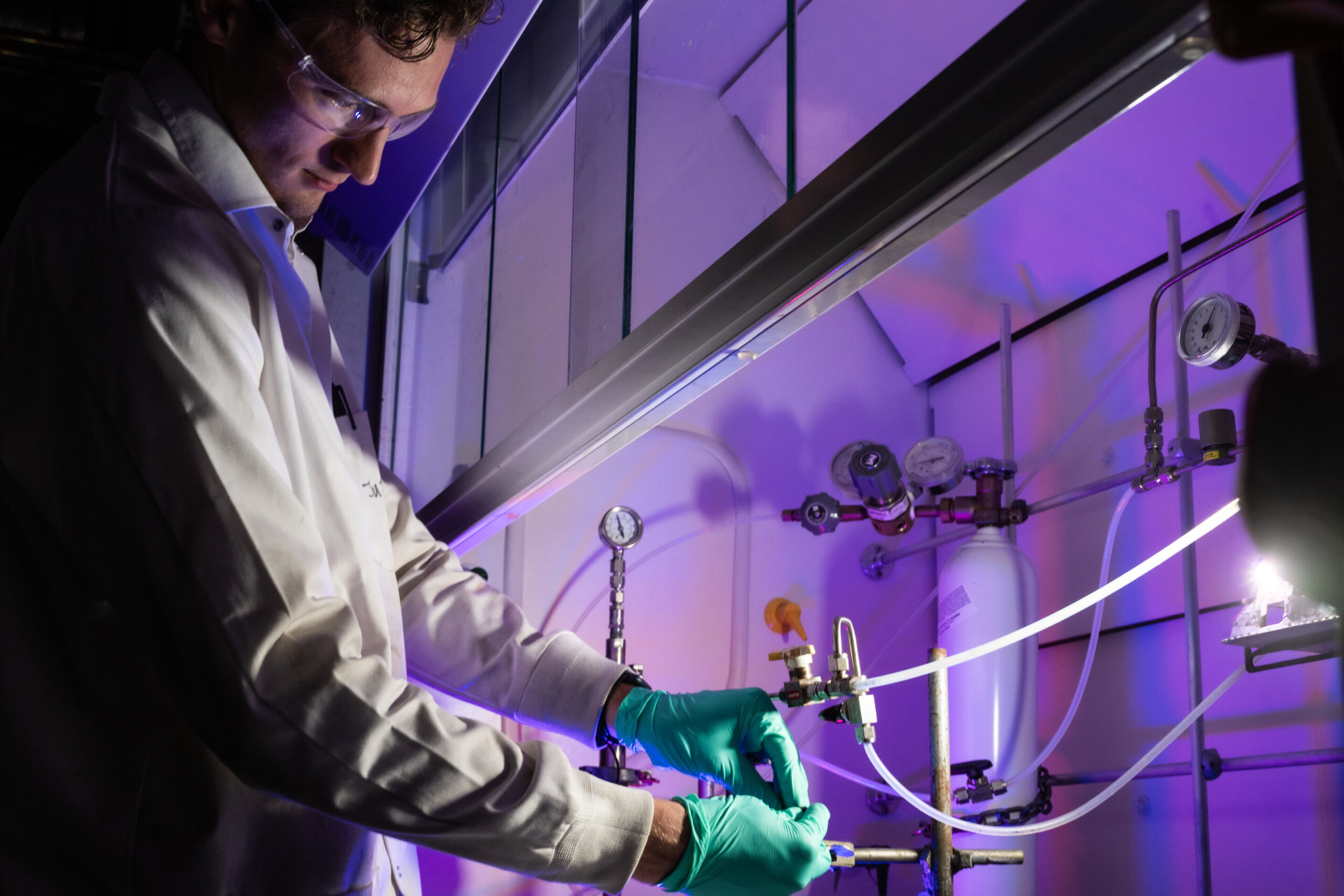
A new one‑step, water‑, acid‑, and alkali‑free method for extracting high‑purity lithium from spodumene ore has the potential to transform critical metal processing and enhance renewable energy supply chains. The study is published in Science Advances.
As the demand for lithium continues to rise, particularly for use in electric cars, smartphones and power storage, current extraction methods are struggling to keep pace. Extracting lithium from salty water is a lengthy process, and traditional methods that use heat and chemicals to extract lithium from rock produce significant amounts of harmful waste.
Researchers led by James Tour, the T.T. and W.F. Chao Professor of Chemistry and professor of materials science and nanoengineering at Rice University, have developed a faster and cleaner method using flash Joule heating (FJH). This technique rapidly heats materials to thousands of degrees within milliseconds and works in conjunction with chlorine gas, exposing the rock to intense heat and chlorine gas, they can quickly convert spodumene ore into usable lithium.
“This method reimagines how to harvest lithium from its most abundant ore, spodumene, a material that is abundant in the U.S.,” said Tour, co‑corresponding author of the study. “We can leapfrog monthslong water evaporation pools and dayslong acid leaching and then directly generate lithium chloride.”
Hypothesis, experiments and the novelty of approach
Guided by thermodynamic calculations, the researchers exposed α‑spodumene, a naturally occurring hard‑rock lithium mineral, to FJH and chlorine gas. This one‑step process eliminates the need for the traditional multistep acid roasting method, allowing lithium to be extracted directly as lithium chloride.
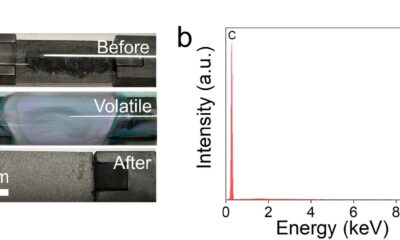
With a flash of electrical current, the mineral shifted from its stable α‑phase to the high temperature‑accessed β‑phase, making lithium available for reaction with chlorine gas. The lithium then vaporized as lithium chloride, while aluminum and silicon compounds were left behind. All of this was complete within seconds.
“Present techniques rely on multistep, chemically intensive treatments,” said study co‑corresponding author Yufeng Zhao, an associate professor of physics at Corban University and visiting professor at Rice. “The unique aspect of this method is the combination of rapid, uniform heating and favorable thermodynamics, which together enable practical and selective extraction.”

Traditional methods, from acid roasting to brine evaporation, simply weren’t designed for ultrafast separation, said Shichen Xu, the first author of the study and a postdoctoral researcher at Rice.
“Our controlled, rapid‑heating approach overcomes kinetic barriers that have hindered single‑step extraction for decades,” Xu said.
Findings and broader significance
The researchers achieved nearly instantaneous lithium extraction from spodumene, producing lithium chloride with 97% purity and 94% recovery, significantly outperforming traditional methods that can take days to months.
“This method paves the way for local, small‑footprint lithium processing units or large‑scale units for massive waste mining operations,” said Justin Sharp, co‑first author and research assistant. “It’s a real paradigm shift. We can now envision battery‑grade lithium production without acids, without large waste outputs and without waiting weeks.”
Additionally, a startup from Tour’s lab, Flash Metals U.S., is already scaling this technology for metals extraction from waste.
“They would be able to rapidly implement this method into their production line once their pilot plant begins operation early next year,” Sharp said.
Environmentally, the elimination of acid and alkali significantly reduces waste burden. Economically, shorter processing times and simpler infrastructure could lower costs and decentralize lithium supply. Academically, the work demonstrates the rapid, acid‑free extraction of lithium from natural ore, raising possibilities for applying FJH and chlorine gas to other strategic minerals.
Co‑authors of the study include Rice’s Alex Lathem, Qiming Liu, Lucas Eddy, Weiqiang Chen, Karla Silva, Shihui Chen, Bowen Li, Tengda Si, Jaeho Shin, Chi Hun Choi, Yimo Han, Kai Gong and Boris Yakobson, along with Yufeng Zhao from Corban University.
More information:
Shichen Xu et al, One-step separation of lithium from natural ores in seconds, Science Advances (2025). DOI: 10.1126/sciadv.ady6457
Citation:
Flash Joule heating lights up lithium extraction from ores (2025, October 7)
retrieved 7 October 2025
from https://techxplore.com/news/2025-10-joule-lithium-ores.html
This document is subject to copyright. Apart from any fair dealing for the purpose of private study or research, no
part may be reproduced without the written permission. The content is provided for information purposes only.












The base of the lamp has two slider buttons. One toggle adjusts the warmth, from cold white light all the way to red. One adjusts the intensity, from ultra-bright down to a glareless glow. Hard taps on each button skip ahead, while holding the toggle down on one side or another adjusts the light settings quite slowly—slowly enough I at first sometimes question whether it’s happening.
The maximum brightness is 1,000 lumens—the approximate intensity of a 75-watt incandescent bulb. At this brightness, the battery lasts about five hours. At a lower intensity, this can extend to as long as a dozen hours.
Red Shift
Photograph: Matthew Korfhage
There’s an added feature I have come to appreciate at night, which is the red-light mode. There’s little evidence that blue light from your little smartphone is keeping you awake at night. But numerous studies do show that blue light wavelengths can affect melatonin levels and thus your body’s circadian rhythm, while red light doesn’t do this.
Red light therapy is, of course, the province of TikTok as much as science—a field where wild exaggerations live alongside legitimate uses and benefits. For every sleep study showing that red light is superior to blue light when it comes to melatonin levels, there’s another showing that red light is associated with “negative emotions” before bed.
So I can only offer my own experience, which is that Edge Light Go’s red reading light offers me a pleasant liminal space between awake time and sleepy time, one not offered by a basic nightstand lamp. It allows me to sort of bask in a darkroom space that still lets me see and read, and drift off a little easier.
If I fall asleep, the light has an automatic 25-minute shut-off, which means I won’t do what I far too often do, which is drift off while reading and then wake up, alarmed, to a room filled with bright light in the middle of the night.
Caveats and Quirks

Photograph: Matthew Korfhage
This said, for all the virtues of portability, the Edge Light Go does not boast a base that’s heavy enough to stop the lamp from tipping over if I bend it forward from its lowest hinge. This can be an annoyance when trying to use the lamp as a reading light from a bedside table or the arm of a couch.

For decades, engineering teams treated code like a vintage Ferrari – expensive to build, painstakingly maintained and too precious to ever throw away. Every line represented a significant investment of human capital and time, and has led to a culture where code was cherished and its longevity was a marker of success.
But at the AWS Summit in London this week, Ryan Cormack, principal engineer at online used car marketplace Motorway, consigned that philosophy to the scrapyard. In the age of agentic artificial intelligence (AI-)driven software development, he says, engineering teams can become more productive and are able to build, revise and maintain code at speeds previously unthinkable.
In this article, we look at Motorway’s radical shift from manual coding to an AI-first development pipeline powered by AWS Kiro. Cormack talks about how the company achieved a 4x increase in engineering output, the challenges that come with the ability to produce more code, why the future of software development lies in treating code as disposable, and the core benefits of codifying organisational culture into AI steering files.
The mindset shift: Disposability vs polish
The most profound change at Motorway is speed of delivery but also a psychological break from the past. Historically, writing code was a “time-expensive process”, Cormack says, adding: “We wanted to have code that was so good that we could cherish it for years to come, because we had invested so much time into making it.”
But since starting to use Kiro – AWS’s agentic AI-capable IDE – that mindset became a bottleneck. “We shifted away from, ‘We need the most well-polished code for every line we write, all the time’, because we can rewrite it again tomorrow at a speed that’s never been possible before,” says Cormack.
This has led to a strategy of “evaluation over production”. Motorway now generates vast amounts of code – a million lines a month – much of which may never reach a customer, says Cormack. Instead, it is used to test and evaluate multiple different ways to solve a problem before committing to it.
The lesson for other organisations is clear. Don’t aim for a perfect first pass. Use AI to cycle through iterations, then use human expertise to refine exactly what you want from the options the AI helps provide.
Managing the ‘volume crisis’: Rigour over speed
While a 4x increase in output sounds like an engineering dream, it creates a real “review bottleneck”. If you write 400% more code but maintain 100% manual review processes, the system collapses. To combat this, Motorway hollowed out the “manual middle” of the development process and moved human energy to the ends of the process – namely, the spec and the review.
“We find ourselves spending more time planning code and the whole process up front, and a little bit more time reviewing what comes out,” Cormack says. “But we lose all this time in the middle where we previously had to manually write all the code.”
To ensure AI doesn’t just produce any code but “Motorway code”, the team utilises “steering files”. These files augment the AI’s system prompts with the company’s specific DNA. They are specific to Kiro and are markdown documents that contain instructions, standards and preferences to guide the AI behaviour and coding style.
They include, for example, naming conventions that standardise how application programming interfaces (APIs) are labelled across Motorway’s 7,500-dealer network, and design patterns that enforce specific software architectures.
By injecting these rules via the AI, generated code looks and feels like it was written by a veteran Motorway engineer.
And AI isn’t just used for the build; it’s used for the full lifecycle. “We need to use AI to help us debug, analyse, understand, and evaluate systems as they run,” Cormack adds, noting that agents now monitor logs and metrics to help humans manage a massive fleet of services.
The ‘Kiro’ engine and model agnosticism
A critical component of Motorway’s success is that Kiro acts as an agentic loop rather than just a simple “autocomplete” tool.
“Kiro knows how our CI pipelines work,” says Cormack. “It knows how our infrastructure is code-driven and it knows how our internal applications work together. It’s able to help guide us every step of the way.
“We’re using Kiro across our full software development lifecycle. Our product and UX teams can ship real prototypes into our customers’ hands quicker than we’ve ever been able to before. What would take weeks now takes hours.”
His team can leverage its model agnosticism too. Cormack explained they aren’t locked into a single LLM: “We use Kiro with Claude’s latest Opus 4.7 model, we use it with some of the open weight models, things like Meta’s Llama models … we’re able to selectively pick the LLM that we know is going to be able to best perform the specific task.”
This flexibility helps to mitigate the risk of hallucinations. Motorway relies on a spec-driven approach where the AI must think through the problem and generate a technical design before writing a single line.
“It will help us write automated tests that are able to prove that each of these points has been accurately done,” Cormack says. This means the AI provides its own proof of work before a human ever touches it.
Legacy transition from Heroku to AWS
Motorway wasn’t always this agile. The company was “born in the cloud”, on Heroku, which Cormack acknowledges was “great for scaling and getting going”. But as the company grew, it hit friction points.
The transition to AWS was driven by a need for “flexibility, adaptability, and scalability”, says Cormack, who views their Kiro-enabled AI-first pipeline as the ultimate tool for such transitions.
If he were to do things all over again, Cormack says he would “adopt this model of thinking much earlier on”. The ability to use AI to map migration logic and service dependencies would have saved months of manual effort during the move off their legacy platform, he believes.
Lessons for the boardroom
For organisations that want to replicate Motorway’s 250% increase in deployment frequency, Cormack warns against automating the grind of coding without also automating the rigour of testing.
“If you try to build just by writing code faster, it doesn’t solve the problems,” he says. “I don’t think our customers necessarily want code; they want features and functionality.”
The winners of the AI era won’t be the ones who write the most code, but the ones who build the most rigorous frameworks to manage its disposability.
As Cormack says: “Kiro’s now writing over a million lines of code for us every single month. So, before we start any new piece of work, our engineering team chooses Kiro to help understand exactly what it is that we want to build.
“The rigour at the start of this process helps enable the precision we want in our engineering at the end. So, every piece of work that we do starts with a spec, understanding the intent of what it is that we’re building and why.”

The 5G mobile market is moving beyond its initial land-grab phase and into a period shaped more by network quality, architectural maturity and service differentiation, according to a study from the Global mobile Suppliers Association (GSA).
The State of the market report – from the industry association representing companies in the global mobile ecosystem engaged in the supply of infrastructure, semiconductors, test equipment, devices, applications and support services – was based on market data taken up until the end of March 2026.
Among the key findings of the research was the underlying dynamic that global 5G expansion is still advancing, but the story is no longer just about adding more launches to the map, and the more meaningful story is how it is broadening.
It reported that 392 operators have now launched 5G networks, up 14% from March 2025, reflecting 44% of total LTE and 5G networks. Spectrum was found to remain as the essential enabler of the next phase of 5G growth, and beyond that, 6G.
Indeed, the study showed that over the past year, 11 5G auctions have been completed across the world, for an average price of $663.4m. And as of the end of March 2026, there were 4,256 announced 5G devices in the market, up 24% from last year. In comparison, total LTE devices totalled 29,024.
5G Standalone was becoming the clearest marker of market maturity. Some 95 operators had launched a 5G Standalone service, highlighting a growth of 42% since the first quarter of 2025. Development of 5G Advanced networks was seen to still be at an early stage, but the GSA stressed that its growth rate makes it one of the clearest signals of where the market is heading next. In total, 35 operators are investing in 5G Advanced, an increase of 71% since 2025. Of these operators and providers, 11 have launched a service.
Looking at one of the key use cases of 5G networks, one the industry has long held to offer future prosperity, the study found that private mobile networks continue to demonstrate that 5G’s opportunity extends well beyond public consumer services. The manufacturing vertical is a strong adopter of mobile private networks, with 374 identified customer deployments, followed by the education and academic research sector, with 169 customers deploying it.
Yet despite the prospects from private 5G, the GSA’s report identified Fixed Wireless Access (FWA) as one of 5G’s strongest and most visible commercial success stories. The study found 394 operators who have launched a 5G fixed wireless service, with another 29 investing in the technology, an increase of 59% since June 2025.
The report also tracked the rapid growth of satellite-enabled mobile connectivity, which it said is moving from experiment to early commercial reality. Some 97 operators are investing in satellite-to-cell phone connectivity, and eight available chipsets are compatible with the technology.
Commenting on the study’s findings, Joe Barrett, president of the GSA, said: “The global 5G market is entering a more selective and strategic phase of development … This shift is most clearly visible in 5G Standalone, which now underpins much of the industry’s next wave of innovation, including 5G RedCap, network slicing and more advanced enterprise offers … These trends all point to a market that is no longer defined simply by how many 5G networks exist, but by what those networks are becoming.
“5G in 2026 will be shaped by standalone adoption, ecosystem readiness and the ability of operators to translate technical capability into commercial value.”


Warner Bros shareholders approve Paramount’s $111bn takeover

Spoiler alert! "Survivor" castaway on elimination from game, role on the jury

‘Summer House’ is going to get cancelled? details revealed

-

 Fashion1 week ago
France’s LVMH Q1 revenue falls 6%, shows resilience amid Iran war
-

 Entertainment1 week ago
Is Claude down? Here’s why users are seeing errors
-

 Sports1 week ago
PSL 11: Peshawar Zalmi win toss, opt to field first against Quetta Gladiators
-

 Tech1 week ago
The Deepfake Nudes Crisis in Schools Is Much Worse Than You Thought
-
 Business1 week ago
Standard Life buys rival in £2b deal to create savings giant
-

 Politics1 week ago
Iran in continuous message exchange with mediator Pakistan after US talks: Report
-

 Tech1 week ago
CYBERUK ’26: UK lagging on legal protections for cyber pros | Computer Weekly
-

 Sports1 week ago
World Cup kit ranking: Which teams will look best in 2026?