

Business
Topshop returns to the high street, but can it get its cool back?


 Karwai Tang/WireImage)
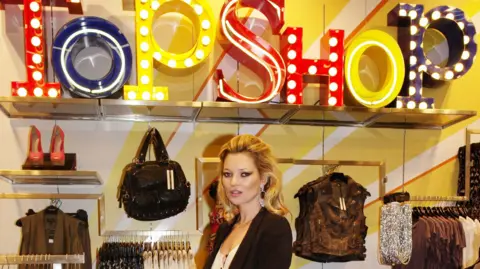
For teenage girls like me in the 2000s and 2010s, going into a Topshop store was like being transported into a fantasy world.
There was music! Makeup! And fashion! All under one roof – with Topshop clothes often found on the pages of Vogue alongside high-end couture.
But somewhere along the way, things went wrong.
“Topshop lost its cool,” said fashion journalist Amber Graafland.
“And when that happens, it’s hard. Fashion is a fickle beast, people move on quickly.”
Then in 2020, its owner, Sir Philip Green’s Arcadia group, collapsed. All of Topshop’s physical stores shut soon after.
But Topshop is now launching a major comeback.
Standalone stores are returning to the High Street, Michelle Wilson, managing director of Topshop and Topman, confirmed to BBC News.
And on Saturday, Topshop is hosting its first catwalk show for seven years in Trafalgar Square. We’ve been told long-time brand muse model Cara Delevingne will be there.
It seems absence (and nostalgia) makes the heart grow fonder. As rumours of Topshop’s imminent return have been met by a wave of affection on social media, particularly among millennials and Gen-Z.
But industry experts say it will take more than nostalgia to make Topshop 2.0 a success.
‘They need to entice younger girls’

 Shutterstock
One of the challenges that Topshop will face is attracting a new wave of shoppers through the doors.
Its previous core following are now women in their late 20s and 30s, but it can’t just rely on them, says Graafland.
“They will need to work hard to entice younger girls in,” she said.
What might help, though, is the nostalgia trend that has taken over social media feeds and High Streets in recent months (Joni jeans, anyone?)
Topshop’s team, for their part, think they can attract both older and newer groups.
“We want to deliver for those that are nostalgic for a brand that they felt like they lost,” Wilson said.
“But we absolutely want to appeal to a new demographic as well.”
Then, there’s the fashion. For me, shopping in Topshop as a teenager made me feel like the ‘it girl’.
On Saturdays, you’d breeze through racks to find the one item that justified taking money out of your barely-there bank balance.
When you bought it, you’d act nonchalant. “Oh this old thing? It’s from Topshop,” you’d tell your school friends, as if you could afford it all the time.
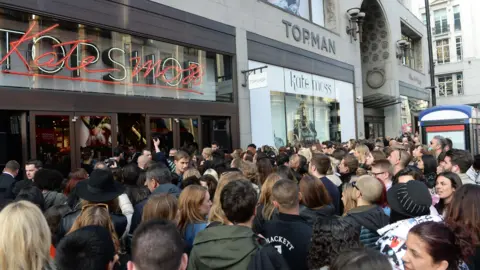
And I wasn’t the only one. Huge crowds would throng to the London landmark store to witness the launch of new ranges from A-listers like Beyoncé and Kate Moss.
 Getty Images
In the 90s and 00s, designers “used to laugh at High Street fashion”, said Wayne Hemingway, a designer and co-founder of Red or Dead.
“They couldn’t keep up with the trends. Topshop was the only one that did.”
Hemingway, who worked with Topshop through its heyday, said a large part of its success was down to the team behind it, including Jane Shepherdson, its hugely influential brand director.
“They brought in second hand clothes for example, that’s normal now, but back then it was seen as absolutely radical to have a shopping department store doing that,” he said.
“You had the collaborations, the London Fashion Walk catwalk, all this design and excitement at High Street prices. It was so fresh, everyone wanted to be part of it.”
But over time, what people were looking for changed – and Topshop didn’t always keep up, said Graafland.
“They offered that unique London look. Then the girls who shopped there grew up, and they didn’t want that look anymore,” she said.
“You cannot afford to take your finger off pulse for one minute in fashion.”
She added that Topshop 2.0 would benefit from the fact its core aesthetic – the London girl look – is back in style, and that not many other retailers are offering it.
“If you look at the High Street now, there’s a strong Spanish presence, with the likes of Zara, and also a Swedish presence with H&M. When Arcadia collapsed, we lost that Britishness,” she said.
She added that a lot of the High Street is “playing it safe right now”, and that could also work in Topshop’s favour if can “get that cool edge back”.
Topshop’s team is confident that it can still win over shoppers with its trademark London-based swagger.
“We still think there’s a huge gap in the market for that,” Wilson said.
“The most important thing that we won’t forget, and maybe got forgotten about towards the end of the previous era, is that product is everything.
“It has to be the best quality product, the most fashionable product for our customer base, and bringing that at good value.”
And then there are the prices
 Getty Images
Topshop’s popularity peaked in the heady years before the cost of living crisis. Its team are aware of the stiff competition it now faces.
A pair of Topshop jeans will easily set you back about £50. Chinese fast fashion giant Shein offers them for about £17.
“If we’re just comparing Shein, then yes, I think most brands on the planet are at a higher price point than Shein,” Wilson said.
But she added: “We know that when we offer great fashion and great value for money then the product does sell very well, so absolutely no concerns about that to be honest.”
While Topshop might not churn out new pieces at the breakneck speed of its online-only rivals, in the past, it’s still faced questions over its environmental record.
For younger shoppers, this can be an important factor in deciding where to go.
Wilson, however, indicates the higher prices reflect a more sustainable model.
The firm’s focus, she said, is very much “on the livelihoods of people within the supply chain that we partner with and also the environmental impacts of the brand”.
‘There’s got to be a buzz around it’
 PA Media
After Sir Green’s retail empire collapsed, the Topshop brand was bought by Asos.
You can still buy the items online on their website – but now, in-store shopping is coming back.
Topshop’s return to the High Street starts this month, with products set to be available to buy in certain stores.
But of course, the real interest is in the standalone stores which Wilson said are “definitely” coming back.
She wouldn’t give a date for their return, but said the aim was to open stores across the nation.
Topshop is choosing to relaunch at a time when the High Street continues to struggle. Just days ago, fashion accessories chain Claire’s collapsed into administration.
But Wilson said lessons have been learnt after what happened to Topshop 1.0.
“We’re just making sure we do it in the right way so that we don’t over-expand ourselves,” she said.
As for the stores themselves, it remains to be seen if they’ll have the same vibe as before.
For me, it was where I met friends after school, tried on eye shadow for the first time, and listened to DJs pumping out dance music.
In some stores you were able to order skinny caramel lattes, get your hair and nails done, and maybe even get a piercing or two if your mum wasn’t watching.
“Fashion is only part of the story. It’s about selling a lifestyle and an experience,” Graafland said. “There’s got to be that buzz around it.”
Topshop’s team say they won’t necessarily be replicating what it used to do, but rather, “finding ways to bring that into 2025 and do interesting things”.
Overall, the hopes are high.
“They will get the girls to the stores, I don’t doubt it,” Graafland said.
“The question is whether they can keep them there.”
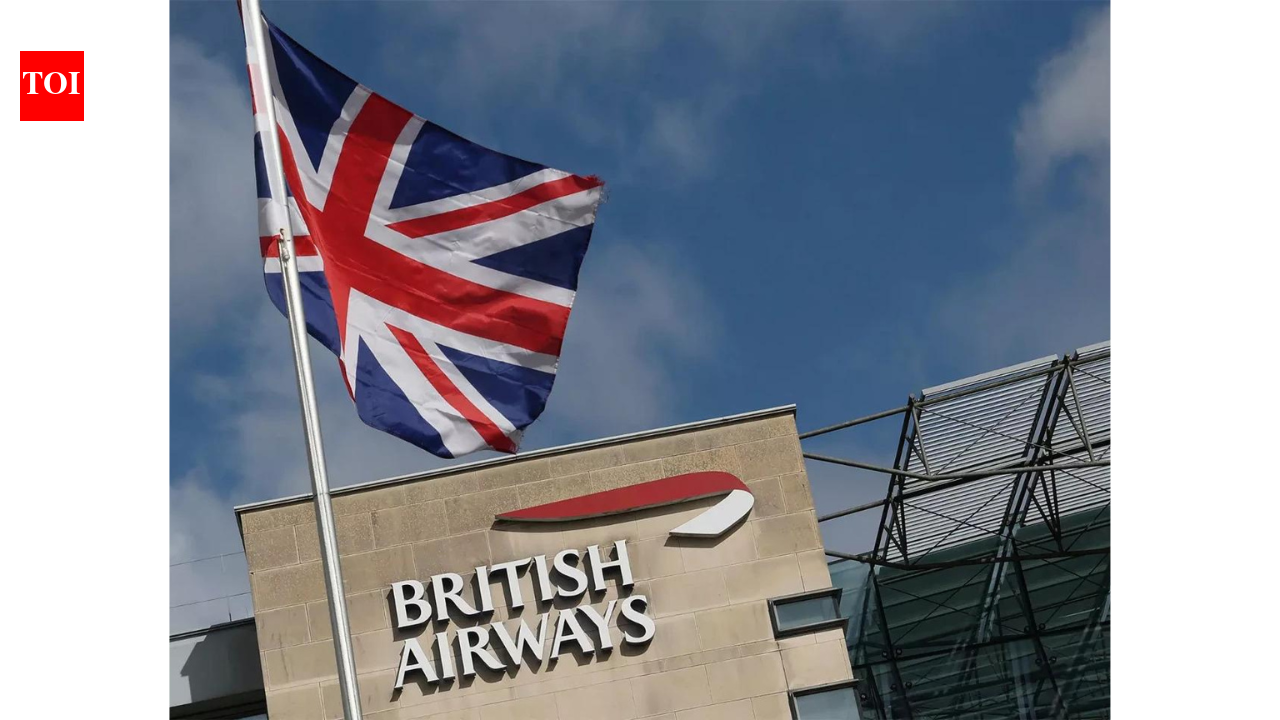
NEW DELHI: With the big Gulf carriers operating a fraction of their schedules, foreign airlines are expanding their India flights to meet the increased demand for options to the likes of Emirates, Qatar Airways and Etihad. SWISS will operate a second daily light between between Delhi and Zurich from April 1 to May 31, 2026. British Airways will have a third daily service from Delhi starting April 7, followed by a third daily service from Mumbai from May 15. Air India has been adding flights to the west whenever possible during the Iran war.In a statement Thursday, Lufthansa group carrier SWISS said it is increasing its flight offering between Switzerland and India. “From April 1 to May 31, 2026, in addition to its regular service from Zurich to Delhi, SWISS will operate a second daily connection using an Airbus A330. Numerous passengers of other airlines are currently unable to take their originally booked flights via the Gulf region. As a result, many are switching to direct connections to and from Asia. SWISS is seeing a corresponding rise in demand for such nonstop services. We are pleased to offer our customers this additional flight to Delhi over the next two months. The flights are available for booking with immediate effect,” SWISS said in a statement.“Depending on further developments in the Middle East, SWISS continuously assesses how aircraft and capacities that become available can be deployed where demand is particularly strong. In addition to demand, key factors include operational constraints such as available airport slots, traffic rights and fleet deployment capabilities,” SWISS statement added.British Airways also announced additional flights from Delhi and Mumbai “to meet strong travel demand”. “In response to the ongoing situation in the Middle East, the airline is adding short-term capacity from Delhi and Mumbai to meet customer demand. A third daily service from Delhi will launch on April 7, followed by a third daily service from Mumbai from May 15. With this additional capacity, British Airways will operate up to 63 weekly flights with more than 1,000 additional seats per week between India and the UK, offering more options for customers travelling to the UK or connecting onwards across the airline’s global network,” BA said in a statement.Neil Chernoff, British Airways’ chief planning and strategy officer, said: “As we continue to respond to the evolving situation in the Middle East, we’ve been able to reallocate additional capacity to meet strong demand to other destinations across our route network. India remains one of our most important global markets, and these additional services from Delhi and Mumbai respond to customer demand and provide greater choice and flexibility for our customers when travelling to the UK and beyond. We will continue to review our network and make adjustments based on where our customers want to fly this summer.”

Two major CEOs told CNBC in recent months that the rise of artificial intelligence contributed to their decisions to hand over the reins and step down from their positions.
It’s one of the latest insights into how America’s corporate leaders are sizing up the AI transition.
Coca-Cola CEO James Quincey told CNBC’s “Squawk Box” on Thursday that his decision to step down from his role was influenced by larger “waves of the organizational momentum.”
“My job is also to think who’s the best team to put on the field to get the next wave done,” Quincey said. “And I concluded that, actually, it was time to put someone else on the field for the next wave of growth.”
Quincey, who has served as CEO of the beverage giant since 2017, will be succeeded by current COO Henrique Braun, effective at the end of this month.
“In a pre-AI, a pre-gen-AI mode, we made a lot of progress. But now there’s a huge new shift coming along,” Quincey said.
While he said he’s leaning into the technological advances, he believes the beverage company needs “someone with the energy to pursue a completely new transformation of the enterprise.”
That person, Quincey said, is Braun, who he believes will uniquely equip the company to embrace its next chapter.
Quincey’s comments echo sentiments from former Walmart CEO Douglas McMillon in December ahead of his departure from that role.

McMillon, who had held the position as CEO of the global retailer since 2014, told CNBC’s “Squawk Box” at the time that he had decided to hand over the role to someone “faster.” John Furner, who was previously head of Walmart U.S., took over the top job on Feb. 1.
“With what’s happening with AI, I could start this next big set of transformations with AI, but I couldn’t finish,” McMillon told CNBC.
“About a year ago, I really started feeling like this next run, you could see what agentic commerce was gonna look like, the vision for AI shopping, and I started thinking about everything that needs to happen over the next few years, and it really caused me to think that now was the right time [to step down],” he said.
Walmart in December made the move to list on the Nasdaq, something McMillon said was symbolic of the progress the company has made with technology.
The retailer has been incorporating AI to optimize its supply chain, provide assistants for customers and more.
“I think what you’re going to see from the Walmart team is they’re just going to keep scaling what we’ve already started, build some new stuff on top, and then use AI to transform it all,” he said.
Business
India’s voluntary carbon market gains ground as net-zero goals drive ecosystem buildup – The Times of India

NEW DELHI: With Climate action gaining momentum as part of India’s net-zero commitment by 2070, the country’s carbon market is beginning to take shape and gain momentum. Homegrown institutions such as the Carbon Registry of India (CRI) are emerging as important enablers for the voluntary carbon market offering platforms to register and track carbon projects, even as corporates and developers scale up efforts around offsets, credits, and trading in line with evolving global frameworks. While the regulatory framework is still in the development stage across many industries, India is leading the development of platforms for listing of voluntary carbon projects in South Asia, creating implementation partners, enabling trading of credits and audit process — all to to align the processes with international standards having an end-to-end setup. “The carbon market today is split into two clear paths,” says Priya Bahirwani, co-founder of Terrablu Climate Technologies, a carbon project developer with proprietary carbon accounting, offsetting and trading platform. “The compliance market is regulation-led and has different levers and framework within which it operates. But the voluntary carbon market is where intent shows up, where companies invest for credibility, brand and long-term responsibility.” It is this voluntary market that is now steering the path and driving the momentum in India for a climate-driven economy. This market is driven by corporates looking to go beyond compliance and are committed to demonstrating real climate impact and social impact – Indian Carbon for Global Markets. CRI (a public-private registry) and other such reputed organisations are building the ecosystem in a sustainable manner. Especially companies like Varaha, Terrablu, NextNow Green (NNG), and other entities are slowly but steadily building the momentum for a climate resilient economy in India. From large conglomerates to mid-sized firms, companies are increasingly investing in carbon credits not just to meet regulatory norms, but to build long-term brand credibility and stakeholder trust. The is the just the beginning of new wave of building a climate resilient economy. CRI helps companies register and formalise their carbon projects in a standardised format. For India, this shift represents a strategic move — from being a supply-side participant to shaping the rules of the market itself. “Carbon markets will only scale on the foundation of trust, transparency, and traceability. With its depth in innovation and resilience, India is well placed to lead this evolution.,” says Richard Bright, CEO of CRI. CRI, he adds, is focused on building a credible domestic bridge between Indian climate projects and global demand, while leveraging digital frameworks to improve transparency, traceability and access. Companies listed on the CRI for carbon projects include Sahyadri Farms, Piplantri FPO, L&T Metro and others are in the pipeline, says Bright. Terrablu’s Bahirwani says India should not just generate carbon credits, but also own the platforms that certify them. “CRI is creating that opportunity, and we are already seeing increasing interest from corporates in sourcing credits listed on such platforms.” Companies such as NNG, which is a carbon consultancy and ecosystem implementation partner, believes that as India moves from a voluntary to a rules- and penalties-based setup in carbon, companies will increasingly work on carbon and climate strategies to strengthen their play in the area. “We are already seeing efforts in this regard. There are enquiries about how to go about carbon projects, how to carry out assessment and audit of current work, and how to work out credits and even offset them, or trade them, across diverse sectors including agriculture and industrial decarbonisation,” says NNG’s Archana Raha. This push is also being reinforced by ecosystem players such as legal frameworks to project developers. They see value in strengthening India’s own carbon market architecture. “Global registries will continue to play a role, but India needs trusted domestic platforms as well,” says Vishnu Sudarsan, senior partner at law firm JSA. “Platforms like CRI provide visibility and credibility within the Indian ecosystem, which is critical as the market matures, supported by robust, dual-layer governance structures that reinforce transparency and accountability,” Sudarsan adds. On the ground, this shift is already taking shape through projects that are choosing to align with India’s emerging carbon infrastructure. Take Piplantri as an example. It is a model that goes beyond carbon to integrate afforestation, water conservation and community livelihoods. By listing on CRI, stakeholders are signalling a clear intent to prioritise transparency, traceability and alignment with India’s evolving climate ecosystem. The market is gradually maturing as reputed and credible market players with sophistication and focus are shaping the ecosystem . The decision reflects a broader trend. Project developers and intermediaries are increasingly working with platforms like CRI and CCTS, supported by ecosystem players such as Terrablu and implementation partners like NNG. Alongside them, credible validation and verification bodies — including KBS certification, 4K Earth Science, VKU Certification and others — are empanelled with CRI, strengthening the integrity and credibility of the overall ecosystem, and helping create a more locally anchored yet globally credible carbon market framework. Experts say that India’s emerging carbon ecosystem is beginning to offer answers through creation of stronger platforms, better verification, and tighter integration across the value chain. “The direction is clear: India is not just participating in the global carbon market but it is leading the market for other emerging economies,” says Sudarsan. It is believed that with the foundation for the climate economy coming in place, India is well poised to become a hub for high-integrity carbon solutions.


Amazon’s Spring Sale Is So-So, but Cadence Capsules Are a Bright Spot

The unexpected path that led Morgan and Frankie Price to Arkansas gymnastics

US-Iran mediation: Politicians castigate India’s Jaishankar for spiteful remarks on Pakistan

Sales at US apparel, clothing accessories stores up 4% YoY in Jan 2026

Justice Department Says Anthropic Can’t Be Trusted With Warfighting Systems

March Madness 2026 – How to watch in SA, start time, schedule, TV channel for NCAA championship basketball tournament

-
 Fashion1 week ago
Sales at US apparel, clothing accessories stores up 4% YoY in Jan 2026
-
 Tech1 week ago
Justice Department Says Anthropic Can’t Be Trusted With Warfighting Systems
-
 Sports1 week ago
March Madness 2026 – How to watch in SA, start time, schedule, TV channel for NCAA championship basketball tournament
-

 Fashion1 week ago
Spain’s Inditex FY25 sales rise 3.2% to $46.28 bn amid strong demand
-

 Politics1 week ago
Iran strikes Tel Aviv with cluster-warhead missiles in retaliation of Larijani’s martyrdom
-

 Entertainment1 week ago
Val Kilmer revived 1 year after death through AI
-
 Business1 week ago
Brits cashing in jewellery as gold price hits record high
-
 Fashion1 week ago
US’ G-III Apparel’s FY26 sales fall 7% to $2.96 bn