

Fashion
VDMA members showcase energy-saving advances in finishing & dyeing

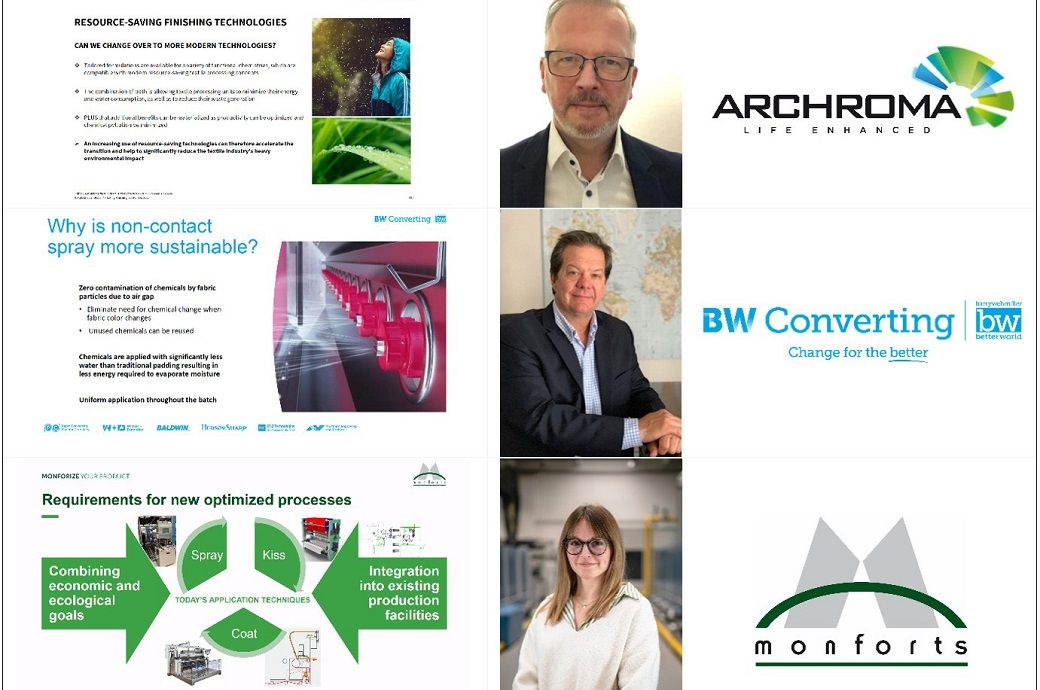
During a recent webinar organised by Germany’s VDMA textile machinery association, specialists from the three companies provided details of the range of new energy-saving options that is now available to mills.
VDMA’s recent webinar highlighted new resource-efficient finishing and dyeing technologies from Monforts, Archroma, and BW Converting.
The Baldwin TexCoat G4 system with Archroma formulations and Monforts MONTEX stenters has achieved major water and energy savings, notably in Pakistan.
The partners now extend innovation to dyeing with the new TexChroma system, debuting at ITMA Asia + CITME 2025.
In particular, BW Converting’s Baldwin TexCoat G4 precision spray technology – in combination with advanced Archroma finishing formulations and Monforts MONTEX stenters and MONFORTEX shrinking ranges and related technologies – is pushing the envelope in new standards for sustainable and long-lasting clean productivity.
Functionality
Michael Schuhmann, Global Marketing Finishing at Archroma Textile Effects, explained that typical key functions provided in textile finishing include sweat and odor control, water repellence and UV resistance. Softeners are primarily applied to make fabrics more comfortable while other finishes provide reduced crease formation for easy-care properties. The traditional padding or exhaust techniques for applying these finishes require huge volumes of water and energy intensive drying.
Spray application, by contrast, requires much less water due to drastically reduced ‘pick up’ – the amount of liquid that a fabric absorbs and retains, determining how much finishing agent remains in the fabric. This also enables significantly faster drying, making process speeds of up to 100 metres per minute possible, depending on the fabric.
“As the global fashion brands commit to reducing their emissions, the textile processing industry must respond by adopting safer chemistries with resource-saving processes such as spray application,” Schuhmann said.
Precision
Rick Stanford, Vice President Global Business Development for Textiles at BW Converting, explained that at the core of the Baldwin TexCoat G4 technology are precision valves that were originally developed for the offset printing industry and have been refined over the past 40 years through more than 40,000 installations globally.
“These enable extremely precise spray flows which are controlled by proprietary software algorithms,” he said.
Over 100 TexCoat G4 units have been installed worldwide and all three companies are enjoying notable success with bed sheeting manufacturers in Pakistan.
“Our first TexCoat G4 in Pakistan was installed in Spring of 2024 for a manufacturer using Archroma chemistry and a ten-chamber Monforts MONTEX stenter,” Stanford explained. “When using the padder at this mill, the pickup rate was 65% and with TexCoat G4 we were able to reduce that to 27%. As a result, the customer was able to increase the MONTEX speed from 60 metres a minute to 100 metres a minute, while also reducing the operating temperature in the stenter. We have subsequently sold 30 TexCoat G4 units in Pakistan, driven primarily by the system’s proven productivity and efficiency gains.”
Energy savings
“A BW Converting Baldwin TexCoat G4 unit is now installed at the Monforts Advanced Technology Center (ATC) for trials and fully complementing spray finishing operations are our multiple energy saving innovations,” added Saskia Kuhlen, Monforts Engineer for Textile Technologies. “MONTEX stenters are equipped with the TwinAir air volume regulation system as well as the TwinTherm system for temperature control and feature CADstreamE variable nozzles. These features enable full adjustment to a specific fabric width for either higher operational speeds or lower electrical energy. A further benefit is the150-mm wide advanced insulation system inside the stenter frame”.
Further Monforts modules for optimizing processes include the coaTTex unit for the knife coating of paste and foam application and the EcoApplicator, a kiss-coating technology for the indirect application of finishes on one or both sides of a fabric, with a stenter production speed up to 100m/min. Both can be integrated into existing lines.
The Monforts Energy Tower and EcoBooster are meanwhile modules for air/air heat exchanging, for heat recovery from the exhaust flow of thermal systems. They can also be retrofitted to existing stenter frames, relaxation dryers, infrared pre-dryers and hotflues.
“We continue to explore the best heating options for every customer, with optimised combinations in order to make our lines as energy efficient as possible,” Kuhlen said. “We have also been deeply investigating the potential of green hydrogen as a further option for the future.”
BW Converting’s Baldwin TexChroma
In response to a big market demand, the three technology partners are now turning their attention to the dyeing process.
At ITMA Asia + CITME in Singapore, from October 28-31, they will introduce the resource-saving combination of THERMEX continuous dyeing ranges with the new BW Converting Baldwin TexChroma spray dyeing system.
“We are excited to introduce the Baldwin TexChroma because spray dyeing is the future,” said Stanford. “We’ve been cautious about providing details on TexChroma too early, but now we’re ready and look forward to outlining its benefits in Singapore with interested customers. We will also be installing a TexChroma unit on a THERMEX line at the Monforts ATC in 2026.”
Monforts is at stand A301 in Hall 3 at ITMA Asia + CITME and BW Converting at stand B201 in Hall 8.
Note: The headline, insights, and image of this press release may have been refined by the Fibre2Fashion staff; the rest of the content remains unchanged.
Fibre2Fashion News Desk (KD)









Sovereign ratings in Southeast Asia are under risk due to the Middle East conflict. Fiscal and external metrics underpinning the ratings will be strained if the global energy market does not begin to normalise in the next few months, the credit rating agency noted.
Prolonged energy disruptions will raise fiscal and external pressures on Southeast Asian nations, according to S&P Global.
Indonesia is more vulnerable to weakening credit metrics if the war continues and energy prices remain high.
Vietnam’s strong economic growth, its booming export sector and relatively unencumbered government balance sheet will act as ballast against the energy market dislocation.
If the longer-term impact of the war is severe, the robust growth prospects of economies dependent on imported energy may also be impaired, weakening economic support for the ratings, it said.
Its base case assumes the war’s intensity will peak and the Strait of Hormuz’s effective closure will ease during April, but some disruptions are likely to persist for months.
A prolonged surge in the cost of energy imports—coupled with a loss of foreign exchange reserves—is one risk scenario that could materially weaken Vietnam’s external liquidity position, the credit rating agency said in a regulatory article.
And a sharp increase in the fiscal deficit, in the unlikely event that economic growth also decelerates abruptly, could also erode the government’s more favourable leverage profile, it noted.
If these scenarios persist beyond six months and the government is unable to mitigate the impact on credit metrics, they could erode Vietnam’s robust credit buffers at the current ratings level.
If the pressure on the economy causes capital outflows, the authorities may use foreign exchange reserves to support the exchange rate.
The budget deficit in the country could also widen if the energy disruption drags on. Outcomes will ultimately be tied to the duration of the conflict and the disruptions, it said
Meanwhile, the sovereign ratings on Indonesia (BBB/stable/A-2) are sensitive to weakening fiscal or external credit metrics resulting from the war.
Potential risks include higher energy prices raising budgetary subsidy payments, weighing on deficits; government interest payments rising if accelerating inflation fuels a further increase in market interest rates; and importing more expensive oil products widening the current account deficit (CAD).
The government’s response to the energy disruption may contain some of the damage to its fiscal performance, S&P Global Ratings noted. But, higher commodity prices could also boost government revenue. This helps to limit the increase in the size of the fiscal deficit and reduces upward pressures on the budgetary interest payment ratio.
Indonesian exports have grown this year, but the growth momentum is tempered by declining sales of energy products. With the sharp rebound in energy prices, Indonesian export growth could rise further to mitigate the increase in oil imports.
Overall, Indonesian credit metrics are likely to weaken marginally under the credit rating agency’s base case.
As a commodities exporter, Indonesia may see some mitigating developments offsetting some of the pressures on the sovereign ratings, particularly if there is a broad-based strengthening of commodities prices. This could help to turn around some of the worsening trend in the country’s credit metrics once the situation normalises.
Fibre2Fashion News Desk (DS)
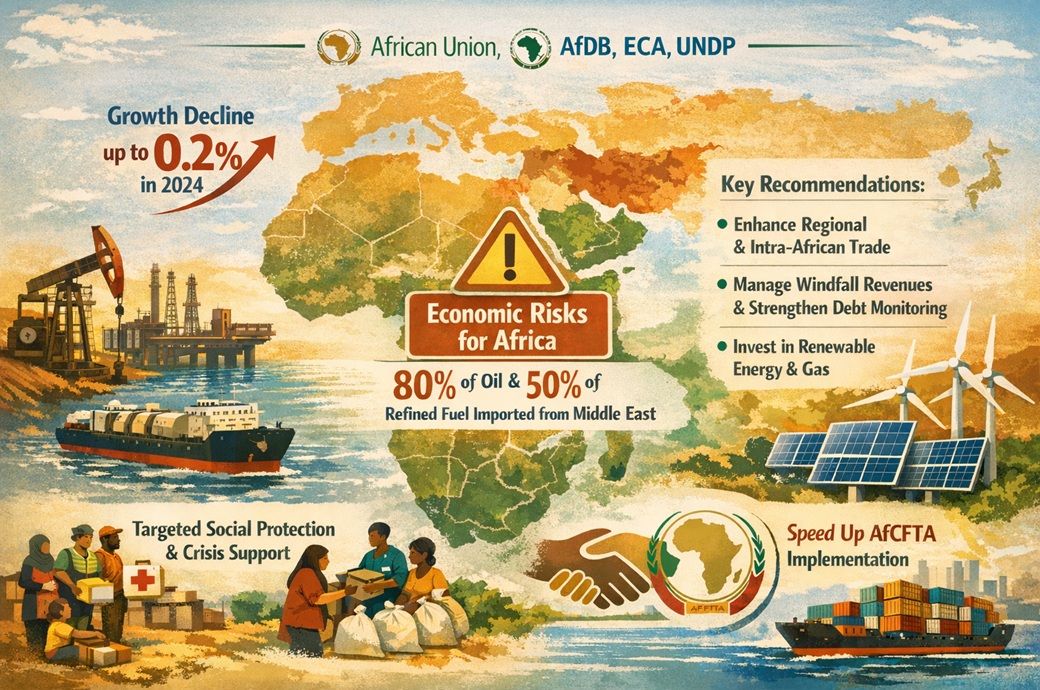
The report titled ‘Impacts of the Conflict in the Middle East on African Economies’, cautions that African economies, which were slowly recovering from the severe consequences of COVID-19, the Russia-Ukraine war and rising trade tariffs, could be among the most affected by the ongoing conflicts in the Middle East.
Growth in African countries is projected to decline by up to 0.2 per cent this year due to the Middle East crisis, according to a joint policy document by the African Union Commission, the African Development Bank Group, the UN Economic Commission for Africa and the UN Development Programme.
The main effects of the conflicts on Africa include surging prices of hydrocarbons, food products and fertilisers.
Kevin Urama, chief economist and vice president for economic governance and knowledge management at AfDB who presented the report on the sidelines of the Spring Meetings of the International Monetary Fund and the World Bank in Washington, DC, recently, urged African governments not to panic or take hasty decisions that could harm their fiscal balances.
The main effects of Middle Eastern conflicts on African economies include surging prices of hydrocarbons, food products and fertilisers, noted the report.
“Eighty per cent of the oil imported into Africa comes from this region, as well as 50 per cent of refined petroleum,” said ECA executive secretary Claver Gatete.
The report recommends, in particular, strategic inflation management to ensure short-term price stability expectations. It cautions oil-exporting countries to adopt strict fiscal discipline by managing windfall revenues prudently, while strengthening debt-monitoring, and using energy reserves strategically.
Where fiscal space allows, it advises that temporary and targeted social protection measures be deployed to shield the most vulnerable populations from the crisis, added the report.
However, the report urged governments to avoid broad-based subsidies that could worsen long-term fiscal deficits, and to diversify sources of energy, inputs and food supplies.
It also recommends that African governments strengthen regional and intra-African trade in oil and fertiliser markets to enhance resilience; and ensure smooth inter-institutional coordination to harmonise strategic monetary and fiscal policies.
At the same time, the report calls upon development partners, multilateral banks and development finance institutions to provide emergency support to African countries through crisis response measures and technical assistance.
It also recommends a speedy operationalisation of the African Continental Free Trade Area (AfCFTA), while strengthening large-scale domestic capital mobilisation.
The report also suggested Africa to diversify its energy mix by accelerating investments in renewable energy and the gas sector.
Fibre2Fashion News Desk (DS)
The measures aimed at improving turnaround time, enabling early approvals and enhancing transparency and predictability under the Advance Authorisation (AA) scheme.
The Indian Ministry of Commerce & Industry has undertaken a series of targeted reforms to strengthen the functioning of norms committees under the Directorate General of Foreign Trade, it recently said.
The measures—aimed at improving turnaround time, enabling early approvals and enhancing transparency and predictability under the Advance Authorisation scheme—have resulted in improved outcomes.
DGFT administers the AA scheme and the Duty-Free Import Authorisation (DFIA) scheme under the Foreign Trade Policy. These schemes allow duty-free import of inputs that are physically incorporated in export products.
Authorisations are generally issued against notified standard input-output norms (SION). In cases where SION is not available, authorisations are issued based on self-declared input-output norms by applicants, which are subsequently examined and finalised by sector-specific NCs.
At present, seven NCs are operational under DGFT, covering a range of export sectors. These comprise technical authorities and domain experts from relevant ministries and departments. They are responsible for fixation of SION and ad-hoc norms, recommending SION notifications and facilitating issuance of authorisations in accordance with the Foreign Trade Policy and handbook of procedures.
The functioning of NCs had been affected by capacity constraints due to a limited number of technical authorities. As of early February 2026, only twelve technical members were associated with the committees, including five serving government officers, resulting in increasing pendency due to overlapping responsibilities.
To address these challenges, a series of reforms have been introduced. These include strengthening of governance and processes; augmentation of technical capacity; and a special disposal drive for expeditious disposal of pending applications.
Detailed guidelines have been issued to ensure uniformity and consistency in the functioning of NCs. These include institutionalised scheduling of meetings on a fixed fortnightly cycle, prioritisation of long-pending cases, time-bound finalisation of meeting minutes and systematic monitoring of pendency and case ageing.
Efforts have also been made to identify recurring cases for conversion into SION to reduce repetitive approvals.
Line ministries have been requested to nominate additional technical officers to the committees to enhance sectoral expertise and reduce dependence on a limited pool of members.
As part of capacity augmentation, ten additional technical members have been nominated from various ministries, increasing the total number of technical authorities from 12 to 22.
The reforms have resulted in improved outcomes, a release from the ministry said. Between January 2026 and 7 April 2026, a total of 38 NC meetings were held, in which 3,925 cases were taken up and 1,770 cases were disposed of.
Fibre2Fashion News Desk (DS)


Long energy disruptions to raise pressures on SEA nations: S&P Global

start time, schedule, route—here’s your complete guide

India and South Korea plan $50 billion trade push with new deals

-

 Fashion4 days ago
France’s LVMH Q1 revenue falls 6%, shows resilience amid Iran war
-

 Sports1 week ago
The case for Man United’s Fernandes as Premier League’s best
-

 Entertainment1 week ago
Palace left in shock as Prince William cancels grand ceremony
-
 Business1 week ago
UK could adopt EU single market rules under new legislation
-

 Entertainment5 days ago
Is Claude down? Here’s why users are seeing errors
-

 Sports1 week ago
Lamar Jackson hits back at critics with faithful message on social media
-

 Fashion1 week ago
Energy emerges as biggest cost driver in textile margins
-
 Business1 week ago
Delta Air Lines unveils first new Delta One suite in premium cabin arms race