

Politics
Key takeaways from White House’s unusually polite Ukraine truce talks

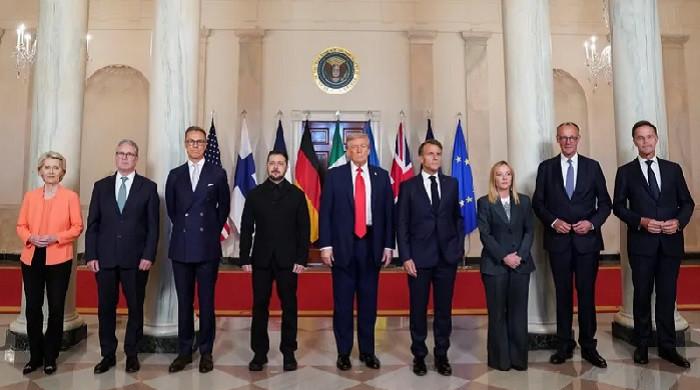
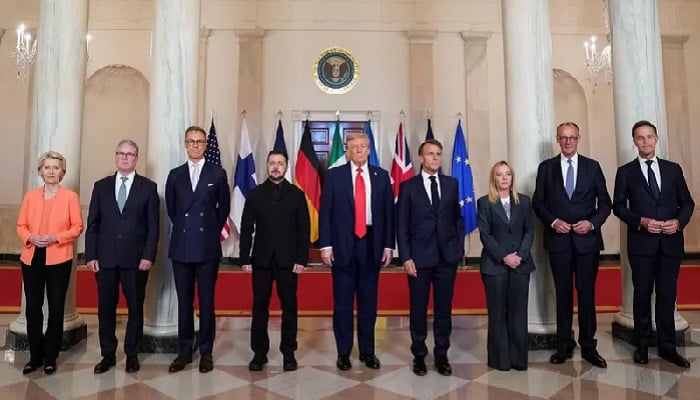
US President Donald Trump gathered European leaders and Ukrainian President Volodymyr Zelensky for a hastily arranged White House meeting on Monday to discuss a path to ending Russia’s war in Ukraine.
Here are the takeaways from the talks:
Warm tone, little substance
Seven European leaders, the Ukrainian president, their motorcades, dozens of Trump administration staff and more than 100 journalists swarmed the White House campus on Monday in anticipation of the unusual meeting.
Would Trump and Zelensky agree on a path to peace? Or would their latest Oval Office session devolve into a bitter squabble as in February?
Neither scenario occurred. Zelensky, chided for his appearance and manner in February, adjusted both. Wearing more formal clothing and repeatedly expressing his gratitude to Trump, he was greeted by a far more complimentary US president than in the past.
But, despite Trump’s vow to assist in Ukraine’s security after a hypothetical peace deal, there was no immediate sign that any party had substantially changed position on land swaps, security guarantees or sanctions.
Instead, Trump ended with promises to host a meeting with Russian President Vladimir Putin to address the many remaining issues.
Heaping praise
“Have you said ‘thank you’ once?” US Vice President JD Vance asked Zelensky in February, accusing him of failing to show sufficient gratitude for US support.
On Monday, Zelensky made sure that was not an issue. His opening remarks in the Oval Office included eight thank-yous, mostly for Trump.
“Thank you so much, Mr. President … thank you for your attention. Thank you very much for your efforts, personal efforts to stop killings and stop this war. Thank you,” Zelensky said.
He included the US first lady, who sent a letter to Putin about abducted children in Ukraine.
“Using this opportunity, my thanks to your wife,” the Ukrainian president said.
“And thanks to all our partners and that you supported this format. And after our meeting, we’re going to have leaders who are around us, the UK and France, Germany… all partners around Ukraine supporting us. Thanks (to) them. Thank you very much for your invitation.”
Unlike in February, Vance this time sat largely silent.
Combat formal
The stakes of the meeting could not have been higher. But one of the most-asked questions among diplomats in DC could not have been more frivolous: Would the Ukrainian president wear a suit?
The answer: kind of.
Zelensky showed up to the White House in what one European diplomat described as “almost a suit.” His black jacket had tiny lapels and jetted chest pockets. He did not wear a tie. His attire, which split the difference between the battlefield and the boardroom, could be described as combat formal.
Those sartorial details matter when it comes to dealing with the US president, who was upset that Zelensky did not wear a suit for their February meeting.
Zelensky passed the fashion test this time, however.
When one journalist in the Oval Office said Zelensky looked “fabulous,” Trump chimed in to agree.
“I said the same thing,” Trump told reporters.
Divide over the ceasefire
The assembled European leaders, Zelensky included, were careful to paper over policy disagreements with Trump, keeping their comments vague and showering the US president with compliments.
But one point of disagreement did bubble to the surface.
German Chancellor Friedrich Merz told the assembled leaders and media that he wanted to see Putin agree to a ceasefire.
Trump had long pushed for a ceasefire in Ukraine. But he largely jettisoned that goal after meeting with Putin last week in Alaska, a shift that was widely seen as a diplomatic defeat for Ukraine. The US president now says he is fine with trying to move directly to a peace deal.
“To be honest, we all would like to see a ceasefire,” Merz said. “I can’t imagine that the next meeting would take place without a ceasefire, so let’s work on that.”
Trump pushed back, arguing he has solved many conflicts without first reaching a ceasefire.
Whose boots are on the ground?
One of the great mysteries that hung over the summit was what support the US would give to secure any Russia-Ukraine deal long term.
Trump hasn’t offered US troops “boots on the ground” to guarantee Ukraine’s security from Russia, reflecting American reticence to commit to military entanglements or a head-to-head confrontation with a nuclear power.
Instead, he has offered weapons sales and promised that Americans will do business in Ukraine, assurances that Ukrainians see as far less than a security guarantee. Europeans are preparing for a peacekeeping mission backed by their forces.
Yet, asked explicitly whether US security guarantees for Ukraine could include US troops in the country, Trump did not rule it out. Instead, he teased an announcement as soon as Monday on the topic.
“We’ll let you know that, maybe, later today,” Trump said. He said Europe was the “first line of defence” but that “we’ll be involved.”
What’s next
Trump said he would call Putin and set up a trilateral meeting with Ukraine at a time and place to be determined.
Despite some private misgivings, the assembled leaders agreed that such a meeting was a logical next step.
Still, the path forward is more complex than Trump and his allies are letting on.
For one, Russia has delayed and obstructed high-level meetings with Ukraine in the past, and it was not immediately clear that Putin would sit down with Zelensky, whom he frequently describes as an illegitimate leader.
Additionally, it is unclear how much a principal-level meeting would actually advance the cause of peace.
The gulf between the Russian and Ukrainian positions is vast.
The Kremlin said on Monday that the presence of NATO troops in Ukraine is a non-starter, a stance that would be hard for Ukraine to swallow.
Russia is also calling for Ukraine to fork over significant chunks of territory that Kyiv controls, another proposal that Ukraine’s leaders are not entertaining.
- Survivor says passengers were “crushed on top of one another” in impact.
- Victims feared suffocation as bodies piled up inside mangled carriages.
- All deaths reported from commuter, women-only carriage hit hardest.
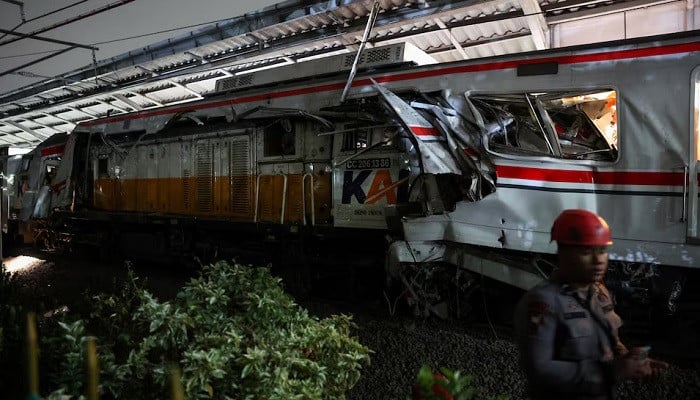
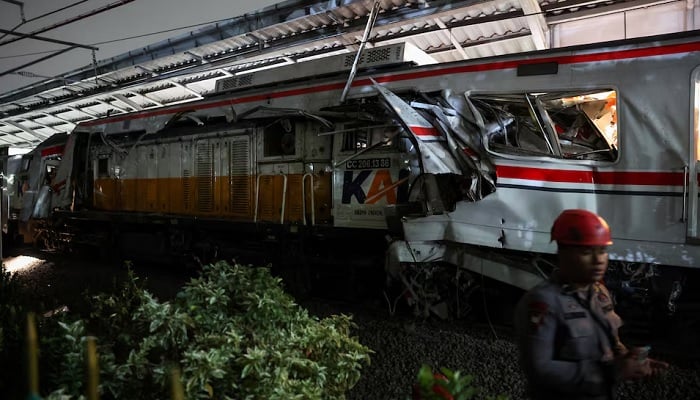
Rescuers were racing to reach survivors Tuesday morning outside Indonesia’s capital Jakarta after two trains collided overnight, killing at least seven people and injuring dozens.
Anna Purba, a spokeswoman for the state-owned KAI rail company, told local television in the early morning hours that seven people had been killed in the crash and 81 were injured.
She said rescuers were working to get to two people still trapped, alive, in the wreckage.
One survivor told AFP of the horrific moments after a long-distance train slammed into the stationary commuter train she was in, trapping people inside mangled carriages.
“I thought I was going to die,” Sausan Sarifah, 29, told AFP from her bed at the RSUD Bekasi hospital, where she was admitted with a broken arm and a deep cut to one thigh.
She was on her way home from work, she said, when her train stopped at the Bekasi Timur station some 25 kilometres (15 miles) from Jakarta.
“It all happened so fast, in a split second,” Sausan recounted.
“There were two announcements from the commuter train. Everyone was ready to get off, and then suddenly there was the sound of the locomotive, really loud,” she said.
“There was no time to get out, and everyone ended up piled up inside the train, crushed on top of one another. I don’t know how the person underneath me is doing.”
She said she had feared suffocating to death in the human pile-up, and worried that some pinned underneath didn’t make it.
“Thank God I was on top, so I could be evacuated quickly,” said Sausan.
According to Franoto Wibowo, a spokesman for rail operator KAI, a taxi appears to have clipped the commuter train on a level crossing, causing it to come to a standstill on the tracks, where it was hit.
At the station, chaotic scenes unfolded in the aftermath of the crash, with rescue workers shouting for oxygen tanks as ambulances stood by in a snaking queue, lights flashing.
An AFP reporter at the scene witnessed people being carried out of the wreckage on gurneys and loaded into waiting ambulances as hundreds of bystanders looked on, some seemingly in shock.
As rescuers worked to free many more trapped in the crushed train carriages, Deputy House Speaker Sufmi Dasco Ahmad said the toll could rise.
“Judging from the evacuation process that is still underway, it is possible that the number of victims may continue to rise,” he told reporters at the scene.
Franoto told Kompas TV the military, fire brigade, the national search and rescue agency, and the Red Cross were aiding in the evacuation effort.
Passengers trapped
Jakarta police chief Asep Edi Suheri said the long-distance train had crashed into the last, women-only, carriage of the commuter train.
All the victims were in the commuter train, and all 240-odd passengers on the other train had been evacuated safely, according to Purba.
The collision caused “significant damage to several train carriages”, the Jakarta search and rescue agency said in a statement.
“The incident caused a number of passengers to suffer injuries, and several victims were reported to be trapped inside the carriages due to the force of the impact,” it added.
The agency said rescuers were “carrying out the evacuation process for the trapped victims using extrication equipment to free them from the wrecked train structures”.
Eva Chairista, 39, told AFP she had rushed to the RSUD hospital after hearing that her sister-in-law, whom she named only as 27-year-old Fira, had been injured in the crash.
She arrived at a frenetic scene of medical triage.
“The doctor told us to be patient; there are many whose condition is worse than my sister-in-law’s,” she said.
The last major train crash in the Southeast Asian country killed four crew members and injured about two dozen people elsewhere in West Java province in January 2024.
Transport accidents are not uncommon in Indonesia, a vast archipelago nation where buses, trains and even planes are often old and poorly maintained.
Sixteen people were killed when a commuter train crashed into a minibus on a level crossing in Jakarta in 2015.


- Court orders detention as federal case continues.
- Suspect calls himself “Friendly Federal Assassin”.
- Secret Service agent struck but vest stops shot.
The man accused of shooting a US Secret Service agent as he tried to breach security at a Washington dinner attended by President Donald Trump is facing federal charges of attempting to assassinate the president, a judge said in court on Monday.
Cole Tomas Allen, 31, of Torrance, California, also faces firearms charges in a three-count complaint.
Allen wore a blue prison jumpsuit at his first appearance in Washington federal court, two days after authorities said they foiled an attack at the White House Correspondents’ Association Dinner, an annual black-tie gathering of journalists and politicians.
“He attempted to assassinate the president of the United States, Donald J. Trump,” prosecutor Jocelyn Ballantine said in court.
Allen has not yet responded to the allegations. Seated at the defense table flanked by US Marshals, Allen said he would answer all questions truthfully and that he had a master’s degree in computer science.
US Magistrate Judge Matthew Sharbaughordered Allen detained while the case moves forward. Sharbaugh scheduled another hearing over Allen’s continued detention for Thursday.
‘Friendly Federal Assassin’
Allen left a manifesto with family members referring to himself as the “Friendly Federal Assassin” and discussing plans to target senior Trump administration officials, who were present in the hotel ballroom. Blanche said his targets likely included Trump himself.

White House press secretary Karoline Leavitt on Monday described the Saturday night attack as the third major assassination attempt against Trump, after two attempts on his life in 2024. She compared the rhetoric in the manifesto to criticism of Trump by his political opponents.
“Much of the manifesto of the would-be assassin is indistinguishable from the words that we hear daily from so many,” Leavitt said. “The entire Democrat Party has made their pitch to voters across the country that Donald Trump poses an existential threat to democracy, that he is a fascist.”
Prominent elected Democrats have condemned the shooting.
Allen booked a room at the Washington Hilton hotel, where the dinner took place, and traveled from California to Washington by train, officials said.
The shooting on Saturday rattled the press dinner, a prominent event on Washington’s social calendar, sending attendees scrambling under tables and prompting law enforcement to whisk senior officials out of the room. Trump, who was set to deliver remarks later in the evening, was rushed off the stage by security personnel after shots were fired.
Secret service agent struck
The suspect allegedly fired a shotgun at a Secret Service agent at a checkpoint inside the hotel before being tackled and arrested, according to authorities. Video footage Trump posted online showed the suspect sprinting through a hallway outside the ballroom.
US officials have said the suspect was subdued just inside a security perimeter and have touted his takedown as a law enforcement success. But the incident has revived concerns about the safety of Trump, who survived two assassination attempts during his 2024 presidential campaign, and other U.S. officials.
The Secret Service agent was struck but a tactical vest stopped the shot, and the agent was released from a hospital hours later.
Allen, who authorities said was armed with a handgun and multiple knives, in addition to the shotgun, was also taken to a local hospital to be evaluated following the shooting.
- UN nuclear talks begin as global tensions intensify.
- Guterres says treaty commitments remain unfulfilled.
- US President Trump signals potential nuclear tests.
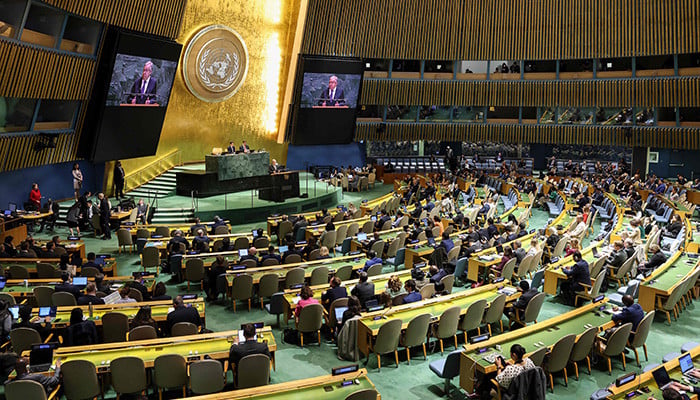
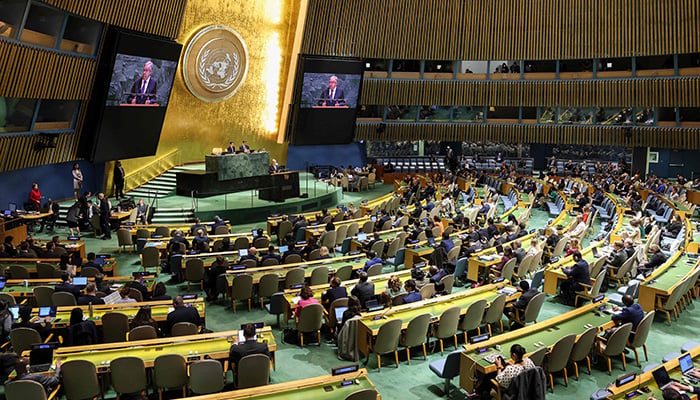
Signatories of the landmark nuclear non-proliferation treaty began a meeting Monday at the United Nations as fears of a renewed arms race escalate, with atomic powers again at loggerheads over safeguards.
In 2022, during the last review of the treaty considered the cornerstone of non-proliferation, UN Secretary-General Antonio Guterres warned humanity was “one misunderstanding, one miscalculation away from nuclear annihilation.”
On Monday, he warned “the drivers” of nuclear weapons proliferation were accelerating.
“For too long, the treaty has been eroding. Commitments remain unfulfilled. Trust and credibility are wearing thin. The drivers of proliferation are accelerating. We need to breathe life into the treaty once more,” Guterres said in opening remarks.
With global geopolitical friction only heightened since the last meeting, it was unclear what the gathering at UN headquarters could achieve.
France’s Foreign Minister Jean-Noel Barrot told signatories that “never has the risk of nuclear proliferation been so high, and the threat posed by Iran’s and North Korea’s programmes is intolerable for each and every state party to this treaty.”
Tempering expectations, Do Hung Viet, Vietnam’s UN ambassador and president of the conference, said: “We should not expect this conference to resolve the underlying strategic tensions of our time.”
“But a balanced outcome that reaffirms core commitments and set out practical steps forward would strengthen the integrity of the NPT,” he said.
“The success or failure of this conference will have implications way beyond these halls,” Viet added. “The prospects of a new nuclear arms race are looming over us.”
The nuclear non-proliferation treaty (NPT), signed by almost all countries on the planet — with notable exceptions including Israel, India and Pakistan — aims to prevent the spread of nuclear weapons, promote complete disarmament, and encourage cooperation on civilian nuclear projects.
The nine nuclear-armed states — Russia, the United States, France, the United Kingdom, China, India, Pakistan, Israel and North Korea — possessed 12,241 nuclear warheads in January 2025, the Stockholm International Peace Research Institute (Sipri) reported.
The US and Russia hold nearly 90% of nuclear weapons globally and have carried out major programs to modernise them in recent years, according to Sipri.
China has also rapidly increased its nuclear stockpile, Sipri said, with the G7 raising the alarm Friday over Moscow and Beijing boosting their nuclear capabilities.
US President Donald Trump has indicated his intention to conduct new nuclear tests, accusing others of doing so clandestinely.
In March, French President Emmanuel Macron announced a dramatic shift in nuclear deterrence, notably an increase in the atomic arsenal, currently numbering 290 warheads.
‘Affront’ to NPT
“It is obvious that trust is eroding, both inside and outside the NPT,” Seth Shelden of the International Campaign to Abolish Nuclear Weapons, a Nobel Peace Prize laureate, told AFP.
He questioned the likely outcome of the four-week summit.
Decisions on the NPT require agreement by consensus, with the previous two conferences failing to adopt final political declarations.
In 2015, the deadlock was largely due to opposition by Israel’s arch-ally Washington to creation of a nuclear-weapon-free zone in the Middle East.
A 2022 impasse was due mainly to Russian opposition to references to Ukraine’s nuclear power plant at Zaporizhzhia, occupied by Moscow.
This year’s summit could hit any number of stumbling blocks.
The ongoing war in Ukraine, Iran’s nuclear programme and the war there, proliferation fears and Pyongyang’s developing arsenal could all be deal-breakers.
The United States along with its allies Britain, the UAE and Australia spoke out at Iran’s appointment as a conference vice president.
Washington’s meeting envoy said conferring a leadership role on Tehran was an “affront” to countries that take the NPT “seriously.”
Artificial intelligence could be a prominent issue as some countries call for all sides to keep human control over nuclear weapons.

Oil prices edge higher as Trump weighs Iran’s latest proposal to open Hormuz

Political economy of power failure

‘The Voice’ star Dylan Carter died at 24: Cause of death revealed

-

 Sports1 week ago
NCAA men’s gymnastics championship: All-time winners list
-

 Sports1 week ago
WWE WrestleMania 42 Night 2: Live match results and analysis
-

 Politics7 days ago
UK’s Starmer seeks to deflect blame over Mandelson appointment
-

 Fashion1 week ago
UK’s Sosandar returns to profitability amid robust FY26 performance
-

 Entertainment1 week ago
Lee Anderson, Zarah Sultana kicked out of UK Parliament for calling PM ‘liar’
-
 Business1 week ago
How Trump’s psychedelics executive order could unlock stalled cannabis reform
-
 Business1 week ago
No fuel shortage: Govt assures 100% domestic LPG, PNG, CNG supply amid Hormuz energy crunch – The Times of India
-

 Sports1 week ago
Quetta Gladiators opt to bowl after winning toss against Peshawar Zalmi in PSL 11 clash