

Business
Deepening CPEC-II collaboration under China’s new Five-Year Plan | The Express Tribune


Pakistan stands to benefit from joint ventures in EV components, solar equipment & AI skill development
Shanghai Auto Show opens with bold message as China leads global electric vehicle race. PHOTO: SHANGHAI AUTO SHOW
KARACHI:
China’s economy is showing unmistakable signs of slowing in 2025, and the ripple effects are being felt across Asia. Its third-quarter GDP growth slipped to 4.8% from 5.2% in the previous quarter, marking the weakest pace in a year. Much of the drag stems from persistent structural weaknesses, particularly in the property market.
Real estate investment has declined 13.9% year-to-date as of September, while home prices in major cities continue to fall despite targeted stimulus measures. Consumer sentiment is subdued as retail sales have grown by just 3%, the lowest in a year, reflecting the cautious attitude of households facing job market uncertainty and shrinking wealth.
Deflationary pressures remain a concern, with producer and consumer prices both depressed, complicating Beijing’s efforts to stabilise demand.
Despite these difficulties, growth has averaged 5.2% during the first nine months of the year – enough for China to meet its annual target of around 5%. Exports have provided some support, though this strength is vulnerable to escalating tensions with the United States, including new tariffs, tighter restrictions on rare earth minerals and additional controls on the transfer of advanced technology.
These frictions signal a structural shift in the relationship between the world’s two largest economies rather than a temporary disruption. In response, policymakers in Beijing are easing monetary conditions, offering selective tax relief and considering interest rate cuts to lift consumption and private investment. At the same time, China is finalising a new Five-Year Plan that prioritises high-tech manufacturing, AI-driven innovation, productivity upgrades and greener industry, aiming to shift the economic model away from property-led growth. For Pakistan, China’s economic trajectory is not a distant macroeconomic development. It directly shapes trade flows, investment inflows, energy availability and industrial expansion. A further slowdown in China would have immediate consequences.
With bilateral trade touching $23.1 billion in 2024, weakening Chinese demand would hit Pakistan’s exports of cotton yarn, copper scrap, seafood, leather and semi-processed foods. This would worsen Pakistan’s already delicate trade deficit, which stood at $17.4 billion last year. Even if global commodity prices fall and offer some import relief, the loss of export earnings would outweigh the benefit.
A deeper Chinese slowdown would also cloud the outlook for CPEC — the backbone of Pakistan’s infrastructure and energy modernisation. China has financed power plants, transmission lines, motorways, ports and industrial zones.
If economic pressures force Beijing to scale back or delay overseas commitments, Pakistan could experience slower progress on Special Economic Zones, reduced momentum in Gwadar’s port and free zone development, postponement of energy upgrades, and delays in railway modernisation, including Main Line-1.
Domestic industries that are dependent on Chinese machinery and components, such as textiles, pharmaceuticals, construction, and renewable energy, could face increased costs or supply disruptions. Foreign exchange reserves would come under pressure as export receipts soften and project financing slows, complicating Pakistan’s efforts to stabilise inflation, interest rates and the exchange rate. In such a scenario, Pakistan would need to diversify export markets, attract investment from a broader pool of countries and push ahead with overdue structural reforms to build resilience.
However, if China succeeds in stabilising growth around the 5% mark, the outlook for Pakistan will become considerably more favourable. Stable Chinese demand would support Pakistan’s industrial and agricultural exports, helping maintain a more manageable trade balance and providing predictability for businesses engaged in cross-border commerce. Crucially, steady economic conditions in China would help sustain momentum under CPEC. Ongoing projects in transport infrastructure, grid modernisation, renewable energy and industrial zones could proceed without major delays. Improvements in logistics and energy availability would strengthen Pakistan’s productive capacity and competitiveness.
China’s incoming Five-Year Plan, with its focus on “new quality productive forces” such as artificial intelligence, robotics, electric mobility and green technologies, offers opportunities for deeper collaboration under CPEC phase-II. Pakistan stands to benefit from joint ventures in electric vehicle components, solar equipment, battery assembly, AI skill development, agri-tech and smart manufacturing. Such cooperation could accelerate the country’s transition towards a higher value-added and innovation-oriented economy.
Stable Chinese investment and predictable financing flows would also support Pakistan’s macroeconomic stability, helping improve investor confidence and giving policymakers greater space to pursue long-term reforms rather than crisis management.
China’s economic performance in 2025 is, therefore, pivotal not only for Beijing but also for Islamabad. A sharper slowdown would test Pakistan’s resilience and force difficult adjustments, while a stable China would offer space to consolidate growth, modernise industry and deepen technological cooperation.
The coming months will determine whether Pakistan must brace for external headwinds or position itself to benefit from new opportunities emerging in China’s evolving economic landscape.
The writer is a Mechanical Engineer and is pursuing a Master’s degree








Business
Rs 20,000 crore gold, silver rush: What will people buy this Akshaya Tritiya? – The Times of India
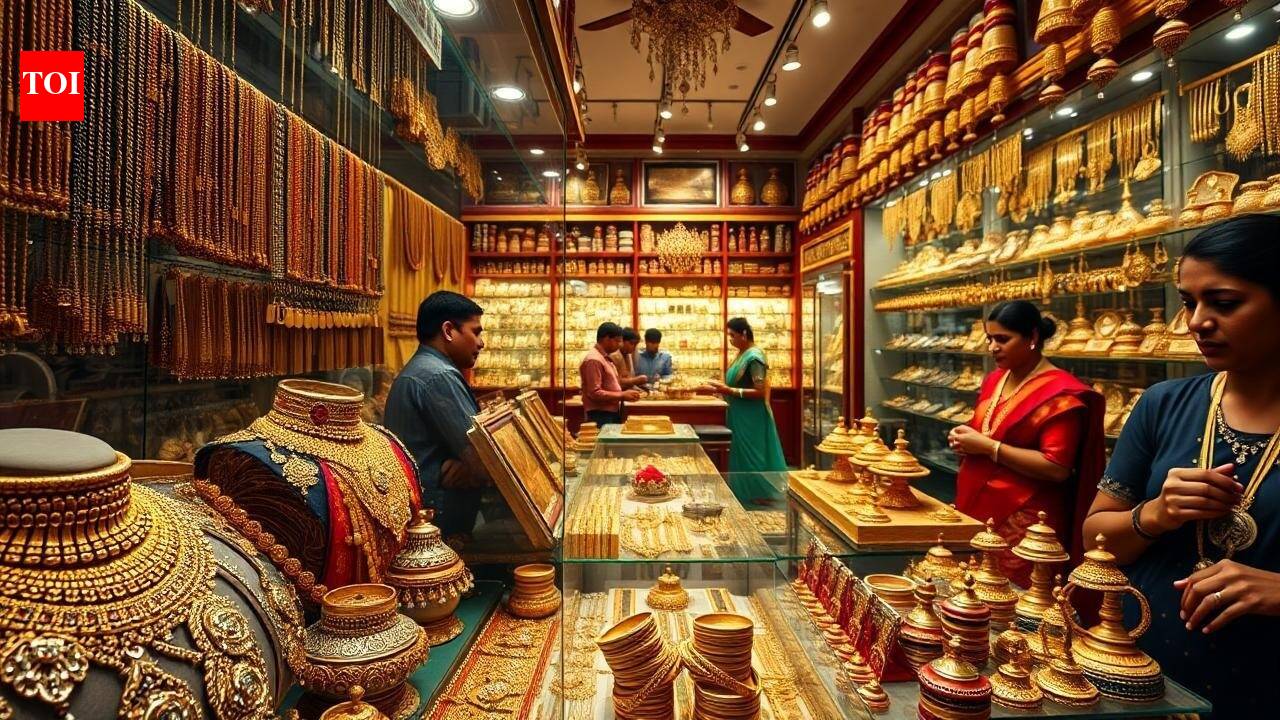
This Akshaya Tritiya, India’s gold and silver markets are heading for bumper purchases, with overall trade likely to cross Rs 20,000 crore even as record-high prices reshape buying patterns. The estimate, shared by the Confederation of All India Traders (CAIT), is higher than last year’s Rs 16,000 crore, signalling growth in value despite a sharp rise in bullion rates.Prices for the yellow metal have surged sharply over the past year, going from Rs 1,00,000 per 10 grams, to Rs 1.58 lakh. Meanwhile, silver has shown a steeper rally, jumping from Rs 85,000 per kilogram to Rs 2.55 lakh per kilogram. According to CAIT, this sharp escalation has not weakened demand, but is instead prompting consumers to make more deliberate and value-oriented purchases.Praveen Khandelwal, member of parliament from Chandni Chowk and secretary general of CAIT told ANI, “Akshaya Tritiya has traditionally been one of India’s most auspicious occasions for purchasing gold… While gold continues to dominate, the nature of purchasing is evolving significantly in response to steep price escalation.”Commenting on customer preference, CAIT national president BC Bhartia highlighted, “There is a clear shift towards lightweight, wearable jewellery, alongside a stronger focus on silver and diamond products. Attractive incentives such as reduced making charges and complimentary gold coins are also helping sustain consumer interest.”Despite the increase in overall trade value, the quantity of metals being sold tells a different story. Pankaj Arora, National President of the All India Jewellers and Goldsmith Federation (AIJGF), an associate of CAIT, explained that the projected Rs 16,000 crore gold trade amounts to nearly 10,000 kilograms (10 tonnes) at current rates. The value, spread across an estimated 2 to 4 lakh jewellers, translates to average sales of only 25 to 50 grams per jeweller, “clearly indicating a sharp decline in volume”.Meanwhile for silver, the estimated Rs 4,000 crore trade corresponds to around 1,56,800 kilograms (157 tonnes), resulting in average sales of about 400 to 800 grams per jeweller during the festival period. “These figures underline a critical shift: while the value of business is expanding due to rising prices, actual consumption is contracting,” Khandelwal said.This gap between value and volume is also reshaping consumer’s buying pattern, with smaller items and lightweight jewellery gaining popularity. At the same time, jewellers are facing challenges due to fluctuating prices, especially when it comes to managing inventory.Even so, festive demand remains steady, with markets witnessing healthy footfall. “Consumers are now adopting a more cautious and pragmatic approach, balancing traditional beliefs with financial discipline,” Khandelwal added.At the same time, it’s not just about physical gold anymore as consumers are increasingly exploring alternatives like digital gold, Sovereign Gold Bonds and gold ETFs, drawn by the promise of liquidity, safety and flexibility when prices are volatile.CAIT and AIJGF have urged jewellers to comply with mandatory hallmarking standards, including HUID certification, and advised buyers to verify the purity and authenticity of their purchases.

Lauren Elcock is among the young Londoners who say rising rents are forcing them to quit the capital.
Source link

As governments across the world restricted the movements of their citizens during Covid lockdowns from 2020, people spent more time online. We bought more online and socialised more online, and this brought us closer to the people who want to scam us. At the same time, realistic video impersonations, voices, websites, and texts became more commonplace, and scammers increased their use of social media including WhatsApp.

Rs 20,000 crore gold, silver rush: What will people buy this Akshaya Tritiya? – The Times of India

Prince Harry corrects blunder before peace with King Charles suffers again
The cost of rising rents: Working four jobs and pushed on to benefits

-

 Entertainment6 days ago
Palace left in shock as Prince William cancels grand ceremony
-

 Sports6 days ago
The case for Man United’s Fernandes as Premier League’s best
-

 Politics1 week ago
Chinese, Taiwanese will unite, Xi tells Taiwan opposition leader
-

 Entertainment1 week ago
Dua Lipa hits major career high ahead of wedding with Callum Turner
-
 Business1 week ago
100% road tax waiver for electric cars, new rules for 2, 3 and 4 wheelers – what Delhi govt’s draft EV policy says – The Times of India
-
 Business6 days ago
UK could adopt EU single market rules under new legislation
-
 Business1 week ago
The FAA wants gamers to apply for air traffic control jobs
-

 Fashion6 days ago
Energy emerges as biggest cost driver in textile margins