

Business
With Trump’s tax bill set to dent giving by the wealthy, can middle-class donors make up the difference?


A woman puts money into a Salvation Army red kettle outside of Giant Supermarket in Alexandria, Virginia on November 22, 2023.
Eric Lee | The Washington Post | Getty Images
A version of this article first appeared in CNBC’s Inside Wealth newsletter with Robert Frank, a weekly guide to the high-net-worth investor and consumer. Sign up to receive future editions, straight to your inbox.
New tax laws risk reducing charitable giving by the wealthy next year, economists and academic experts say, leaving less-wealthy Americans to make up the difference.
Under President Donald Trump’s “big beautiful bill,” signed into law in July, several tax benefits for wealthy donors will be reduced. Top earners will also have their effective tax benefit cut from 37% to 35%. The Indiana University Lilly Family School of Philanthropy estimates this cap alone will reduce giving by $4.1 billion to approximately $6.1 billion annually.
In addition, the bill also limits tax incentives for itemizers, who will only be able to deduct donations in excess of 0.5% of their adjusted gross income.
At the same time, the bill also creates new incentives for middle- and lower-income filers to give. Starting next year, roughly 140 million taxpayers who do not itemize will still be able to deduct up to $1,000 in cash donations per filer. About 90% of taxpayers take the standard deduction since it was raised in 2017 during the first Trump administration.
While the tax changes may help broaden the base of giving, making it less dependent on the ultra-wealthy, experts are skeptical that the math will balance out.
Elena Patel, co-director of the Urban-Brookings Tax Policy Center, told Inside Wealth she is not optimistic that middle- and lower-income donors will be able to make up the shortfall as top earners give less.
“The nonprofit sector says that every dollar matters, and so incentivizing small donations from every household could have a meaningful impact for certain kinds of organizations. But the truth is that those kinds of contributions, however, just are not the bulk of charitable giving in the charitable sector,” she said. “That 2-percentage-point reduction [for top earners] might not seem like a big deal, but you have to keep in mind the scale of gifts that are being given among the highest-net-worth individuals in the United States.”
What the ‘K-shaped’ economy means for philanthropy
Charitable giving by American households continues to rise, reaching $392.45 billion last year, per the latest report by the Lilly School of Philanthropy for Giving USA. That’s up 52% since 2014.
But while donations are increasing, fewer Americans are giving as wealthy donors make up an increasing share of philanthropy, according to the university’s research.
Amir Pasic, dean of the Lilly School of Philanthropy, said incentivizing Americans of all income levels to donate is valuable in and of itself.
“We’ve had this general problem of dollars going up but the number of donors going down. This is a positive development because this could really increase the number of donors,” he said.
However, Pasic said, financial stress has limited everyday donors’ ability to give, while wealthier ones have been donating more. The share of Americans who donate dropped from 66.2% to 45.8% between 2000 and 2020, according to the university’s research.
“Economic uncertainty is always worrisome for people’s giving planning,” Pasic said.
This lopsided, or “K-shaped,” economy shows signs of getting worse amid tariff hikes and inflation. Lower- and middle-income consumers are spending less on everything from McDonald’s burgers to flights, while wealthier Americans flex their spending power.
Will the new deduction move the needle?
Economist Daniel Hungerman said he questions whether the new deduction would spur a substantial number of donations or mainly reward taxpayers who would have given anyway.
While the new deduction is larger, at $1,000 per single filer and $2,000 for married joint filers, a similar legislative effort in the ’80s failed to move the needle on charitable giving, he said. A temporary $300 deduction in 2020 spurred by the Covid pandemic only increased charitable donations by 5%, according to the Tax Foundation.
Trump’s tax bill also permanently raises the standard deduction, which significantly dampens charitable giving, Hungerman said. His study estimated that the higher deduction led to a permanent annual drop of $16 billion after the 2017 reforms.
However, raising the cap on the federal deduction for state and local taxes (better known as SALT) may provide some relief, he said. More taxpayers in high-cost states will benefit from itemizing, which encourages donations.
Hungerman said encouraging everyday donors to get in the habit of giving now could lead to higher levels of donating later if they increase their wealth.
“Maybe what is even more compelling to me is the long game, if we can send a message that everybody should give like this, and we change some of these people’s giving behavior,” he said. “Somewhere out there is the Bill Gates of tomorrow.”
What donors can do now
Currently, taxpayers who plan to take the standard deduction would benefit from waiting until 2026 to make donations. However, itemizers and high-income donors will get more bang for their buck by giving before the end of the year.
Robert Westley, senior vice president and regional wealth advisor at Northern Trust, said he is recommending that clients accelerate their donations to this year if they were planning to donate over the next four years.
Filers can only deduct up to 60% of their adjusted gross income for cash donations to public charities per year. The percentage drops to 30% for contributions of long-term appreciated assets like stock or real estate.
However, taxpayers can generally carry forward excess deductions over five years, he said. Still, it’s unclear how much bang they will get for their buck as the IRS has yet to specify whether excess deductions will be subject to the new floor and ceiling on charitable deductions, according to Westley.
For donors who want to give more now but are unsure of how to do so, he said he suggests giving to a donor-advised fund, or DAF. With a DAF, donors get an upfront deduction but can wait to allocate those funds to specific charities. For donors wanting to offload appreciated assets, it is much simpler to donate stock to a DAF than directly to a nonprofit.
Given this year’s stock run up, Westley said many of his clients are looking to donate appreciated stock, especially in tech, to offset gains as well as rebalance their portfolios.
“Their equities have appreciated, and some of them might now represent a higher percentage of the portfolio than their target asset allocation,” he said. “When you donate those risk assets to charity, you get the tax benefit, you don’t realize the gain, and when it’s done you’ve lowered your risk-asset allocation.”
Lawyers and tax planners are still waiting for guidance from the IRS on a bevy of issues stemming from the changes. For instance, it’s still unclear whether deductions will be capped for non-grantor trusts that make charitable donations, according to Westley.
But high-income donors still have many tools at their disposal, he said. Top earners who are 73 and older can effectively reduce their taxable income dollar-for-dollar by giving their required minimum distributions from an IRA to charity.
Westley said this tactic is popular among his retirement-age clients and likely to become even more so with the raised SALT cap. Filers can lower their income to qualify for the enhanced SALT deduction, which maxes out at $40,000 for taxpayers with incomes of $500,000 or less.
“You’re not even dealing with any of the itemized deduction rules,” he said. “There’s no ceiling on the tax benefit and there’s no floor or hurdle to get over for the deduction.”









Business
Fundamental shift from savers to investors: What Indian households are doing with their money? – The Times of India

For years, Indian families have saved in gold, stored cash, and put money in tangible assets to safeguard their future. But now, there’s a noticeable shift is visible as more Indian households are moving away from old saving ways and putting their money to work through investments.India’s total household wealth, by the end of FY25, stood at Rs 1,300-1,400 lakh crore. Of this, investable financial assets stand at almost 35% of the total, growing at nearly 17% over the past five years, according to a recent Bain–Groww report, titled How India Invests.
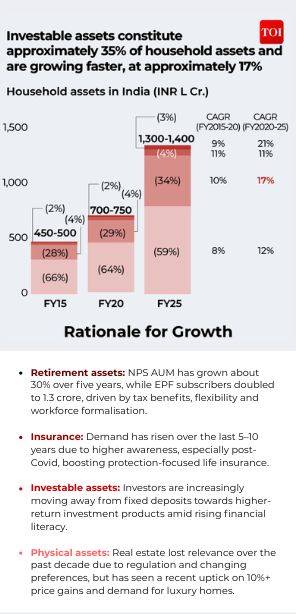
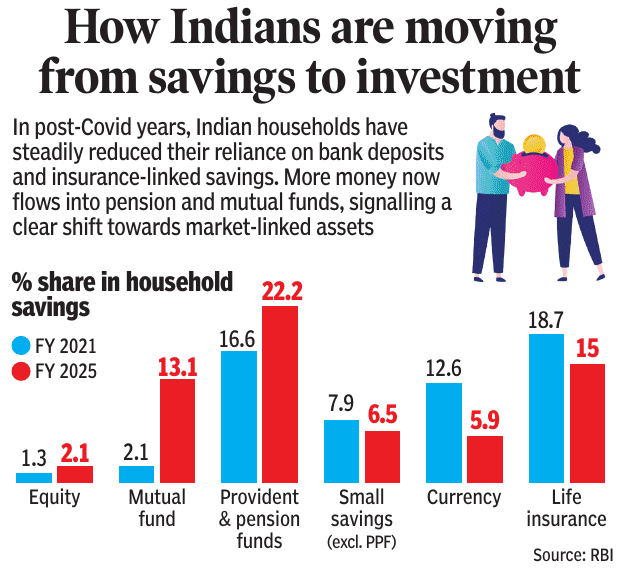
Household wealth has gone through a shift since the Covid era. Indians have moved from traditional fixed deposits toward market-linked instruments like mutual funds, pension funds and listed equities, which are growing at a fast rate, far outpacing deposits growth.Over the last five years, individual investor base in the country has expanded sharply, going from around 3 crore investors in 2019 to over 12 crore by 2025, according to the Market Pulse December 2025 report by the National Stock Exchange of India (NSE), India. In 2025 alone, households invested a whopping Rs 4.5 lakh crore into equity markets, both directly and indirectly through mutual funds. This, pushed the overall household investment in equities since 2020 to around Rs 17 lakh crore. In FY25, mutual fund assets under management (AUM) held by individuals reached Rs 41 lakh crore, driven by double participation by households, going from 5–6% to 10–11%, and increasing popularity of systematic investment plans (SIPs).According to RBI data, equity formed 1.3% of household savings in FY2021, but its share increased to 2.1% by FY2025. Similarly, mutual funds recorded a significant jump over the same period, with their share rising sharply from 2.1% to 13.1%. Contributions to provident and pension funds also grew, increasing from 16.6% in FY2021 to 22.2% in FY2025.In contrast, traditional savings instruments saw a decline. Small savings, excluding PPF, fell from 7.9% to 6.5%, while the share of currency in household savings dropped steeply from 12.6% to 5.9%. Life insurance also witnessed a reduction, with its share slipping from 18.7% in FY2021 to 15% in FY2025.Gradually, households reduced their dependence on bank deposits and insurance-based savings. Instead, investments in pension schemes and mutual funds have gathered pace, pointing to a broader shift towards market-linked financial products.
Mutual funds, stocks, SIPs: Who is choosing what?
Salaried households show a clear preference for mutual funds, particularly through SIPs, reflecting a tilt toward disciplined, professionally managed investing aligned with long-term financial goals, according to the Bain report. In contrast, business owners display a stronger inclination toward direct equity investments, marked by higher trading frequency and a greater appetite for risk. Within mutual funds, SIPs remain the dominant entry route, while lump-sum investments are steadily gaining traction as investors mature, build market confidence, and increase their risk tolerance.
Interest in investing spiked after Covid?
Covid didn’t just change daily life, it changed how Indians invest. Retail participation in the stock market rose sharply after the pandemic, driven by a mix of high liquidity, lower household spending during lockdowns and the flexibility of work-from-home, Rohit Shah, Certified Financial Planner and founder of Getting You Rich told TOI. Shweta Rajani, head of mutual funds at Anand Rathi Wealth Limited, pointed out that mutual funds made up only 4–5% of household financial assets between FY15 and FY20, but this share nearly doubled from around 5% in FY20 to close to 10% by FY25. At the same time, direct equity investments also grew sharply, rising from about 4% of household assets in FY20 to around 9% by FY25. “Together, these shifts indicate a clear move away from traditional savings instruments towards market-linked investments, indicating investors are comfortable with equity as an asset,” the expert added.Meanwhile, Nirav Karkera, head of research at Fisdom believes that Covid acted more as an accelerator than a starting point as the shift had already begun after demonetisation. The switch made Indians comfortable with digital payments and later with digital investing. By the time the pandemic arrived, systems such as Aadhaar-based KYC, easy online transactions and awareness campaigns like Mutual Fund Sahi Hai had removed most barriers. “When the pandemic hit, investors suddenly had the time and urgency to reflect on their personal finances. More importantly, the infrastructure to execute decisions with almost zero friction already existed. Willingness, ability and accessibility came together and translated into action. The sharp and mostly linear market recovery that followed further strengthened confidence, pulled in fence-sitters and accelerated the broader financialisation of household assets that was underway,” Nirav added.
Change in India’s risk appetite
India’s shift from saving to investing is being driven less by thrill-seeking and more by necessity, experts said. Traditional savings instruments are increasingly failing to protect wealth, as post-tax returns often fall below inflation, steadily eroding purchasing power. “What looks like rising risk appetite is partly a change in the understanding of risk itself,” said Karkera, adding that investors now see the risk of staying idle and falling behind as greater than the risk of market volatility. This shift has been reinforced by deeper financial awareness, easier access to investing through fintech platforms, and stronger regulation, said Rajani. The expert further noted that SIPs, simplified KYC and digital onboarding have lowered entry barriers, while a generational change is reshaping attitudes, older investors prioritised capital preservation, but younger earners, facing higher inflation and lower real interest rates, are more focused on long-term wealth creation using growth assets. However Shah cautioned that rising participation does not always mean better risk management. “Four structural factors drive this shift: financial literacy campaigns, fintech accessibility reducing entry barriers, higher equity allocations in mutual fund inflows, and rising per capita incomes. Yet risk appetite may be overstated. Data on retail trading patterns shows concentration in speculative segments, suggesting investors confuse market participation with risk management. Many haven’t weathered a bear market, leading to underestimation of downside volatility,” Shah told TOI.
Here’s what is driving the investors:
A combination of demographic change, regulatory support, digital access and strong market returns has accelerated India’s move from traditional savings to investing.

Demographic changesYounger investors are driving India’s shift from traditional savings to investing, with NSE data showing that more than half newly registered investors are below 30. At the same time, women are steadily increasing their presence in financial markets. As of November 2025, women account for nearly a quarter of India’s investor base, with their share in the NSE’s individual investor pool remaining stable at almost 24%.Digital transformationDigital platforms have emerged as the main entry point for retail investors in the country, with almost 80% of direct equity investors and around 35% of mutual fund investors investing through digital channels. According to the Bain report, driven by app-based onboarding, paperless KYC and fintech-led distribution, platforms such as Groww, Zerodha and Upstox have simplified investing, brought in millions of first-time investors, and together account for almost 80% of India’s retail equity investor base.Going beyond metro citiesInvestment activity is increasingly coming from smaller cities. Around 55–60% of new SIP registrations now originate from B30 cities, highlighting the growing role of Tier-2 and Tier-3 regions in driving mutual fund growth.Rising financial literacy and awarenessThe spread of regional and digital financial content across YouTube, Instagram and fintech platforms has made investing concepts more accessible. Regulatory awareness campaigns by AMFI — including “Mutual Funds Sahi Hai” and “Bharat Nivesh Yatra” — have further boosted investor education.Market performance reinforcing trustSustained returns have strengthened long-term investor confidence. The Nifty 50 and Sensex delivered 10–15% returns over the last decade, while equity-oriented mutual funds have significantly outperformed traditional fixed deposits over the past five years.
Women and GenZ hit investment markets
GenZYounger investors are emerging as key drivers of the shift from traditional savings to investment. Data from the NSE shows that more than half, almost 56%, of newly registered investors are below 30. Mutual fund trends also reflected this shift, with 55% of investors under 40 and the 20–30 age group emerging as the fastest-growing segment in the top 100 cities.Comparing the contribution of GenZ and millennials, Rohit Shah said that according to the data, both cohorts contribute meaningfully, but with distinct patterns.“GenZ dominates app-based trading volumes due to digital nativity and lower capital requirements. Millennials drive mutual fund and long-term investments through larger disposable incomes and established goals.” He further added, after the market expansion happening after the pandemic, benefited both simultaneously, “making it difficult to isolate one generation as the primary driver. The real story lies in democratization across age groups, not generational dominance.The equity shift is broad-based across age groups according to AMFI’s age-wise distribution of individual investor AUM. Gen Z investors (under 25 years) have allocated nearly 65% of their assets to equity, Rajani told TOI. Millennials (25–44 years), meanwhile, “show the highest equity allocation at approximately 75.5%, and importantly, even investors above 58 years of age maintain a meaningful equity allocation of around 54%”Nirav Karkera, head of research at Fisdom, highlighted a different approach, saying that while millennials currently lead the equity surge, the baton is likely to pass to Gen Z in the coming years. “Gen Z is still in the early stage of their earning life, where consumption tends to dominate. At the same time, they are arguably the most financially aware generation we have seen. They understand the language of money much earlier than millennials did at their age. Once their incomes rise and they have surplus capital, they are likely to play an even bigger role than millennials in shaping investment patterns. For now, millennials are doing the heavy lifting, but the baton looks set to pass smoothly to Gen Z.”WomenAs of November 2025, women account for nearly a quarter of India’s investor base, highlighting their growing presence in financial markets. Data from NSE shows that over the corresponding period, women’s share in the individual investor base has remained stable at 24.7% over the corresponding period. Among the top five states by registered investors, Maharashtra leads with women comprising 28.8% of its investor pool, up from 25.6% in FY23, followed closely by Gujarat at 28.1% (26.6% in FY23). In contrast, Uttar Pradesh, despite being the second-largest state by investor count, continues to lag, with women forming 18.9% of investors, though this marks an improvement from 16.9% in FY23.Encouragingly, nearly 53% of Indian states now report female investor participation above the national average, compared to 44% in FY23. Smaller regions are emerging as frontrunners in gender inclusion, with Goa (33.1%), Mizoram (32.4%), Chandigarh (32.2%), Sikkim (31.1%) and Delhi (30.9%) leading the way – reflecting rising financial awareness, greater workforce participation, and improved access to investment avenues among women. Mutual funds also saw rising participation from women, particularly in B30 cities, where the share of women investors climbed from 20% to 25% over the past five years. In the top 30 cities, women now make up nearly 35% of mutual fund investors as of FY25, accompanied by a sharper rise in average MF folio sizes between FY19 and FY24.
Short-term or long-term: Where are Indians putting their money?
Indian investors are participating across both short-term trading and long-term wealth building, but experts say the balance is slowly tilting toward the latter. In the immediate post-Covid phase, many first-time investors entered markets with speculative intent. However, that period helped break psychological barriers. “Once investors experienced volatility firsthand rather than hearing about it abstractly, they started building familiarity, confidence and a basic understanding of market behaviour,” said Karkera, adding that the early rush acted as a gateway to more mature participation.Rajani told TOI that the trend is driven by long term objectives rather than short term. The expert pointed to AMFI’s SIP holding-period analysis, which shows that the share of SIP assets held for over five years has jumped from 11% to 29% in the past five years, while investments held for less than a year have fallen sharply from 41% to 23%.Meanwhile Shah said that even though “retail trading volumes have grown exponentially—NSE data shows consistent month-on-month increases in F&O participation. Simultaneously, mutual fund SIP adoption remains strong, but it’s overshadowed by trading activity. With fixed deposit yields compressed by falling interest rates, investors are chasing equity returns without corresponding time horizons. The evidence suggests a bifurcation: disciplined SIP investors versus growing trading populations driven by short-term performance metrics.”
Are there any risks for the investment express?
Shah warned that many new investors entered the market during a long bull run, and historically, market corrections of 30–50% happen every 7–10 years. Therefore, a prolonged downturn could lead to panic selling, especially among first-time investors with little experience of market volatility. Meanwhile, in the short term, market ups and downs may push some investors to move money into safer options like debt funds. Investors also tend to chase assets that have done well recently, such as gold and silver. However, Rajani pointed out that these shifts are temporary and not a fundamental change. “Over the long term, the broader trend toward equity investing is expected to continue as investors looking for inflation-beating returns to meet long-term financial goals.”Karkera also highlighted that even though risks remain, they are manageable. He noted that lower equity returns or bouts of market volatility could cause short-term, speculative investors to step back, and better performance in fixed-income or real assets may temporarily pull some money away from equities. However, the larger shift is firmly in place thanks to improved investor awareness, growing digital access. “Growth may pause or plateau intermittently, but the long-term trajectory of retail participation still feels upward.”
Still room to grow
Despite the rapid shift, India continues to lag developed markets. Mutual funds and equities account for just 15–20% of household investable assets, compared with 50–60% in countries like the US and Canada, highlighting significant headroom for future growth.As the Bain report notes: Over the next decade, mutual fund AUM is projected to cross Rs 300 lakh crore, while direct equity holdings could approach Rs 250 lakh crore, supported by deeper penetration in tier-2 and tier-3 cities, regulatory reforms and investor education initiatives.
Business
Green energy exports: $10-bn green ammonia project positions India as global clean-fuel supplier; Kakinada plant nears key milestone – The Times of India

A $10-billion green hydrogen and green ammonia project at Kakinada in Andhra Pradesh is set to cross a major construction milestone, reinforcing India’s ambition to emerge as a global supplier of clean energy to markets such as Germany, Japan and Singapore.The first major equipment erection ceremony of AM Green’s Green Hydrogen and Green Ammonia Complex will be held on January 17 and will be attended by Chief Minister N Chandrababu Naidu and Deputy Chief Minister Konidala Pawan Kalyan, state government officials said, PTI reported.Billed as one of the largest clean-energy investments in India to date, the project involves a total outlay of $10 billion and is expected to generate up to 8,000 jobs during the construction phase, besides substantial high-skill employment during operations and across allied sectors including renewable energy, logistics, storage and port services.AM Green is developing India’s first and the world’s largest green ammonia complex at Kakinada, with a planned capacity of 1.5 million tonnes per annum, through the brownfield conversion of an existing ammonia-urea facility. The project will be commissioned in phases, beginning with 0.5 million tonnes per annum by 2027, scaling up to 1 million tonnes by 2028 and reaching full capacity by 2030.Once operational, the facility will enable India’s first exports of green ammonia, which is increasingly being adopted globally as a clean shipping fuel, for power generation and as a carrier for green hydrogen.The integrated project spans 7.5 gigawatts of solar and wind capacity, 1,950 megawatts of electrolyser capacity and 2 gigawatts of round-the-clock renewable power, supported by pumped hydro storage, including India’s first such facility at Pinnapuram in Andhra Pradesh.AM Green has already signed long-term supply agreements with Germany-based utility Uniper and is in advanced discussions with potential buyers in Japan and Singapore, establishing India’s first green-energy export linkages with Europe and advanced Asian economies.The project is aligned with Andhra Pradesh’s Integrated Clean Energy Policy, 2024, which seeks to position the state as India’s primary hub for green hydrogen and green ammonia. Once fully commissioned, the facility is expected to mark a structural shift from energy import dependence towards clean-energy exports, placing Andhra Pradesh at the centre of the global green-energy value chain.AM Green, backed by the founders of the Greenko Group, is developing the project through AM Green Ammonia, a partnership involving Malaysia-based Gentari, Singapore’s sovereign wealth fund GIC and the Abu Dhabi Investment Authority. Construction at the Kakinada site is already under way, placing it among a limited set of large-scale green ammonia facilities globally that meet Renewable Fuels of Non-Biological Origin (RFNBO) standards.Beyond production, the project showcases an end-to-end clean-energy ecosystem within a single state, encompassing large-scale renewable generation, round-the-clock green power backed by storage, hydrogen and ammonia production, and port-based export infrastructure.AM Green has also moved to strengthen global linkages. In May last year, it announced a partnership with the Port of Rotterdam Authority to create a dedicated green-fuel corridor linking India with north-western Europe, aimed at enabling annual trade of up to 1 million tonnes of green fuels valued at nearly $1 billion. Earlier, it tied up with global logistics firm DP World to develop green fuel storage and export facilities in India and overseas.“This is not merely an industrial project, but a strategic step in positioning Andhra Pradesh and India as leaders in clean-energy exports and climate action,” the state government said.
Business
Budget 2026 Should Support MSMEs, Critical Minerals For Boosting Trade Resilience: Deloitte

Last Updated:
Deloitte India urges FY27 Budget to boost MSME support and critical mineral security, job protection and advancing India’s global manufacturing and clean energy goals.



Budget 2026 Expectations.
Budget 2026: Deloitte India has pitched a sharper focus on MSME support and critical mineral security in the FY27 Union Budget, arguing that these measures are essential to strengthen India’s trade resilience and reduce external vulnerabilities amid rising global uncertainty.
In its Budget expectations note, Deloitte India said micro, small and medium enterprises play a pivotal role in the economy, accounting for nearly 46% of India’s exports and emerging as the second-largest employer after agriculture. According to the firm, easing financial and compliance-related pressures on MSMEs would help them cope with global volatility, sustain production and remain competitive in overseas markets.
The Union Budget 2026-27 will be tabled on Sunday, February 1.
“Strengthening MSMEs will safeguard jobs and drive inclusive economic growth, boost rural incomes and support India’s ambition to become a global manufacturing hub,” Deloitte said.
The firm recommended measures such as enhanced export credit availability, concessional financing and simplified digital compliance systems to reduce the regulatory burden on small businesses. It also called for comprehensive training programmes to improve last-mile competitiveness of MSMEs, particularly those linked to global value chains.
Deloitte further suggested targeted export incentives or enhanced duty drawback support for tariff-sensitive sectors such as ready-made garments, gems and jewellery, and leather, which are more vulnerable to global trade disruptions.
Highlighting the risks from an increasingly protectionist global environment, Deloitte Economist Rumki Majumdar said rising uncertainty from tariff hikes, changes in rules of origin and non-tariff barriers could disproportionately affect Indian exporters. While the direct impact of global trade frictions on GDP growth may be limited to 40-80 basis points, the spillover effects on MSMEs and employment could be far more severe.
“MSMEs contribute 30.1 per cent to GDP, account for 45.79 per cent of India’s exports and employ nearly 290 million people; disruptions in export markets or tightening trade rules pose serious risks to jobs and income stability,” Majumdar said.
Beyond MSMEs, Deloitte emphasised the need for a strategic push on critical minerals to secure supply chains and support India’s clean energy transition. It proposed setting up a dedicated critical minerals fund to finance overseas acquisitions and technology partnerships, ensuring long-term access to essential resources.
The firm also recommended deeper global collaboration with regions such as Africa, Australia and Latin America to secure upstream access to minerals, alongside joint research and development in mineral processing and recycling. In addition, it called for incentives to promote investments in renewable energy, green hydrogen and grid-scale energy storage.
Deloitte said expanded funding for exploration, extraction and processing of key critical minerals, including lithium, cobalt and rare earth magnets, would be crucial to reduce import dependence and strengthen India’s strategic and economic security in the years ahead.
 Click here to add News18 as your preferred news source on Google.
January 16, 2026, 15:02 IST
Read More


H&M India unveils official Lollapalooza India 2026 collection
Fundamental shift from savers to investors: What Indian households are doing with their money? – The Times of India
Green energy exports: $10-bn green ammonia project positions India as global clean-fuel supplier; Kakinada plant nears key milestone – The Times of India

-

 Politics1 week ago
UK says provided assistance in US-led tanker seizure
-

 Entertainment1 week ago
Does new US food pyramid put too much steak on your plate?
-

 Entertainment1 week ago
Why did Nick Reiner’s lawyer Alan Jackson withdraw from case?
-

 Sports5 days ago
Clock is ticking for Frank at Spurs, with dwindling evidence he deserves extra time
-
 Business1 week ago
Trump moves to ban home purchases by institutional investors
-

 Sports1 week ago
PGA of America CEO steps down after one year to take care of mother and mother-in-law
-

 Tech3 days ago
New Proposed Legislation Would Let Self-Driving Cars Operate in New York State
-
 Business1 week ago
Bulls dominate as KSE-100 breaks past 186,000 mark – SUCH TV