

Entertainment
Power outages, waterlogging persist as Karachi reels after torrential rains

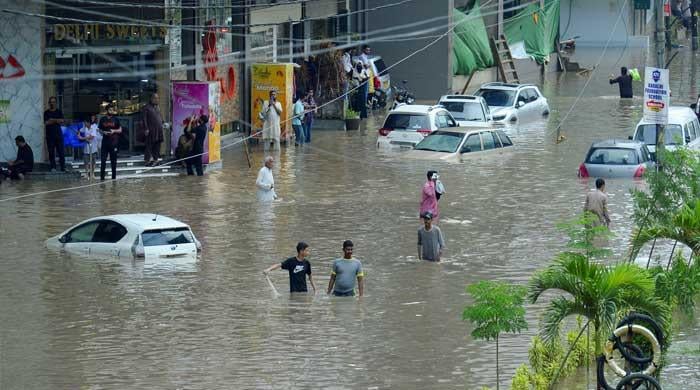
A day after heavy showers triggered urban flooding in Karachi and left at least 10 people dead, large parts of the metropolis remain without electricity, while waterlogging continues to disrupt life on major roads amid forecast of more torrential rains.
Power supply has yet to be restored in several neighbourhoods, including Gulistan-e-Jauhar Blocks 7, 13, and 18, Mehmoodabad, Akhtar Colony, Manzoor Colony, Defence View, and Malir Alamgir Society—despite more than 16 hours having passed since the downpour subsided.
K-Electric, the city’s sole power utility, said in a statement that its field teams remained actively engaged throughout the spell and that feeders were switched off only where safety precautions demanded.
“Restoration efforts continued undeterred despite significant waterlogging and congestion. Areas with high levels of stagnant water, particularly low-lying zones, were particularly affected due to restricted access and safety risks for residents and field teams,” the utility said.
Meanwhile, rainwater has yet to be fully drained from several major roads, including Tower, II Chundrigar Road, the FTC area, the PAF Museum on Sharea Faisal, and Safoora on University Road.
Water has also accumulated in Karachi’s Red Zone, Shaheen Complex, MR Kayani Road near the Arts Council, and Ziauddin Ahmed Road. As a result, one track of Dr Ziauddin Ahmed Road has remained closed to traffic since yesterday, while the Drigh Road and Nazimabad underpasses also remain shut.
Moreover, the Aiwan-e-Sadr Road near the Governor House is submerged with rainwater up to the police lines. Other affected areas include Kharadar, MA Jinnah Road, Bolton Market, and Jamia Sindh Madrasatul Islam.
‘Main roads largely cleared’
Speaking to Geo News, Karachi Mayor Murtaza Wahab said that while main roads had largely been cleared after the rains, drainage work was still underway in several waterlogged areas.
“Drainage efforts are continuing where rainwater has accumulated,” he said, noting that the city received over 235mm of rainfall—far exceeding its drainage capacity of just 40mm.
Wahab said that 3.024 million cubic feet of debris had so far been removed from storm drains, improving water flow and easing drainage across the city.
He acknowledged shortcomings in the drainage system but stressed the need for long-term solutions. “Basic steps are needed to expand drainage capacity, but this requires land and faces resistance from residents, making the task difficult,” the mayor said.
“Traffic is moving, but slows down where water remains on the sides of roads. Overall, the situation has improved compared to earlier in the day,” he added.
The mayor also confirmed receiving complaints about power outages in multiple neighbourhoods.
Over 550 feeders disrupted
Electricity supply has been disrupted to more than 550 feeders across the city, with some areas experiencing blackouts for up to 16 hours.
A K-Electric spokesperson said that power is currently being supplied through more than 1,550 of the city’s 2,100 feeders. The spokesperson explained that heavy rain had left many roads submerged, disrupting fuel deliveries and hampering access for repair teams.
However, residents told Geo News that several hours had passed since the rain stopped, yet no K-Electric teams had arrived to restore supply in their areas, leaving citizens distressed and helpless.
More torrential rains
According to the Met Office, strong monsoon currents from the Arabian Sea and Bay of Bengal are continuously penetrating the country, especially the southern parts. Under the influence of these meteorological conditions, widespread rain-wind/thundershower (with scattered heavyfalls at times very heavy) is expected in several Sindh districts, including Karachi, from August 19-22, with occasional gaps.
It is also expected in Mithi, Tharparker, Umer Kot, Mirpurkhas, Hyderabad, Shaheed Benazirabad, Karachi, Thatta, Badin, Sajawal, Tando Allayar, Tando Muhammad Khan, Sanghar, Jamshoro, while at scattered places in Sukkur, Larkana, Khairpur, and Jacobabad.
The PMD added that torrential rains may cause urban flooding in low-lying areas of Sindh, including Karachi.

US first lady Melania Trump said on Monday it was time for ABC to “take a stand” on Jimmy Kimmel after a monologue the late-night talk show host delivered prior to a shooting near a gathering of journalists and politicians over the weekend.
“Enough is enough. It is time for ABC to take a stand. How many times will ABC’s leadership enable Kimmel’s atrocious behaviour at the expense of our community?” she said in a post on X.
Kimmel, in a parody of the White House Correspondents Dinner that aired last week before the actual event, said: “Mrs. Trump, you have a glow like an expectant widow.”
President Donald Trump and the first lady were rushed out of the dinner on Saturday after a shooting in the lobby of the Washington Hilton. A suspect identified as Cole Allen charged through a checkpoint and fired at Secret Service agents, wounding one, before he was subdued and arrested.
Disney and ABC did not immediately comment.
In September, the head of the Federal Communications Commission pressured broadcasters to take Kimmel off the air. ABC briefly suspended Kimmel’s show that month over comments he made about the assassination of conservative activist Charlie Kirk.
Hours before the suspension, FCC head Brendan Carr warned that local broadcasters who aired Kimmel could face fines or loss of licenses and said “it’s time for them to step up.” His comments garnered pushback from the entertainment industry and politicians on both sides of the aisle, including Republican Senator Ted Cruz, who likened his threats to that of an organised crime boss.
In September, Sinclair and Nexstar Media Group briefly took Kimmel’s show off the air on their 70 ABC-affiliated stations, covering nearly a quarter of US households. Carr wants to make it easier for local broadcasters to preempt national programming.

Prince Harry has made a significant statement pointing out urgent humanitarian concerns, drawing attention to the evolving crisis in Ukraine and the growing role of technology in modern mine clearance efforts.
On the ground, the Duke of Sussex saw how old-school manual clearance is being rapidly transformed by innovation.
Drones scanning hazardous land from above, advanced mapping systems flagging threats with precision, and smarter demining techniques are now being used to protect both civilians and the teams working on the front lines.
His comments come at a moment of heightened royal activity, as King Charles is almost set to begin a visit to the United States.
HALO Trust tweeted his remarks on Monday sharing a visit that brought the brutal reality of modern warfare and the technology fighting back into sharp focus.
Ukraine today is widely regarded as one of the most mine contaminated countries on Earth, with entire regions still unsafe long after the fighting has shifted elsewhere.
Harry also witnessed and praised the organisation’s forward thinking approach, stressing that this is about far more than removing explosives.

House of the Dragon lit up CCXP Mexico with the debut of its season three trailer, promising a darker, bloodier chapter in the Game of Thrones prequel saga.
Cast members Matt Smith, Olivia Cooke, and Fabien Frankel joined fans in Mexico City on Saturday to tease the upcoming season.
Co creator and showrunner Ryan Condal, appearing via video, described the new installment as “the biggest we’ve made by any margin” dark, funny, action packed, emotional and, of course, “it has lots and lots of dragons.”
The trailer featured Corlys Velaryon declaring, “All that remains is for you to decide what you want from this war,” while Ser Criston Cole warned, “Doom and ruin surround us.”
Smith teased “a lot of battles”.
He said season three aims to be “bigger, bolder, bloodier, more brutal, more dangerous.”
Cooke reflected on Alicent Hightower’s fractured bond with Rhaenyra Targaryen, noting that “to hate someone, there has to be a passion that you have to set fire to.”
Frankel added that his character is now “driven to survive,” while Smith praised Daemon Targaryen’s defiance: “he just doesn’t give a f—: ‘I’ll do what I want, how I want, when I want.’”
With dragons like Caraxes set to dominate the skies, season three promises to deliver the spectacle and intensity fans have come to expect when House of the Dragon returns in June.


Melania Trump says ABC should ‘take a stand’ on late-night host Kimmel

A Brain Implant for Depression Is About to Be Tested in Humans

UN proliferation meeting begins amid ‘looming’ risk of nuclear arms race

-

 Sports1 week ago
NCAA men’s gymnastics championship: All-time winners list
-

 Sports1 week ago
WWE WrestleMania 42 Night 2: Live match results and analysis
-

 Politics6 days ago
UK’s Starmer seeks to deflect blame over Mandelson appointment
-

 Fashion1 week ago
UK’s Sosandar returns to profitability amid robust FY26 performance
-
 Business1 week ago
No fuel shortage: Govt assures 100% domestic LPG, PNG, CNG supply amid Hormuz energy crunch – The Times of India
-

 Entertainment7 days ago
Lee Anderson, Zarah Sultana kicked out of UK Parliament for calling PM ‘liar’
-
 Business7 days ago
How Trump’s psychedelics executive order could unlock stalled cannabis reform
-

 Sports1 week ago
Quetta Gladiators opt to bowl after winning toss against Peshawar Zalmi in PSL 11 clash