

Business
The regulatory path ahead for a Netflix and Warner Bros. deal could get dicey


Logos of Netlfix and Warner Bros.
Reuters
The Netflix and Warner Bros. Discovery deal came together quickly — but its path to regulatory approval may not be so speedy.
Netflix stunned the media industry on Friday when it announced its proposed $72 billion deal to acquire the iconic Warner Bros. film studio and streaming service HBO Max. The combination brings together two of the most popular streaming platforms in the business. Netflix reported 300 million global subscribers as of late 2024, the last time it reported the metric. HBO Max had 128 million customers as of Sept. 30.
Netflix currently claims 46% of mobile app monthly active users in global streaming, according to data from market intelligence firm Sensor Tower. Combined with HBO Max, that share would rise to 56%, it found.
“This deal cements Netflix’s position as the premier streaming service for original content,” according to a research note from analysts at William Blair on Friday.
The size of the deal makes it ripe for scrutiny, from both industry insiders and U.S. lawmakers.
The Trump administration is viewing the merger with “heavy skepticism,” CNBC reported Friday, and Sen. Elizabeth Warren has already called for an antitrust review.
“This deal looks like an anti-monopoly nightmare. A Netflix-Warner Bros. would create one massive media giant with control of close to half of the streaming market — threatening to force Americans into higher subscription prices and fewer choices over what and how they watch, while putting American workers at risk,” Warren, a Democrat from Massachusetts, said in a statement.
The merger would also give Netflix control over the famed Warner Bros. film studio, further consolidating the cinematic space and raising concerns that the number or typical windowing of popular releases could shrink.
It’s typical in the days and weeks following a deal announcement of this scale for interest groups, politicians and corporate competitors to call foul on antitrust grounds.
The Department of Justice is most likely to review the deal, as it has other media mergers in the past, and it could take some time. DOJ reviews can take anywhere from months to more than a year.
Netflix said Friday it expects the transaction to close in 12 to 18 months, after Warner Bros. Discovery spins out its portfolio of cable networks into Discovery Global.
Netflix confidence
Ted Sarandos, co-chief executive officer of Netflix , attends the annual Allen & Co. Media and Technology Conference in Sun Valley, Idaho on July 11th, 2025.
David A. Grogan | CNBC
Netflix executives on Friday said they were “highly confident” the deal would win regulatory approval.
“You know, this deal is pro-consumer, pro-innovation, pro-worker, it’s pro-creator, it’s pro-growth,” Netflix co-CEO Ted Sarandos said during an investor call following the acquisition announcement.
“Our plans here are to work really closely with all the appropriate governments and regulators, but [we’re] really confident that we’re going to get all the necessary approvals that we need,” Sarandos added.
As part of the deal, Netflix has agreed to pay a $5.8 billion breakup fee to Warner Bros. Discovery if the deal were to get blocked by the government.
Netflix’s bid won out over competing offers from Paramount Skydance and Comcast.
Analysts at Deutsche Bank and William Blair were at least minimally convinced Friday of the potential for the deal to go through.
“A merger of Warner Bros. Discovery and any of the three bidders would probably succeed, even if the DOJ were to sue to block a proposed combination,” Deutsche Bank analysts wrote in a note on Friday, citing insights from a Department of Justice veteran who the analysts said “does not see any significant antitrust problems with any of the three scenarios.”
“However … we don’t know all of the detailed facts that will be collected and analyzed by the DOJ, nor do we know who the judge hearing the case will be, and both of these factors can have an impact on the outcome,” the Deutsche Bank analysts noted.
Paramount, for its part, has been fanning the flames.
Paramount’s lawyers sent a letter to Warner Bros. Discovery this week, first reported by CNBC, in which it argued the sale process had been rigged in Netflix’s direction. The Wall Street Journal reported that in a separate letter, Paramount said a Netflix transaction would likely “never close” because of regulatory headwinds.
Paramount was the only bidder looking to buy WBD’s massive portfolio of pay-TV networks — and it’s unlikely to walk away from the process quietly.
Not so fast
Oracle co-founder, CTO and Executive Chairman Larry Ellison (C), U.S. President Donald Trump, OpenAI CEO Sam Altman (R), and SoftBank CEO Masayoshi Son (2nd-R), share a laugh as Ellison uses a stool to stand on as he speaks during a news conference in the Roosevelt Room of the White House on January 21, 2025 in Washington, DC. Trump announced an investment in artificial intelligence (AI) infrastructure and took questions on a range of topics including his presidential pardons of Jan. 6 defendants, the war in Ukraine, cryptocurrencies and other topics.
Andrew Harnik | Getty Images
Wall Street expected President Donald Trump’s second term to usher in a windfall of dealmaking. However, economic uncertainty has slowed the process for some companies, and regulatory holdups have played a bigger role than anticipated.
“Under Donald Trump, the antitrust review process has also become a cesspool of political favoritism and corruption,” Warren said in Friday’s statement. “The Justice Department must enforce our nation’s anti-monopoly laws fairly and transparently — not use the Warner Bros. deal review to invite influence-peddling and bribery.”
Paramount’s merger with Skydance was left in limbo for more than a year before it finally won federal approval in July.
The Federal Communications Commission (which is unlikely to review the Netflix-WBD tie-up since it doesn’t involve a broadcaster) signed off on the $8 billion merger shortly after Paramount agreed to pay $16 million to Trump to settle a lawsuit over the editing of a “60 Minutes” interview with former Vice President Kamala Harris. Paramount had also ended its diversity, equity and inclusion policies earlier in the year after the FCC said it would investigate the company over its DEI programs.
In September, the newly combined Paramount Skydance, run by David Ellison, set its sights on Warner Bros. Discovery. The company is now considering whether to take a hostile bid straight to WBD shareholders and try to unseat Netflix as the would-be buyer, CNBC reported Friday.
Ellison’s billionaire father, Oracle co-founder Larry Ellison, is known to be close with Trump.
The argument for whether to clear Netflix’s proposed takeover of Warner Bros. would likely come down to questions around streaming — first, on pricing for consumers, and second, on how to define Netflix’s audience.
The pricing of streaming subscriptions has risen across the board in recent years. In 2022 Netflix instituted a cheaper, ad-supported model after years of resistance in an effort to beckon more customers. The following year, Disney followed with its own more-affordable plan.
Netflix is used to upending the legacy media industry. The company ended its DVD rentals business in 2023 and went all in on streaming. It’s since found massive scale and has taken over the zeitgeist with original series like “Squid Game,” “Wednesday,” “Stranger Things,” and “Bridgerton.”
Its maverick approach to media and its broadening foothold in the industry may be its saving grace in the eyes of regulators.
“My expectation on the regulatory side is Netflix is going to advocate and argue with their advisors for a very expansive definition of what their market is … so that would include broadcast, cable, subscription and ad-supported streaming,” said said Jeff Goldstein, a partner and managing director at AlixPartners, and co-lead of the U.S. Media group.
“And really, really, really importantly, that would include YouTube,” he said.
YouTube has come to dominate the industry when it comes to viewership. Nielsen once again reported in October than YouTube had the largest share of TV usage, with Netflix in sixth place and Warner Bros. Discovery in seventh place. Traditional media companies with linear networks — Disney, NBCUniversal, Fox and Paramount — filled the spots in between.
Critics of the deal will define Netflix’s reach more narrowly to try to demonstrate outsized dominance, said Goldstein.
“I believe that streaming is not a category. Television viewership is a category … you know, eyeballs might be a category,” media industry titan John Malone told CNBC in November when asked about antitrust questions surrounding the WBD sale process.
“But if you’re going to broaden the category to that, you got to take in YouTube and Facebook and the social networks, TikTok,” he said. “I mean, that’s really the question, is streaming a category? … Are studios a category … and is that going to get looked at hard? These regulatory things are a little bit difficult to predict.”
— CNBC’s Julia Boorstin contributed to this report.
Disclosure: Comcast is the parent company of NBCUniversal, which owns CNBC. Versant would become the new parent company of CNBC upon Comcast’s planned spinoff of Versant.









The federal government announced a Rs26.77 per litre hike in the price of petrol and high-speed diesel each on Friday, according to a notification issued by the Petroleum Division.
The new prices will be effective from April 25, 2026 for a week, the notification stated.
Following the increase, the price of HSD has jumped from Rs353.42 to Rs380.19, while the petrol price now stands at Rs393.35.
The government has been reviewing petroleum prices every Friday night following the now-paused US-Israel war on Iran, which began on February 28.
In the previous weekly review, the prime minister announced a reduction of Rs32.12 per litre in the price of high-speed diesel, while the petrol price remained unchanged.
The government jacked up petrol and diesel prices despite oil prices falling globally on Friday after it appeared a second round of Middle East talks was back on, bolstering prospects for an end to a war that has crippled energy shipments from the Gulf.
Oil prices had been climbing earlier as investors worried about a lack of progress in ending the Middle East crisis, with Tehran keeping the Strait of Hormuz closed and the US maintaining a blockade of Iranian ports.
But they dropped on reports that Iran’s Foreign Minister Abbas Araghchi was to arrive in Islamabad on Friday night.
Brent crude, the international benchmark contract, fell back below $100 a barrel.
facebook twitter
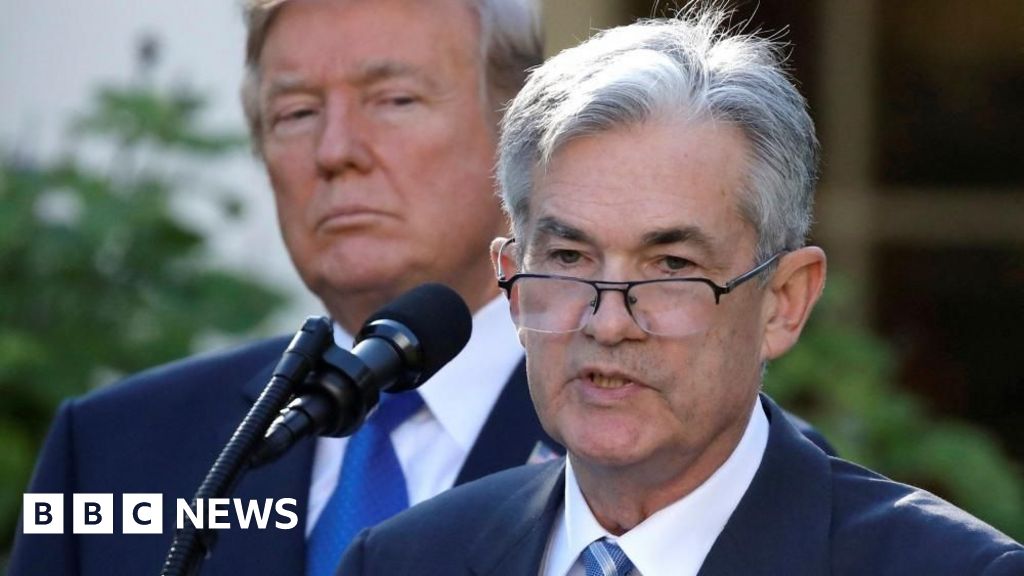
Powell’s term is nearing its end and the US Senate is considering Trump’s nominee for his replacement, Kevin Warsh. A key Republican, Thom Tillis, has withheld his support for Warsh unless the Trump administration would drop its investigation into Powell.
Business
Intel bags big gains! Chipmaker’s shares jump 26% on blockbuster results; how Trump admin benefits – The Times of India
Intel share price soared sharply on Friday after the chipmaker delivered a first-quarter performance that exceeded market expectations. And the win was not just for the chipmaker, but also the whole of US!The stock climbed 26.7% during trading on Friday, marking what could be its strongest single-day gain since 1987. Momentum continued after the closing bell, with shares rising a further 20% in after-hours trading as investors reacted to signs of a sustained turnaround driven by artificial intelligence.Intel reported revenue of $13.58 billion (€11.6bn) for the quarter, ahead of the $12.3 billion (€10.5 bn) forecast and up 7.2% from a year earlier. Adjusted earnings per share came in at $0.29, far exceeding expectations of $0.01.A key contributor to this performance was the company’s Data Centre and AI (DCAI) division, which delivered revenue of $5.05 billion (€4.2bn), up 22.4% year-on-year and well above analyst estimates of $4.41 billion (€3.77bn). The results indicate strong demand for Intel’s Xeon 6 processors and Gaudi 3 AI accelerators, particularly among enterprise clients and cloud service providers.Chief executive Lip-Bu Tan pointed to a broader shift in artificial intelligence usage as a major factor behind the growth. He said, “the next wave of AI will bring intelligence closer to the end user, moving from foundational models to inference to agentic.” He added, “This shift is significantly increasing the need for Intel’s CPUs and wafer and advanced packaging offerings.”The company also issued an upbeat outlook for the second quarter, forecasting revenue in the range of $13.8 billion (€11.8billion) to $14.8 billion (€12.6billion), surpassing investor expectations of $13 billion (€11.1billion).
But how is Washington winning?
The rally has had a direct impact on the US administration’s investment in Intel. In 2025, during a period of severe financial strain for the company, the administration of Donald Trump acquired a 9.9% stake in a move aimed at stabilising the business. The government invested $8.9 billion (€7.8bn) at a share price of $20.47 (€18.01), with $5.7 billion (€5bn) of that amount coming from previously approved but unpaid grants, according to the Euro News.At the time, Intel was facing multi-billion dollar losses and operational challenges, prompting concerns over its viability. As part of the intervention, the company cancelled planned factory projects in Germany and Poland, redirected focus towards US-based manufacturing, and reduced its global workforce by 25%, cutting around 25,000 jobs.Following the latest jump, Intel’s shares are now trading at $81.3 (€71.5), representing an increase of nearly 300% since the government first took its stake. The sharp rise highlights how the company’s improved financial performance has translated into substantial gains for the US administration.


NASCAR makes major change in front office, including new CEO in unprecedented move: report

Extended interview: Don Cheadle – CBS News

Charlie Sheen updates on relationship with old pal Jon Cryer

-

 Fashion1 week ago
France’s LVMH Q1 revenue falls 6%, shows resilience amid Iran war
-

 Tech1 week ago
CYBERUK ’26: UK lagging on legal protections for cyber pros | Computer Weekly
-

 Sports5 days ago
WWE WrestleMania 42 Night 2: Live match results and analysis
-

 Sports1 week ago
Faheem Ashraf backs Islamabad United’s push, calls league a ‘career-changing platform’
-

 Sports5 days ago
NCAA men’s gymnastics championship: All-time winners list
-
 Business1 week ago
PepsiCo earnings beat estimates as North American food business improves
-

 Tech1 week ago
Anthropic Plots Major London Expansion
-

 Entertainment4 days ago
Lee Anderson, Zarah Sultana kicked out of UK Parliament for calling PM ‘liar’