

Business
What are tariffs, how do they work and why is Trump using them?

 Getty Images
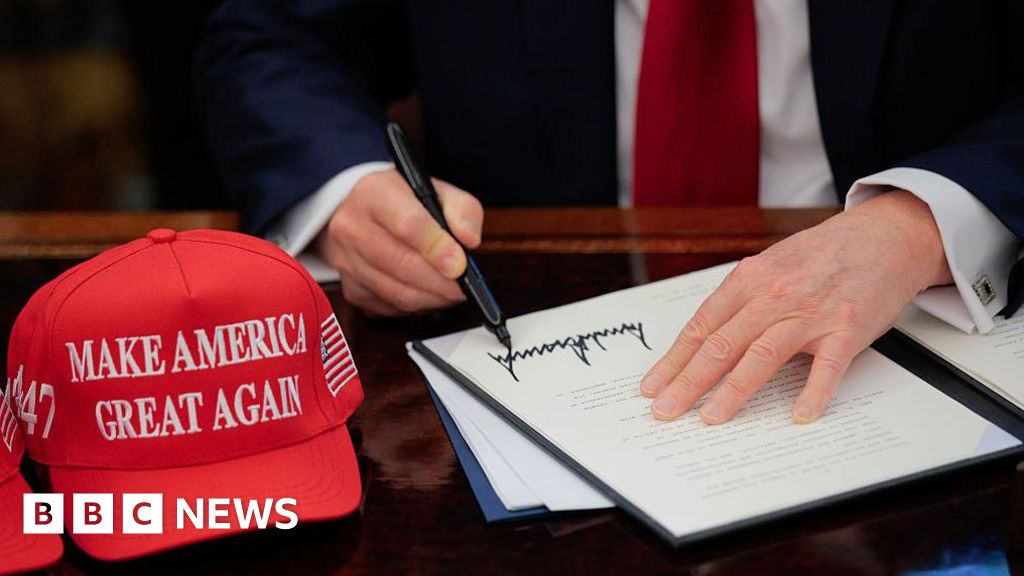
US President Donald Trump has threatened to impose further tariffs on eight European allies who oppose his demands for control of Greenland.
In 2025, he placed a number of taxes on goods reaching the US from countries around the world, arguing that the move would boost American manufacturing and create jobs.
Critics warned of higher prices and damage to the global economy, and the US Supreme Court is considering the legality of the tariffs Trump has brought in.
What are tariffs and how do they work?
Tariffs are taxes on imported goods.
Typically, the charge is a percentage of a good’s value.
For example, a 10% tariff on a $10 product would mean a $1 tax on top – taking the total cost to $11 (£8.17).
The tax is paid to the government by companies bringing in the foreign products.
These firms may pass some or all of the extra cost on to their customers, which in this case means ordinary Americans and other US businesses.
They may also decide to import fewer goods.
Why is Trump using tariffs?
Trump says tariffs increase the amount of tax raised by the government, encourage consumers to buy more American-made goods and boost investment in the US.
He wants to reduce the US trade deficit – the gap between the value of goods it buys from other countries and those it sells to them.
The president argues that the US has been exploited by “cheaters” and “pillaged” by foreigners.
He said that China, Mexico and Canada must do more to stop migrants and the illegal drug fentanyl reaching the US.
Trump has also used the threat of tariffs to encourage other countries to support the US on issues unrelated to trade – Russia’s invasion of Ukraine and Iran’s suppression of protests, as well as his demands on Greenland.
Many tariffs have been amended or delayed after being announced.
How will the new tariffs on eight European countries work?
On 17 January, Trump threatened to impose a further 10% tariff on eight European countries who have rejected his Greenland plans.
He said the rate would apply to goods from Denmark, Norway, Sweden, France, Germany, the UK, the Netherlands and Finland from 1 February, but could later rise to 25% – and would last until a deal was reached.
The move was widely condemned by European leaders, including UK Prime Minister Sir Keir Starmer and French President Emmanuel Macron, who said the EU could consider a series of retaliatory options including a so-called “trade bazooka”.
Officially known as the Anti-Coercion Instrument (ACI), this is a law that allows the EU to respond to economic blackmail from non-EU countries. It threatens very severe consequences.
In July 2025, European Commission President Ursula von der Leyen agreed the EU would pay 15% tariffs on its US exports.
After the agreement, Brussels suspended the tariffs it had planned to introduce on €93bn (£81bn; $109bn) worth of US goods sold to the EU, from livestock and aircraft parts to whiskey.
The European Parliament had been due to ratify the 15% deal shortly, but is now expected to suspend the agreement, sparking fears of a new trade war.
What are Trump’s tariffs on individual countries?
Negotiations continue with a number of countries, including America’s top three trading partners, China, Canada and Mexico, who have been threatened with particularly high tariffs:
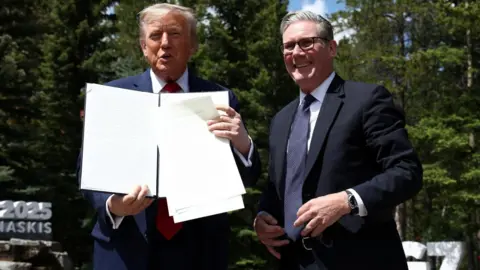
What is the UK tariff deal?

 Reuters
Which goods are affected by Trump’s tariffs?
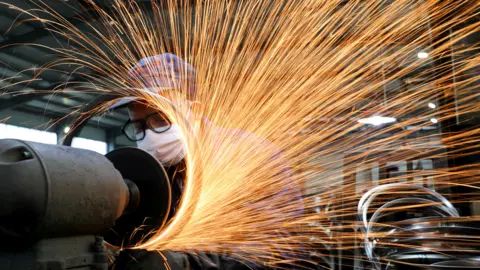
Some taxes announced by Trump are on particular products, wherever they are made.
These include:
 Reuters
In addition, Trump ended an exemption for imports valued at $800 (£592) or less.
It means low-cost goods are no longer duty-free – a move affecting millions of packages sent every day, including those from online retailers like Shein and Temu.
The companies shipping the parcels now have to pay duties based on the tariff rate which applies to the country the goods were sent from. Otherwise, for six months, they can choose to pay a fixed fee of between $80 and $200 per package.
On 2 January, the White House confirmed it had slashed proposed tariffs of almost 92% on some imported pasta after what it called constructive engagement from firms.
In November, Trump had signed an executive order exempting a range of other food products from tariffs, including avocados, bananas, beef and coffee because of domestic shortages.
Why has the Supreme Court been considering the legality of Trump’s tariffs?
Trump’s tariffs have faced numerous legal challenges.
The Trump administration brough in certain tariffs using the 1977 International Emergency Economic Powers Act. Declaring an emergency under the law meant Trump could bypass Congress.
In August 2025, a US appeals court ruled that most of the tariffs were illegal, but left them in place.
The White House asked the US Supreme Court to overturn that decision. A ruling is expected soon.
Trump posted on social media that it would be a “complete mess” if the Supreme Court struck down his tariffs, and warned of difficulties if businesses were told they could claim refunds.
“It would take many years to figure out what number we are talking about and even, who, when, and where, to pay,” he said.
Have prices gone up for US consumers?
Some products have become more expensive – including toys, appliances and furniture as well as certain foodstuffs.
US inflation was 2.7% in the 12 months to December, down from 3% in September, but up from 2.4% in April, before most tariffs started.
Many firms say they are passing on the cost of tariffs to US customers, including Target, Walmart and Adidas.
The cost of goods manufactured in the US using imported components is also expected to rise.
For example, car parts typically cross the US, Mexican and Canadian borders multiple times before a vehicle is completely assembled.
How are tariffs affecting the US and global economies?
Trump was accused of throwing the global economy into turmoil when he announced the first tariffs of his second presidential term.
Although financial markets have since largely recovered, in October 2025 the International Monetary Fund (IMF) said the overall picture remained volatile, and that US tariffs were having a negative effect.
It forecast global growth of 3.2% for 2025, and 3.1% in 2026. That was a slight increase from its July predictions, but still below the 3.3% it had projected for both years before Trump’s measures were announced.
It thinks the US economy will grow by 2% in 2025, and 2.1% in 2026. That’s down from the 2.8% growth recorded in 2024, but still the fastest among the world’s most advanced economies.
The most recent US figures show the economy picked up speed over the three months to September 2025, as consumer spending jumped and exports increased.
The economy grew at an annual rate of 4.3%, up from 3.8% in the previous quarter. That was better than expected, and marked the strongest growth in two years.
Imports – which count against growth – continued to decline during the period.
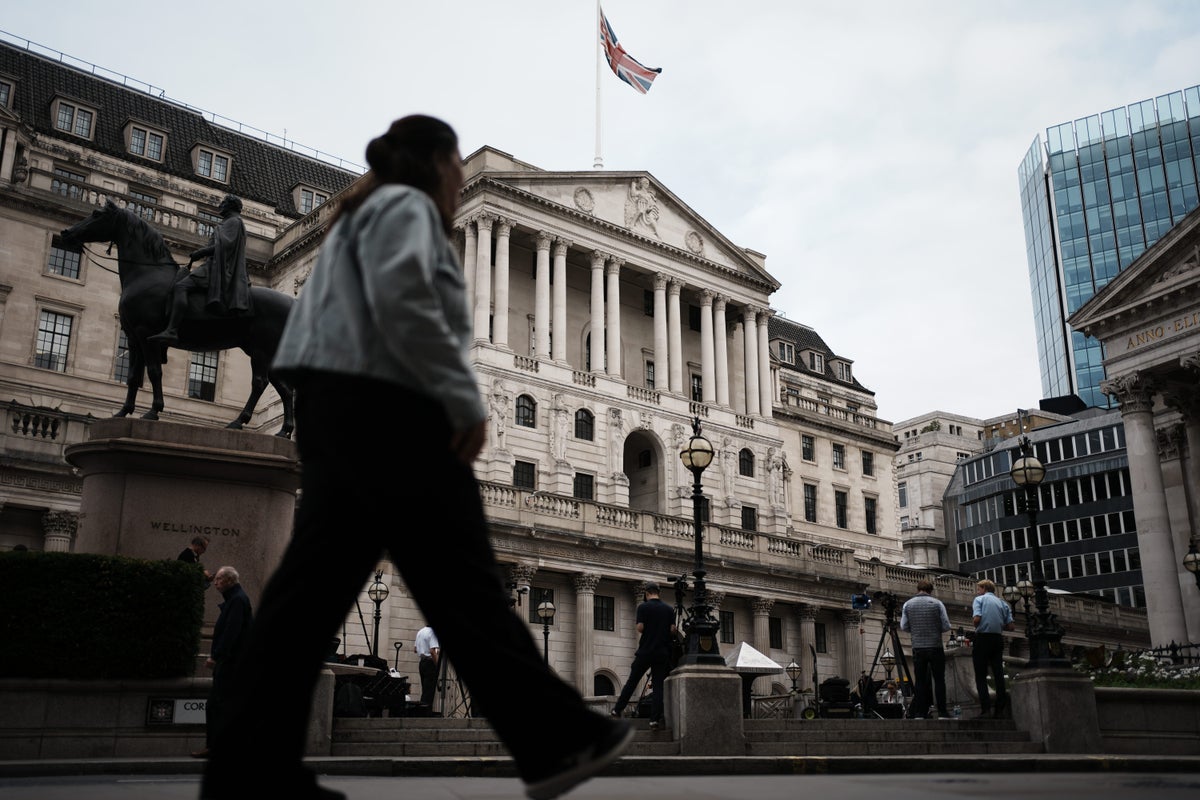
Bank of England policymakers will “almost certainly” hold interest rates at 3.75% at their meeting next week despite the Iran war pushing up the cost of living, economists have said.
However, experts have said a future interest rate increase could still be a possibility if firms and households continue to face inflationary pressure.
The Bank of England’s nine-strong Monetary Policy Committee (MPC) will vote on whether to maintain, increase or decrease its base interest rate on Thursday April 30.
The Bank will also publish its first full monetary policy report and set of economic forecasts since the conflict between US-Israeli and Iranian forces began in late February.
This week, a raft of economic data has shown that the conflict has helped to drive inflation higher.
Data published by the Office for National Statistics (ONS) on Wednesday showed that UK Consumer Prices Index (CPI) inflation lifted to 3.3% in March, a three-month-high, on the back of accelerating fuel prices.
The price of motor fuels jumped by 8.7% month-on-month – the largest increase since June 2022 – as disruption to oil production and transportation drove diesel and petrol prices higher.
Meanwhile on Friday, Bank of England research saw UK firms warn they think food inflation could jump as high as 7% as they increased their inflation outlook for next year.
Other economic data also indicated that activity in the UK economy has been stronger than expected.
The ONS reported the UK economy grew by 0.5% in February, ahead of forecasts of 0.1%, before the conflict began.
Elsewhere, UK retail sales volumes were stronger-than-expected after a boost from fuel, with motorists buying more in March in a bid to stock up amid rising prices.
Despite these figures, economists broadly expect the Bank’s rate-setters to maintain the current interest rate.
Oxford Economics chief UK economist Andrew Goodwin said: “We expect the MPC to keep bank rate unchanged at 3.75%, with most committee members seemingly keen to hold policy at its current restrictive level as they gather more information about how the energy shock is feeding through to the economy.
“Nevertheless, we suspect a minority will opt for a 25 basis point (0.25 percentage point) hike, on the basis that some pre-emptive tightening is a more robust strategy to guard against an inflation outlook where the risks are skewed to the upside.”
Thomas Pugh, chief economist at RSM UK, said the result of the meeting looks “nailed on”.
He said: “The Bank of England (BoE) will almost certainly hold interest rates at 3.75% at its meeting next week, most likely in a unanimous 9-0 vote again.
“The picture of the war in Iran is little clearer than at the last meeting and the value in waiting for more information is significant, given the uncertainty over both the future direction of energy prices and their impact on the economy.”
He indicated however that the “resilience” of some recent data “raises the risk that interest rates will rise in the summer”.
Elliott Jordan-Doak, senior UK economist at Pantheon Macroeconomics, also predicted a unanimous hold vote but also suggested that recent data could drive future concerns over elevated inflation.
He said: “If surveys for May repeat the same pattern, and crucially the ‘dirty’ Middle East ceasefire continues with oil flows disrupted, we think the MPC will be bumped into a hike in June or perhaps July.
“We expect rate setters to hike once this year, in June, before cutting twice in 2027 to leave interest rates at 3.5%.”

new video loaded: Who’s Getting a Tariff Refund?

By Tony Romm, Nour Idriss, Stephanie Swart, Whitney Shefte and Paul Abowd
April 24, 2026
Business
Hair oil, ACs, soaps become costlier: How FMCG companies are dealing with Middle East supply blow – The Times of India

Consumer goods companies in India are facing a sharp rise in input costs due to the ongoing war in the Middle East. Surging raw material prices are forcing firms to track costs on a near-daily basis, review pricing frequently, and focus on short-term decisions instead of long-term planning.As firms are struggling with volatile input costs, company executives have told ET that the sudden spike in inflation has made it harder to manage business, while also raising concerns that higher prices could hurt consumer demand. This comes at a time when consumption had started improving after the government reduced goods and services tax rates on several products last September.Havells India chief executive officer Anil Rai Gupta was cited by the financial agency as saying that the company is taking a cautious approach and reviewing the situation month by month. “I have not seen this kind of price escalation in the recent past or in recent memory. Usually, inflation happens, but it is neither so steep nor spread across all product categories… consumer offtake can get affected if the price hike is too sharp.” Bajaj Consumer Care managing director Naveen Pandey said the company is closely tracking input costs and taking decisions almost daily. Speaking during the company’s earnings call last week, he said costs across the business have gone up between 20% and 60%. He added that the war has created “extreme volatility” in the prices of light liquid paraffin and packaging materials. At the same time, prices of mustard and copra have not fallen as expected and are still at pre-war levels. The company is working on cutting costs across its operations.Industry executives said the war has pushed up commodity prices and crude-linked products, increased freight costs, and made imports more expensive due to the fall in rupee. They added that even after a ceasefire, prices have not come down, and uncertainty remains over whether the conflict could start again.In the past month, companies have already raised prices in several categories, including air-conditioners, refrigerators, soaps, detergents, hair oil, apparel, decorative paints and footwear. Some companies have also reduced pack sizes to deal with higher costs. More price hikes are expected by the end of this month.Parle Products vice president Mayank Shah said the pressure on input costs is very high and the uncertainty is “killing”.Retailers are also seeing more careful spending. Trent Ltd, which runs Westside and Zudio stores, said in an investor presentation that while demand was steady at the start of the January–March quarter, the current situation is affecting consumer behaviour.“Consumers are spending with caution, resulting in moderation of discretionary spending on the back of continuing macro uncertainties and potential increase in cost of living. Structurally the demand levels and the underlying market opportunities remain strong. However, the duration and intensity of disruptions in the Middle East along with its second order effect on supply chain, commodity prices and inflation in general has potential implications for near term demand,” the company said.AWL Agri Business executive deputy chairman Angshu Mallick said the company has already increased edible oil prices by Rs 7–10 per kg to pass on higher freight costs. “Being a staples company, we hike or reduce prices immediately. As we are in basic necessities, the volume impact is usually lower,” he said.Meanwhile, the Middle East conflict is inching closer towards the two month mark. The conflict began back on February 28, when the US and Israel launched joint strikes on Iran. In retaliation, Tehran choked the crucial Strait of Hormuz, a pipeline that carries 20% of global energy supplies, straining flow across the globe.


Jada Pinkett Smith seeks $49K legal fees from Will Smith former friend
Bank of England set to hold interest rates despite Iran war pushing up inflation

Sweden’s H&M & Stella McCartney return with nostalgic 2026 collection

-

 Fashion1 week ago
France’s LVMH Q1 revenue falls 6%, shows resilience amid Iran war
-

 Entertainment1 week ago
Is Claude down? Here’s why users are seeing errors
-

 Sports1 week ago
PSL 11: Peshawar Zalmi win toss, opt to field first against Quetta Gladiators
-

 Tech1 week ago
CYBERUK ’26: UK lagging on legal protections for cyber pros | Computer Weekly
-

 Fashion1 week ago
Raymond unveils luxury Chairman’s Collection Store in Mumbai
-

 Sports5 days ago
WWE WrestleMania 42 Night 2: Live match results and analysis
-
 Business1 week ago
PepsiCo earnings beat estimates as North American food business improves
-

 Sports5 days ago
NCAA men’s gymnastics championship: All-time winners list