

Business
Our son can’t come home for Christmas after insulation mould took over

Zoe ConwayNews Correspondent
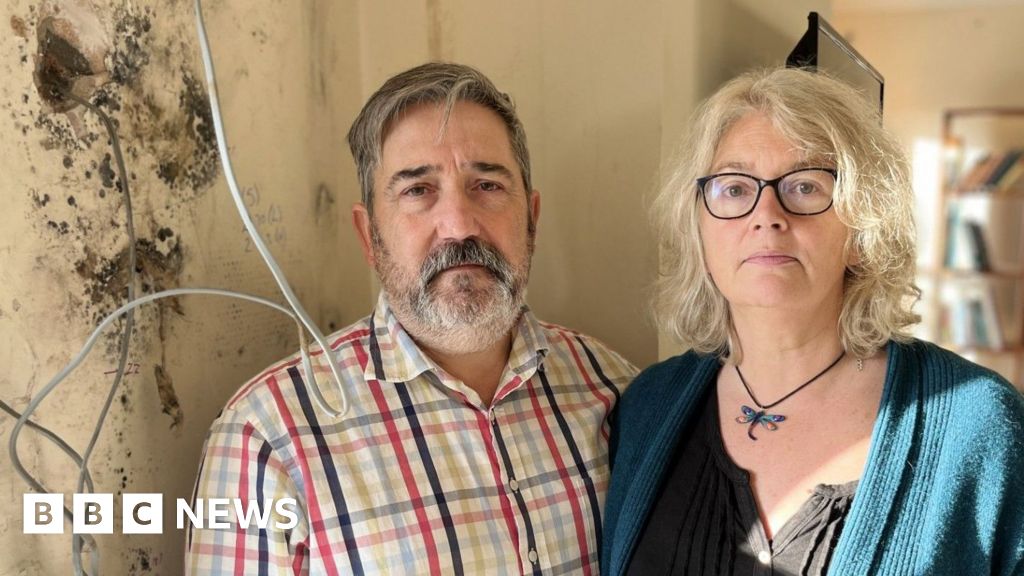
Tony and Becs Wadley say they can’t spend Christmas at home after insulation installed under a government scheme has caused black mould in several rooms, and their asthmatic son can’t be inside the property.
Mr Wadley says the situation is tearing the family apart: ”It’s awful. Elliott can’t come into our house, it’s as if he’s been ostracised from his own home.”
The couple are among more than 300 people who have contacted the BBC in recent weeks to tell us about insulation that has gone wrong in their homes.
The Department of Energy Security and Net Zero (DESNZ) said it was taking action to ensure consumers are no longer let down by poor installations.
 Becs Wadley
Mr and Mrs Wadley got a government grant to have energy efficiency measures fitted in their Gower Peninsula house because they hoped a warmer home would help Elliott’s asthma. The grant covered the cost of insulating his bedroom walls.
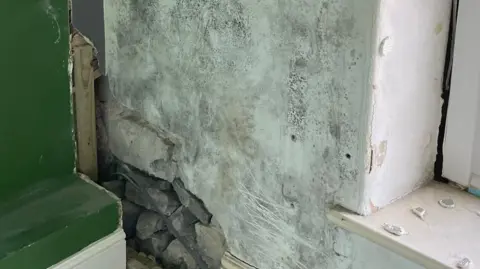
But months after the work was completed, the Wadleys discovered black mould was growing behind the insulation boards. It was removed by the installer and replaced with a new insulation system. But this also had to be removed along with all the plaster after it became damp. Elliott, 19, hasn’t entered the house since April, instead staying with his grandmother during university breaks.
”I miss him like you wouldn’t believe’,” says Mrs Wadley.
The family are going to stay with Mr Wadley’s sister for Christmas so they can all be together.
Billions of pounds of public money has been spent on insulating homes over the last 15 years.
The Wadleys’ home was insulated under a government scheme known as ECO4. In October, the National Audit Office (NAO) spending watchdog found that 98% of homes fitted with external wall insulation under ECO4 and the Great British Insulation Scheme since 2022 had major issues that needed to be repaired.
It added that 29% of homes that had internal wall insulation fitted under the schemes had major issues.
The report also said there had been “weak” government oversight and regulatory ”failure”.
DESNZ said it had “inherited a flawed system of oversight and regulation”. A spokesman for the department said it was “committed to introducing comprehensive reforms through the Warm Homes Plan to ensure that consumers get the quality installations they deserve and failures like these are not repeated”.
The spokesman added: “People should not be expected to navigate a complex web of organisations when they want to improve their homes – and with this government, they won’t.”

 Becs Wadley
In the downstairs rooms of the Wadleys’ home the insulation has also failed and has had to be removed. There is black mould on the walls while electric sockets hang loose with the wires exposed. The family says it has been in this condition for months.
The installer, Stellar Energy, says it has ”no record of any immediate safety hazards being flagged.” It says the descriptions of the exposed wires and sockets was “highly inconsistent” with their standard operating procedures, which required all such work to be made safe.
Building surveyor, David Walter, says the insulation wasn’t fitted correctly and says the installer ”didn’t understand what they were doing and what they were doing to the building which is why we’ve got these problems.”
Stellar Energy told the BBC the design was ”technically correct for a stone house and was installed…in strict accordance with the mandatory technical specifications of ECO4.”
Mr Wadley says he wouldn’t have signed up for the grant if he’d known what would happen. ”You wouldn’t put your family through this. Nobody would. Somebody needs to take responsibility.”
Stellar Energy says it ”sincerely regrets any distress this situation has caused the family” and says its priority is ”providing a final resolution to ensure the home meets the high standards” it strives for.
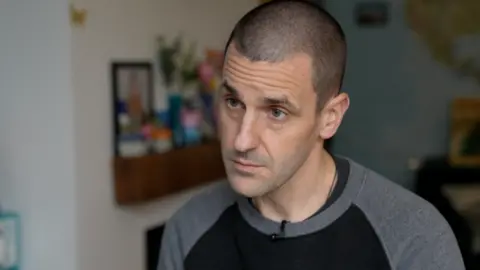
Scott Proudman contacted the BBC about the botched external wall insulation fitted to his Bristol home in 2021.
His family had been eligible for a government grant because of his eight-year-old daughter’s disabilities. Born 24 weeks premature, she has cerebral palsy, a partial visual impairment and was recently diagnosed with autism.
”I feel like a failure every time I come home because this was meant to be something to look after my family, to make life easier, and it hasn’t,” he says.
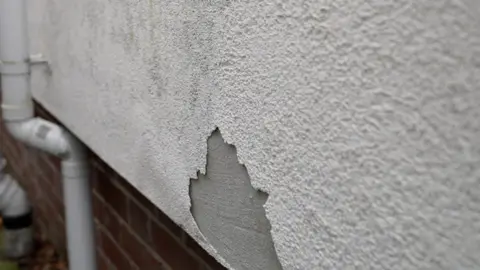
When the work was done, insulation boards were fixed to the outside of the house and render was applied to make it waterproof. But the render has been falling off for years.
 Scott Proudman
Building surveyor Mr Walter, says poor design and poor workmanship has caused the render to disintegrate. He says rainwater will very likely get under the cracked render and behind the insulation and will likely cause dampness inside.
”It’s like a timebomb. It’s going to get worse and worse, affecting the inside of the property,” he says.
Mr Walter says all of the render and insulation will have to come off and will cost tens of thousands of pounds to put right.
Right now the family is stuck with the repair bill because the installer, SPMS Wales, is being liquidated and Mr Proudman says they weren’t given the required guarantee for the work. Trustmark, the organisation responsible for overseeing quality, told Mr Proudman it couldn’t help because the company is no longer accredited.
Mr Proudman says he chose the company ”because it was on a government website and was Trustmark registered. I can’t believe how few rights consumers have.”
Brett Langdon, a director at SPMS Wales says he is ”very sorry the Proudmans have ended up in this situation” and says all works ”were done to the manufactures specification.” He says he gave a guarantee to the Proudmans but has told the BBC he can’t remember who the guarantee is with. He says the delamination of the render was “due to a failure of the system”.
In a statement TrustMark said it was ”very sorry to hear about what’s happened to Mr and Mrs Proudman and Mr and Mrs Wadley and the conditions both families’ homes have been left in. It is totally unacceptable and we are in discussions with the relevant Scheme Providers and guarantee providers to help resolve these situations.”
And it said it underlined ”the need for reform to the current system”.
Business
Noida International Airport inauguration: Delhi-NCR gets new airport – all you need to know – The Times of India
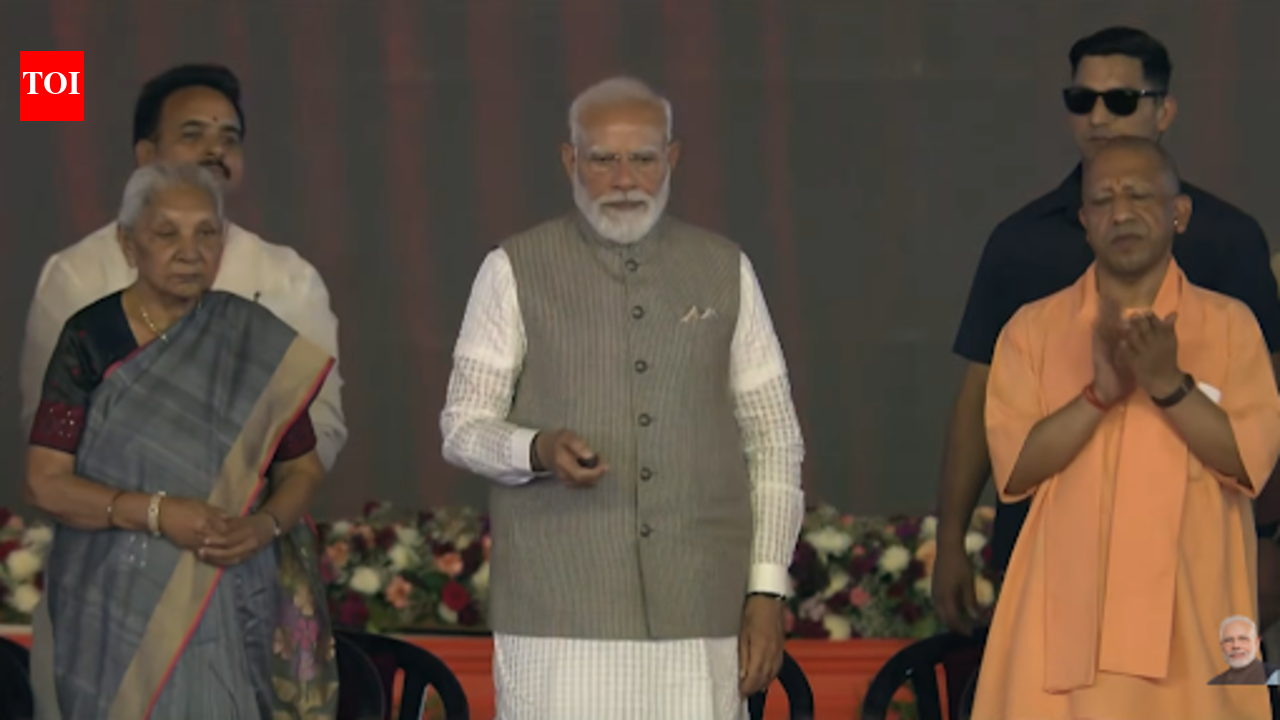
NEW DELHI: Prime Minister Narendra Modi on Saturday inaugurated Phase I of the Noida International Airport at Jewar in Uttar Pradesh, marking a significant milestone in India’s expanding aviation infrastructure.PM Modi was accompanied by Uttar Pradesh chief minister Yogi Adityanath and Governor Anandiben Patel.
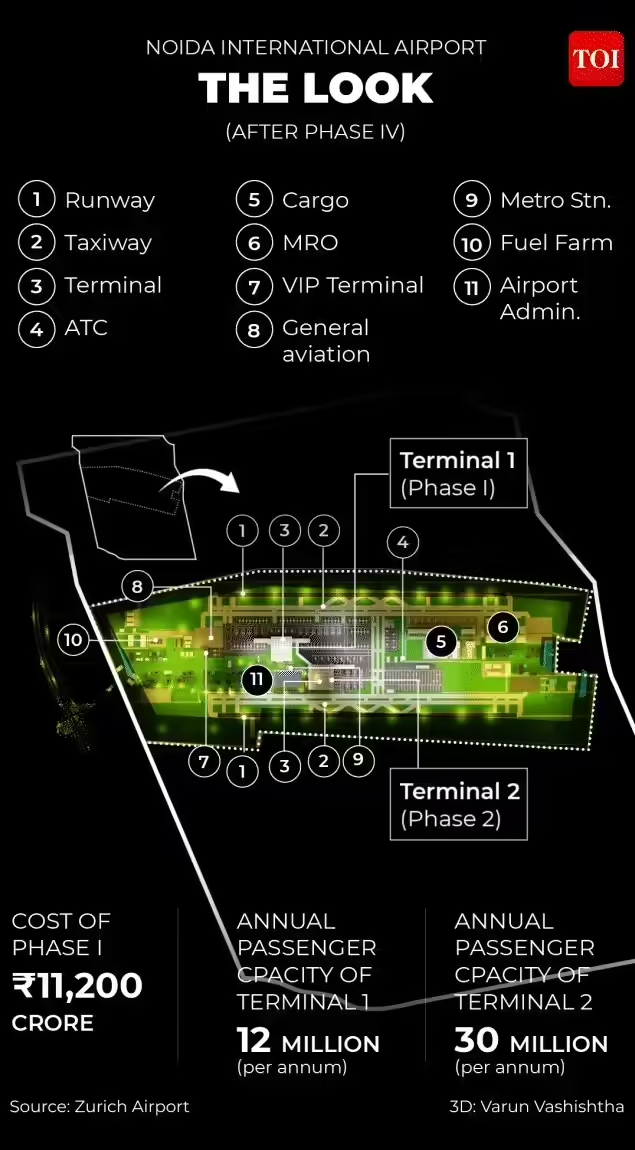
Developed at an investment of around Rs 11,200 crore under a Public–Private Partnership (PPP) model, the project is expected to enhance both regional and international connectivity for the National Capital Region (NCR).The airport is being positioned as a key addition to India’s aviation network, aimed at easing pressure on existing infrastructure while supporting the country’s ambition of becoming a global aviation hub.
Second international gateway for Delhi NCR
Noida International Airport has been developed as the second international gateway for Delhi NCR, complementing the existing Indira Gandhi International Airport, which currently handles the majority of the region’s air traffic.
.
With rising passenger demand and capacity constraints at IGI Airport, the new facility is expected to play a crucial role in distributing traffic more efficiently.Together, the two airports will function as an integrated aviation system, helping reduce congestion, improve connectivity, and enhance the region’s standing among leading global aviation hubs.
Phase I capacity and future expansion plans
Phase I of the airport is designed to handle 12 million passengers per annum (MPPA), providing immediate relief to the region’s growing air travel demand.The project has been planned with scalability in mind, with provisions to expand capacity to 70 million passengers annually in subsequent phases. This long-term vision reflects the government’s strategy to future-proof infrastructure and accommodate sustained growth in air travel.
Modern infrastructure and all-weather operations
The airport features a 3,900-metre runway capable of handling wide-body aircraft, making it suitable for both domestic and international long-haul operations.
.
Equipped with advanced navigation systems such as the Instrument Landing System (ILS) and modern airfield lighting, the facility is designed to support efficient, all-weather, round-the-clock operations. These features ensure operational reliability even under challenging weather conditions.
Cargo hub and logistics ecosystem
In addition to passenger services, the airport includes a comprehensive cargo ecosystem aimed at strengthening logistics and trade.The Multi-Modal Cargo Hub comprises an Integrated Cargo Terminal and dedicated logistics zones, with an initial handling capacity of over 2.5 lakh metric tonnes annually. This capacity is expected to expand significantly to around 18 lakh metric tonnes in the future, positioning the airport as a major cargo and logistics centre in North India.
Dedicated MRO facility to enhance efficiency
A key component of the airport’s infrastructure is a 40-acre Maintenance, Repair and Overhaul (MRO) facility.This dedicated facility is expected to improve operational efficiency by enabling airlines to service and maintain aircraft locally, reducing turnaround times and operational costs. It also strengthens India’s capabilities in aviation maintenance services.
Sustainability and future-ready design
Noida International Airport has been designed as a sustainable and future-ready infrastructure project, with a focus on achieving net-zero emissions.The project incorporates energy-efficient systems and environmentally responsible practices, aligning with India’s broader climate goals. The airport’s development reflects a growing emphasis on green infrastructure in large-scale projects.
Architecture inspired by Indian heritage
Blending modern infrastructure with cultural aesthetics, the airport’s architectural design draws inspiration from traditional Indian elements such as ghats and havelis.This approach aims to create a distinctive identity for the airport while offering passengers a sense of place rooted in Indian heritage.
Strategic location and multi-modal connectivity
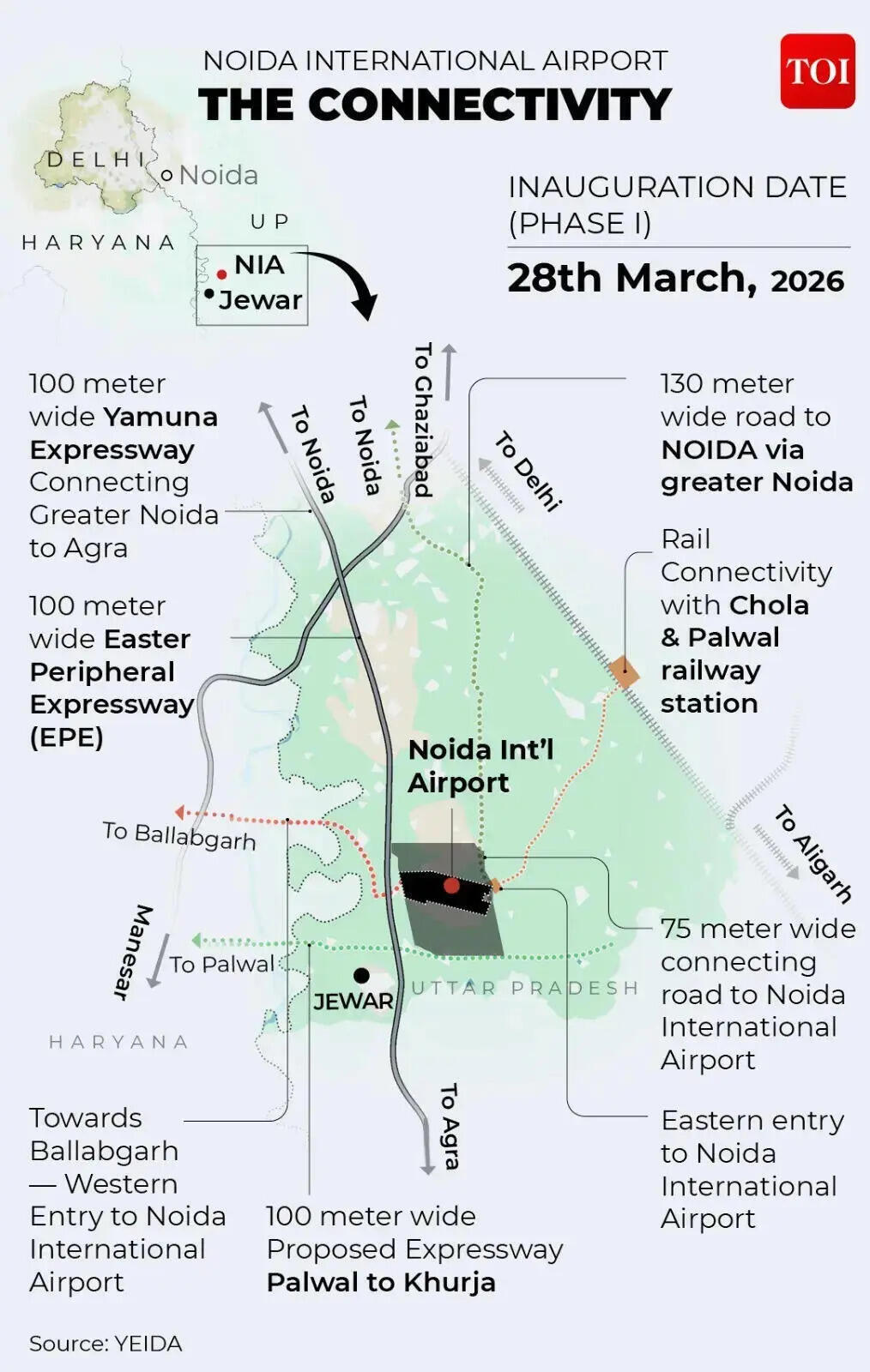
Strategically located along the Yamuna Expressway in Gautam Buddha Nagar district, the airport is planned as a multi-modal transport hub.It will feature seamless integration with road, rail, metro and regional transit systems, ensuring smooth connectivity for passengers and cargo. This connectivity is expected to significantly improve accessibility for travellers across Delhi NCR and neighbouring regions.
Boost to India’s aviation ambitions
The inauguration of Phase I of Noida International Airport is being seen as a major step in strengthening India’s aviation ecosystem.By expanding capacity, improving connectivity, and integrating modern infrastructure with sustainability, the project is expected to play a key role in positioning Delhi NCR as a major global aviation hub while supporting economic growth and regional development

Butter, chocolate, coffee and milk have all seen prices rocket. Tracing back through the story of one particular supermarket staple begins to explain why
Source link
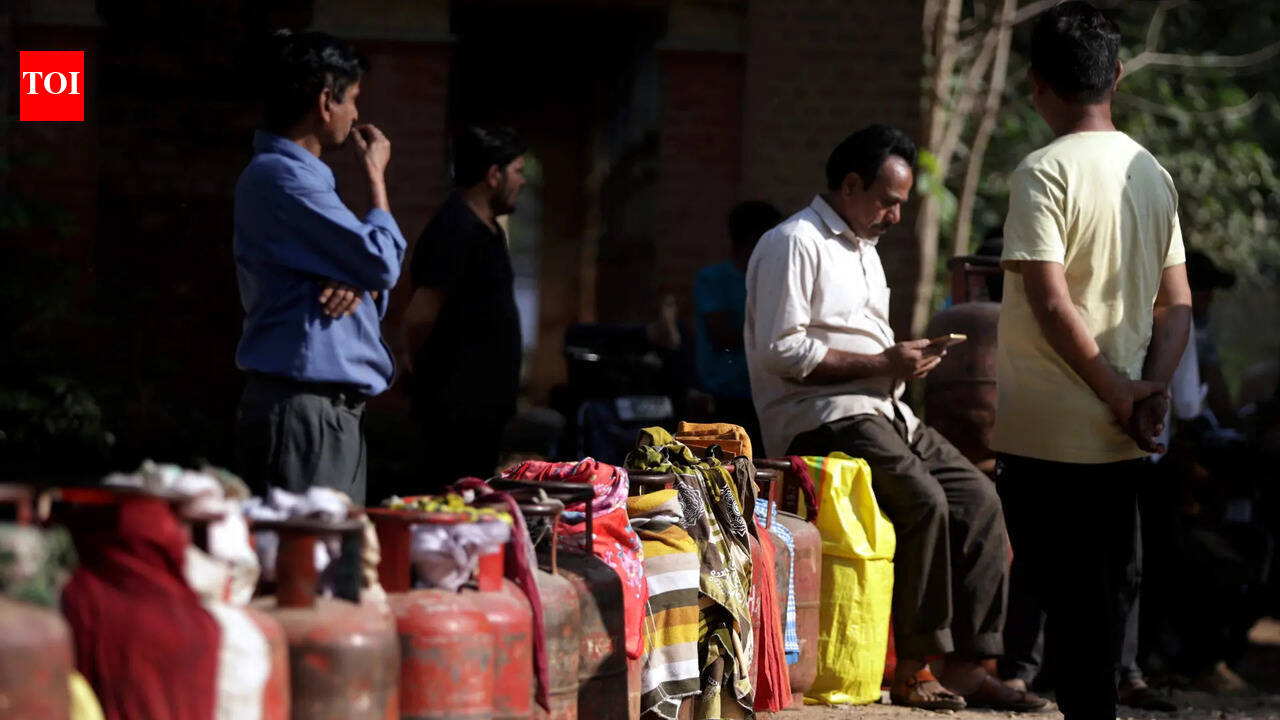
MUMBAI/BENGALURU: The restaurant industry is struggling to run regular operations due to the meagre supplies of LPG cylinders . With the govt’s move to hike commercial LPG allocation to up to 70%, it will take some time before the measure actually translates into sustained supply, executives said. “Supply is still hugely limited and erratic. A feeling of uncertainty looms large,” said Anurag Katriar, founder at Indigo Hospitality. The key question is how quickly this revised allocation will translate into on-ground availability, said Pradeep Shetty, vice-president at Federation of Hotel & Restaurant Associations of India (FHRAI).A walk along Indiranagar’s 12th Main, known for its cluster of independent restaurants, reflects the strain. “It is all hand-to-mouth at this point,” said Nikhil Gupta, who runs brands including The Pizza Bakery and Paris Panini . The move doesn’t directly help the restaurant sector which is still getting 20%-30% of LPG supplies, said Sagar Daryani, co-founder & CEO at Wow! Momo Foods and president at National Restaurant Association of India (NRAI). State-wise, the supply situation varies with some such as Maharashtra, Karnataka, Rajasthan restricting allocation for restaurants, hurting the sector , Daryani said.


Zayn Malik shares personal video message on ‘Mind of Mine’ 10th anniversary

EU Parliament, Council reach deal on major reform of Customs Code

Tiger Woods released from jail after DUI arrest; eyes appear bloodshot in booking photo

-
 Business1 week ago
Flipkart group CFO to leave co amid IPO plans – The Times of India
-
 Business1 week ago
Video: The Effects of High Oil Prices
-

 Fashion1 week ago
China’s textile & apparel exports surge 17% to $50 bn in Jan-Feb 2026
-

 Sports1 week ago
Rating Adidas’ 2026 World Cup away shirts: Argentina, Spain, Mexico and more
-

 Fashion1 week ago
The hidden $1.62 war tax now embedded in every garment you source
-

 Sports1 week ago
American Conference Commissioner Tim Pernetti thanks Trump for Army-Navy game executive order
-
Tech1 week ago
The Corsair 4000D RS PC Case Keeps Your System Cool
-

 Tech1 week ago
‘Uncanny Valley’: Nvidia’s ‘Super Bowl of AI,’ Tesla Disappoints, and Meta’s VR Metaverse ‘Shutdown’