

Business
Amazon accidentally sends email confirming layoffs


US technology giant Amazon has informed employees of a new round of global layoffs in an email apparently sent in error.
A draft email written by Colleen Aubrey, a senior vice president at Amazon Web Services (AWS), was included as part of a calendar invite sent by an executive assistant to a number of Amazon workers late on Tuesday.
In the email, Aubrey refers to a swathe of employees in the US, Canada and Costa Rica having been laid off as part of an effort to “strengthen the company.”
The message, which has been seen by the BBC, was apparently shared by mistake, as it was quickly cancelled. An Amazon spokesman declined to comment.
The title of the invite was “Send project Dawn email,” an apparent reference to Amazon’s code name for the job cuts.
While the email made clear that layoffs were happening at Amazon, employees had not yet been officially informed.
“This is a continuation of the work we’ve been doing for more than a year to strengthen the company by reducing layers, increasing ownership, and removing bureaucracy, so that we can move faster for customers,” the email said.
“Changes like this are hard on everyone. These decisions are difficult and made thoughtfully as we position our organization and AWS for future success,” it added.
Amazon announced 14,000 job cuts in late October.
This second round of layoffs had been expected by Amazon employees for weeks, according to a former employee who asked not be identified.
The broad understanding among employees had been that bosses intended to cut a total of around 30,000 roles, added the former employee, who left the company as part of the cuts in October.
The firm was expected to reach that number of job cuts with another major round of layoffs this month, followed by further redundancies until the end of May.
While laid-off workers were invited to reapply for open positions at Amazon, the number of such roles was limited. People who did not move to another role received severance pay based on how long they had worked at the company.
Since 2022, major tech companies like Amazon, Meta, Google, Microsoft and others have slashed their workforces by laying off tens of thousands of people each year.
Across the entire tech industry, an estimated 700,000 people have been laid off over the last four years, according to Layoffs.fyi, which tracks job cuts.
So far this year, Facebook owner Meta has cut more roles, impacting several hundred employees. As has Pinterest, which this week cut around 700 jobs.
Since Amazon founder Jeff Bezos stood down as its chief executive four years ago, his successor Andy Jassy has led the company through several rounds of layoffs in 2023, 2024 and 2025.
Jassy has also attempted to bring a more strict work culture to the firm.
In-office work is now mandatory five-days a week, making Amazon one of the only major tech companies to require its employees to be in the office full-time.
Amazon is also focused on reducing costs, even monitoring corporate mobile phone use by AWS employees, according to a report in Business Insider, in an effort to limit a long-standing $50 per month reimbursement.
In an email Jassy sent to employees before the Thanksgiving holiday viewed by the BBC, the CEO said he was thankful for the “challenges at opportunities at work” as “the world is changing at a very rapid rate.”
Jassy called this era at Amazon “a time to rethink everything we’ve ever done.”

The speed of price rises in the UK has stayed the same, according to data which was collected before the US-Israel war with Iran began.
Source link

Buying continued at the Pakistan Stock Exchange (PSX), with the benchmark KSE-100 Index gaining over 1,700 points during the opening minutes of trading on Wednesday. At 10 am, the benchmark index was at 155,730.37, up 1,764.37 points (1.13%).
Buying interest was observed in key sectors, including automobile assemblers, cement, commercial banks, fertiliser, oil and gas exploration companies, OMCs, power generation, and refinery. Index-heavy stocks, including ARL, HUBCO, PSO, MARI, OGDC, POL, PPL, HBL, MCB, and MEBL traded in the green.
On Tuesday, PSX ended with moderate gains as thin volumes and profit-taking capped the upward momentum despite supportive global cues and easing geopolitical concerns.
The KSE-100 Index closed at 153,966.36 points, gaining 1,225.99 points or 0.80%.
K-Electric led trading volumes with over 35 million shares exchanged, coinciding with the company’s announcement of a new chief executive earlier in the day.
Market heavyweights, including Engro Holdings, Fauji Fertiliser Company, Lucky Cement, Systems Limited, and Hub Power Company, contributed significantly to the index gains, while banking and select industrial stocks weighed on overall performance.
Despite the rebound, analysts noted that the market remained cautious after last week’s decline, which was driven by geopolitical uncertainty, particularly tensions in the Middle East, and concerns over global energy prices.
Experts suggest that future market direction will depend on regional stability, energy policy developments, and progress in ongoing discussions with the International Monetary Fund.
Globally, stocks rose, and oil fell on Wednesday on reports the US is seeking a month-long ceasefire in its war on Iran, and had sent a 15-point plan to Iran for discussion, raising hopes for a resumption of oil exports out of the Persian Gulf.
S&P 500 futures rose 0.9% in the Asian morning, European futures lifted 1.2%, and Brent crude futures fell about 6% to $98.30 a barrel.
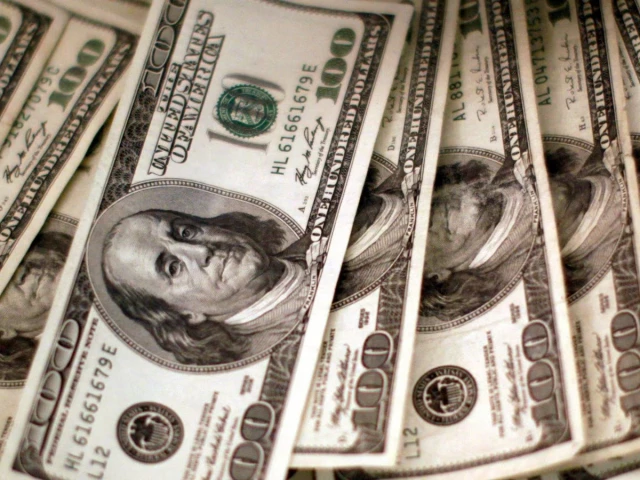
Fed hike odds jump to 26% from 70% cut probability week ago as Middle East war fuels inflation fears
A picture showing $100 bills. SOURCE: REUTERS
Currency markets took a breather on Wednesday, with traders cautious over United States President Donald Trump’s efforts to bring an end to the war with Iran. While Trump told reporters at the White House the US was making progress in talks with Iran, Tehran denied that direct negotiations had taken place, keeping investors on edge.
The US dollar index, which measures the greenback’s strength against a basket of six currencies, was last 0.13% higher at 99.317, with the euro little changed at $1.1603. The British pound was 0.16% weaker at $1.3388 as data showed that British consumer price inflation held at an annual rate of 3.0% in February, unchanged from January’s rate. However, inflation is broadly expected to pick up as the war in the Middle East pushes up prices.
The subdued volatility contrasted with a pickup in equities and a fall in crude oil prices after Trump said on Tuesday the US was making progress in its efforts to negotiate an end to the war.
Read: Trump approval sinks to 36% as fuel prices surge amid Iran war
“For those reacting to every breaking headline around dialogue between the US and its allies and Iran, including speculation of high-level talks and temporary ceasefire proposals, an element of fatigue is now firmly setting in,” said Chris Weston, head of research at Pepperstone Group Ltd in Melbourne.
Against the yen, the US dollar was up a slight 0.2% at 158.99, after the release of minutes from the Bank of Japan’s January policy meeting showed many board members saw the need to keep raising interest rates without any specific pace in mind. The Australian dollar weakened 0.33% to $0.697 after the release of inflation data for February, which showed a 3.7% rise prior to the start of the US-Israeli war with Iran, a slightly slower pace than expected by analysts.
Although markets still anticipate no change in US interest rates this year, expectations of policy tightening are rising. Fed funds futures now imply a 26.1% chance of a 25-basis-point hike at the Federal Reserve’s December meeting, compared to a 69.5% probability of a cut a week ago, according to CME Group’s FedWatch tool.
Read More: Global shares skid as oil surge threatens inflation shock
The Fed may need to keep interest rates steady “for some time” before further cuts are warranted, Fed Governor Michael Barr said on Tuesday, noting continued inflation above the Fed’s 2% target and the risks posed by the conflict in the Middle East.
Bond markets rebounded after a volatile week, with the yield on the US 10-year Treasury bond down 3.4 basis points at 4.356%. “Higher oil prices added to expectations of increasing inflationary pressures and tighter monetary policy,” analysts from Westpac wrote.
In cryptocurrencies, bitcoin climbed 1.6% to $71,202.33, while ether was up 1.2% at $2,174.14.


US’ Torrid sees FY25 sales fall 9.4%, reports $7 mn loss

Wristband enables wearers to control a robotic hand with their own movements
UK inflation rate steady in February ahead of Iran war

-

 Fashion7 days ago
Sales at US apparel, clothing accessories stores up 4% YoY in Jan 2026
-
 Business1 week ago
Peloton is launching bikes and treadmills for gyms, accelerating commercial strategy
-

 Tech1 week ago
Justice Department Says Anthropic Can’t Be Trusted With Warfighting Systems
-

 Fashion1 week ago
Trump signs order to combat fraudulent ‘Made in America’ labels
-
 Business1 week ago
Stocks and pound rise as US rate call approaches
-

 Fashion1 week ago
Lenzing launches TENCEL Lyocell-HV100 at Intertextile Shanghai
-

 Entertainment7 days ago
Val Kilmer revived 1 year after death through AI
-

 Sports1 week ago
PCB files complaint over allowing Bangladesh to take review on penultimate ball – SUCH TV