

Tech
Predicting sudden traffic congestion in real time using optical fiber cables

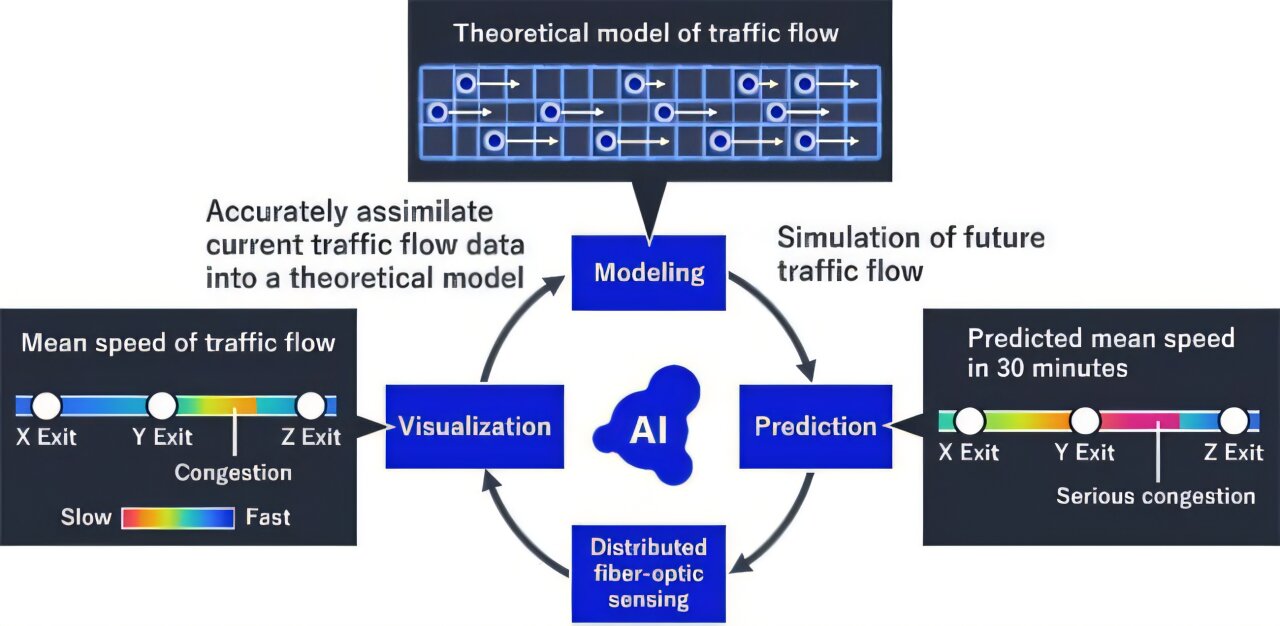
NEC Corporation has developed an optical fiber sensing technology to monitor road conditions and accurately predict sudden traffic congestion in real time. By collecting data from existing optical fiber communications cables and analyzing real-time traffic flow data using a proprietary AI model, the researchers have reduced prediction errors by 80% compared to conventional methods.
This technology enables effective traffic control, including the arrangement of detour routes, thereby contributing to the resolution of societal challenges such as logistics issues and CO2 emissions.
Technology overview
Traffic congestion is a significant social issue, threatening safety and causing substantial economic losses. In particular, congestion on expressways—the backbone of many logistics networks—has a significant economic impact. Addressing this issue requires real-time understanding of road conditions for both immediate congestion mitigation and proactive avoidance, as well as highly accurate congestion prediction based on up-to-date data.
Current monitoring approaches primarily rely on point-based instruments, including cameras and loop detectors, as well as probe vehicle data. However, both have limitations: the former is costly to install and maintain over entire road networks, and the latter only provides data when equipped vehicles pass by specific receiver points, limiting real-time and continuous coverage. Moreover, existing congestion prediction models heavily rely on long-term historical data, making it difficult to capture the emergence and propagation of sudden, unexpected congestion patterns.
To address these challenges, NEC has developed a technology that utilizes optical fiber cables—originally installed for communications purposes alongside roads—as extensive, distributed sensors for collecting real-time, continuous traffic flow data across entire routes. NEC’s unique AI-powered model then provides real-time, high-precision predictions regarding the development and clearance of sudden congestion.

Technical features
NEC has developed a data assimilation algorithm that combines advanced model parameter optimization and data adapting techniques, enabling accurate simulations of real-time traffic flow using comprehensive data collected along the entirety of roadways.
The team has created an algorithm to optimize theoretical model parameters—such as driver behaviors (e.g., inter-vehicle distance adjustment)—so that simulations faithfully reproduce observed traffic flow data for entire road segments.
Data adaptation algorithm
An advanced algorithm converts diverse traffic flow data, including “average speed” and individual vehicle “position/speed,” into formats compatible with simulation inputs. This makes it possible to set the initial conditions for simulations based on comprehensive traffic flow data obtained on entire routes, significantly enhancing the reliability of simulation outputs.
Through these innovations, the researchers have confirmed—using real-world data—that travel time prediction errors (a key indicator for congestion forecasting) can be reduced by approximately 80% compared to the existing method that relies on cross-sectional data from point sensors such as cameras.
NEC is further advancing the realization of a dynamic road digital twin that enables real-time, network-wide traffic monitoring, the prediction of congestion evolution, and optimization of responsive measures. Real-world trials are currently underway in close collaboration with road authorities, with the goal of practical deployment by fiscal 2026.
This technology was developed using data provided by Central Nippon Expressway Company Limited (NEXCO CENTRAL) and was presented at the Transportation Research Board 104th Annual Meeting held in Washington D.C. January 5–9, 2025 as a paper titled “A Novel Approach to Real-Time Short-Term Traffic Prediction based on Distributed Fiber-Optic Sensing and Data Assimilation with a Stochastic Cell-Automata Model.” It is available on the arXiv preprint server.
A related paper will be presented at the 31st ITS World Congress in Atlanta, Georgia, U.S. held August 24–28, focused on enhancing the accuracy of traffic flow monitoring on expressways.
More information:
Yoshiyuki Yajima et al, A Novel Approach to Real-Time Short-Term Traffic Prediction based on Distributed Fiber-Optic Sensing and Data Assimilation with a Stochastic Cell-Automata Model, arXiv (2025). DOI: 10.48550/arxiv.2501.03628
Provided by
NEC
Citation:
Predicting sudden traffic congestion in real time using optical fiber cables (2025, August 25)
retrieved 25 August 2025
from https://techxplore.com/news/2025-08-sudden-traffic-congestion-real-optical.html
This document is subject to copyright. Apart from any fair dealing for the purpose of private study or research, no
part may be reproduced without the written permission. The content is provided for information purposes only.









Tech
‘STAGED’: Conspiracy Theories Are Everywhere Following White House Correspondents’ Dinner Shooting

In the immediate aftermath of the attack on the White House Correspondents’ Dinner on Saturday night, influencers, pundits, and random posters lit up social media platforms like X, Bluesky, and Instagram with conspiracy theories about the attack and the alleged shooter.
Both left and right-wing accounts claimed, without evidence, that the attack was staged.
President Donald Trump, Vice President JD Vance, and dozens of other high-profile administration officials and journalists were attending the dinner at the Hilton hotel in Washington, DC, when a suspect, later identified by media reports as Cole Tomas Allen from California, allegedly ran past security towards the event. He was detained by law enforcement while the president and vice president were evacuated. Police said that they believe Cole acted alone, but did not expand on who his intended target was or what his motive may have been. “We believe the suspect was targeting administration officials,” acting attorney general Todd Blanche told NBC’s Meet the Press on Sunday morning.
On Bluesky, which has a predominantly left-leaning user base, many people simply wrote the word “STAGED” over and over again, echoing the response to the Trump assassination attempt in Butler, Pennsylvania in 2024.
On X, many claimed the shooting was staged as a way to bolster support for Trump’s plan to build a new ballroom in the White House. The president referenced the ballroom in a press conference after the incident and a Truth Social post on Sunday morning. Many prominent online Trump boosters echoed the need for the ballroom, including far-right podcaster Jack Posobiec, Libs of TikTok creator Chaya Raichik, and Tom Fitton, the right-wing activist who runs Judicial Watch.
Their quick response, conspiracy theorists claimed, was evidence of a coordinated campaign following the shooting. “Is this another staged event,” one X user asked in a post that has been viewed more than 5 million times.
Other social media users who claimed the incident was staged pointed to a Fox News clip that featured the station’s White House correspondent Aishah Hasnie speaking from the Hilton hotel. Hasnie told viewers that prior to the shooting, press secretary Karoline Leavitt’s husband allegedly told her “you need to be very safe,” before the call was cut off.
“Fox News just cut one of their reporters off as they seemed to indicate the shooting was a pre-planned false flag,” one X user wrote in a post that has been viewed more than 2 million times. Hasnie later clarified in an X post that her cell service had cut out in a location with notoriously bad service, adding: “He was telling me to be careful with my own safety because the world is crazy. He was expressing his concern for my safety.”
“I don’t want to be fomenting conspiracies,” wrote Angelo Carusone, the chair and president of Media Matters, on Bluesky about the Fox News interview. “But I mean…this was super weird. Super weird.”
Leavitt herself was also the focus of conspiracy theories after she said “shots will be fired” in an interview ahead of the dinner, referring to the jokes Trump was scheduled to deliver. Following the attack, X users claimed the comment was “strange,” “sus,” or a “curious choice of words,” while sharing memes that suggested the shooting was staged. At least one mainstream outlet appeared to amplify the conspiracy theory as well, describing Leavitt’s comment as “eerie” and “bizarre.”

Kindle Holders
Hate holding up your Kindle? Or struggle with chronic pain that makes holding it feel terrible? These holders will literally take the weight out of your hands.
A Freestanding Charger
Looking to keep your Kindle charged without adding another cord to the floor of your desk or bedside table? Same. Here’s a more stylish solution if you have one of the Signature editions.

Anker
Wireless Charging Dock for Kindle
This wireless charging dock is made by Anker for Kindles, specifically for Kindle Paperwhite and Colorsoft’s seven-inch Signature editions. Those versions have wireless charging capabilities, and this stand takes advantage of that with charging coils that line up with the back of the Kindle, where the wireless charging is. You’ll want to take off any MagSafe cases; leaving mine on made the little light on the charging dock flash until I took it off.
A Kindle Page Turner
The hottest new item to get as a Kindle lover is a page turner. They’re especially handy for holders like the ones above, where your hands aren’t already on the device, and can make for a great accessibility accessory for readers with different needs.
My biggest irritation with these devices so far is that you have to charge them both individually, and if one runs out of battery, the whole thing is useless. I also don’t love that the turner does tend to block at least one letter while I read, and you can’t place it on the lower or upper margins since it’ll activate the menus instead of turning the page. Still, it makes reading ultra comfortable, especially for my strained wrists.
Here’s my favorite one so far, that’s been solid at holding a charge, and next I’m testing this remote ($15) with a wearable ring clicker instead of a remote.
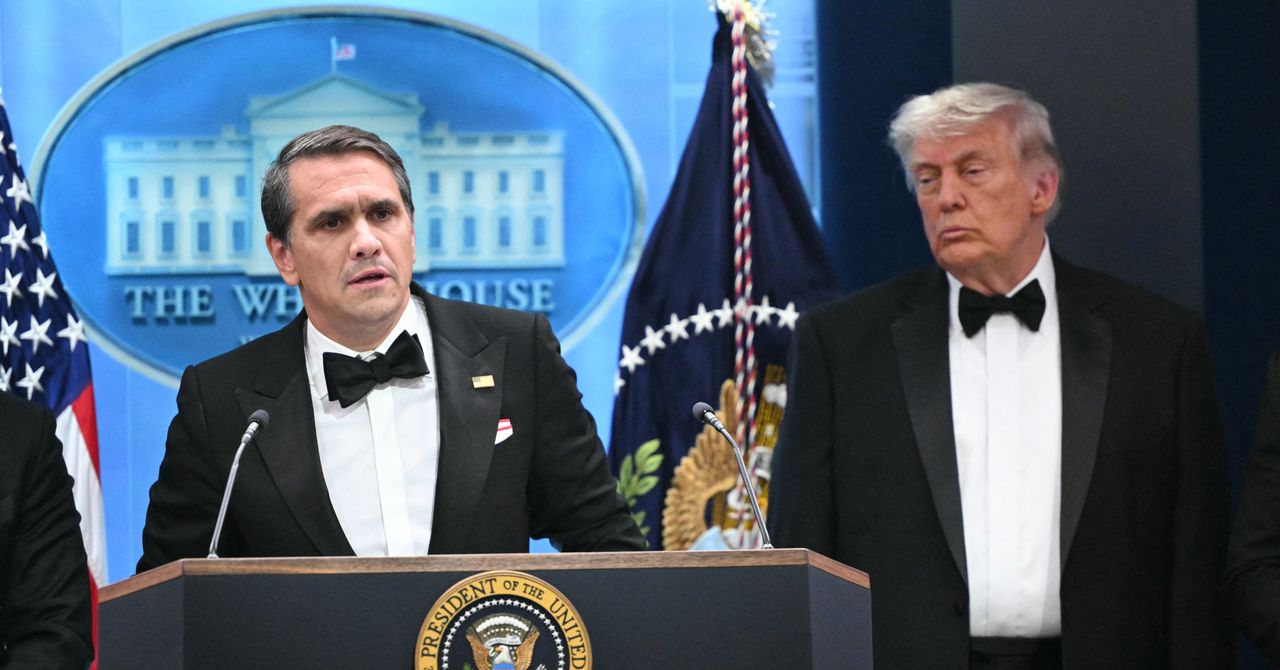
A 31-year-old engineer and computer scientist was identified by media reports and President Donald Trump as the suspected shooter at the White House Correspondents Dinner on Saturday night.
Cole Tomas Allen, of Torrance, California, was apprehended following the firing of shots at the Washington Hilton, where Trump was scheduled to deliver remarks to a ballroom full of journalists, cabinet officials, and Hilton staff. Allen’s name surfaced in media reports shortly before Trump posted two photos of a suspect following his apprehension. The person in the photos Trump posted matches photos of Allen.
In dramatic scenes, several shots were heard outside the ballroom, after which Trump and Vice President JD Vance were immediately rushed off the stage by the United States Secret Service. In the immediate aftermath of the shooting incident, it briefly appeared as if the event would proceed—Trump posted “LET THE SHOW GO ON” on Truth Social—but the event was eventually shut down.
According to the Metropolitan Police Department, the suspect “charged” a Secret Service checkpoint at the Hilton hotel, and was intercepted by agents. MPD interim chief Jeffery Carroll said the suspect was carrying a “shotgun, handgun, and multiple knives.”
At a White House press conference following the shooting, Trump said one United States Secret Service agent was shot but saved from serious injury by his bulletproof vest. Trump said the agent, who was not named, is “doing great” and in “great shape.” No other injuries were immediately reported.
The suspect was later transported to a local hospital “to be evaluated,” according to Carroll, who said he appears to be a “lone actor.”
Around the time Trump’s press conference began on Saturday night, he posted a picture on his Truth Social account appearing to show the suspected shooter on the ground, with his hands restrained behind his back, and a foil warming blanket covering the lower half of his body.
A WIRED review of public databases shows a seemingly minimal online presence associated with Allen’s name. According to his LinkedIn profile, he graduated from Caltech in 2017 with a bachelor’s in mechanical engineering and from California State University Dominguez Hills in 2025 with a master’s in computer science. An apparent photo of Allen that appears on Caltech’s website identifies him as a member of the school’s Mechanical Engineering 72 class, described by the school as a “two-term engineering design lab” for building robots and autonomous vehicles. His name is also listed in a 2025 Dominguez Hills graduation program. A search in a public facial recognition database returns only two images, both apparently of him as an undergraduate.
According to the alleged shooter’s LinkedIn profile, he has been employed part-time since March 2020 at C2 Education, a private company that helps students prepare for the SAT and ACT exams. In December 2024, C2 Education said in posts on LinkedIn and Facebook that he was the company’s “December Teacher of the Month.”
Since 2018, the suspected shooter has self-identified on his LinkedIn profile as a “self-employed” indie game developer. He appears to have released an “atomic fighting game” called Bohrdom on Steam in 2018. The game was advertised using accounts on YouTube and X that appeared to have little to no following. The caption for a trailer of the game describes it as a “non-violent, skill-based, asymmetrical fighting game loosely based on a chemistry model that is itself loosely based on reality.”
C2 Education and did not immediately respond to requests for comment. When reached for comment, the Metropolitan Police Department referred WIRED to a video of its public press conference.


Strait of Hormuz disruption ‘systemic shock’ threatening SE Asia: ERIA

Anta: The Chinese sports brand taking on Nike and Adidas

Prince Harry stirs new debate at Palace with bold move: ‘walking liability’

-

 Sports1 week ago
WWE WrestleMania 42 Night 2: Live match results and analysis
-

 Sports1 week ago
NCAA men’s gymnastics championship: All-time winners list
-

 Fashion1 week ago
UK’s Sosandar returns to profitability amid robust FY26 performance
-

 Entertainment1 week ago
Ruby Rose old essay resurfaces detailing night of alleged Katy Perry assault
-

 Politics6 days ago
UK’s Starmer seeks to deflect blame over Mandelson appointment
-

 Entertainment6 days ago
Lee Anderson, Zarah Sultana kicked out of UK Parliament for calling PM ‘liar’
-

 Entertainment1 week ago
Nathalie Baye, low-key legend of French cinema, dies aged 77
-
 Business1 week ago
No fuel shortage: Govt assures 100% domestic LPG, PNG, CNG supply amid Hormuz energy crunch – The Times of India