

Business
Trump raises new global tariffs to 15% after hitting out at ‘terrible’ Supreme Court

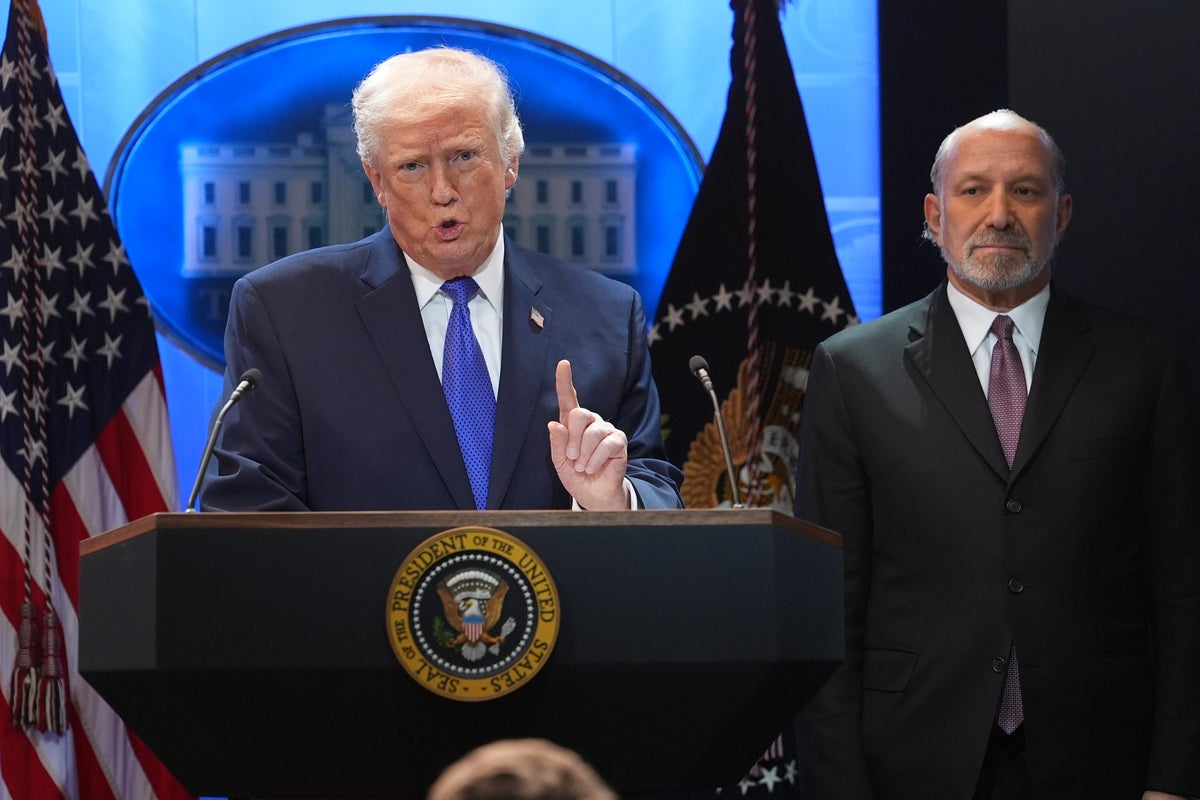
Donald Trump has increased global tariffs to 15 per cent as he hit out at a Supreme Court ruling that struck down his previous import levies, calling the ruling “terrible” and branding the justices who rejected his trade policy as “fools”.
On Friday, the US president said he would replace the tariffs axed by the court with a 10 per cent tax on all goods entering the US. But in a post on Truth Social on Saturday he announced plans to increase this to 15 per cent.
The US president’s “reciprocal tariffs”, imposed on most of the rest of the world last April under an emergency powers law, were overturned by the US Supreme Court on Friday in a major blow to the president’s economic agenda.
But he doubled down on imposing levies following the decision, claiming the court “has been swayed by foreign interests” and other countries were “dancing in the streets, but they won’t be dancing for long, that I can assure you”.
The UK scrambled to respond in the wake of the announcement, with ministers saying they expect the country’s “privileged trading position with the US” to continue following the Supreme Court’s ruling.
The UK received the lowest tariff rate of 10 per cent, and a subsequent deal struck by Sir Keir Starmer and Mr Trump saw further carve-outs for Britain’s steel industry and car manufacturers.
The US president’s latest tariff announcements raise questions over whether those deals still stand, although officials are understood to believe it will not impact on most of the UK’s trade with America, including preferential deals on steel, cars and pharmaceuticals.
Posting on Truth Social on Saturday afternoon, Mr Trump said: “I, as President of the United States of America, will be, effective immediately, raising the 10% Worldwide Tariff on Countries, many of which have been ‘ripping’ the U.S. off for decades, without retribution (until I came along!), to the fully allowed, and legally tested, 15% level.”
It came after a post on Friday evening said: “It is my Great Honor to have just signed, from the Oval Office, a Global 10 per cent Tariff on all Countries, which will be effective almost immediately. Thank you for your attention to this matter! PRESIDENT DONALD J. TRUMP”
He later added in a follow-up post criticising the Supreme Court Justices who ruled against his levies: “Their decision was ridiculous but, now the adjustment process begins, and we will do everything possible to take in even more money than we were taking in before!”
Speaking at the White House earlier, Mr Trump said the Supreme Court decision affirmed his ability to charge more tariffs under different statutes.
He said: “In order to protect our country, a president can actually charge more tariffs than I was charging in the past… period of a year.
“Under the various tariffs authorities, so we can use other of the statutes, other of the tariff authorities, which have also been confirmed and are fully allowed.
“Therefore, effective immediately, all national security tariffs under Section 232 and existing Section 301 tariffs, they’re existing, they’re there, remain in place, fully in place. And in full force.
“Today I will sign an order to impose a 10 per cent global tariff under Section 122, over and above our normal tariffs already being charged.
“And we’re also initiating several Section 301 and other investigations to protect our country from unfair trading practises of other countries and companies.”
A UK government spokesperson said: “This is a matter for the US to determine but we will continue to support UK businesses as further details are announced.
“Under any scenario, we expect our privileged trading position with the US to continue and will work with the administration to understand how the ruling will affect tariffs for the UK and the rest of the world.”

It was an updated version of a statement released earlier in response to the court ruling, but removed a reference to the UK enjoying “the lowest reciprocal tariffs globally”.
In the wake of the announcement, Liberal Democrat leader Sir Ed Davey said the UK government should sue Mr Trump for $100bn for the damage caused to the UK by trade tariffs, arguing it is “the only language he understands”.
He branded Mr Trump the “most dangerous, damaging US president of modern times” as he welcomed the “brilliant” decision by the US Supreme Court on Friday.
It came after Mr Trump said that some trade deals negotiated after he imposed his reciprocal tariffs will no longer be valid after the US Supreme Court ruling.
“Some of them stand. Many of them stand. Some of them won’t, and they’ll be replaced with the other tariffs,” he said.
When he first announced the 10 per cent “global tariff”, the US president said it would be in place for around five months.
“We’re going straight ahead with 10 per cent straight across the board… and then during that period of about five months, we are doing the various investigations necessary to put fair tariffs, or tariffs period, on other countries.
“So we’re doing that, period, but we’re immediately instituting the 10 per cent provision, which we’re allowed to do. And in the end, I think we’re taking more money than we’ve taken in before.”
The US has collected more than $133bn (£98.4bn) since Mr Trump imposed the tariffs, but now faces the prospect of having to refund that money to importers.
Friday’s decision, approved by a 6-3 majority, found that a 1977 law did not give Mr Trump the power to impose tariffs without the approval of the US Congress.
The British Chambers of Commerce (BCC) said the decision did little to “clear the murky waters for business” around US tariffs.
William Bain, head of trade policy at the BCC, said Mr Trump could use other legislation to reimpose tariffs.
He said: “For the UK, the priority remains bringing tariffs down wherever possible. It’s important the UK government continues to negotiate on issues like steel and aluminium tariffs and reduces the scope of other possible duties.”
Campaign group Best for Britain said the decision “underlines the instability of doing deals with Trump’s USA and the importance of forging deeper, more reliable trade with our EU neighbours”.

Crude prices fall back below $100 a barrel as markets hope an agreement can be reached between the two sides.
Source link

Broad-based rally fuelled by de-escalation hopes as investors turn optimistic about global peace
KARACHI:
The Pakistan Stock Exchange (PSX) opened on a distinctly bullish note as a renewed whisper of global calm set the tone for trading on Tuesday. The benchmark KSE-100 Index surged sharply in early hours, reflecting a wave of optimism among investors. At 9:39am, the index was hovering around 164,322.07, with gains of 3,730.74 points or 2.32%. It was then trading at 164,782.58, advancing with 4,191.25 points, or 2.61% at 12:34pm.
The rally follows growing expectations of a possible resumption of diplomatic talks between the United States and Iran, reviving hopes of de-escalation in a conflict that has shaken global financial markets.
The shift in sentiment comes in stark contrast to the previous session, where the market endured heavy losses amid failed negotiations and a spike in oil prices, triggering widespread panic selling across sectors.
Today, however, investors appear to be pricing in a different narrative – one where diplomacy may yet prevail. The prospect of renewed dialogue has eased concerns over supply disruptions and runaway energy prices, both critical variables for Pakistan’s import-heavy economy.
Read: PSX plunges over 6,600 points as US-Iran talks end without deal
Early gains were broad-based, led by index-heavy sectors such as automobile assemblers, cement, commercial banks, fertiliser, oil and gas exploration companies, OMCs, power generation and refinery, as participants moved to rebuild positions after the recent sell-off.
The sharp rebound underscores the market’s sensitivity to geopolitical signals, where even tentative progress towards peace can ignite strong bullish momentum.
Despite the upbeat start, analysts caution that volatility may persist, with much depending on whether diplomatic efforts translate into concrete outcomes. “Investors are optimistic about the likely resumption of talks between the US and Iran,” AKD Securities Director Research Mohammed Awais Ashraf told The Express Tribune.
Timely affirmation from Saudi Arabia and Qatar to bridge the gap in external financing to be created by the payment of UAE $3.5 billion this month and higher imports due to elevated oil prices have also helped to uplift the sentiment, he added. This is also likely to help in the timely approval of a $1.2 billion disbursement from the International Monetary Fund (IMF) after the approval of its executive board, Ashraf predicted.
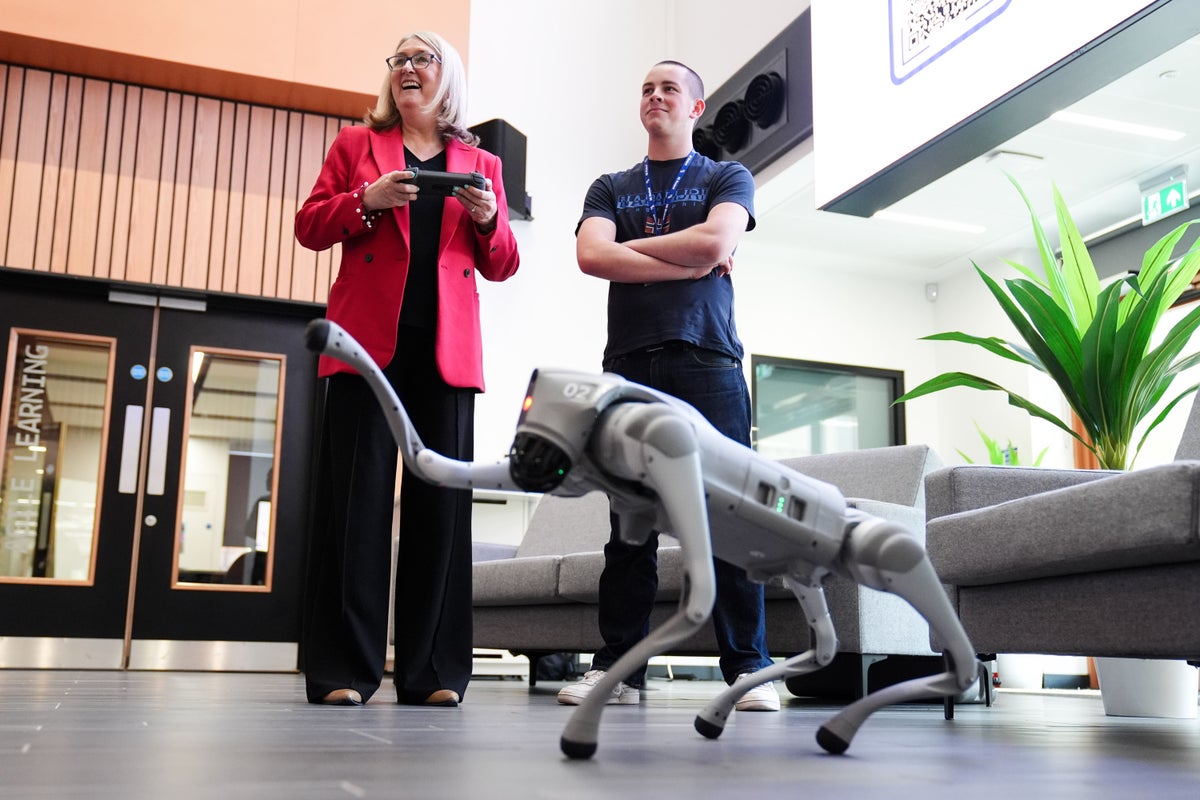
Around 65,000 young people will be able to train to enter the defence, clean energy, digital and manufacturing industries under the latest round of Government investment into colleges.
The Government will provide £175 million for 19 new Technical Excellence Colleges across the country to deliver training in sectors deemed important for the future of the UK.
Minister for skills Baroness Jacqui Smith said the investment would help build a pipeline of skilled workers for industries key to Britain’s future.
The Government has identified the areas most likely to help grow the economy, Baroness Smith told the Press Association, and said given the war happening in the Middle East, the UK needed to be able to support different ways of getting its energy.
“The Clean Energy (technical excellence colleges) that we’re announcing today will help us to develop that to speed up our shift to clean energy, to protect our energy supply and to help people with their bills,” she said.
“In the area of defence, where, given the instability and some of the new challenges to our defence in the world, and our contribution to that, this Government has pledged a big increase in defence spending that needs to support our armed forces and our capacity, but that spending also needs to deliver quality jobs to the UK defence industry, who will need skilled people in order to be able to deliver it.”
It is estimated nearly 600,000 additional workers will be needed in these key sectors by 2030, the Department for Education said.
If follows the first wave of 10 technical excellence colleges announced last year specialising in construction.
Prime Minister Sir Keir Starmer said: “I want every young person to know there is a clear route into well‑paid work, whatever their background. These colleges put technical skills front and centre, opening up high‑quality jobs in the industries driving Britain’s future.
“We are backing talent across the country, strengthening our workforce and making sure opportunity is built into the system – not left to chance.”
The colleges may spend the funding they receive on specialist equipment, developing new courses, training more specialist staff, and more.
On Monday, Baroness Smith met students and staff at Milton Keynes College, selected as a technical excellence college for digital, where students are already learning about robotics and artificial intelligence (AI).
It comes after the latest figures showed nearly a million (957,000) 16 to 24-year-olds were “Neet” (not in education, employment or training) in October to December 2025.
The high number of young people who were Neet was a “loss of opportunity” and a “loss for the country”, Baroness Smith told PA.
“That’s why we need really high-quality provision for young people between 16 to 19 to be able to access,” she said.
“We need our schools to better identify the young people who are potentially going to become Neet, we need them to take responsibility for making sure that young people have got the places, the college places, the apprenticeships, the jobs to go into.
“And we need brilliant colleges like Milton Keynes, where I am today, to be supported, to be able to provide the opportunities for young people who would otherwise be lost at such a crucial time in their lives and for the future of the skills that we need as a country as well.”
The Government has set a target for two-thirds of young people to be in higher education, higher-level training or doing a gold standard apprenticeship by age 25.
Jawad Al Midani, 21, started studying at Milton Keynes College for a Level 1 course, and has since worked his way up to studying for a Higher National Diploma (HND) in cyber security.
“I feel as soon as I finish my qualifications I’ll be ready to start my career,” he told PA.
Christian Proctor, 18, who is studying for a Higher National Certificate (HNC) in games design and will go on to an HND next year, said he was confident the skills he was learning would equip him for the next step once he finished college.
The 19 new Technical Excellence Colleges are as follows:
Defence
– Blackpool and The Fylde College– City College Plymouth– Lincoln College– RNN Group– Yeovil College
Clean Energy
– Colchester Institute– South Bank Colleges– The City of Liverpool College– The Education Training Collective– University Centre Somerset College Group
Digital and Technologies
– Birmingham Metropolitan College– Capital City College Group– Gloucestershire College– LTE Group– Milton Keynes College
Advanced Manufacturing
– City of Wolverhampton College– New College Durham– Newcastle and Stafford College Group– Weston College of Further and Higher Education


North India cotton yarn prices steady amid slow demand

Ryan Reynolds ‘unwantedly’ caught in Blake Lively legal mess

Transfer rumors, news: Bayern, Barça eye move for Milan’s Leão

-

 Fashion7 days ago
India’s exports face reset as EU links trade to carbon metrics: EY
-

 Entertainment6 days ago
Queen Elizabeth II emotional message for Archie, Lilibet sparks speculation
-

 Tech6 days ago
As the Strait of Hormuz Reopens, Global Shipping Will Take Months to Recover
-

 Tech6 days ago
Azure customers up in arms over ‘full’ UK South region | Computer Weekly
-

 Entertainment1 week ago
Lamar Odom shocking response to Khloé Kardashian account of his overdose
-

 Sports1 week ago
With Messi goal, Inter Miami open new stadium with dream moment
-

 Tech5 days ago
This AI Button Wearable From Ex-Apple Engineers Looks Like an iPod Shuffle
-

 Fashion6 days ago
CII submits 20-pt agenda to Indian govt to back firms hit by Iran war