

Business
Trump’s 50% tariffs on India take effect: Industry analysts warn of fallout as export hubs brace for pain; trade deal still in limbo— key takeaways – Times of India

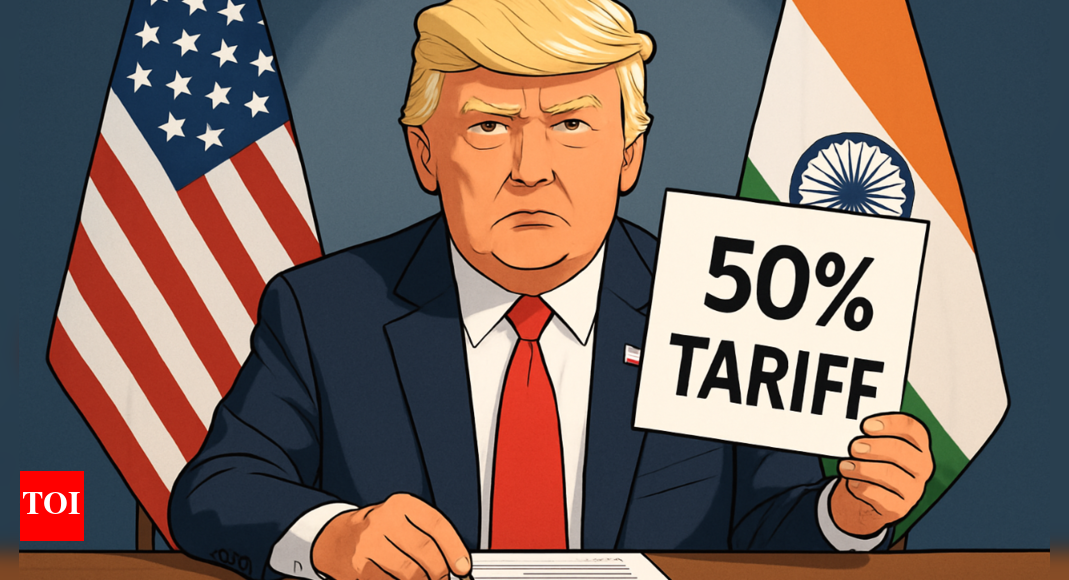
NEW DELHI: The additional 25 per cent tariff imposed by US President Donald Trump on Indian goods over New Delhi’s purchases of Russian oil have come into effect, raising the overall levy on exports to 50 per cent.Trump had first announced reciprocal tariffs of 25 per cent on India from August 7, alongside similar levies on about 70 other countries. He later doubled tariffs on Indian goods to 50 per cent, citing Russian crude imports, but allowed a 21-day window for negotiations.
Who’ll pay the price?
Several sectors, including textiles and apparels, gems and jewellery, seafood (primarily shrimp), and leather goods, are set to be affected by the newly imposed tariffs. The Indian pharmaceutical industry, a crucial supplier of generic drugs to the US, along with electronics and smartphones, including Apple iPhones, have been exempted from the tariffs. While some of the tariff costs may be absorbed by Indian exporters through price reductions and US importers by incurring higher expenses, the tariffs are expected to render Indian exports less competitive compared to exporters from neighbouring countries that face tariffs in the 10–25 percent range. The resulting decline in orders from the US, India’s largest market for these products, is anticipated to adversely impact hundreds of MSMEs (micro, small and medium enterprises), leading to layoffs and increased unemployment.
Exemptions and transit Clause
Indian products already “loaded on a ship and in transit” to the US before the August 27 deadline will be exempt from the additional 25 per cent duty, provided they are cleared for consumption by September 17, 2025, and importers declare the special code HTSUS 9903.01.85 to US Customs, DHS said.
FIEO sounds alarm as US tariffs bite
Apex exporters body Federation of Indian Export Organisations (FIEO) on Tuesday had warned that steep US tariffs have forced textile and apparel manufacturers in Tirupur, Noida, and Surat to halt production, reported PTI.President S C Ralhan said about $47–48 billion worth of India’s exports to the US now face 30–35 per cent cost disadvantages, making them uncompetitive against rivals from Vietnam, Bangladesh and China. Labour-intensive sectors like leather, shrimp and handicrafts are also at risk.He urged immediate support through cheaper credit, loan moratoriums, and faster trade deals, while stressing urgent diplomatic engagement with Washington.Also read: Indian refiners unlikely to stop Russia crude oil trade under US pressure
India stays firm
The government has ruled out retaliation but is preparing measures to cushion exporters from the 50% US tariffs. Senior officials told ET that a Rs 25,000-crore Export Promotion Mission is under consideration, covering trade finance, SEZ reforms, warehousing, ecommerce hubs, and “Brand India” promotion. Commerce minister Piyush Goyal said India will protect domestic interests through GST tweaks to boost demand in sectors like textiles and food processing, while also diversifying trade ties with other economies.Earlier, on Monday, Prime Minister Narendra Modi had said he could not compromise on the interests of farmers, cattle-rearers, and small-scale industries. “Pressure on us may increase, but we will bear it,” he asserted. India had described the US move as “unjustified and unreasonable.”
Experts call it a ‘lose-lose’
Trade experts warned the escalation risks damaging both economies. Mark Linscott, Senior Advisor with The Asia Group, was quoted by that “unfortunately”, the US and India have managed to convert what appeared to be a true and unprecedented win-win on trade into a “remarkable lose-lose.”“Hopefully, we will find a way to conclude a satisfactory mutually beneficial Free Trade Agreement with the United States early rather than late and that would certainly take us to the next step of the visit of President Trump to India,” said former foreign secretary and Rajya Sabha MP Harsh Vardhan Shringla.Meanwhile, Raj Manek, Executive Director and Board Member of Messe Frankfurt Asia Holdings Ltd stated India must intensify its focus on innovation and sustainability to achieve its $100 billion target in textiles. He stressed that investment in man-made fibres (MMF) and performance fabrics would be critical at this stage. “Over 60 per cent of global fibre consumption is now in MMF. With the PLI scheme targeting MMF apparel and technical textiles, India is well-positioned to build scale and future-ready capacity,” Manek said after the conclusion of the 13th edition of Gartex Texprocess India, a tradeshow on garment and textile machinery held in the capital, as reported by ET. He added, “At the same time, adopting energy-efficient machinery, managing effluents effectively, and converting waste into value will help meet ESG expectations while lowering costs.”
Indian refiners unlikely to stop Russia crude oil trade
Indian refineries are continuing their imports of Russian crude despite the Trump administration’s 25 per cent additional tariffs, with officials indicating minimal likelihood of halting purchases. Executives told ET that September-loading cargoes were slightly lower due to reduced discounts on Russian oil, but October volumes could rise as prices adjust. They stressed that there are no official instructions to stop procurement, reflecting the government’s clear message of “country first, commerce later.” Officials, including PM Narendra Modi, External Affairs Minister S Jaishankar, and Commerce Minister Piyush Goyal, have conveyed that India will support exporters through challenges rather than yield to US pressure. Industry representatives also noted that while transitioning from Russian oil is technically feasible, rapid changes are unnecessary as supply lines and global markets remain stable.Also read: India prepares multi-pronged strategy to shield economy; details here
Blow to the US too?
The tariff shock is also expected to hit the American economy. According to a report by the State Bank of India (SBI), US GDP could be shaved by 40–50 basis points, while inflationary pressures are likely to rise due to higher input costs and a weaker dollar.Also read: 50% tariffs on India to blowback on Trump? US GDP could shrink 40–50 bps, inflation to flare “We believe that US tariffs are likely to affect US GDP by 40–50 bps along with higher input cost inflation,” the SBI report noted. Import-sensitive sectors such as electronics, automobiles, and consumer durables are already feeling the strain. The report added that US inflation is expected to remain above the Federal Reserve’s 2 per cent target through 2026, driven by tariff pass-through and currency effects.
Trade deal still in limbo
Talks on a bilateral trade agreement (BTA) between India and the US have stalled, with the American delegation having postponed its scheduled August 25 visit to New Delhi.US Treasury Secretary Scott Bessent has accused India of “profiteering” by reselling Russian oil, while trade talks between the two sides remain on “thin ice,” according to experts. Analysts warn that unless Prime Minister Modi and President Trump engage directly, chances of reviving the deal remain slim. The deadlock raises uncertainty for exporters, who had earlier hoped for tariff relief through a limited trade pact.







The Eli Lilly logo appears on the company’s office in San Diego, California, U.S., Nov. 21, 2025.
Mike Blake | Reuters
Eli Lilly on Monday said it is lowering the cash prices of single-dose vials of its blockbuster weight loss drug Zepbound on its direct-to-consumer platform, LillyDirect, building on efforts by the company and the Trump administration to make the medicine more accessible.
The announcement also comes weeks after chief rival Novo Nordisk unveiled additional discounts on the cash prices of its obesity and diabetes drugs.
Starting Monday, cash-paying patients with a valid prescription can get the starting dose of Zepbound vials for as low as $299 per month on LillyDirect, down from a previous price of $349 per month. They can also access the next dose, 5 milligrams, for $399 per month and all other doses for $449 per month, down from $499 per month across those sizes.
Zepbound carries a list price of roughly $1,086 per month. That price point, and spotty insurance coverage for weight loss drugs in the U.S., have been significant barriers to access for some patients.
Eli Lilly’s announcement comes just weeks after President Donald Trump inked deals with Eli Lilly and Novo Nordisk to make their GLP-1 drugs easier for Americans to get and afford. The agreements will cut the prices the government pays for the drugs, introduce Medicare coverage of obesity drugs for the first time for certain patients and offer discounted medicines on the government’s new direct-to-consumer website launching in January, TrumpRx.
But Eli Lilly’s deal with Trump centers around lowering the prices of a different form of Zepbound – a multi-dose pen – after it wins Food and Drug Administration approval.
That means Eli Lilly’s Monday announcement around cutting prices on the existing single-dose vials could allow more patients to get discounted treatments more quickly.
“We will keep working to provide more options — expanding choices for delivery devices and creating new pathways for access — so more people can get the medicines they need,” said Ilya Yuffa, president of Lilly USA and global customer capabilities, in a statement.
Eli Lilly’s stock, which has climbed more than 36% this year, fell nearly 2% on Monday. Its meteoric rise due to the success of Zepbound and its diabetes injection Mounjaro vaulted it to becoming the first health-care company to hit a $1 trillion market value last month. Though cutting prices means lower revenue per medication sold, Eli Lilly’s sales — and shares — have continued to soar through past pricing announcements as demand balloons.
With single-dose vials, patients need to use a syringe and needle to draw up the medicine and inject it into themselves. Eli Lilly first introduced that form of Zepbound in August 2024.
It’s unclear how many patients are currently using single-dose vials of Zepbound. But Eli Lilly previously said that direct-to-consumer sales now account for more than a third of new prescriptions of Zepbound.
Novo Nordisk earlier this month lowered the price of its obesity drug Wegovy and diabetes treatment Ozempic for existing cash-paying patients to $349 per month from $499 per month. That excludes the highest dose of Ozempic.
The company also launched a temporary introductory offer, which will allow new cash-paying patients to access the two lowest doses of Wegovy and Ozempic for $199 per month for the first two months of treatment.

The chairman of the Office for Budget Responsibility (OBR) has resigned over the early publication of the watchdog’s forecasts.
Richard Hughes said he was resigning to allow the OBR to “quickly move on from this regrettable incident”.
His resignation follows publication of a report that described the leak as “the worst failure in the 15-year history of the OBR” and strongly criticised the watchdog’s processes for protecting sensitive information.
In a letter to the Chancellor and the chairwoman of the Commons Treasury Committee, Mr Hughes said he took “full responsibility” for “the shortcomings identified in the report”.
He said: “By implementing the recommendations in this report, I am certain the OBR can quickly regain and restore the confidence and esteem that it has earned through 15 years of rigorous, independent economic analysis.”
Mr Hughes has served as chairman of the OBR since 2020 and was reappointed to the job for a second five-year term in July this year.
Speaking in the Commons as the news of the resignation broke, Chief Secretary to the Treasury James Murray offered the Government’s thanks to Mr Hughes “for his dedication to public service”.
Later, the Chancellor herself offered her thanks for Mr Hughes’ “many years of public service”, adding: “This Government is committed to protecting the independence of the OBR and the integrity of our fiscal framework and institutions.”
Conservative leader Kemi Badenoch accused the Chancellor of using Mr Hughes as a “human shield” and called on Rachel Reeves to resign.
Liberal Democrat Treasury spokeswoman Daisy Cooper said Mr Hughes was “a dedicated public servant” who had “rightly taken responsibility for a failure on his watch”, adding the OBR needed to learn from its “catastrophic error”.
Treasury Committee chairwoman Dame Meg Hillier also thanked Mr Hughes, saying: “I commend his decision to take full responsibility for the incident and I wish him well for the future.”
The Treasury said it would begin the process of finding a replacement for Mr Hughes “in the coming weeks”.
The OBR launched an investigation after official forecasts were uploaded to the watchdog’s website, releasing details of the Budget almost an hour early.
In a report published on Monday, the OBR said the leak had been “seriously disruptive to the Chancellor, who had every right to expect that the (forecasts) would not be publicly available until she sat down at the end of her Budget speech”.
Noting Mr Hughes had already “rightly” apologised for the leak, the report said it was “not a case of intentional leakage” or a matter of pressing publish too early.
The OBR said it was caused by two errors linked to the WordPress publishing site it used.
The report into the incident said that, while it knew web addresses for its files follow a pattern, it assumed “the protections provided” by WordPress “would ensure it could not be accessed”.
But two configuration errors were the technical causes of the premature access.
The forecast for the last spring statement in March was also “accessed prematurely” on one occasion, the report noted, but concluded that no activity appeared to have been taken as a result and the most likely explanation is “benign”.
The report recommended a review of the watchdog’s processes for publishing such documents.
“To rebuild trust, the leadership of the OBR must take immediate steps to change completely the publication arrangements for the two important and time-sensitive documents containing the results of its biannual forecasts that it publishes in a normal year, and review arrangements for all other publications,” the report said.
One option would be for the watchdog to use the Government’s digital architecture but publish when it wants.
Another would be to have the Treasury publish the forecasts for the Budget and spring statement, but this would only work if safeguards for “real and perceived independence” could be put in place.
There may need to be an interim solution, the report noted, but said new arrangements must be in place in time for the next statement in spring 2026.

The Oil and Gas Regulatory Authority (OGRA) has approved a fresh increase in the price of liquefied petroleum gas (LPG), raising the cost for both domestic consumers and commercial users.
According to the notification issued, the LPG price has been increased by Rs7.39 per kilogram, setting the new rate at Rs209 per kg for December. As a result, the price of a domestic LPG cylinder has risen by Rs87.21, bringing the new price to Rs2,466.10.
In November, the price of LPG stood at Rs201 per kg, while the domestic cylinder was priced at Rs2,378.89.
The latest price hike is expected to put additional pressure on households already grappling with rising living costs nationwide.

How Nick Saban and ESPN tried to help Lane Kiffin coach two teams at once

MIT Sea Grant students explore the intersection of technology and offshore aquaculture in Norway
Eli Lilly cuts cash prices of Zepbound weight loss drug vials on direct-to-consumer site

-

 Sports1 week ago
WATCH: Ronaldo scores spectacular bicycle kick
-

 Entertainment1 week ago
Welcome to Derry’ episode 5 delivers shocking twist
-

 Politics1 week ago
Washington and Kyiv Stress Any Peace Deal Must Fully Respect Ukraine’s Sovereignty
-
 Business1 week ago
Key economic data and trends that will shape Rachel Reeves’ Budget
-

 Tech6 days ago
Wake Up—the Best Black Friday Mattress Sales Are Here
-

 Politics1 week ago
53,000 Sikhs vote in Ottawa Khalistan Referendum amid Carney-Modi trade talks scrutiny
-

 Fashion1 week ago
Canada’s Lululemon unveils team Canada kit for Milano Cortina 2026
-

 Tech1 day ago
Get Your Steps In From Your Home Office With This Walking Pad—On Sale This Week