

Business
Govt, Private Sector Can Keep Tariff Disruptions To Minimum: FinMin Economic Review


New Delhi: While near-term risks to economic activity, principally exports and capital formation remain due to tariff-related uncertainties, the government and the private sector, acting in tandem and concert, can keep the disruptions to a minimum, the Finance Ministry’s ‘Monthly Economic Review’ said on Wednesday. Going ahead, the robust macroeconomic fundamentals continue to bolster the resilience of the Indian economy.
“Setbacks eventually make us stronger and more agile, if handled properly. If the near-term economic pain is absorbed more by those who have the ability and the financial strength to do so, then small and medium enterprises in downstream industries will emerge stronger from the trade imbroglio. Now is the time to demonstrate an understanding of national interest,” according to the ‘Monthly Economic Review July 2025’.
The government’s recent policy initiatives, including the setting up of a Task Force for Next-Generation Reforms and the forthcoming GST reforms, deregulation initiatives of the States, coupled with the sovereign rating upgrade, are set to reduce borrowing costs, attract foreign capital, and bolster investment and consumption.
“These reforms mark the beginning of an accelerated phase of governance transformation, ensuring that India extends its own line of progress, becoming more resilient, inclusive, and globally competitive in an era of rising global economic self-interest,” the Review further stated. The US administration has imposted a hefty 50 per cent tariffs on Indian goods, a move touted as the ‘economic blackmail’.
According to the Economic Review, robust macroeconomic performance and sound fundamentals over the past few years have earned India a well-deserved sovereign rating upgrade by the S&P credit rating agency to ‘BBB’.
“The rating upgrade underscores India’s resilient growth, anchored inflation expectations, and stronger credit metrics, underpinned by fiscal consolidation and improved quality of spending. Building on the growth momentum gained during Q1 of FY26, the Indian economy continues to reflect resilience in July 2025,” it noted.
Record e-way bill generation and a 16-month high in PMI manufacturing point to robust business activity. Further, the stronger expansion in the services PMI indicates growth in the services activity. Domestic demand remained buoyant, as reflected in FMCG sales, UPI transactions, and vehicle sales, supported by strong rural consumption, strengthening urban demand and favourable monsoon conditions.
Forward-looking surveys of the Reserve Bank of India (RBI) signal broad-based improvements in business conditions, with rising capacity utilisation, stable inventories, and optimistic expectations across manufacturing, services, and infrastructure, underscoring sustained confidence in economic activity.
Fiscal performance during Q1 of FY26 reflects a strong capex push, with robust growth in capital expenditure alongside healthy revenue growth driven primarily by non-tax receipts. In July 2025, India’s total exports (goods and services) recorded a growth rate of 4.5 per cent (YoY), driven primarily by a 12.7 per cent growth (YoY) in core merchandise exports.
As of August 08, 2025, the foreign exchange reserves stand at a comfortable level of $695.1 billion, providing an import cover of 11.4 months. “In the dynamic global trade landscape, India has adopted a calibrated approach to negotiating FTAs, aiming to expand market access while protecting domestic interests. Recently, two major agreements, the India-UK CETA and the India-EFTA TEPA, have been concluded, and negotiations continue with a few other nations,” said the Economic Review.






Firms say digital twins make staff more productive, but are they a potential legal minefield?
Source link
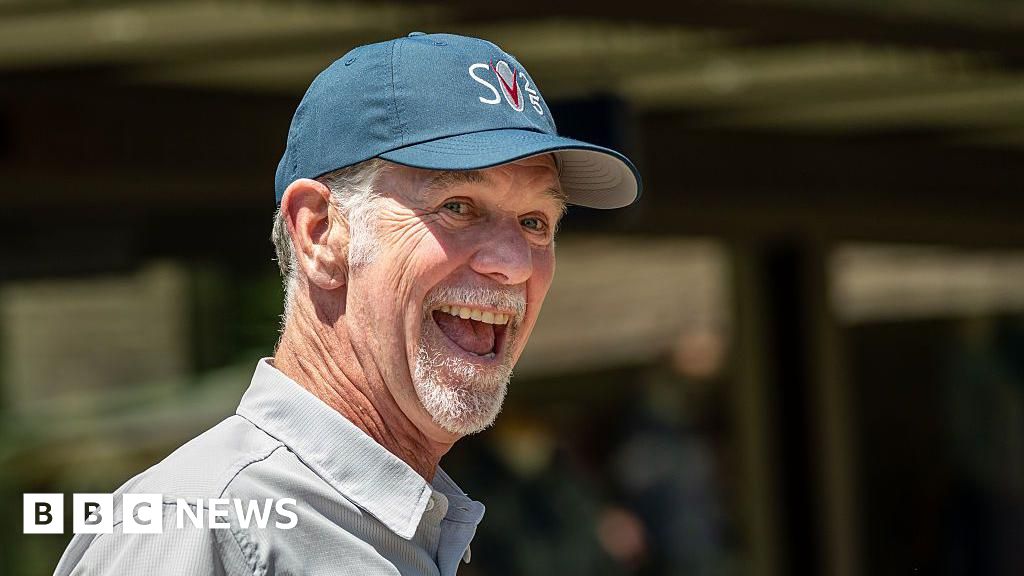
Hastings set up the company in 1997, when it rented DVDs to customers and delivered by post.
Source link
Business
Trump nominates Erica Schwartz as CDC director amid turmoil around leadership, vaccine policy

Rear Admiral Erica G. Schwartz.
U.S. Department of Health and Human Services
President Donald Trump on Thursday nominated Erica Schwartz to serve as director of the Centers for Disease Control and Prevention, concluding a monthslong effort to choose a permanent leader of the embattled health agency.
Schwartz, who will have to be confirmed by the Senate, would take over the role as Health and Human Services Secretary Robert F. Kennedy Jr. oversees a string of controversial health policy changes at the agency, including an overhaul of childhood vaccine recommendations.
Schwartz served as deputy surgeon general during the first Trump administration, where she played a major role in the U.S. response to the Covid-19 pandemic. She spent more than 20 year in uniform, including as rear admiral and chief medical officer of the Coast Guard.
Dr. Jay Bhattacharya had been acting director of the CDC — a title that expired last month under federal law. That law, called the Vacancies Act, limits the amount of time an acting officer can serve in place of a Senate-confirmed official to 210 days.
Late last month marked 210 days since the most recent CDC director, Dr. Susan Monarez, was fired.
A sign sits outside of the Centers for Disease Control and Prevention (CDC) Roybal campus in Atlanta, Georgia, U.S. March 18, 2026.
Megan Varner | Reuters
She has so far been the only person to serve as a confirmed CDC director during Trump’s second term, holding the role for under a month last summer. In congressional testimony in September, Monarez said she was fired after refusing Kennedy’s demands to approve vaccine recommendations she believed lacked scientific support.
It is unclear how Schwartz’s views on vaccines or other key public health policies compare with Kennedy’s.
Also on Thursday, Trump said he chose Sean Slovenski as deputy CDC director and chief operating officer, and Jennifer Shuford as deputy CDC director and chief medical officer. Shuford, as head of the Texas Department of State Health Services, led the state’s response to a massive measles outbreak last year, and credited vaccination and testing in declaring it over.
Schwartz’s nomination comes after a tumultuous several months for the agency, which is reeling from the leadership upheaval, plummeting morale, significant staff turnover and controversial changes to U.S. vaccine policy. Ahead of leadership departures last year, staff members were shaken by a gunman’s attack on the CDC’s Atlanta headquarters on Aug. 8.
Last month, a judge blocked a critical vaccine panel’s efforts to overhaul U.S. immunization policy. That includes an effort to reduce the number of recommended childhood shots from 17 to 11.
Trust in federal health agencies has plummeted during Kennedy’s tenure as Health and Human Services secretary, according to a February poll from health policy research group KFF, with declines across the political spectrum.


Mike Trout crushes fifth Yankee Stadium HR in four games

AI version of Val Kilmer to star in new movie after his death

2026 NCAA gymnastics championships: Live updates from semifinals

-

 Entertainment1 week ago
Queen Elizabeth II emotional message for Archie, Lilibet sparks speculation
-

 Tech1 week ago
Azure customers up in arms over ‘full’ UK South region | Computer Weekly
-

 Tech1 week ago
As the Strait of Hormuz Reopens, Global Shipping Will Take Months to Recover
-

 Fashion1 week ago
CII submits 20-pt agenda to Indian govt to back firms hit by Iran war
-

 Tech1 week ago
This AI Button Wearable From Ex-Apple Engineers Looks Like an iPod Shuffle
-

 Politics7 days ago
Indian airlines hit hardest after Dubai limits foreign flights until May 31
-

 Entertainment4 days ago
Palace left in shock as Prince William cancels grand ceremony
-

 Politics7 days ago
Chinese, Taiwanese will unite, Xi tells Taiwan opposition leader