

Politics
Trump says US won’t intervene in Islamabad-Kabul conflict

- Fighting continues as Pakistan, Afghanistan enter in “open war”.
- Trump stresses he has “very good relations” with Pakistan.
- President says he has a lot of respect for PM Shehbaz, CDF Munir.
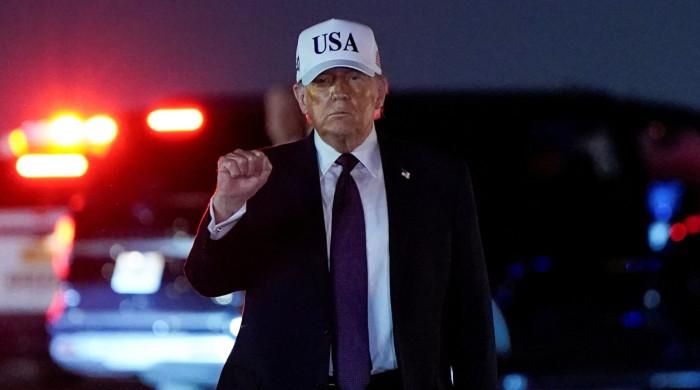
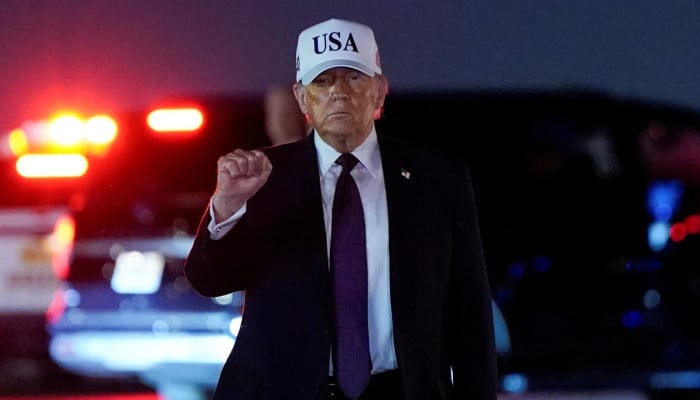
As hostilities between Pakistan and Afghanistan continue along the border, United States President Donald Trump has said that Washington will not intervene in a possible conflict between Islamabad and Kabul.
Trump said he could step in but stressed that he has “very good relations” with Pakistan.
He further said Pakistan has a great prime minister and a great military leader, adding that they are two people I have a lot of respect for.
The neighbouring countries entered an “open war” after Pakistan retaliated with full force after the Taliban regime resorted to unprovoked firing along multiple sectors in Khyber Pakhtunkhwa (KP), including Chitral, Khyber, Mohmand, Kurram, and Bajaur on Thursday night.
In their retaliatory attacks named Operation Ghazab lil-Haq (Righteous Fury), Pakistan’s armed forces destroyed several key Afghan Taliban posts, while the PAF conducted strikes in Kandahar, Kabul, and Paktia, causing heavy losses on the Afghan side.
As many as 12 security personnel embraced martyrdom and 27 sustained injuries during the retaliatory response, while 331 Afghan Taliban have been killed so far, as per Pakistani authorities.
The US president, who has repeatedly boasted about ending several wars across the globe, said on Friday that he would not step into the latest ongoing conflict when asked whether the United States would intervene.
Trump said he could step in but stressed that he has “very good relations” with Pakistan. He talked highly of the Pakistani leadership.
“Well, I would (intervene), but I get along with Pakistan, as you know, very well. Very, very well. You have a great Prime Minister, you have a great general there, you have a great leader, two of the people that I really respect a lot,” he told reporters.
He further said he believes Pakistan is moving forward very strongly, signalling that Washington does not intend to interfere.
US supports Pakistan’s ‘right to defend’
The US said it supported Pakistan’s “right to defend itself” against attacks from the Taliban regime after Islamabad said earlier that the neighbouring countries were in “open war.”
Afghanistan’s rulers had said on Friday they were willing to negotiate after Pakistan bombed their forces in major cities.
“The United States supports Pakistan’s right to defend itself against attacks from the Taliban, a Specially Designated Global Terrorist group,” a State Department spokesperson said in an emailed statement.
The State Department spokesperson said Washington was aware of the escalation in tensions and “outbreak of fighting between Pakistan and the Afghan Taliban,” adding the US was “saddened by the loss of life.”
“The Taliban have consistently failed to uphold their counterterrorism commitments,” the State Department said, adding that “terrorist groups use Afghanistan as a launching pad for their heinous attacks”.
The recent escalation of tensions between Pakistan and Afghanistan follows Pakistan’s retaliatory actions in response to suicide bombings in Islamabad, Bajaur, and Bannu, all of which were traced back to militants based in Afghanistan.
Islamabad, which has repeatedly urged Kabul to prevent its soil from being used by terrorist organisations to carry out attacks, conducted intelligence-based strikes targeting seven terrorist camps and hideouts belonging to Fitna al Khawarij (FAK) — a term used for the banned Tehreek-e-Taliban Pakistan (TTP) — its affiliates and the Daesh-Khorasan, along the Pakistan-Afghanistan border last week.
Prime Minister’s spokesperson for Foreign Media, Mosharraf Zaidi, has said Afghan Taliban authorities had allowed militant groups to operate from their soil by providing what he described as safe havens.
Talking to the foreign media on Friday, he argued that the alleged patronage of such groups by Taliban leadership constituted a breach of commitments made under the Doha Agreement.
The two countries agreed to a ceasefire in October 2025 when the Afghan Taliban regime opened unprovoked gunfire at several border points.
The Afghan forces’ firing was aimed at helping Khawarij formations cross the border into Pakistan.
Islamabad, however, back then had agreed to an initial ceasefire at Kabul’s request. The countries then later reached a ceasefire deal in Qatar, which was mediated by Doha and Turkiye.
Under the agreement, terrorism from Afghanistan on Pakistani soil was to be stopped immediately.
The two sides then further held follow-up discussions in Turkiye which did not deliver the desired results due to stubbornness from the Afghan side, as Kabul used the Istanbul talks to malign Pakistan rather than address Islamabad’s core concern of terrorism emanating from Afghan soil.
- Authorities urge residents to stay away from coastal areas.
- Tsunami waves of up to 3 metres (9.84 ft) expected.
- Biggest waves expected in Iwate, Aomori and Hokkaido prefectures.
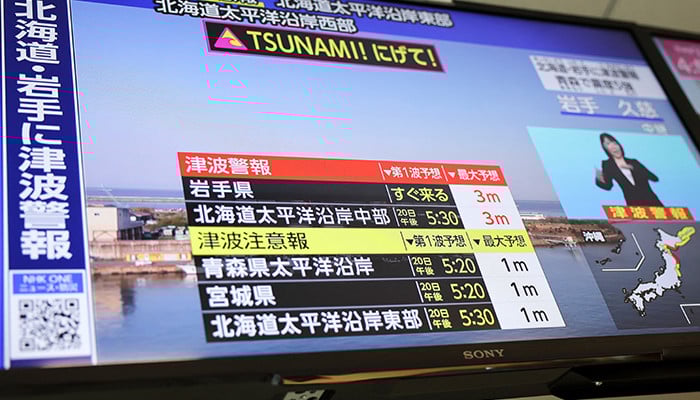
An earthquake with a magnitude of 7.5 struck off the northeastern coast of Japan on Monday, as authorities urged residents to stay away from coastal areas where tsunami waves of up to 3 metres (9.84 ft) were expected.
The tremor had an epicentre in the Pacific Ocean and was 10km deep, according to the Japan Meteorological Agency. The biggest waves were expected in Iwate, Aomori and Hokkaido prefectures, authorities said.
Speaking to reporters, Prime Minister Sanae Takaichi said the government had set up an emergency task force and urged citizens in the affected areas to evacuate to safety.
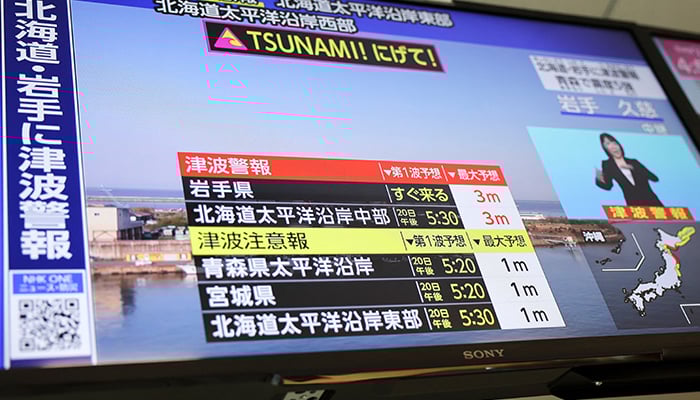
Broadcaster NHK showed ships sailing out of Hachinohe port in Hokkaido in anticipation of the waves, as an alert ‘Tsunami! Evacuate!’ flashed across the screen.
Bullet train services in Aomori at the northern tip of Japan’s main Honshu island were halted due to the tremors, Kyodo news agency reported.
The quake measured an ‘upper 5’ on Japan’s seismic intensity scale — strong enough to make it difficult for people to move around. In many cases, unreinforced concrete-block walls collapse.
Japan is one of the world’s most earthquake-prone countries, with a tremor occurring at least every five minutes. Located in the “Ring of Fire” of volcanoes and oceanic trenches partly encircling the Pacific Basin, Japan accounts for about 20% of the world’s earthquakes of magnitude 6.0 or more.
There are no nuclear power plants currently in operation in Hokkaido and Tohoku regions, but Hokkaido Electric Power and Tohoku Electric Power have a number of shutdown nuclear power plants there. Tohoku Electric said it was checking the impact of the earthquake and tsunami on its Onagawa nuclear power plant.

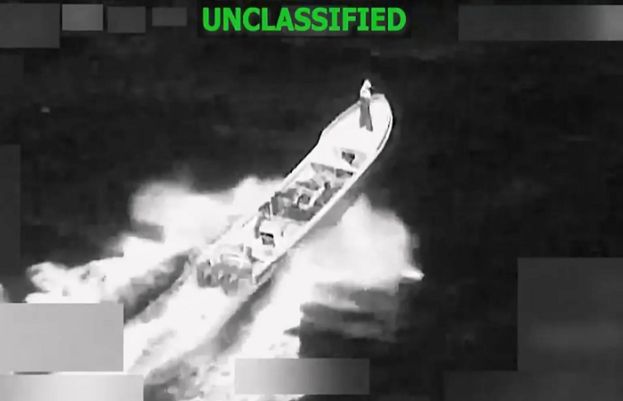
US forces killed three men whom the military described as illicit drug smugglers in a strike on a boat in the Caribbean, US Southern Command said on Sunday.
Southern Command posted what it said was a video of the strike on the social media platform X, showing an explosion of a small boat travelling on open water.
The boat was travelling on “known narco-trafficking routes in the Caribbean,” Southern Command said.
The US military has so far killed 157 alleged members or affiliates of drug organisations in 45 strikes against drug trafficking vessels in the Western Hemisphere, a senior US defence official said last month.
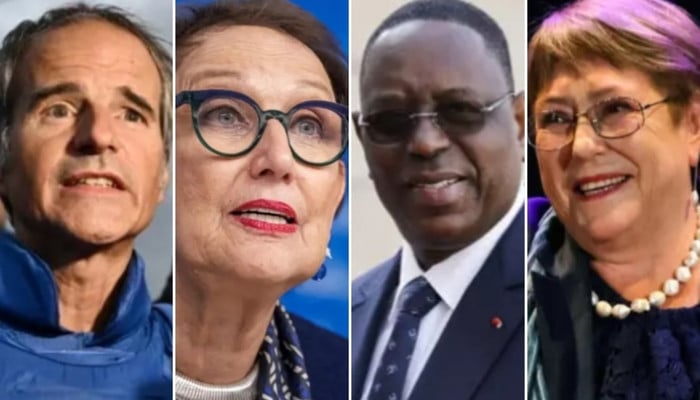
Four contenders are squaring up to succeed Antonio Guterres as leader of the United Nations, which faces unprecedented global instability, wars and its own crushing budget crisis.
Chile’s Michelle Bachelet, Argentina’s Rafael Grossi, Costa Rican Rebeca Grynspan, and Senegal’s Macky Sall will each face grillings by 193 member states and NGOs for three hours on Tuesday and Wednesday.
It is only the second time the UN has held a public Q&A, a format created in 2016 to boost transparency.
Ultimately the five permanent members of the UN’s top body, the Security Council, hold the power, wielding vetoes over who leads the global organisation as its secretary-general.
US President Donald Trump’s envoy to the Manhattan-based UN, Mike Waltz, has warned the next chief must align with “American values and interests” and that Washington would back the best candidate — not necessarily a Latin American woman, as some countries are demanding.
All four candidates to take over the embattled UN when Guterres departs on December 31, 2026 pledge to grow trust in the bitterly divided organisation that faces financial Armageddon because of Washington’s refusal to pay its bills.
Here is a look at the contenders:
Michelle Bachelet
A Chilean socialist brutally tortured by the regime of Augusto Pinochet, Bachelet became her country’s first woman president in 2006.
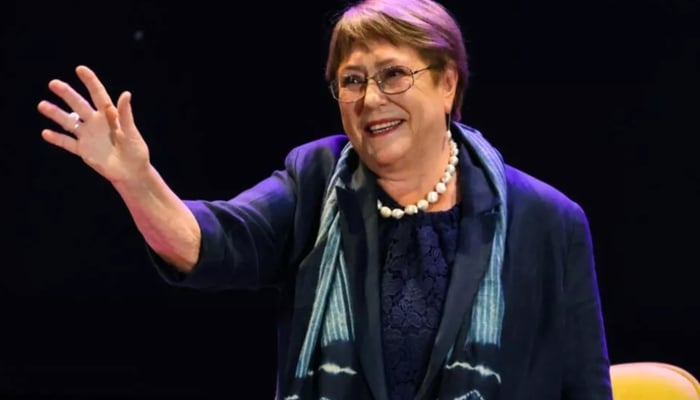
She went on to be the UN rights chief, a sensitive role in which she alienated some countries, especially China, which mauled her for reporting on alleged abuses of the Uyghur people.
Bachelet, 74, has said that she is “convinced” she has the experience “to confront a moment” marked by unprecedented crises and conflicts.
She is backed by Mexico and Brazil — but Chile withdrew its backing after far-right President Jose Antonio Kast took office.
Rafael Grossi
The 65-year-old Grossi, a career diplomat, has led the International Atomic Energy Agency since 2019, propelling him into the middle of the battle over Iran’s nuclear programme as well as the Russian occupation of Ukraine’s Zaporizhzhia nuclear plant.
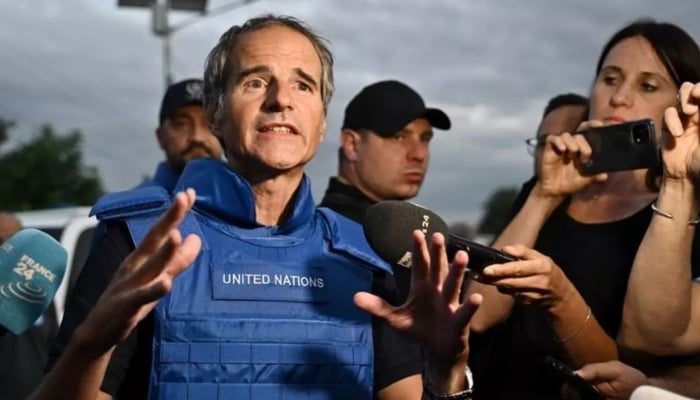
His handling of the two situations has drawn close scrutiny from the United States and Russia, which both have veto power on the Security Council.
Grossi has called for the UN to “return to its founding promise — to save humanity from the scourge of war.”
Rebeca Grynspan
Less well-known than her opponents, Grynspan — Costa Rica’s former vice president — leads the UN trade and development body UNCTAD, pulling off a diplomatic feat by brokering the Black Sea Grain Initiative between Moscow and Kyiv to allow grain exports following Russia’s invasion.
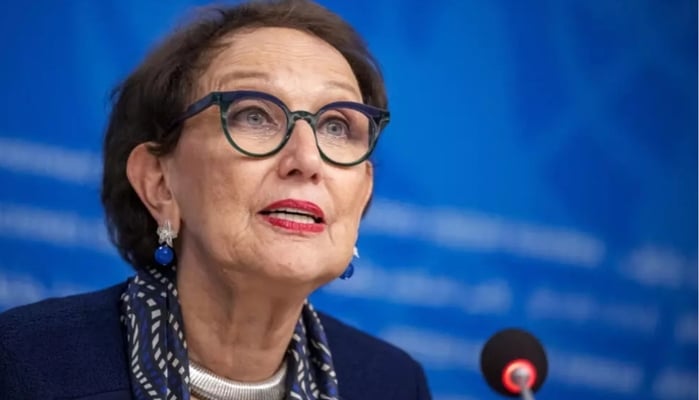
In her pitch to world leaders, the 70-year-old plays up her personal story as the daughter of Jewish parents.
She said they “barely survived” the Holocaust before emigrating to Costa Rica, stressing her attachment to the UN Charter, calling the document signed as World War II came to an end a “standing warning against the perils of dehumanisation, distrust and fragmentation.”
Macky Sall
Macky Sall, 64, is the only candidate who does not come from Latin America, from where the next UN boss should come, according to convention.
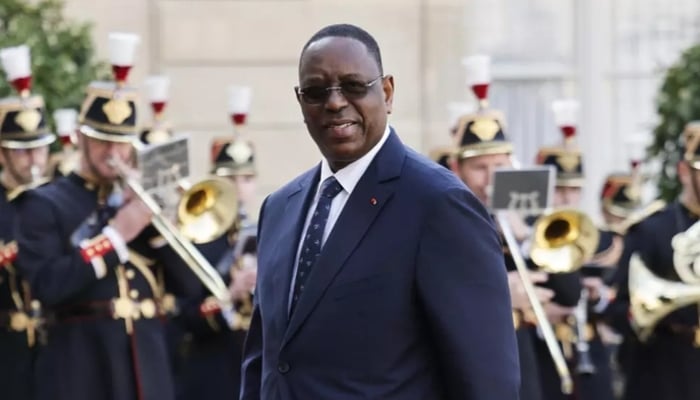
The former Senegalese president has stressed the link between peace and development in his pitch to lead the UN.
He said peace can never be “sustainable” if development is undermined “by poverty, inequality, exclusion and climate vulnerability.”
Proposed by Burundi, the current chair of the African Union, Sall is supported neither by the regional African bloc — 20 of its 55 members oppose him — nor by his own country.
Senegalese authorities accuse him of bloodily repressing violent political demonstrations that left dozens dead between 2021 and 2024.


‘Saturday Night Live’ alum Tina Fey admits past jokes missed the mark

There’s New Evidence for How Loneliness Affects Memory in Old Age

Prince William’s ally Robert Irwin rejects Prince Harry, Meghan offer

-

 Fashion4 days ago
France’s LVMH Q1 revenue falls 6%, shows resilience amid Iran war
-

 Sports7 days ago
The case for Man United’s Fernandes as Premier League’s best
-

 Entertainment1 week ago
Palace left in shock as Prince William cancels grand ceremony
-
 Business1 week ago
UK could adopt EU single market rules under new legislation
-

 Entertainment5 days ago
Is Claude down? Here’s why users are seeing errors
-

 Sports1 week ago
Lamar Jackson hits back at critics with faithful message on social media
-

 Fashion1 week ago
Energy emerges as biggest cost driver in textile margins
-
 Business1 week ago
Road accidents: a massive economic challenge | The Express Tribune