

Politics
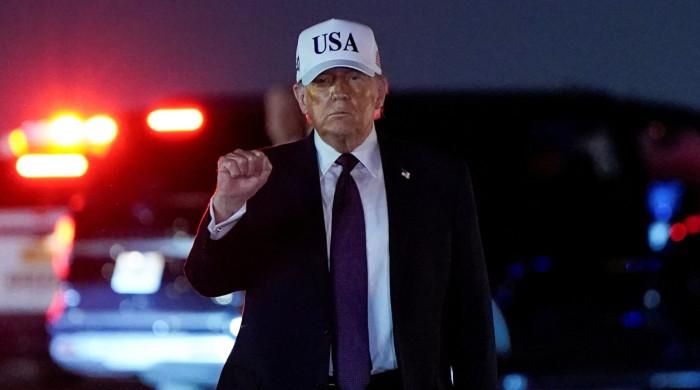
Trump says US won’t intervene in Islamabad-Kabul conflict

- Fighting continues as Pakistan, Afghanistan enter in “open war”.
- Trump stresses he has “very good relations” with Pakistan.
- President says he has a lot of respect for PM Shehbaz, CDF Munir.
As hostilities between Pakistan and Afghanistan continue along the border, United States President Donald Trump has said that Washington will not intervene in a possible conflict between Islamabad and Kabul.
Trump said he could step in but stressed that he has “very good relations” with Pakistan.
He further said Pakistan has a great prime minister and a great military leader, adding that they are two people I have a lot of respect for.
The neighbouring countries entered an “open war” after Pakistan retaliated with full force after the Taliban regime resorted to unprovoked firing along multiple sectors in Khyber Pakhtunkhwa (KP), including Chitral, Khyber, Mohmand, Kurram, and Bajaur on Thursday night.
In their retaliatory attacks named Operation Ghazab lil-Haq (Righteous Fury), Pakistan’s armed forces destroyed several key Afghan Taliban posts, while the PAF conducted strikes in Kandahar, Kabul, and Paktia, causing heavy losses on the Afghan side.
As many as 12 security personnel embraced martyrdom and 27 sustained injuries during the retaliatory response, while 331 Afghan Taliban have been killed so far, as per Pakistani authorities.
The US president, who has repeatedly boasted about ending several wars across the globe, said on Friday that he would not step into the latest ongoing conflict when asked whether the United States would intervene.
Trump said he could step in but stressed that he has “very good relations” with Pakistan. He talked highly of the Pakistani leadership.
“Well, I would (intervene), but I get along with Pakistan, as you know, very well. Very, very well. You have a great Prime Minister, you have a great general there, you have a great leader, two of the people that I really respect a lot,” he told reporters.
He further said he believes Pakistan is moving forward very strongly, signalling that Washington does not intend to interfere.
US supports Pakistan’s ‘right to defend’
The US said it supported Pakistan’s “right to defend itself” against attacks from the Taliban regime after Islamabad said earlier that the neighbouring countries were in “open war.”
Afghanistan’s rulers had said on Friday they were willing to negotiate after Pakistan bombed their forces in major cities.
“The United States supports Pakistan’s right to defend itself against attacks from the Taliban, a Specially Designated Global Terrorist group,” a State Department spokesperson said in an emailed statement.
The State Department spokesperson said Washington was aware of the escalation in tensions and “outbreak of fighting between Pakistan and the Afghan Taliban,” adding the US was “saddened by the loss of life.”
“The Taliban have consistently failed to uphold their counterterrorism commitments,” the State Department said, adding that “terrorist groups use Afghanistan as a launching pad for their heinous attacks”.
The recent escalation of tensions between Pakistan and Afghanistan follows Pakistan’s retaliatory actions in response to suicide bombings in Islamabad, Bajaur, and Bannu, all of which were traced back to militants based in Afghanistan.
Islamabad, which has repeatedly urged Kabul to prevent its soil from being used by terrorist organisations to carry out attacks, conducted intelligence-based strikes targeting seven terrorist camps and hideouts belonging to Fitna al Khawarij (FAK) — a term used for the banned Tehreek-e-Taliban Pakistan (TTP) — its affiliates and the Daesh-Khorasan, along the Pakistan-Afghanistan border last week.
Prime Minister’s spokesperson for Foreign Media, Mosharraf Zaidi, has said Afghan Taliban authorities had allowed militant groups to operate from their soil by providing what he described as safe havens.
Talking to the foreign media on Friday, he argued that the alleged patronage of such groups by Taliban leadership constituted a breach of commitments made under the Doha Agreement.
The two countries agreed to a ceasefire in October 2025 when the Afghan Taliban regime opened unprovoked gunfire at several border points.
The Afghan forces’ firing was aimed at helping Khawarij formations cross the border into Pakistan.
Islamabad, however, back then had agreed to an initial ceasefire at Kabul’s request. The countries then later reached a ceasefire deal in Qatar, which was mediated by Doha and Turkiye.
Under the agreement, terrorism from Afghanistan on Pakistani soil was to be stopped immediately.
The two sides then further held follow-up discussions in Turkiye which did not deliver the desired results due to stubbornness from the Afghan side, as Kabul used the Istanbul talks to malign Pakistan rather than address Islamabad’s core concern of terrorism emanating from Afghan soil.
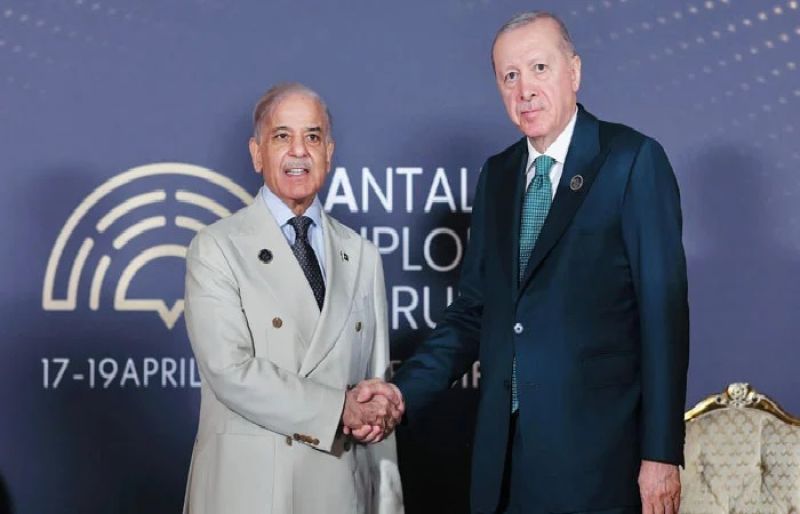
Prime Minister Shehbaz Sharif on Friday held a bilateral meeting with Turkish President Recep Tayyip Erdogan on the sidelines of the 5th Antalya Diplomacy Forum.
According to a statement released by the Prime Minister’s Office, during the warm and cordial meeting, President Erdogan welcomed PM Shehbaz to Turkiye and thanked him for attending the Antalya Diplomacy Forum.
The meeting comes a day after the premier reached Turkiye on the third leg of his tri-nation tour after concluding visits to Saudi Arabia and Qatar.
During his visit to Riyadh and Doha, PM Shehbaz held meetings with Saudi Crown Prince Mohammed bin Salman and Qatar’s Emir Sheikh Tamim bin Hamad Al Thani.
The Turkish president, during the meeting with PM Shehbaz on the sidelines of the diplomacy forum earlier today, praised the prime minister’s peace efforts and said Turkiye would continue to support Pakistan’s diplomatic initiative to bring peace to the region.
The prime minister thanked President Erdogan for his warm invitation and traditional Turkish hospitality extended to him and his delegation during his stay in Antalya.
He congratulated the Turkish president on the success of the Antalya Diplomacy Forum, which he said had transformed into an important global event.
The two leaders exchanged views on recent regional developments, particularly the evolving situation in the Middle East. PM Shehbaz thanked Erdogan for his strong support and encouragement of Pakistan’s peace efforts and shared with him the updates on how to extend the ceasefire and resume talks so that a peace agreement could be reached.
The two leaders also emphasised the importance of effectively utilising the current window of opportunity to advance a durable and lasting regional peace.
While reaffirming the deep-rooted, historic, and brotherly ties between Pakistan and Turkiye, both leaders expressed satisfaction at the positive trajectory of bilateral relations. They agreed to convene the 8th High-Level Strategic Cooperation Council (HLSCC) meeting in Ankara later this year.
The two leaders emphasised the importance of expediting the implementation of ongoing initiatives and exploring new opportunities to further deepen economic engagement.
The meeting concluded with both leaders reaffirming their resolve to further strengthen the strategic partnership between Pakistan and Türkiye, building on fraternal ties and a shared vision for peace and prosperity.
The meeting was attended by Deputy Prime Minister and Foreign Minister Ishaq Dar, Minister for Information Ataullah Tarar and other senior officials.
Turkish Foreign Minister Hakan Fidan and other senior Turkish officials were also present.
PM meets world leaders on sidelines of diplomacy forum
Prime Minister Shehbaz Sharif held a series of meetings with world leaders on the sidelines of the Antalya Diplomacy Forum.
During the interactions, the prime minister met Qatar’s Emir Sheikh Tamim bin Hamad Al Thani, Kazakhstan’s President Kassym-Jomart Tokayev, Azerbaijan’s President Ilham Aliyev, and Syria’s President Ahmed al-Sharaa.
He also held meetings with Qatar’s Prime Minister and Foreign Minister Sheikh Mohammed bin Abdulrahman bin Jassim Al Thani, as well as former Kosovo president Vjosa Osmani.
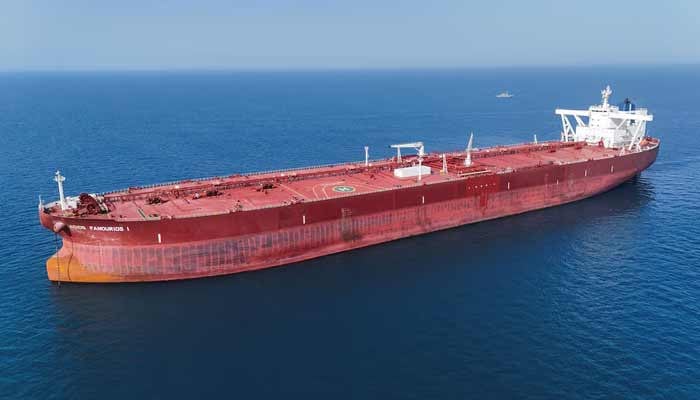
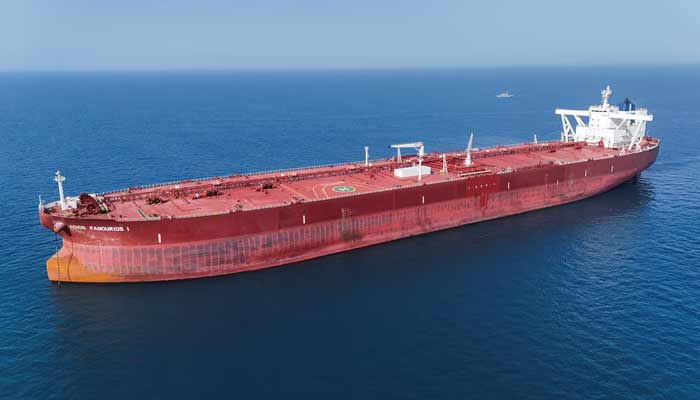
The world has lost over $50 billion worth of crude oil that has not been produced since the Iran war began nearly 50 days ago and the aftershock of the crisis will be felt for months and even years to come, according to analysts and Reuters calculations.
Iranian Foreign Minister Abbas Araghchi said on Friday the Strait of Hormuz was open following a ceasefire accord agreed in Lebanon, while US President Donald Trump said he believed a deal to end the Iran war would come “soon”, though the timing remains unclear.
Since the crisis began at the end of February, more than 500 million barrels of crude and condensate have been knocked out of the global market, according to Kpler data — the largest energy supply disruption in modern history.
Put differently, 500 million barrels of oil lost to the market is equivalent to:
Curtailing aviation demand globally for 10 weeks; no road travel by any vehicle globally for 11 days; or no oil for the global economy for five days, said Iain Mowat, principal analyst at Wood Mackenzie.
Nearly a month of oil demand in the United States, or more than a month of oil for all of Europe, according to Reuters estimates.
Roughly six years of fuel consumption for the US military, based on annual usage of about 80 million barrels from fiscal year 2021.
Enough fuel to run the world’s international shipping industry for around four months.
Key facts:
Gulf Arab countries lost about 8 million barrels per day of crude production in March, nearly equivalent to the combined production of Exxon Mobil and Chevron, two of the biggest oil companies in the world.
Jet fuel exports from Saudi Arabia, Qatar, the United Arab Emirates, Kuwait, Bahrain and Oman fell from about 19.6 million barrels in February, to just 4.1 million barrels for March and April so far combined, according to Kpler data.
The loss in exports would have been enough for around 20,000 round-trip flights between New York’s JFK airport and London Heathrow, according to Reuters estimates.
With crude prices averaging around $100 a barrel since the conflict began, those missing volumes represent roughly $50 billion in lost revenues, said Johannes Rauball, a senior crude analyst at Kpler. That equates to a 1% cut in Germany’s annual gross domestic product, or roughly the entire GDP of smaller countries such as Latvia or Estonia.
Full restoration could take years
Even as Iranian Foreign Minister Araghchi said the Strait of Hormuz was open, recovery of output and flows is expected to be slow.
Global onshore crude inventories have fallen by about 45 million barrels so far in April, according to Kpler. Since late March, production outages have reached roughly 12 million bpd.
Heavier crude fields in Kuwait and Iraq could take four to five months to return to normal operating levels, extending stock draws through the summer, Rauball said. Damage to refining capacity and Qatar’s Ras Laffan LNG complex means full restoration of regional energy infrastructure could take years.
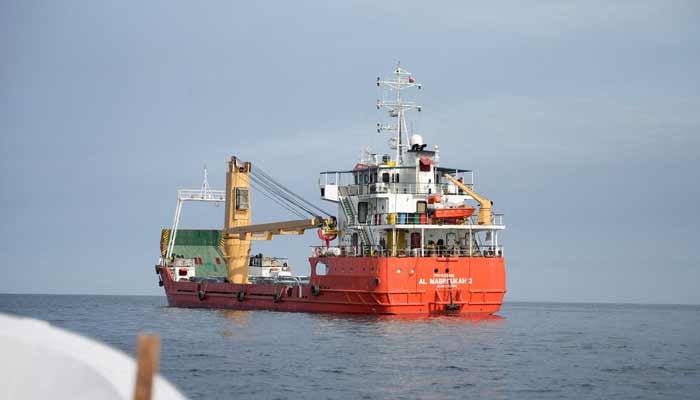
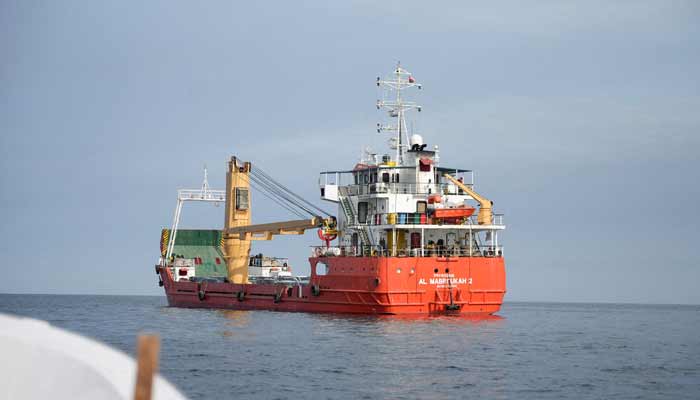
Shipping industry figures gave a cautious welcome on Friday to Iran’s announcement that it was reopening the crucial Strait of Hormuz trade route to commercial freight after nearly seven weeks closed.
Iranian forces’ closure of the strait has trapped hundreds of ships in the Gulf and driven up the costs of shipping goods, with captains avoiding the region for fear of attacks or mines.
A spokesman for German transportation giant Hapag-Lloyd, which has ships stuck in the Gulf, told AFP by phone that the reopening was “in general… good news”.
But he cautioned that shippers still needed details of what route vessels could take and in what order, citing fears of sea mines.
“One thousand ships cannot just go now to the entrance of the strait, that will be chaos. They (the Iranians) need to give clear orders,” said the spokesman, Nils Haupt.
“We would be ready to go very soon if some of these open questions can be solved within the weekend.”
Bloomberg data indicated there were about 770 vessels used for carrying commodities sending transponder signals inside the Gulf on Thursday, of which about 360 were oil and gas carriers.
Before the war, average daily crossings of the strait overall numbered about 120, according to industry journal Lloyd’s List.
‘Inaccurate’
Afer Iran’s announcement on Friday, US President Donald Trump said the Islamic republic had declared the waterway “fully open and ready for full passage”.
Jakob Larsen, chief security officer of major shipping association Bimco, said in a statement emailed to AFP that this claim was “inaccurate”.
“The status of mine threats in (Iran’s maritime) traffic separation scheme is unclear, and Bimco believes shipping companies should consider avoiding the area,” he said.
The secretary general of leading industry lobby the International Chamber of Shipping, Thomas Kazakos, said the announcement was “a positive step (but) there is still much uncertainty around what it means in practice”.
In a statement sent to AFP, he said it offered “a cautious measure of reassurance to” shippers and the thousands of seafarers stuck in the Gulf by the Middle East war for nearly seven weeks.
“It is essential that it marks the beginning of a broader and more durable return, beyond the current ceasefire, to freedom of navigation in one of the world’s most critical maritime corridors,” he said.


Nathalie Baye, low-key legend of French cinema, dies aged 77

Transfer rumors, news: Liverpool eye Wharton amid Man United, Real Madrid interest

The Best Movies to Stream This Month

-

 Politics1 week ago
Indian airlines hit hardest after Dubai limits foreign flights until May 31
-

 Entertainment5 days ago
Palace left in shock as Prince William cancels grand ceremony
-

 Sports5 days ago
The case for Man United’s Fernandes as Premier League’s best
-

 Politics1 week ago
Chinese, Taiwanese will unite, Xi tells Taiwan opposition leader
-

 Sports1 week ago
Documents: NC State trainer initiated ‘unwelcome,’ ‘sexual’ contact
-

 Entertainment1 week ago
Dua Lipa hits major career high ahead of wedding with Callum Turner
-

 Sports7 days ago
Lamar Jackson hits back at critics with faithful message on social media
-
 Business5 days ago
UK could adopt EU single market rules under new legislation