

Business
Nifty Prediction For Monday: Iran-Israel War Hits Market Sentiments; Gap-Down Likely On March 2

Last Updated:
Indian equities face a volatile week as Israel Iran US tensions drive up crude prices. Nifty 50 and Sensex fell, with bearish momentum and cautious outlook amid macro risks.




Nifty Prediction For Monday, March 2.
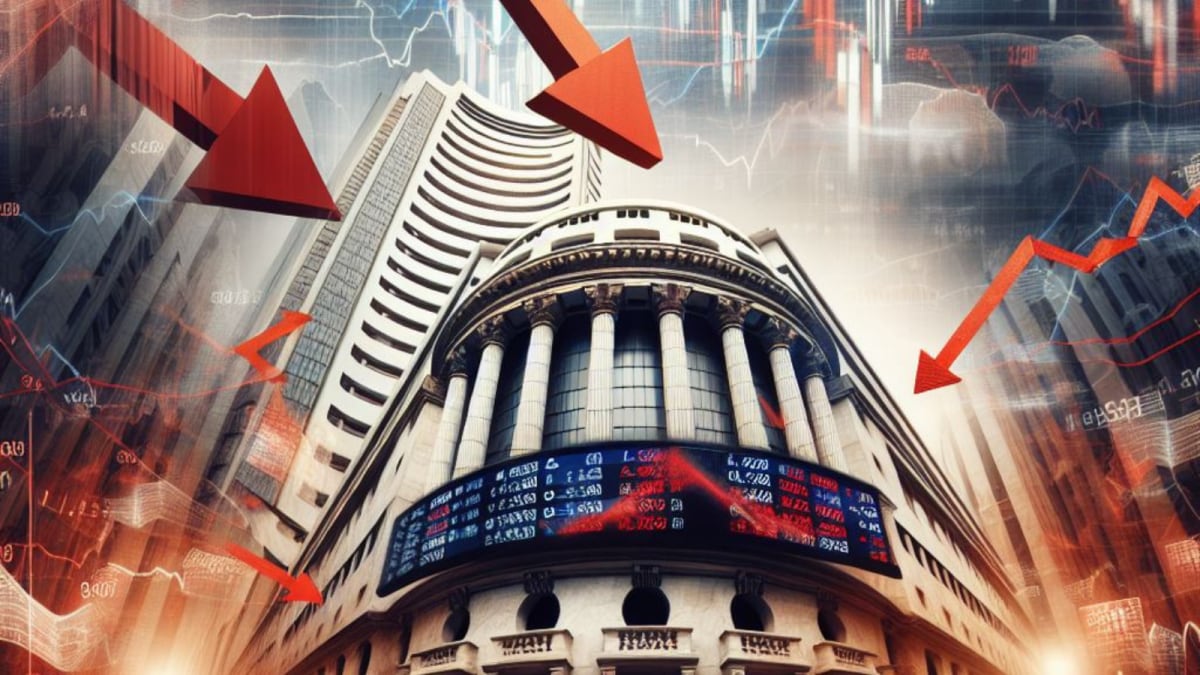
Nifty Prediction For Monday, March 2: Indian equities are bracing for a weak start on Monday, March 2, after a sharp escalation in geopolitical tensions in the Middle East. A direct military confrontation involving Israel, Iran and the United States has triggered a global risk-off wave, raising concerns around crude oil prices and equity markets worldwide.
For India, which imports over 80% of its crude requirement, elevated oil prices pose immediate macro risks, widening the current account deficit, stoking inflationary pressures and complicating the RBI’s rate trajectory.
Against this backdrop, Dalal Street had already ended the week on a weak note, and the geopolitical shock could set the stage for a gap-down opening in benchmark indices.
Iran-Israel War: Global Crosscurrents Add To Volatility
Ponmudi R, CEO of Enrich Money, said global macro and geopolitical developments had already weakened sentiment even before the latest military escalation.
The Nifty 50 closed the week at 25,178.65, down 1.54%, while the Sensex ended at 81,287, losing 1.84%, reflecting broad-based selling pressure amid geopolitical uncertainty and sector-specific disruptions.
Also Read: Gold Price Prediction For Monday: Will Precious Metal Rise On March 2 Amid Iran-Israel War?
“Indian equity markets navigated a volatile corrective phase in the week ended February 27, 2026, as global crosscurrents and domestic pressures weighed on sentiment. Early weakness stemmed from concerns over AI-led disruption to the IT outsourcing model, a slide in the U.S. Nasdaq, and fading hopes of near-term Federal Reserve rate cuts after mixed economic data. Trade and geopolitical developments reinforced the cautious tone. President Trump’s 10–15% global tariff under Section 122 of the Trade Act, effective February 24, injected fresh uncertainty for export-driven sectors including textiles, pharmaceuticals, gems and machinery, though the impact appears more contained than initially feared,” Ponmudi said.
Meanwhile, rising US-Iran tensions have kept crude oil prices firm amid concerns over potential disruptions through the Strait of Hormuz. For India, a major oil importer, elevated energy prices add another macroeconomic strain to an already fragile risk backdrop, he added.
Ravi Singh, chief research officer from Master Capital Services, said, “The Nifty 50 ended the week on a shaky note, slumping 1.54% this week after a sharp Friday sell-off. Technically, the index has breached its critical 25,300 support and the 200-day EMA, signalling a bearish shift in short-term momentum.”
Nachiketa Sawrikar, fund manager, Artha Bharat Global Multiplier Fund, said, “In February, equity markets were already fragile, with the S&P 500 and the Nasdaq Composite declining in the USA, and India’s Nifty 50 down on a year-to-date basis. Against this backdrop, a USA and Israel attack on Iran would likely trigger broad selling of risky assets across both the developed and emerging markets.”
For India, the impact is typically magnified: higher crude oil prices widen the current account deficit, stoke domestic inflation, pressure the rupee, and could lead to FII outflows as global investors reduce risk exposure, Sawrikar added.
Week Ahead: Geopolitics, Crude And Data In Focus
Ponmudi added that volatility is likely to remain elevated. “The week ahead is likely to be marked by elevated volatility, as mounting tensions in the Middle East, raising the spectre of a direct confrontation between the US and Iran, coincide with a heavy slate of macroeconomic data releases in both the US and India.”
He noted that US jobs data, domestic PMI readings, industrial production figures and monthly auto sales will be key triggers for sentiment.
Technical View On Nifty & Bank Nifty
On the technical front, he said, “The Nifty 50 has slipped below its key short-term moving averages (20, 50, 100, and 200-day EMAs), confirming emerging weakness after a failed rebound. A bearish formation on the weekly chart signals distribution at higher levels. Immediate support lies at 25,100-25,000; a break below this zone could expose 24,900-24,700 near the long-term trendline. On the upside, 25,350-25,500 now acts as immediate resistance, and a sustained move above this band is needed for stabilization. RSI around 46 and a negative MACD indicate mild bearish momentum. Overall bias remains negative to range-bound, with consolidation possible near support.”
For Bank Nifty, he added, “Bank Nifty closed at 60,529, retreating from recent highs and forming a short-term double-top pattern, suggesting profit booking. Immediate support is placed at 60,300-59,900; a breakdown could extend losses toward 59,700-59,500. Resistance is seen at 60,800-61,000, with a sustained reclaim required to revive upward momentum toward 61,400-61,500. RSI near 52 reflects neutral but weakening momentum. The bias remains mildly negative unless support levels hold firmly.”
What To Expect On March 2
Though the GIFT Nifty, Nifty Futures, closed 90 points higher on Friday evening, analysts expect volatility in the markets.
With global markets likely to react sharply to the Israel-Iran escalation and crude oil remaining firm, Indian equities appear poised for a gap-down opening on Monday.
The immediate focus for traders will be whether Nifty holds the crucial 25,000 level. A sustained breach could trigger further downside, while any intraday rebound toward 25,350-25,500 may see fresh selling pressure.
In the current environment, the dominant strategy, as echoed by both experts, remains cautious positioning with a ‘sell on rise’ bias until key resistance levels are decisively reclaimed.
Iran-Israel War
The US and Israel launched a major attack on targets across Iran on Saturday, and US President Donald Trump called on the Iranian people to “take over your government” — an extraordinary appeal that suggested the allies could be seeking to end of the country’s theocracy after decades of tensions.
The first strikes of the attack appeared to target the compound home to Iran’s 86-year-old Supreme Leader Ayatollah Ali Khamenei in downtown Tehran. It wasn’t immediately clear if he was there at the time. Smoke could be seen rising from the Iranian capital.
“For 47 years, the Iranian regime has chanted Death to America and waged an unending campaign of bloodshed and mass murder, targeting the United States, our troops and the innocent people in many, many countries,” Trump said in a video posted on social media that sought to justify the attacks. He urged Iranians to take cover during the strikes, but then: “When we are finished, take over your government. It will be yours to take.” The attack quickly expanded beyond Iran. Iran’s paramilitary Revolutionary Guard said it responded by launching a “first wave” of drones and missiles targeting Israel, where a nationwide warning was issued as the military said it bring down Iranian fire.
Meanwhile, Bahrain said that a missile attack targeted the US Navy’s 5th Fleet headquarters in the island kingdom. Witnesses heard sirens and explosions in Kuwait, home to US Army Central. Explosions could be also be heard in Qatar.
Iraq and the United Arab Emirates closed their airspace, and sirens sounded in Jordan.
The Iranian-backed Houthis in Yemen, meanwhile, vowed to resume attacks on Red Sea shipping routes and on Israel, according to two senior Houthi officials. They spoke on condition of anonymity because there was no official announcement from the Houthi leadership.
(With inputs from agencies)
 Click here to add News18 as your preferred news source on Google.
Follow News18 on Google. Join the fun, play games on News18. Stay updated with all the latest business news, including market trends, stock updates, tax, IPO, banking finance, real estate, savings and investments. To Get in-depth analysis, expert opinions, and real-time updates. Also Download the News18 App to stay updated.
February 28, 2026, 15:43 IST
Read More






Experts say Mythos potentially has an unprecedented ability to identify and exploit cybersecurity weaknesses.
Source link
Business
Anthropic’s new AI model exposes fresh risks, flaws for cybersecurity, IT services – The Times of India
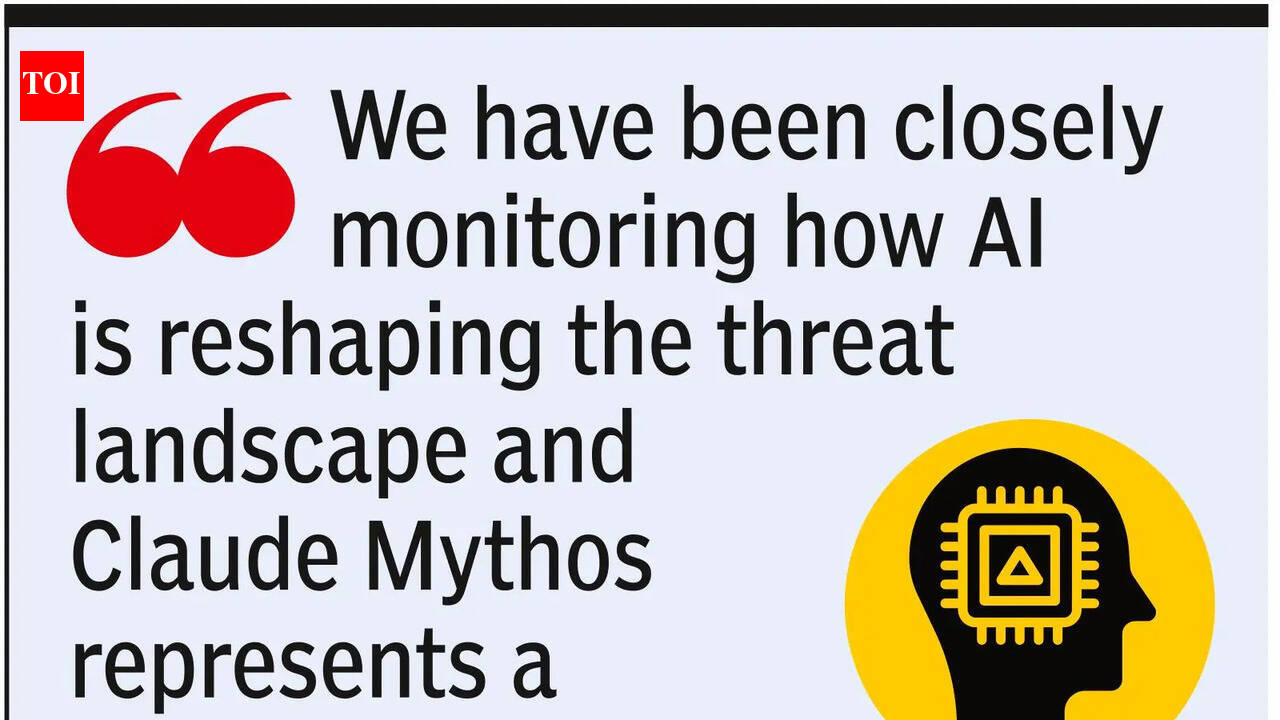
New Delhi: A powerful new AI model is forcing govts, banks, and technology firms to rethink the rules of cybersecurity – and in India, the stakes may be even higher.Claude Mythos, developed by Anthropic, has demonstrated the ability to autonomously detect and exploit software vulnerabilities, including flaws that have persisted for decades. Early tests revealed that the model could identify long-standing weaknesses and simulate complex, multi-step cyberattacks, prompting the company to restrict its wider release. Anthropic CEO Dario Amodei highlighted the shift, noting that AI systems are now capable of finding vulnerabilities “that humans have missed”, a signal of how quickly the cybersecurity landscape is changing.US Treasury Secretary Scott Bessent reportedly convened a meeting with top bank executives – including leaders from JPMorgan Chase, Goldman Sachs, Citigroup, BoA, and Morgan Stanley – to assess the risks posed by such advanced AI systems.That concern is not theoretical. According to Jaydeep Singh, GM for India at Kaspersky, the emergence of such systems represents a turning point not just for security professionals, but for everyday users. “We have been closely monitoring how AI is reshaping the threat landscape, and Claude Mythos represents a moment that every user, not just the cybersecurity industry, needs to understand,” Singh said.The dual-use nature of AI is at the heart of the concern. The same capability that strengthens defences can just as easily be weaponised. “The same capability that finds a 27-year-old vulnerability in hardened infrastructure is the capability that, in the wrong hands, turns every unpatched system into an open door,” Singh added.Cybersecurity firm Check Point Software Technologies echoed the warning. Sundar Balasubramanian, MD, India and South Asia, for Check Point, says, AI is “dramatically lowering the barrier to entry for cyber attackers,” enabling even less-skilled actors to identify and exploit vulnerabilities. He added that defensive tools can be repurposed offensively, compressing the traditional gap between attackers and defenders. Jayant Saran, partner, Deloitte India, described this as a “changed reality,” where organisations must prepare for risks that were previously invisible. He called AI a “double-edged sword…that cannot be reversed,” highlighting an accelerating race between those securing systems and those attempting to break them.In India, the risks are amplified by scale. From UPI to banking and govt platforms, millions depend on digital infrastructure – much of it built on legacy systems. These systems are often slower to patch, harder to monitor, and lack continuous threat intelligence, creating what Saran called an “asymmetric risk exposure.” Singh pointed out that this gap is especially critical in India, where legacy infrastructure serves hundreds of millions.Beyond cybersecurity, ripple effects could reach financial markets. Analysts say models like Mythos could automate parts of software development, testing, and security – core functions of IT services industry. While disruption may be gradual, labour-intensive outsourcing models could face pressure, while firms embracing AI may benefit.

Firms say digital twins make staff more productive, but are they a potential legal minefield?
Source link

Finance ministers and top bankers raise serious concerns about Mythos AI model
Anthropic’s new AI model exposes fresh risks, flaws for cybersecurity, IT services – The Times of India

Mike Trout crushes fifth Yankee Stadium HR in four games

-

 Entertainment1 week ago
Queen Elizabeth II emotional message for Archie, Lilibet sparks speculation
-

 Tech1 week ago
Azure customers up in arms over ‘full’ UK South region | Computer Weekly
-

 Tech1 week ago
As the Strait of Hormuz Reopens, Global Shipping Will Take Months to Recover
-

 Fashion1 week ago
CII submits 20-pt agenda to Indian govt to back firms hit by Iran war
-

 Tech1 week ago
This AI Button Wearable From Ex-Apple Engineers Looks Like an iPod Shuffle
-

 Politics7 days ago
Indian airlines hit hardest after Dubai limits foreign flights until May 31
-

 Entertainment4 days ago
Palace left in shock as Prince William cancels grand ceremony
-
Uncategorized1 week ago
[CinePlex360] Please moderate: “Trump considers