

Business
No demand for repayment of $2b loan from UAE, says SBP governor | The Express Tribune

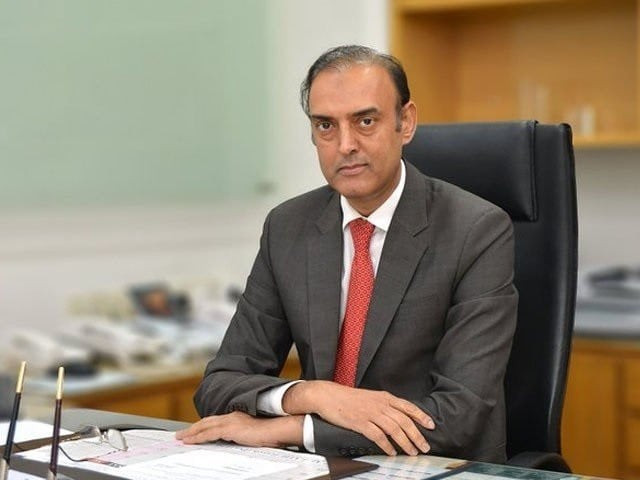
Central bank governor says country has shifted from annual loan rollovers to monthly rollovers
State Bank of Pakistan Governor Jameel Ahmad. PHOTO: TWITTER
ISLAMABAD:
State Bank of Pakistan Governor Jameel Ahmad said on Wednesday that the United Arab Emirates (UAE) was not demanding repayment of a $2 billion loan, but had instead shifted it to a monthly rollover.
The SBP governor provided the National Assemly’s Standing Committee on Finance insights into the country’s economic challenges, including the UAE’s loan rollover, inflation rates and export performance.
“The UAE is not asking back for a loan of $2b. The only difference is that earlier the UAE’s loan was rolled over on an annual basis, now it is being rolled over on a monthly basis,” he said.
“Initially, the debt servicing had reached $4b, but this has now been reduced,” he stated, acknowledging the strain on Pakistan’s exports.
Read More: OGRA orders daily LPG stock reporting amid supply concerns
Highly placed sources in the federal government and the central bank told The Express Tribune last month that the UAE had rolled over two loans of $1b each, which matured on January 16 and 22. They said the debt was rolled over for one month to allow time for further discussions on the tenor and interest rate.
Under the $7b International Monetary Fund (IMF) programme, the UAE, Saudi Arabia and China have committed to maintaining their combined $12.5b in cash deposits with the SBP at least until the programme expires in September next year. However, last month was the first time the UAE extended the debt repayment period by only one month, unlike the previous practice of granting one-year extensions.
In December, Govenor Ahmad had requested the UAE government to roll over $2.5b in debt for two years and cut the interest rate by almost half. Subsequently, Prime Minister Shehbaz Sharif also requested the UAE president to extend the repayment period. The prime minister said the UAE had agreed to roll over the debt, but did not provide further details.
The UAE provided $2b to Pakistan in 2018 for one year, but Pakistan was unable to repay the amount and has sought rollovers annually since then. Later, the UAE extended another loan of $1b in 2023 to help Pakistan meet external financing requirements for an IMF bailout.
The $2b debt forms part of Pakistan’s foreign exchange reserves of $16b. Pakistan is paying about $130 million annually in interest on the UAE debt at current rates. In 2018, the UAE charged an interest rate of 3% on the debt, but last year increased it to 6.5%. Pakistan has requested the UAE to reduce the rate to around 3%, citing improvements in its credit rating and lower global interest rates.
Pressure on exports
The governor further highlighted that, despite the ongoing pressure on exports, the situation was being managed. This, he noted, was partially due to declining food prices globally, including a reduction in rice exports, which alone accounted for a $1b drop.
Regarding inflation, the SBP governor projected that it was expected to stay between 5% and 7% this year.
“In 2022, the current account deficit was $17.5 billion, but through strategic measures, we managed to reduce it to just 1% of GDP in 2023, with a surplus of $2b,” he explained. Ahmad pointed out that this marked the first current account surplus in 14 years.
He further stated that foreign exchange reserves had increased significantly, from $2.8b, just enough for two weeks of imports, to over $16b. His target, the governor said, was is to raise the reserves to $18b by the end of June 2026 and to $20b by December 2026.
Read More: Govt refuses IMF help on 142 reforms
The governor also discussed Pakistan’s rising external debt, which has grown from $55b in 2016 to $103b. He assured that the debt level had remained stable since last year, and Pakistan’s total debt stood at $148b, with the government’s share at approximately $103b.
In response to concerns raised by the committee, Chairman Saleem Mandviwala remarked that the country’s export schemes were being phased out, which he believed contributed to the pressure on exports.
However, the SBP govenor countered that export financing schemes had not been abolished and attributed the export decline to multiple factors, including the global food price drop and weaker demand.
Furthermore, the governor acknowledged the economic strain of being under an IMF programme, which limited the country’s ability to offer subsidies and rebates. He noted that, despite challenges, the central bank continued to pursue strategies to ensure economic stability.




Now one of the biggest sportswear firms, Anta’s rise follows a playbook adopted by many Chinese giants.
Source link
Business
Gold price prediction today: Will gold prices continue to be volatile? Key levels to watch out for April 27, 2026 week – The Times of India

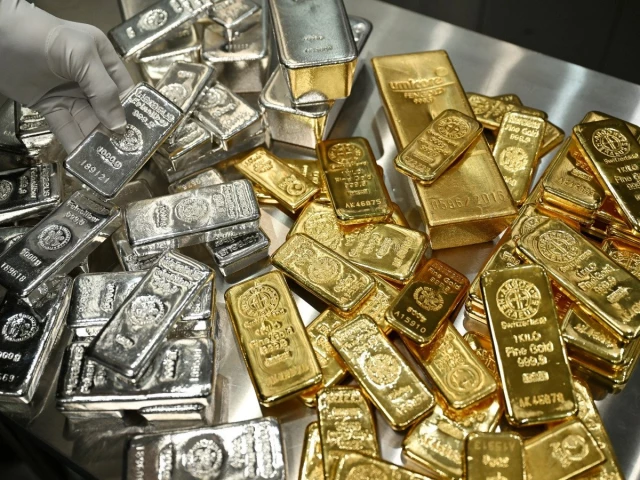
Gold price prediction today: Gold prices will closely track movements on the rate decisions by several central banks, including the US Federal Reserve, this week, says Manav Modi, Senior Analyst, Commodity Research at Motilal Oswal Financial Services Ltd.Gold is currently consolidating after sharp swings in a broad range, indicating a pause rather than a reversal. Price action shows a higher-high structure intact, but the recent sideways movement suggests indecision near the upper supply zone around 158,000–160,000. The formation resembles a short-term flag/triangle continuation pattern, where a breakout on either side will define the next directional move. Volume has tapered slightly, reinforcing the consolidation narrative.Gold prices recently moved from the upper band toward the mid-band (20 DMA), and are now attempting to stabilize. The bands have started to contract, signaling a potential volatility expansion ahead. Sustaining above the mid-band (~150,500–151,000 zone) keeps bullish bias intact, while a breakdown below this could trigger a deeper mean reversion toward the lower band.For the week, immediate support for gold prices is placed at around Rs 150,500, which is followed by stronger support near Rs 148,500. On the upside, the resistance stands at around Rs 155,500, and after that the key supply zone is at Rs 158,000. A decisive close for gold above Rs 158,000 levels can then resume the broader uptrend. However, a break in gold prices below levels of Rs 148,500 may shift the momentum to bearish in the near term.The economic docket is filled with data points and events this week as the focus will be on FED, BOJ, ECB and ECB policy meetings. US consumer confidence, GDP, inflation and durable goods orders data will also be in radar.(Disclaimer: Recommendations and views on the stock market, other asset classes or personal finance management tips given by experts are their own. These opinions do not represent the views of The Times of India)

British families tell BBC Panorama how the Iran war is affecting their monthly budgets.
Source link


UNCTAD, Maritime and Port Authority of Singapore launch partnership

Lexie Brown denies Klay Thompson cheated on Megan Thee Stallion with her

Strait of Hormuz disruption ‘systemic shock’ threatening SE Asia: ERIA

-

 Sports1 week ago
WWE WrestleMania 42 Night 2: Live match results and analysis
-

 Sports1 week ago
NCAA men’s gymnastics championship: All-time winners list
-

 Fashion1 week ago
UK’s Sosandar returns to profitability amid robust FY26 performance
-

 Politics6 days ago
UK’s Starmer seeks to deflect blame over Mandelson appointment
-

 Entertainment7 days ago
Lee Anderson, Zarah Sultana kicked out of UK Parliament for calling PM ‘liar’
-

 Entertainment1 week ago
Ruby Rose old essay resurfaces detailing night of alleged Katy Perry assault
-

 Entertainment1 week ago
Nathalie Baye, low-key legend of French cinema, dies aged 77
-
 Business1 week ago
No fuel shortage: Govt assures 100% domestic LPG, PNG, CNG supply amid Hormuz energy crunch – The Times of India