

Politics
Nepal goes to the polls; voters seek change after youth-led protests

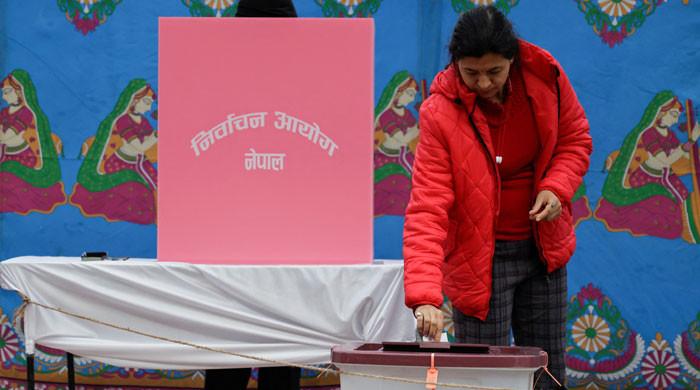
- Voting to run from 7am to 5pm local time, counting to follow.
- Nepal faces political instability, economic issues and corruption.
- Rastriya Swatantra Party’s Balendra Shah gains youth support.
KATHMANDU: Nearly six months after a wave of unprecedented youth-led protests and the deaths of 77 people forced Nepal’s then prime minister to quit, people began voting on Thursday in a general election that will choose a new parliament in the Himalayan nation.
Perched between China and India, the country of 30 million people has been plagued for decades by political instability, crippling a largely agrarian economy and worsening unemployment — structural issues compounded by rampant corruption.
The long-festering malaise erupted into street demonstrations last September, triggered by a social media ban, that brought thousands on the streets, leading to clashes and fatalities that forced the resignation of Prime Minister KP Sharma Oli.
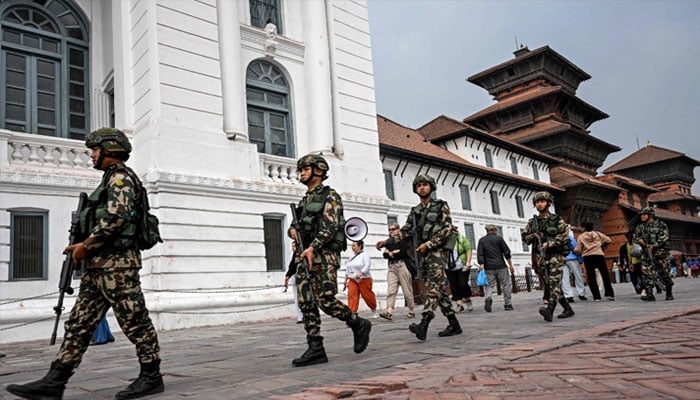
On Thursday, voters flocked to schools, temples, and ancient courtyards that have been converted into polling booths across the country, with some braving the morning chill in the capital Kathmandu to vote early.
Voting started at 7am local time (0115 GMT) and will close at 5pm, with counting scheduled to start soon after, according to the country’s election commission.
Officials said more than 300,000 security personnel, including the military, had been deployed to ensure peaceful voting in the more than 23,000 polling booths across the country.
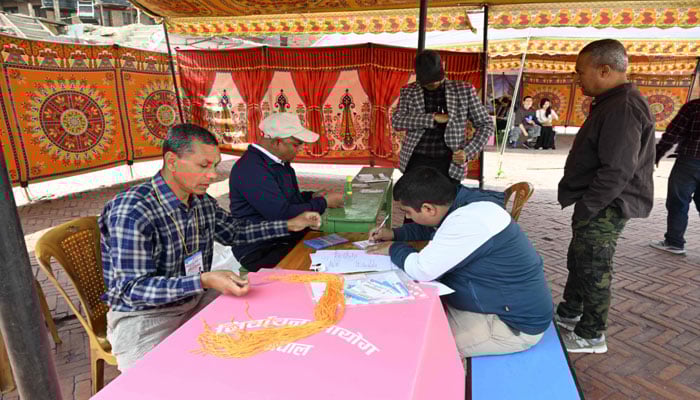
Oli, who leads the moderate Communist Party of Nepal (Unified Marxist-Leninist, UML), is once again in the fray, along with more than 3,400 other candidates from 65 parties.
They include the country’s oldest party, the Nepali Congress led by 49-year-old Gagan Thapa, and the Nepali Communist Party (NCP) comprising former Maoist insurgents who joined mainstream politics.
Together with UML, these parties have dominated Nepali politics for the last three decades, although the country has seen 32 government changes in the past 35 years.
But the frontrunner for these polls is the three-year-old Rastriya Swatantra Party (RSP), which has fielded the charismatic rapper-turned-politician Balendra Shah as its prime ministerial candidate.
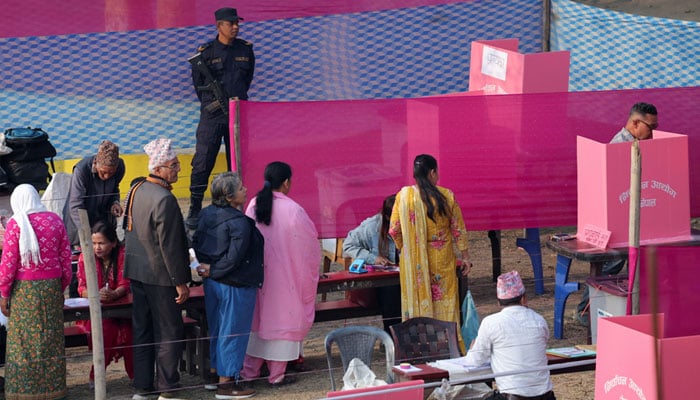
The 35-year-old former mayor of Nepal’s capital Kathmandu is drawing large crowds, connecting with legions of young voters clamouring for change on the ground and online, even as he takes on Oli, 74, on his home turf in the Jhapa constituency along the Indian border.
Jobs, corruption, main issues
In Jhapa, Menuka Chauhan,70, standing in line for more than 40 minutes at a polling booth, said she was worried about her son, who was working in Qatar as a security guard, as tensions in the Middle East escalated.
“I can’t sleep at night. I worry all the time. My son tells me bombs keep dropping there. I wish there were employment opportunities here,” she said.
Promises of jobs, reining in corruption, and improving governance — all demands raised during the September protests — have dominated much of the election campaign.
“The election is critical to address the aspirations of the youths expressed during the Gen Z protests,” said political analyst Puranjan Acharya.
“If the newly elected leaders are seen as unfit to do so, there is a risk of further trouble.”
Some 19 million voters are eligible to cast their ballot for 275 members of parliament through a mixed electoral system — 165 seats in direct first-past-the-post elections and 110 through proportional representation.
Early trends are likely to emerge by Friday but complete results could take a week or more as counting of proportional representation votes would take time, election commission officials said.
“Voting is not just about sending someone to victory,” Interim Prime Minister Sushila Karki, who took over after Oli, said in a public broadcast this week.
“It’s a decision you make about your future and that of your children.”
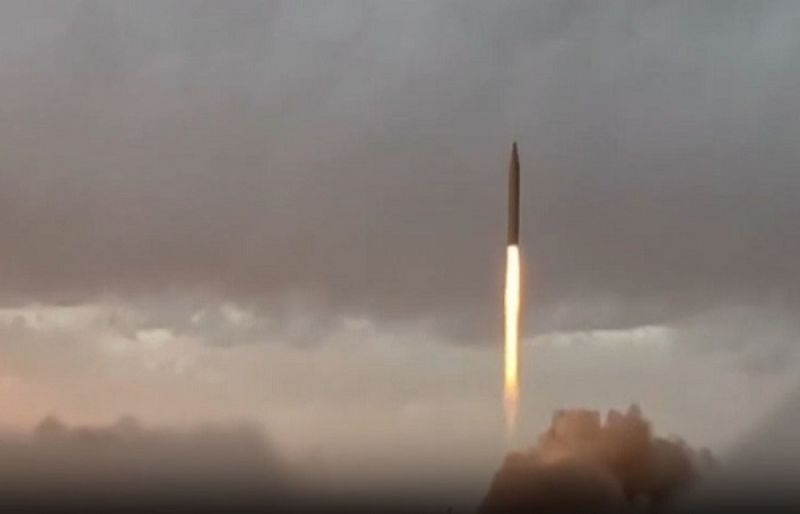
Iran has fully prepared for the possible resumption of war as the ceasefire deadline approaches, with new surprises ready for any new round of imposed war, the Tasnim News Agency reported on Tuesday, citing informed sources.
According to the report, the US naval blockade announcements and Washington’s excessive demands have prevented the formation of new negotiations as the agreed ceasefire period nears its end.
“Iran is fully prepared for the possibility of a new war and has prepared new surprises for a potential new round of combat,” the report said.
The sources told Tasnim that over the past two weeks, Iran has taken the possibility of renewed war seriously.
“Accordingly, some military movements and new target lists have been prepared for this purpose,” the report added.
Iran is ready to create “another hell” for Americans and Israelis from the very beginning of any potential new war, the sources said.
The United States and Israel launched their unprovoked, illegal war of aggression against Iran on February 28, assassinating the Leader of the Islamic Revolution, Ayatollah Seyyed Ali Khamenei, and striking nuclear facilities, schools, hospitals and bridges, along other civilian sites.
Iran’s armed forces responded with 100 waves of decisive retaliatory strikes under Operation True Promise 4, launching hundreds of ballistic and hypersonic missiles, as well as drones, against American military bases across West Asia and Israeli positions throughout the occupied territories.
A two-week ceasefire, brokered by Pakistan, took effect following the intense 40-day war. However, tensions have remained high.
The United States has declared plans for a naval blockade of Iranian ports, a move Tehran has condemned as provocative and a violation of the ceasefire.
Iranian officials have repeatedly warned that any US attempt to impose a blockade or conduct mine-sweeping operations in the Strait of Hormuz will be met with a decisive military response.
Iranian Foreign Minister Abbas Araghchi has previously accused Washington of bad faith, citing repeated US violations of the ceasefire, threats against Iranian shores and vessels, and continuous contradictions in American statements.
Tehran has made it clear that while it remains committed to diplomacy, it will not accept diktats or conditions imposed by the United States.
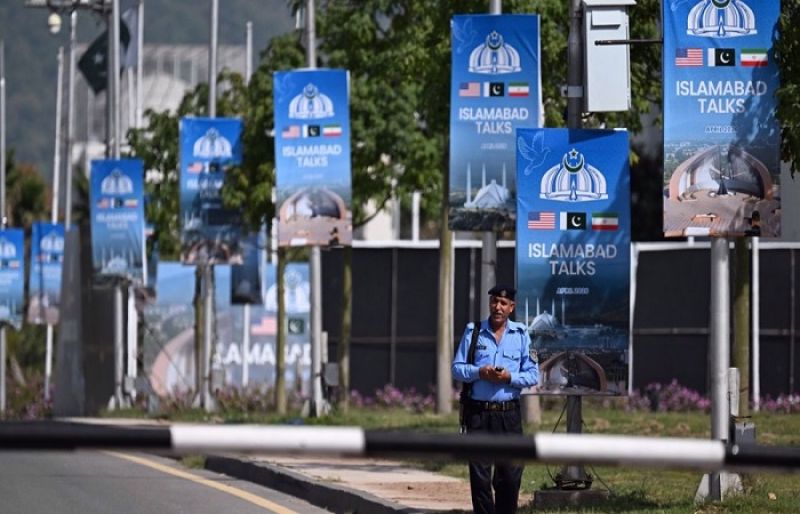
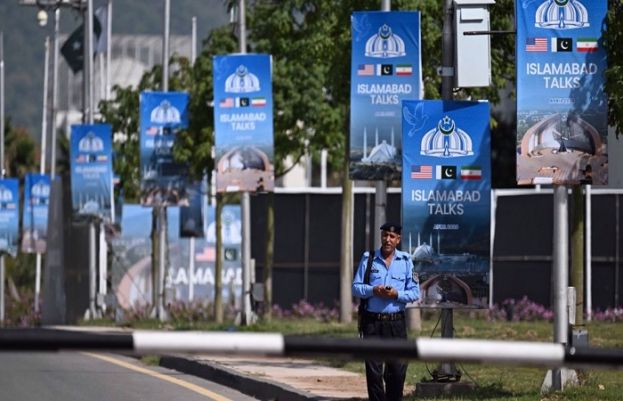
No Iranian delegation has arrived in Islamabad for talks with the United States, says a report, as senior Iranian officials declared they will not engage in talks “under the shadow of threats” following renewed American aggression at sea.
Contrary to numerous international and regional media reports suggesting an Iranian delegation was set to arrive for talks, IRIB News Agency reported on Tuesday that “to date, no delegation from Iran has gone to Islamabad, Pakistan; neither a main nor a subsidiary delegation; neither primary nor secondary.”
The report dismissed speculation about scheduled meetings, stating that news circulated since Saturday about the “departure” or “arrival” of an Iranian team, or even specific meeting times, was entirely without basis.
This firm stance follows blatant breaches of a two-week-old ceasefire by Washington. Iranian officials have maintained a consistent position since Sunday evening, asserting that the “continuation of talks depends on a change in American behavior and positions.”
Adding his voice to the resolute message, Iranian Parliament Speaker and lead negotiator Mohammad Baqer Qalibaf said on Monday that the US President was attempting to force Tehran into submission. “Trump, by imposing a blockade and violating the ceasefire, wants – in his own delusion – to turn the negotiating table into a table of surrender or to justify renewed warmongering,” he said in a post on X.
The speaker made Tehran’s position unequivocal. “We do not accept negotiations under the shadow of threats,” he said, warning, “Over the past two weeks, we have prepared ourselves to reveal new cards on the battlefield.”
The uncertainty shrouding the next round of talks escalated after the US Navy targeted an Iranian merchant vessel in the Sea of Oman on Sunday. Iran’s military condemned the incident as a “criminal operation” and “maritime piracy,” reiterating that its response posture remains active.
The backdrop to these renewed tensions is a 40-day US-Israeli war of aggression that began on February 28 with the assassination of high-level Iranian figures and civilians. After 40 days of criminal aggression, the US agreed to a ten-point proposal from Iran, leading to trilateral talks mediated by Pakistan.
While Iran subsequently opened the Strait of Hormuz to commercial traffic, it was forced to close the chokepoint again on Sunday after the US maintained its naval blockade in breach of the deal.
President Masoud Pezeshkian on Monday dismissed the American ultimatums as “pressure tactics,” insisting Iran will not submit to coercion.
This came as President Trump issued a direct threat on his social media pages, stating, “We’re offering a very fair and reasonable deal, and I hope they take it because, if they don’t, the United States is going to knock out every single power plant, and every single bridge, in Iran.”
The ongoing US blockade is also reportedly frustrating the mediation efforts. According to reports, Pakistani army chief Asim Munir conveyed to President Trump that the continued naval blockade of Iranian ports was hampering Islamabad’s ability to facilitate a permanent end to the war.
- Cause of fire being ascertained: police chief.
- Fire broke out during Hindu festival preparations.
- Indian PM offers condolences to victims’ families.
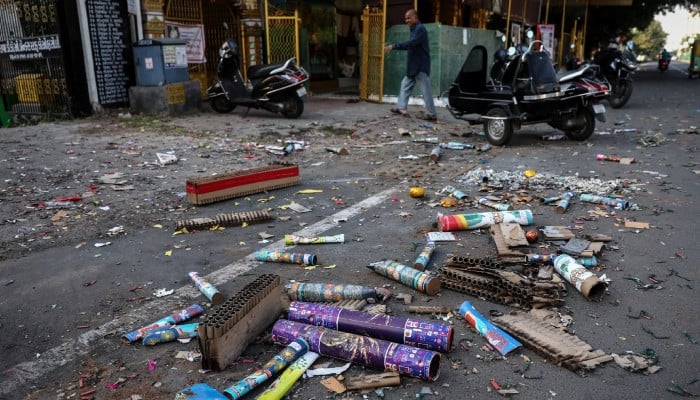
A firecracker storage facility in southern India caught fire on Tuesday, killing at least eight people, police said, the second such incident in three days.
Nakul Rajendra Deshmukh, police chief in Kerala state’s Thrissur district, told AFP that rescue operations were “over” after the deadly fire, which also left 15 people injured including two in critical condition.
The cause of the fire was being ascertained, he added.
Local media said it broke out during preparations for a Hindu festival.
Prime Minister Narendra Modi said in a social media post that he was “saddened” by the loss of lives and offered his “deepest condolences” to the families of the victims.
On Sunday, 20 people died in a similar blaze at a firecracker factory in the neighbouring state of Tamil Nadu.
Industrial accidents are common in India, often due to poor adherence to safety regulations and weak enforcement.
Last month, another fire at a fireworks factory in western India killed 17 people.


IMF to give specific attention to low-income, vulnerable nations

A case for fuel reforms

World’s biggest condom maker Karex set to raise prices due to Iran war

-

 Fashion6 days ago
France’s LVMH Q1 revenue falls 6%, shows resilience amid Iran war
-

 Sports1 week ago
The case for Man United’s Fernandes as Premier League’s best
-

 Entertainment1 week ago
Palace left in shock as Prince William cancels grand ceremony
-
 Business1 week ago
UK could adopt EU single market rules under new legislation
-

 Entertainment7 days ago
Is Claude down? Here’s why users are seeing errors
-

 Fashion1 week ago
Energy emerges as biggest cost driver in textile margins
-
 Business1 week ago
Delta Air Lines unveils first new Delta One suite in premium cabin arms race
-

 Fashion1 week ago
Asia claims largest share of markets on Kearney FDI Confidence Index