

Business
Major UAE refinery shut as Saudi Aramco warns war spells catastrophe for oil | The Express Tribune

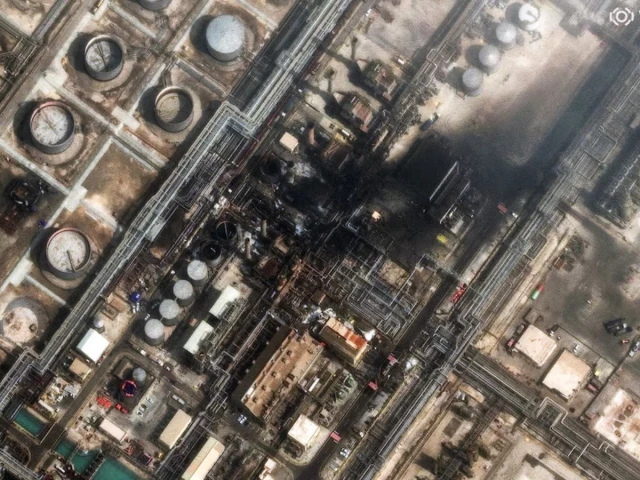
State-owned oil company Adnoc describes its Ruwais facility as ‘the world’s fourth-largest single-site refinery’
A satellite image shows smoke rising in the Ras Tanura oil refinery in Saudi Arabia after a drone attack, in Ras Tanura, Saudi Arabia, March 2 PHOTO: REUTERS
One of the world’s largest refineries in the United Arab Emirates was shut as a “precaution” after a drone attack nearby, a source said, while Saudi giant Aramco warned of the war’s devastating consequences on oil.
Aramco CEO and president Amin H. Nasser warned the war could have “catastrophic consequences” on oil markets, and called for reopening the Strait of Hormuz — which normally carries about 20% of global oil supplies but has been closed by the conflict.
Tehran appears to be attempting to knock major Gulf refineries offline as it tightens its chokehold on the Strait of Hormuz in a quest to inflict maximum pain on the global economy.
“The Ruwais refinery has halted operations out of precaution,” the source said, requesting anonymity to discuss sensitive matters.
Read More: Iran vows ‘eye for an eye’, warns Trump to ‘be careful not to be eliminated’
Earlier, the Abu Dhabi Media Office said a drone attack caused a fire in Ruwais Industrial City in the emirate of Abu Dhabi.
تتعامل الجهات المختصة في إمارة أبوظبي مع نشوب حريق في إحدى المنشآت ضمن مجمع الرويس الصناعي، ناجم عن استهداف بالطائرات المسيرة، دون تسجيل إصابات حتى الآن.
وأهابت الجهات المختصة بالجمهور استقاء المعلومات من المصادر الرسمية فقط، وتجنُّب تداول الشائعات أو المعلومات غير الموثوقة.
— مكتب أبوظبي الإعلامي (@ADMediaOffice) March 10, 2026
Neither the source nor the authorities said whether the refinery had been hit.
State-owned oil company Adnoc describes its Ruwais facility as “the world’s fourth-largest single-site refinery”.
The Middle East war has now severely destabilised supplies. Iran has fired at energy installations across the Gulf, including Aramco’s sprawling Ras Tanura facility, which halted some operations.
The massive complex on the Gulf coast is home to one of the Middle East’s largest refineries and is a cornerstone of the Saudi energy sector.
Saudi oil fields have also been targeted.
A driver working at the Ruwais industrial complex told AFP he was picking up staff who were ordered to evacuate.
“Just as we were about to leave, we saw two more bursts of fire rising from the complex, with loud sounds like explosions,” he said, requesting not to be named.
Read More: Over 10,000 Chinese citizens return from Middle East amid war
‘Chain reaction’
“The disruption has caused a severe chain reaction in not only shipping and insurance but there’s also a drastic domino effect on aviation, agriculture, automotive and other industries,” Nasser told a media call to announce Aramco’s 2025 earnings.
“There would be catastrophic consequences for the world’s oil markets the longer the disruption goes on, and the more drastic the consequences for the global economy.
The oil-rich Gulf has borne the brunt of Iran’s attacks in response to US-Israeli strikes that sparked the Middle East war, with Tehran targeting US assets but also civilian infrastructure, including energy facilities and airports.
“While we have faced disruptions in the past, this one by far is the biggest crisis the region’s oil and gas industry has faced.”
“It’s absolutely critical that shipping resumes in the Strait of Hormuz,” Nasser said.
Oil prices have swung wildly over supply disruptions, rocketing 30% on Monday before plunging again on comments from United States President Donald Trump that the war may soon end.
“The Gulf energy sector is getting whacked from multiple angles,” said Robert Mogielnicki, a non-resident scholar at the Arab Gulf States Institute.
“Energy facilities being targeted, export capability though the strait is hampered, and storage capacity filling up,” he added.
‘Dangerous precedent’
Iranian attacks have already forced state-owned QatarEnergy, one of the world’s largest producers of liquefied natural gas, to halt production last week and declare force majeure.
Energy producers in Kuwait made similar declarations, which are a warning that events beyond their control may lead them to miss export targets.
Nasser was speaking as Aramco reported a 12.1% decline in net income in 2025 after higher supply, US tariffs and other economic headwinds weighed on revenues.
The Saudi giant, which launched a record initial public offering in 2019, also announced a first-ever share buyback programme of up to $3 billion over 18 months.
Qatar’s foreign ministry spokesman Majed al-Ansari also warned today that attacks on energy facilities “on both sides, are a dangerous precedent … it will cause repercussions throughout the world”.
Throughout last year, the oil alliance OPEC+, of which Saudi Arabia is a key member, oversaw an increase in production, eroding prices.






Reform UK leader Nigel Farage said in an interview on BBC Breakfast on Wednesday that “most of our gas now comes from Montana in the (US) Midwest”.
It is not the first time that Mr Farage has made a similar claim. Earlier in April he said: “Most of the gas we currently import comes from Montana.”
Evaluation
The US is only the third largest source of the UK’s gas supply, and the second largest foreign supplier. It is the largest supplier of liquid natural gas, the type that is transported by ship, rather than pipeline.
It is unclear why Mr Farage mentioned Montana specifically. Montana is not a major gas producing state.
The facts
Provisional data for 2025 shows that the UK’s own production of gas was 332,444 gigawatt hours (GWh). The country imported 463,692 GWh of gas. Of that, 320,249 GWh came from Norway and 104,360 GWh came from the US.
All the gas imported from the US was liquid natural gas (LNG) – the type that is super-chilled and transported by ship rather than in pipelines. The US was the UK’s largest supplier of LNG.
But it unclear how much – if any – of the UK’s gas comes from Montana specifically.
Data from the US Energy Information Administration (EIA) show that in 2024, the US produced a total of 37.7 trillion cubic feet of dry gas. Of this Montana accounted for around 40.0 billion cubic feet, or 0.1% of the total US production.
EIA data also show that Montana’s gas production was lower than its consumption of gas.
However, this does not mean that the state does not export any of its gas to other states or countries.
A 2023 report from the Montana Department of Environmental Quality said that while “Montana currently consumes more natural gas than it produces” a “significant portion” of the state’s production is exported.
Data from the US Census Bureau show that the US exported 2.8 billion US dollars worth of natural gas to the UK in 2025. This came from four states: Georgia, Louisiana, Maryland and Texas.
The data shows the state that the gas was exported from, not where the gas was actually initially produced. Although they are major LNG exporters, Maryland and Georgia produce little to no natural gas themselves.
The US Census Bureau data also show that Montana exported 525,083 US dollars worth of natural gas in 2025, all of which went to Canada.
A 2021 report from the UK’s Foreign and Commonwealth Office and Department for International Trade said that the UK was the fifth largest export market for Montana in 2019, selling 39 million US dollars worth of goods to the UK.
It listed the main goods exports from Montana to the UK in 2019 as electrical equipment, basic chemicals, navigational and measurement instruments, aerospace products and parts, and miscellaneous general purpose machinery.
There is no mention of gas in that report.
The US Census Bureau does not define Montana as being part of the Midwest.
Links
Facebook video (archived video download)
Gov.uk – Natural gas supply and consumption (archived page and spreadsheet)
Gov.uk – Natural gas imports (archived page and spreadsheet)
EIA – Natural Gas Gross Withdrawals and Production (archived)
EIA – Natural Gas Summary, Montana (archived)
Montana Department of Environmental Quality – Understanding energy in Montana (archived)
US Census Bureau – Foreign Trade (archived page and spreadsheet download)
EIA – Natural Gas Summary, Georgia (archived)
Gov.uk – UK-Montana trade and investment highlights (archived)
US Census Bureau – 12 States Make up the Midwest Region of the Country (archived)
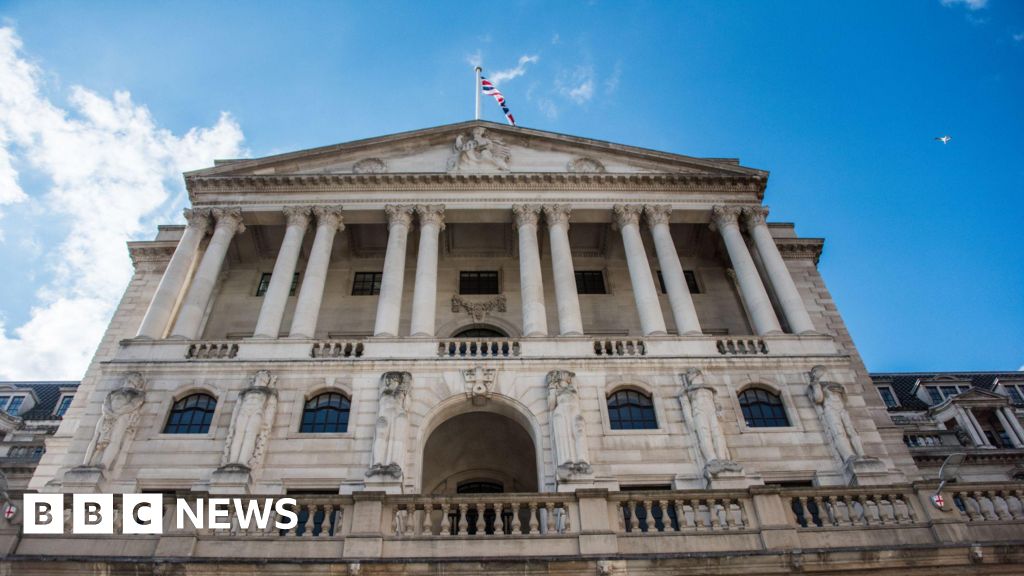
The Bank of England votes for no immediate change to borrowing costs as it monitors the knock-on effects of the Middle East conflict.
Source link
Business
India’s FDI inflow may cross $90 billion in FY26, says DPIIT secretary – The Times of India

India’s total foreign direct investment (FDI) inflows are likely to cross $90 billion in 2025-26 after already surpassing $88 billion during April-February, a top government official said on Thursday.DPIIT Secretary Amardeep Singh Bhatia said the government had undertaken a series of policy measures to attract foreign investments into the country, PTI reported.He said that during April-February 2025-26, inflows had crossed $88 billion and were “hopefully crossing $90 billion” for the full fiscal year.According to Bhatia, reform measures, free trade agreements and India’s fast-growing economy are helping the country attract strong investment flows.This reflects continued momentum in foreign investment inflows amid the government’s push to improve ease of doing business and expand global trade linkages.


EU laws push APAC factories towards data over certificates

David Allan Coe, country singer who wrote “Take This Job and Shove It,” dies at age 86

EU a step closer to extending GSP for 10 more years

Us-India Trade Talks: US–India trade deal: Where do talks stand & what to expect – explained – The Times of India

PSL 11: Hyderabad Kingsmen opt to field after winning toss against Multan Sultans

Trump administration in advanced talks for a rescue package for Spirit Airlines, source says

-
Business1 week ago
Us-India Trade Talks: US–India trade deal: Where do talks stand & what to expect – explained – The Times of India
-
 Sports1 week ago
PSL 11: Hyderabad Kingsmen opt to field after winning toss against Multan Sultans
-
Business1 week ago
Trump administration in advanced talks for a rescue package for Spirit Airlines, source says
-
 Business1 week ago
UK inflation accelerates after Iran war drives sharp rise in fuel prices
-

 Tech1 week ago
Nation states responsible for ‘nationally significant’ cyber attacks against UK, says NCSC chief | Computer Weekly
-

 Tech1 week ago
Microsoft faces court battle in £2bn Windows Server class action | Computer Weekly
-
 Business1 week ago
Gold prices in Pakistan Today – April 23, 2026 | The Express Tribune
-

 Entertainment1 week ago
Anne Hathaway shares major news about ‘Princess Diaries 3’