

Business
Has oil crisis Trumped US? Inside the war-time paradox of fighting Iran and funding its crude – The Times of India

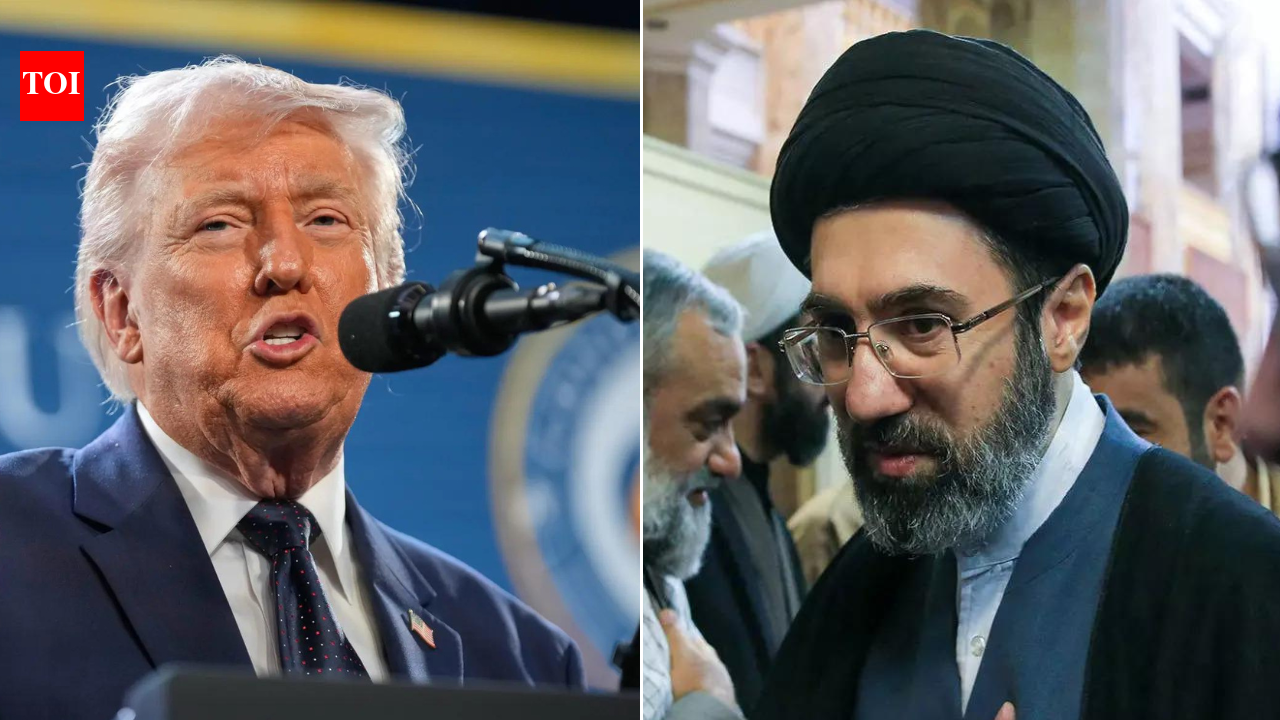
The United States is fighting Iran on the battlefield, and turning to its oil to keep the global economy afloat. As war in the Middle East chokes supplies through the Strait of Hormuz and sends prices soaring, the Donald Trump administration has begun easing restrictions on Iranian crude, allowing allies to buy the very resource that funds Tehran. For a president who came to power vowing to avoid “stupid” wars, the moment is especially fraught, a conflict he helped set in motion now risks slipping beyond his control, both on the battlefield and in its economic fallout.The move lays bare a stark war-time paradox — in trying to weaken Iran, Washington is being forced to rely on it.Though the move has been framed as “very temporary”, Mike Waltz, speaking at a CNN town hall, defended it as necessary to counter Iran’s strategy of driving up global energy prices.Even the administration’s messaging has been mixed — de-escalation in rhetoric, escalation in action. Trump said he was considering “winding down” military operations in the Middle East, even as the United States deployed three more amphibious assault ships and roughly 2,500 additional Marines to the region. Moreover, it attacked Iran’s nuclear facility Natanz again, even as Tehran has clearly warned against any attacks on its energy infrastructure, else bear oil shocks. Then what explains this sanctions shift?
World’s energy lifeline hit
Three weeks into the war with Iran, the United States is confronting a supply disruption of a scale few policymakers had anticipated. The near-total shutdown of the Strait of Hormuz has choked one of the world’s most critical oil arteries, sending shockwaves through global markets.The crisis has been compounded by direct attacks on critical energy infrastructure across the region. Strikes on Iran’s South Pars gasfield, part of the world’s largest natural gas reserve, were followed by missile attacks on Qatar’s Ras Laffan LNG facilities, causing extensive damage to one of the world’s biggest gas export hubs. Additional targets have included refineries in Saudi Arabia, Kuwait, and the UAE, raising fears of a broader energy war. With some of these facilities expected to take three to five years to fully repair, the disruption is no longer temporary — it threatens to lock in a prolonged global supply crunch. Brent crude, the international benchmark, has surged to around $106 per barrel, up sharply from roughly $70 before the conflict, underscoring how rapidly the crisis has escalated and how tightly global prices are tied to Middle East stability. Inside the administration of Donald Trump, officials are scrambling for solutions that can meaningfully ease supply pressures. A newly announced pause in sanctions applies only to Iranian oil already loaded on ships and is set to expire by April 19, limiting its immediate impact. Crucially, the move does not increase actual production, a central factor behind soaring prices, and much of Iran’s oil was already finding its way to buyers despite sanctions. That reality mirrors earlier steps, including a temporary pause on restrictions on some Russian shipments, which critics said offered only modest relief while exposing the limits of Washington’s options.
Policy levers pulled with little effect
Washington has already deployed nearly every conventional mechanism to cushion the blow. Hundreds of millions of barrels have been released from strategic reserves, sanctions on Russian oil have been partially eased, and domestic crude flows have been accelerated in an effort to boost supply. Yet these measures have barely dented rising prices. Global benchmarks continue to surge, and US consumers are feeling the impact at the pump. Officials privately acknowledge that the tools at their disposal are either insufficient in scale or too slow to counter the immediacy of the crisis, exposing the limits of state intervention in a tightly wound global oil market. The strain is also evident in Washington’s shifting diplomatic posture. After initially insisting the US did not need Nato’s help to secure the Strait of Hormuz, Donald Trump publicly urged allies to “step up” and help reopen the vital route. The appeal has met a muted response, with many countries reluctant to be drawn into a conflict they did not start, further complicating efforts to stabilize the situation and underlining the limits of US leverage even among its partners.Trump has criticized Nato countries as “cowards” for refusing to assist while insisting the campaign is unfolding according to plan, even declaring the battle “militarily won.” Yet those claims sit uneasily against the reality of a defiant Iran continuing to choke off Gulf energy flows and launch missile strikes across the region, underscoring the widening gap between rhetoric and conditions on the ground.
Finally, turning to enemy’s oil
With options dwindling, the administration has turned to a controversial stopgap: allowing allies to purchase Iranian oil already at sea. The move is designed to inject roughly 140 million barrels into a market starved of supply, offering short-term relief even as the broader conflict rages on. Officials argue that this oil would have likely been sold regardless, particularly to countries willing to bypass sanctions. Redirecting those flows to US allies, they contend, helps stabilize markets without fundamentally altering the pressure campaign against Tehran. Still, the decision lays bare an uncomfortable truth, that immediate economic needs are forcing Washington into choices that cut against its own strategic posture.
But is it enough to solve the energy crisis?
Even with Iranian barrels entering the market, the relief is expected to be fleeting. The additional supply amounts to barely a day and a half of global consumption, underscoring how limited the impact will be if disruptions persist. Energy experts warn that without a reopening of key shipping routes, the imbalance between supply and demand will continue to widen. That leaves the administration facing a stark choice: find a way to restore passage through the Strait of Hormuz or brace for prolonged economic fallout. For now, officials appear to be managing rather than resolving the crisis, navigating a war where the battlefield extends far beyond missiles and troops, deep into the fragile mechanics of the global economy.
Will the war end?
Beyond the immediate energy crisis, the conflict is pushing Donald Trump toward a deeper strategic crossroads. Analysts say the administration now faces a narrowing set of choices under what it has called Operation Epic Fury, with no clear indication of which path it is prepared to take, Reuters reported. One option is escalation — intensifying the offensive, potentially targeting critical infrastructure such as Iran’s oil hub at Kharg Island or expanding the US military footprint along Iran’s coast to neutralize missile threats. But such a move risks drawing Washington into a prolonged conflict, one that could face significant resistance from an American public wary of another long war in the Middle East. The alternative is to claim victory and scale back operations. Yet that, too, carries risks. It could leave Gulf allies exposed to a weakened but still defiant Iran, capable of disrupting shipping lanes and projecting power across the region. With diplomacy stalled and neither side showing signs of backing down, the administration is left navigating a conflict where every option deepens the very uncertainty it is trying to contain.




Business
Warner Bros. Discovery books $2.9 billion net loss tied to Paramount deal, restructuring costs

An American flag flies at Warner Bros. Studio in Burbank, California, on Sept. 12, 2025.
Mario Tama | Getty Images
Warner Bros. Discovery on Wednesday reported a staggering net loss for the first quarter, but it has an explanation.
The company booked a net loss of $2.9 billion, far larger than the net loss of $453 million it reported in the year-earlier quarter.
The figure included $1.3 billion of “pre-tax acquisition-related amortization of intangibles, content fair value step-up and restructuring expenses” as well as the $2.8 billion termination fee that Warner Bros. Discovery owed Netflix after their pending transaction fell through in February.
Netflix walked away from its proposed deal to buy WBD’s assets after Paramount Skydance came in with a higher offer. Paramount agreed to pay the termination fee as part of its agreement to buy the entirety of WBD, but the cost lives on WBD’s books until the close of that deal.
Since the amount is refundable to Paramount under certain circumstances, such as if it were to terminate the deal with Paramount for a higher offer, the obligation would be shifted to WBD.
Paramount’s proposed acquisition received approval from WBD shareholders in April and is currently in the midst of a regulatory review process. On Monday, Paramount said in its earnings release that it has “made significant progress” toward closing the deal, which it expects to be completed in the third quarter.
WBD on Wednesday also reported first-quarter revenue that was down 1% year over year to $8.89 billion. The company’s adjusted earnings before interest taxes, depreciation and amortization was up 5% to $2.2 billion. WBD had $33.4 billion in gross debt at the end of the quarter.
Streaming continued to be a highlight for the company.
Total streaming revenue was up 9% to about $2.89 billion as subscriber revenue increased due to the expansion of HBO Max — WBD’s flagship streaming platform — in international markets. Advertising revenue for the unit was up 20% due to an increase in customers subscribing to the ad-supported tier.
The company said in a shareholder letter it exceeded its guidance of more than 140 million global streaming customers at the end of the first quarter, and it remains on track to surpass 150 million global subscribers by the end of the year.
WBD’s portfolio of pay TV networks, which includes CNN, TBS and the Discovery Channel, continued to weigh on the company. The linear TV networks reported $4.38 billion in revenue, down 8% from the prior year. The company said linear advertising revenue was down 11%, which was primarily driven by the absence of NBA media rights from its portfolio.
Revenue for the film studio division, meanwhile, increased 35% to $3.13 billion year over year.

Virgin Media O2 recorded its highest-ever broadband traffic spike as millions across the UK tuned in to watch Arsenal‘s Uefa Champions League semi-final victory over Atletico Madrid.
Peak downstream traffic on the network surged by 17 per cent compared to an average Tuesday evening, marking an unprecedented event in Virgin Media’s broadband history.
This figure was 4.2 per cent higher than the previous record, established during Liverpool’s Champions League match against Real Madrid last November.
Jeanie York, chief technology officer at Virgin Media O2, commented on the phenomenon: “Live sport is one of the biggest drivers of broadband traffic in the UK and last night’s Champions League semi-final set a record on our network.
“As more people stream the biggest sporting moments from home, reliable, high-capacity connectivity has never been more important.”
Bukayo Saka delivered the decisive goal at the Emirates Stadium on Tuesday night as Arsenal secured a 2-1 aggregate triumph over Atletico Madrid to reach the Champions League final in Budapest on May 30 – their first on Europe’s grandest stage for 20 years.
And although Arsenal have received an official allocation of just 16,824 tickets from UEFA for the final at the 67,000-capacity Puskas Arena, Declan Rice wants the Hungarian capital to be a sea of red for the fixture against either Bayern Munich or Paris St Germain.
He said: “Bring it on, bring it on, I’ll be ready. I want every Arsenal fan out there, 200,000 of you, come out. Let’s try and do it because we’re going to need all the support, all the energy and let’s make it special.”
Mikel Arteta, meanwhile, hailed his “incredible” players for “making history” after securing the win.
Arteta said: “It was an incredible night. We made history again together and I cannot be happier and prouder for everybody that’s involved in this football club.
“The supporters were with us for every ball. They made it special and unique, and I have never felt it like that in this stadium.
“We knew how much it meant to everybody, we put everything on the line, the boys did an incredible job and after 20 years, and the second time in our history, we are back in the Champions League final.”
Business
Airlines spent 56.4% more on jet fuel in month after Iran war started, U.S. government says

A technician prepares to refuel a Delta Airlines aircraft at the Austin-Bergrstrom International Airport on April 10, 2026 in Austin, Texas.
Brandon Bell | Getty Images
U.S. airlines spent 56.4% more on jet fuel in March, the month after the U.S.-Israel strikes on Iran began, than they did in February, U.S. government data released Wednesday shows.
U.S. carriers spent $5.06 billion on fuel in March, up from $3.23 billion in February. It was 30% more than what they paid in March 2025, according to the Department of Transportation.
Airlines have lowered or scrapped their 2026 forecasts altogether because of the spike in fuel, their biggest expense after labor. Some carriers have scaled back growth plans to cut costs and avoid having too much expensive capacity in the markets.
The spike in jet fuel was even sharper and topped $4 a gallon in some markets in April as the war continued and the Strait of Hormuz was effectively closed.
Spirit Airlines collapsed over the weekend, and the carrier said the surge in jet fuel costs foiled its plans to emerge from bankruptcy midyear.
Other major carriers told Wall Street as they reported earnings last month that they expect customers to cover the higher jet fuel costs by early 2027, if not the end of this year.
So far, booking trends show consumers are still traveling, In March, travel agency ticket sales rose 12% from a year ago to $10.4 billion, with the number of domestic trips up 5% and international up 1%, according to the Airlines Reporting Corp.


Looking back on nearly a century of World Cup balls.

Elon Musk’s Last-Ditch Effort to Control OpenAI: Recruit Sam Altman to Tesla

Dave Chappelle clarifies his intentions with Trans jokes

-

 Sports1 week ago
Pro wrestling star Steph De Lander reveals how colleague’s advice helped lead her to title triumph at ACW
-
 Business7 days ago
PSX plunges over 4,800 points | The Express Tribune
-

 Tech1 week ago
This Ambitious Laptop Doesn’t Leave Much Room for Your Hands
-

 Tech7 days ago
Almost half of UK businesses hit by cyber attacks | Computer Weekly
-
Uncategorized1 week ago
[CinePlex360] Some plugins have failed to updat
-

 Fashion6 days ago
Canada’s Lululemon appoints Esi Eggleston Bracey to board of directors
-

 Sports1 week ago
Match officials announced for HBL PSL 11 qualifier – SUCH TV
-

 Tech6 days ago
This Indigenous Language Survived Russian Occupation. Can It Survive YouTube?